
10 TET-style questions on the principles of development and the relation between development and learning, each with an explanation.
Principles of Development Quiz: WB TET CDP Practice
Quiz challenge
A little practice. A step forward.
10 questions
Learn with explanations
Time per question: 45 sec
0 / 10 completed
--:--
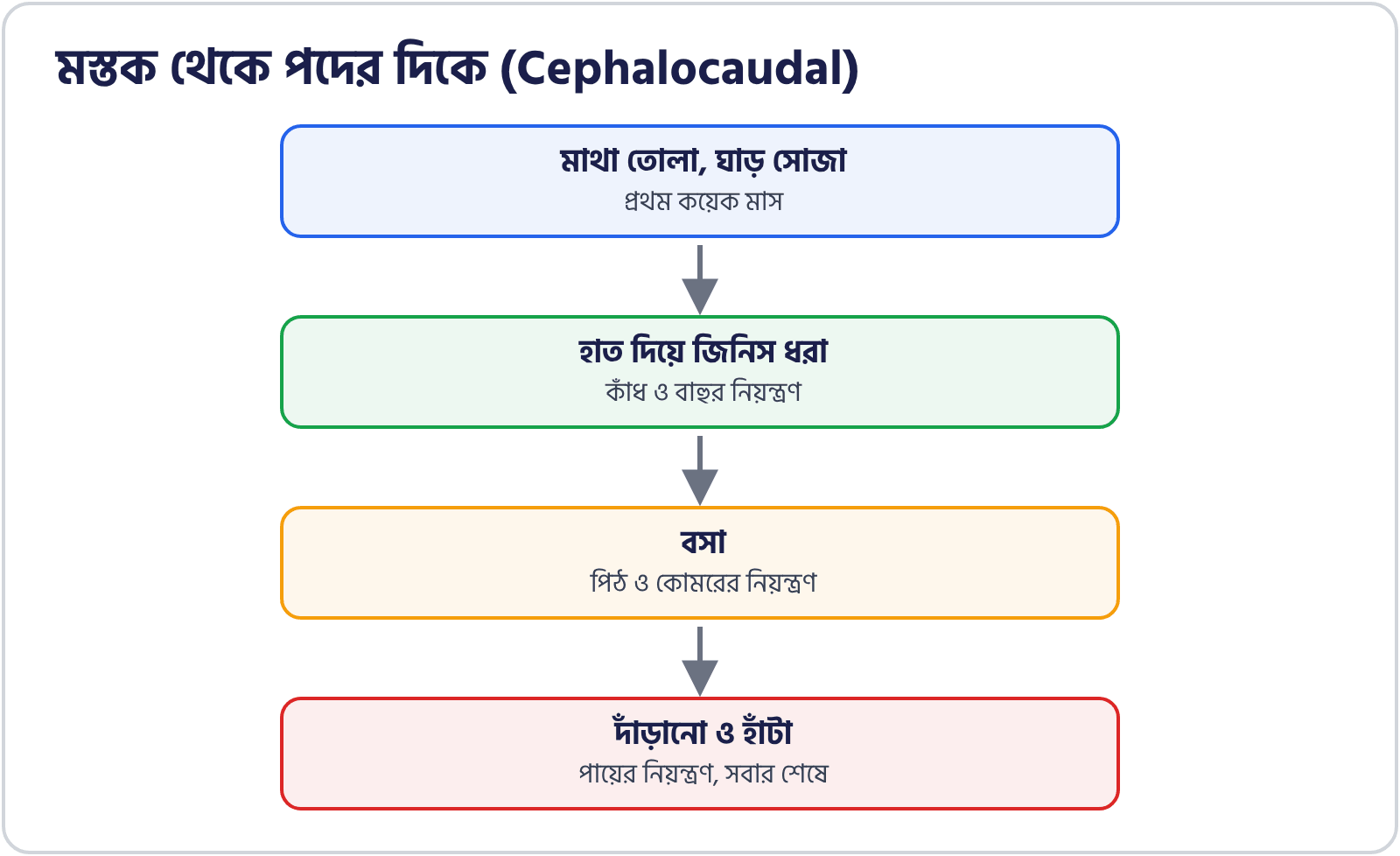
A child first learns to lift the head and hold the neck steady, then sits, and walks last of all. Which principle of development is this?
Explanation
Control moves down from the head to the feet, so this is the cephalocaudal principle. Proximodistal runs from the centre of the body outwards (shoulder to fingers), not top to bottom. Development goes from general to specific, not the other way round.
Key Points
- Cephalocaudal: head → toe
- Proximodistal: centre → periphery
- Both are principles of direction
Confusion Points
- Top to bottom is Cephalocaudal; inside to outside is Proximodistal
Memory Tips
- Cephalo = head, caudal = tail
Additional Information
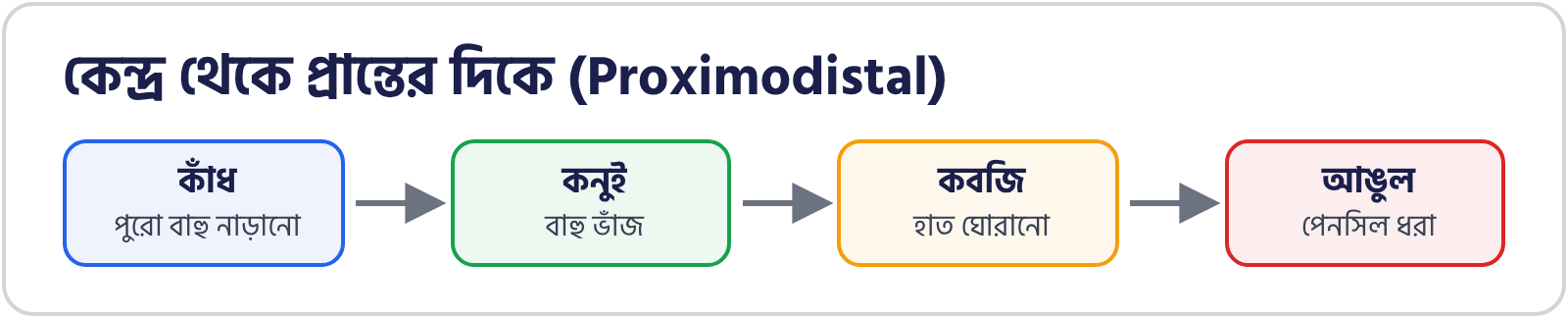
A child first pulls a toy by moving the shoulder and the whole arm, later learns to turn the wrist, and finally picks up beads with the fingers. Which principle is seen here?
Explanation
The shoulder is near the centre of the body and the fingers are farthest from it; control moves from inside outwards, so this is the proximodistal principle. Head to toe is top to bottom. Continuity and individual differences say nothing about direction.
Key Points
- Proximo = near, distal = far
- Shoulder → elbow → wrist → fingers
Memory Tips
- Near to far: proximo to distal
Additional Information
Before making children write small letters with a pencil, a Class I teacher has them draw big lines with chalk on the floor and shape toys from clay. Which idea lies behind her plan?
Explanation
Big lines use the gross muscles of the shoulder and arm; small letters need the fine muscles of the fingers. Development goes from general to specific and from centre to periphery, so big movements prepare the child first. The reverse order is wrong, and children do not all learn on the same day (individual differences).
Key Points
- Gross motor first, fine motor later
- Scribbling, clay and paper tearing before writing: pre-writing work
Additional Information
All the children in a class are learning to read in the same order, but some are fast and some slow. Following the principles of development, what should the teacher do?
Explanation
The order of development is the same for all, but the rate differs: this is the principle of individual differences. So the teacher lets each child learn at their own pace. Forcing one pace, seating children apart or comparing them hurts a child's confidence.
Key Points
- Same order, different rate
- Child-centred education: learning at one's own pace
Memory Tips
- "Same order, different rate"
Which of the following is NOT a principle of development?
Explanation
The rate of development differs from child to child (the principle of individual differences), so "all children develop at the same rate" is wrong. The other three are accepted principles: continuity, a definite sequence and predictability.
Key Points
- Continuity: from the womb to death
- Because the sequence is fixed, development is predictable
Confusion Points
- The sequence is the same for all, the rate is not: do not mix up "sequence" and "rate"
After a long illness, a child cannot concentrate in class, has become irritable and mixes less with friends. Which principle of development does this show?
Explanation
A physical problem is affecting the child's attention (mental), mood (emotional) and mixing with others (social): the aspects of development are interrelated. The other two principles are about the direction of bodily control, and development comes from both heredity and environment.
Key Points
- Physical, mental, emotional, social: each affects the others
- A teacher watches a child's health and feelings, not only studies
"Learning leads development; good learning is a little ahead of development." Whose view is this?
Explanation
For Vygotsky, learning leads development: what a child learns with the help of adults or peers in the zone of proximal development (ZPD) later becomes the child's own skill. Piaget held the opposite, development first. Gesell stressed maturation, and Skinner was a behaviourist.
Key Points
- Vygotsky: ZPD, scaffolding, social interaction
- Piaget: the stage of development sets the limit of learning
Confusion Points
- Piaget: development → learning; Vygotsky: learning → development
Memory Tips
- V before L: in Vygotsky, Learning comes first
Additional Information
| View | Development and learning |
|---|---|
| Piaget | Development first, learning follows |
| Vygotsky | Learning leads development (ZPD) |
| Behaviourists (Skinner) | Development = accumulated learned behaviour |
A teacher is teaching Class II children a complex idea only through abstract symbols, with no concrete material, and the children understand nothing. In Piaget's view, what is the reason?
Explanation
For Piaget, development comes before learning: children of 7 to 11 are in the concrete operational stage and think with things they can see and touch; abstract thinking comes at the next stage. So the fault is not the children's attention or intelligence, nor too little repetition: the lesson did not match their stage of development.
Key Points
- Concrete operational stage: about 7 to 11 years
- Teach with concrete material (TLM) at the primary level
Additional Information
| View | Development and learning |
|---|---|
| Piaget | Development first, learning follows |
| Vygotsky | Learning leads development (ZPD) |
| Behaviourists (Skinner) | Development = accumulated learned behaviour |
What does the formula "Development = Heredity × Environment" mean?
Explanation
The formula has a multiplication sign: if one factor is zero, the product is zero, so without either heredity or environment there is no development. This is the principle of interaction of heredity and environment. Dependence on one alone, or a sum, is not what the formula says.
Key Points
- The formula is usually credited to Woodworth
- Heredity gives the potential, environment develops it
Confusion Points
- Not a sum but a product: a sum would leave something without one of them
Memory Tips
- Multiply means both are needed: anything times zero is zero
A newborn who wants a toy moves the whole body and kicks its arms and legs; a few months later it just reaches out a hand and grasps the toy. This is an example of which principle?
Explanation
First a general response of the whole body, later a specific action of one limb: this is the general-to-specific principle. The reverse is wrong. Head to toe is control moving from top to bottom, and continuity is not the point here.
Key Points
- Whole-body response → action of one limb
- In language too: first every man is "baba", later only one's own father
0/10


Leave a Comment
Commenting as ·