
10 questions on place value, face value, expanded form, forming numbers and how to teach them, each with a worked explanation.
Place Value and Face Value Quiz: WB TET Maths Practice
Practice session
A little practice. A step forward.
10 questions
Learn with explanations
At your own pace
0 / 10 completed
00:00
What is the place value of 4 in 8,46,293?
Explanation
From the right, 8,46,293 has 3 in ones, 9 in tens, 2 in hundreds, 6 in thousands, 4 in ten thousands and 8 in lakhs. So the place value of 4 is $4 \times 10000 = 40000$. 4 alone is its face value, and 400000 would need 4 in the lakhs place.
Key Points
- Place value = digit × value of its place
- The ten-thousands place is worth 10000
Memory Tips
- Add as many zeros as there are digits to its right: four digits after 4, so 40000
Additional Information
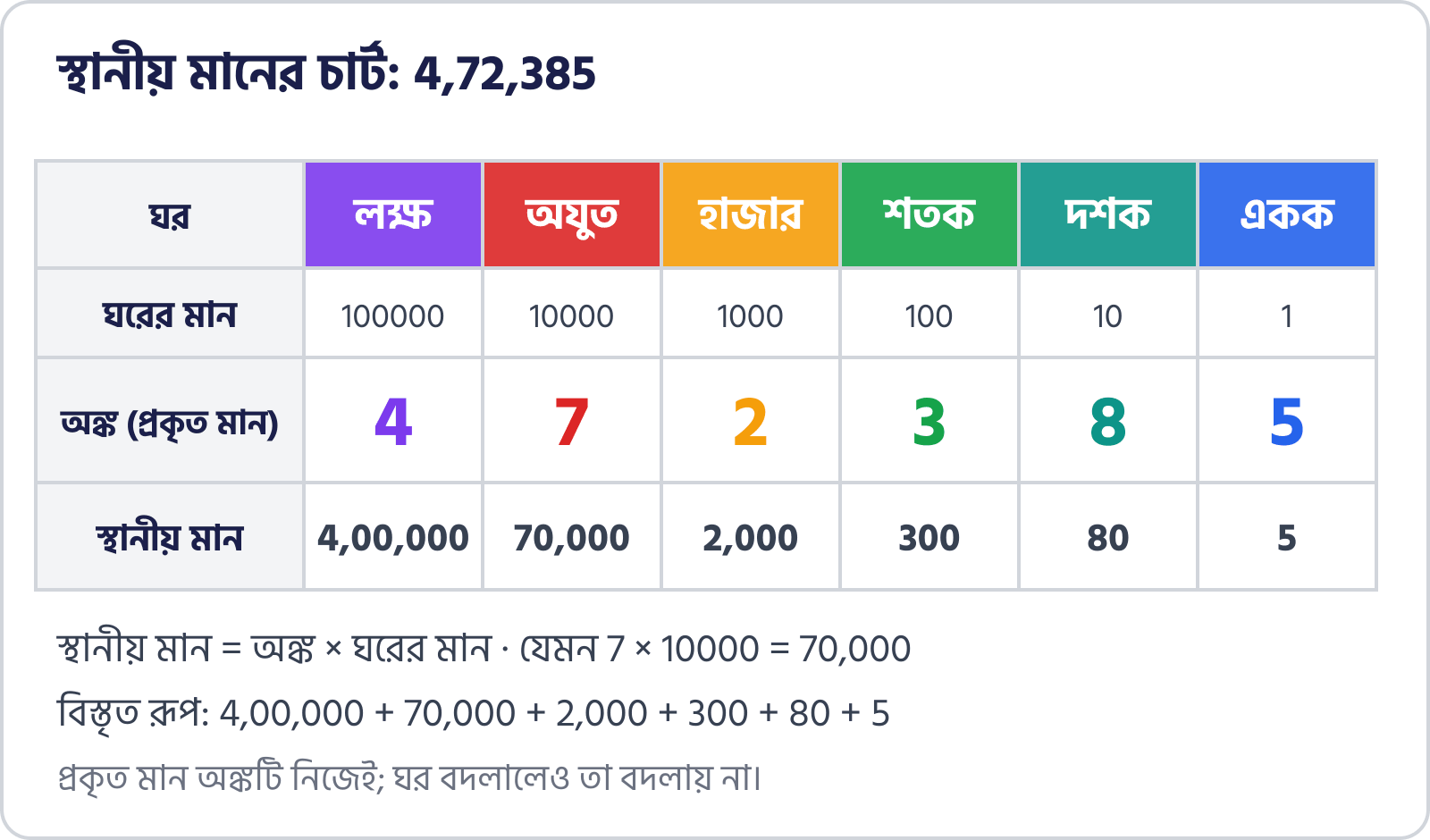
What is the difference between the place value and the face value of 6 in 3,61,520?
Explanation
6 is in the ten-thousands place, so its place value is 60000 and its face value is 6. The difference is $60000 - 6 = 59994$. 60006 is their sum, not the difference; 5994 comes from taking 6 in the thousands place.
Key Points
- Face value is the digit itself
- Difference means subtract, not add
Confusion Points
- Place value − face value is 0 only when the digit is 0 or sits in the ones place
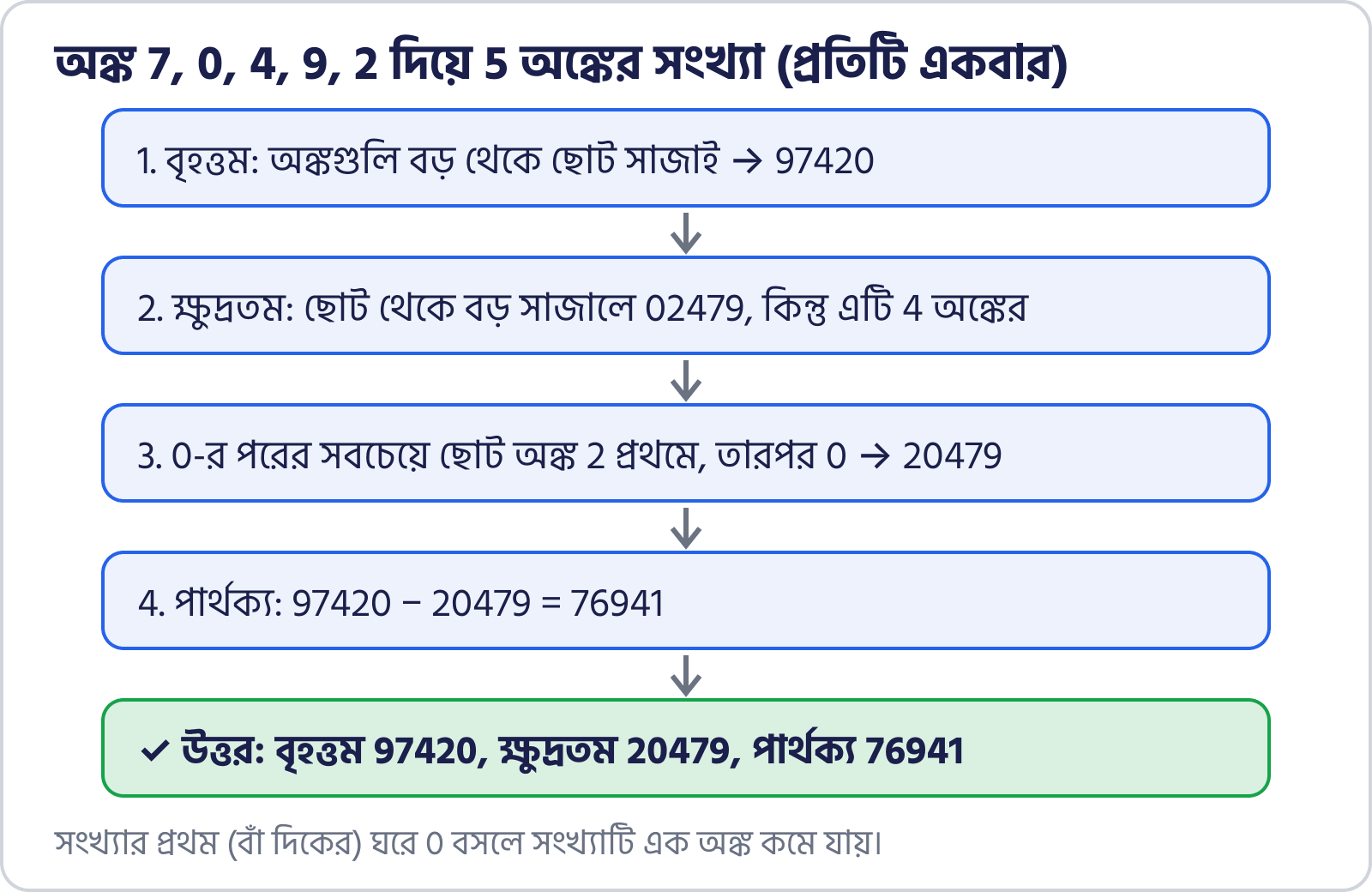
Using each of the digits 5, 0, 8, 3 once, which is the smallest 4-digit number?
Explanation
In increasing order the digits are 0, 3, 5, 8, but 0358 is really 358, a 3-digit number. So the smallest non-zero digit 3 comes first, then 0, 5, 8: 3058. 3085 and 3508 are larger.
Key Points
- 0 never takes the first place in the smallest number
- Putting 0 second keeps the number smallest
Confusion Points
- 0358 looks like four digits but is 358, a 3-digit number
Additional Information
4 × 10000 + 6 × 100 + 9 = ?
Explanation
$4 \times 10000 = 40000$, $6 \times 100 = 600$, and 9. Their sum is $40000 + 600 + 9 = 40609$. The thousands and tens places are empty, so they take 0: 4 ten-thousands, 0 thousands, 6 hundreds, 0 tens, 9 ones.
Key Points
- From expanded form back to the number: 0 in every missing place
- Write the places first, then fill in the digits
Memory Tips
- Ten thousands down to ones is 5 places, so the answer has 5 digits
Which of these is NOT a suitable teaching-learning material (TLM) for place value?
Explanation
A protractor measures angles and has nothing to do with place value. Each rod of an abacus is a place, ten unit cubes of base-ten blocks make one ten-rod, and arrow cards put 300 + 40 + 5 together into 345: all three show the value of places.
Key Points
- TLM for place value: bundles of sticks, abacus, base-ten blocks, arrow cards, play money
- Their main job is to show the exchange of 10
A Class 2 child writes "four hundred seven" as 4007. What does this error show?
Explanation
The child wrote 400 and 7 side by side, writing from the number name and not by places. This is a conceptual place value error, corrected with a place value chart and bundles of sticks. One error does not show a learning disability like dyscalculia, and the child knows the digits, since 4, 0, 7 are written correctly.
Key Points
- An error is a window into the child's thinking: the teacher looks for its cause
- Remedy: write numbers by placing sticks in a hundreds-tens-ones chart
Confusion Points
- Dyscalculia is a lasting learning disability, not a single conceptual error
Additional Information
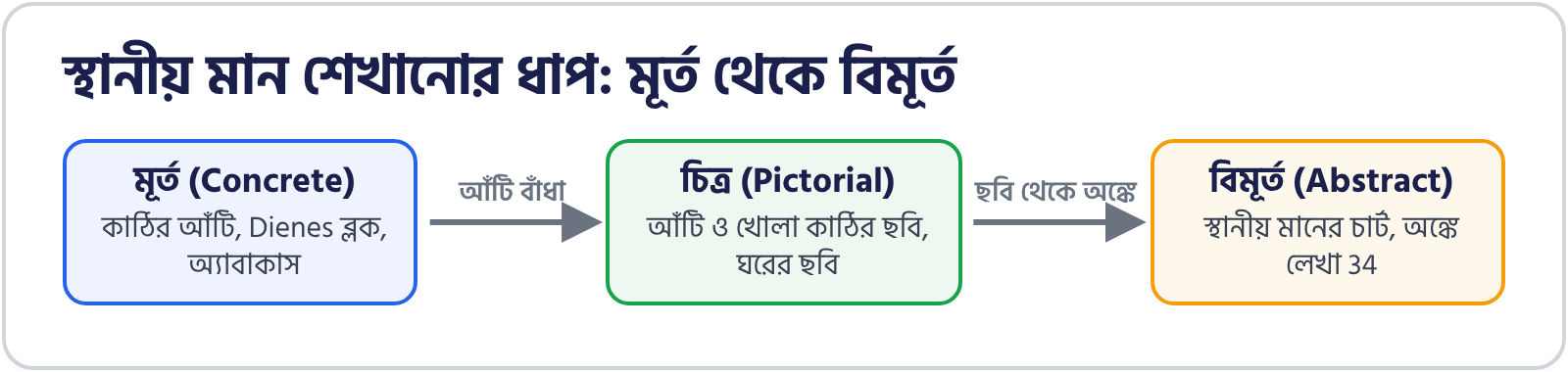
What is the right order for building the idea of place value in class?
Explanation
The child first makes a ten from ten ones with real objects (bundles of sticks, blocks), then sees pictures of them, and finally writes digits in a chart. Primary children are in Piaget's concrete operational stage, so starting with abstract symbols does not build the concept.
Key Points
- CPA: Concrete → Pictorial → Abstract
- Known to unknown, concrete to abstract: a maxim of teaching
Memory Tips
- Hands → eyes → notebook
Additional Information
Asked for the smallest 4-digit number from 5, 0, 8, 3, a child writes 0358. What is the teacher's most suitable step?
Explanation
Reading it from the chart, the child sees that 0 in the thousands place means nothing there and the number is three hundred fifty-eight. An error the child discovers alone builds a lasting concept (Constructivism). Writing the answer, drill or a rule without its reason leaves the cause of the error in place.
Key Points
- Letting the child discover the error = a constructivist approach
- Explaining the reason behind a rule matters
Additional Information
"Ten ones make one ten": which material best shows this exchange at the concrete stage?
Explanation
Counting ten loose sticks and tying them with a rubber band makes one bundle, one ten: the child does the exchange by hand. Digit cards and a printed chart are symbols (abstract), and a table chart is for multiplication.
Key Points
- A bundle = a ten, a loose stick = a one
- Ten bundles tied together make a hundred
Additional Information
How many 5-digit numbers are there in all?
Explanation
The smallest 5-digit number is 10000 and the largest is 99999. In all, $99999 - 10000 + 1 = 90000$. 89999 comes from forgetting the + 1; 9000 is the count of 4-digit numbers.
Key Points
- n-digit numbers number 9 followed by (n − 1) zeros
- Count = largest − smallest + 1
Confusion Points
- Both ends are counted, hence the + 1
Additional Information
| Digits | Smallest | Largest | How many |
|---|---|---|---|
| 1 digit | 1 | 9 | 9 |
| 2 digits | 10 | 99 | 90 |
| 3 digits | 100 | 999 | 900 |
| 4 digits | 1000 | 9999 | 9000 |
| 5 digits | 10000 | 99999 | 90000 |
0/10


Leave a Comment
Commenting as ·