
WBPSC Clerkship 2024 Part-I General Studies: 20 questions on West Bengal and general knowledge, with explanations.
WBPSC Clerkship 2024: West Bengal and GK Mixed Quiz (Round 5, 20 Questions)
Quiz challenge
A little practice. A step forward.
20 questions
Learn with explanations
Time per question: 30 sec
0 / 20 completed
--:--
In which district of West Bengal is the Hazarduari Palace?
Explanation
The Hazarduari Palace stands in Murshidabad town on the bank of the Bhagirathi. It was built by the architect Duncan McLeod, and completed in 1837, for Nawab Nazim Humayun Jah. Its name means 'a thousand doors', though many of them are false doors. It is now a museum of the Archaeological Survey of India (ASI).
Key Points
- Murshidabad was the capital of the Nawabs of Bengal
- The palace was completed in 1837; architect Duncan McLeod
- It is now an ASI museum
Memory Tips
- A thousand doors = Hazarduari = the Nawabs' town, Murshidabad
Additional Information

Where was the capital of Shashanka, king of Gauda?
Explanation
Shashanka, king of Gauda in the early 7th century, ruled from Karnasubarna, in today's Murshidabad district (near Chiruti-Rangamati). He was a contemporary of Harshavardhana and the first notable independent king of Bengal. Gaur or Lakshmanavati became the capital later, under the Senas and the Sultans; Tamralipta was an ancient port.
Key Points
- Shashanka: 7th century, a contemporary of Harshavardhana
- Karnasubarna is in today's Murshidabad district
- Tamralipta (Tamluk) was a port, not his capital
Confusion Points
- Gauda was the kingdom, but Shashanka's capital was Karnasubarna, not the city of Gaur
Memory Tips
- Shashanka's 'golden ear': Karna-subarna
Additional Information
Who founded the Dakshineswar Kali Temple?
Explanation
The Dakshineswar Kali Temple on the east bank of the Hooghly was founded in 1855 by Rani Rashmoni of Janbazar. Sri Ramakrishna served as its priest. Rani Bhabani was the zamindar of Natore, Krishnachandra the Raja of Nadia, and Dwarkanath Tagore a businessman.
Key Points
- Founded in 1855, on the east bank of the Hooghly
- Sri Ramakrishna was its priest
- Rani Rashmoni was a zamindar of Janbazar
Memory Tips
- Rashmoni → Dakshineswar → Ramakrishna
Additional Information
In which district of West Bengal are the Ayodhya Hills?
Explanation
The Ayodhya Hills are in Purulia district, on the eastern edge of the Chota Nagpur Plateau. Their highest peak is Gorgaburu. Bankura's well-known hill is Susunia, and Jhargram has the Belpahari area.
Key Points
- Purulia is part of the Chota Nagpur Plateau
- Gorgaburu is the highest peak of the Ayodhya Hills
- Susunia Hill is in Bankura
Memory Tips
- The hilly far west of the state, Purulia: the Ayodhya Hills
Additional Information
Which was Satyajit Ray's first feature film?
Explanation
Satyajit Ray's first film was 'Pather Panchali' (1955), based on Bibhutibhushan Bandyopadhyay's novel. It is the first film of the Apu Trilogy; the other two are 'Aparajito' (1956) and 'Apur Sansar' (1959). 'Jalsaghar' (1958) is based on a story by Tarashankar Bandyopadhyay.
Key Points
- Pather Panchali was released in 1955
- The story is by Bibhutibhushan Bandyopadhyay
- Apu Trilogy: Pather Panchali, Aparajito, Apur Sansar
Memory Tips
- Apu Trilogy in order: the road (start) → the unvanquished → the home
Additional Information
| Film | Year | Story by |
|---|---|---|
| Pather Panchali | 1955 | Bibhutibhushan Bandyopadhyay |
| Aparajito | 1956 | Bibhutibhushan Bandyopadhyay |
| Jalsaghar | 1958 | Tarashankar Bandyopadhyay |
| Apur Sansar | 1959 | Bibhutibhushan Bandyopadhyay |
Who founded Fort William College in Calcutta (1800)?
Explanation
Governor-General Lord Wellesley founded Fort William College in Calcutta in 1800 to teach Indian languages and law to the Company's new British officials. Bengali prose writing grew around this college; William Carey taught Bengali there. Cornwallis is linked with the Permanent Settlement (1793) and Bentinck with the abolition of sati (1829).
Key Points
- Founded in 1800 by Lord Wellesley
- Aim: training the Company's officials
- William Carey taught in its Bengali department
Memory Tips
- Wellesley = 1800 = Fort William College (and the Subsidiary Alliance)
Additional Information
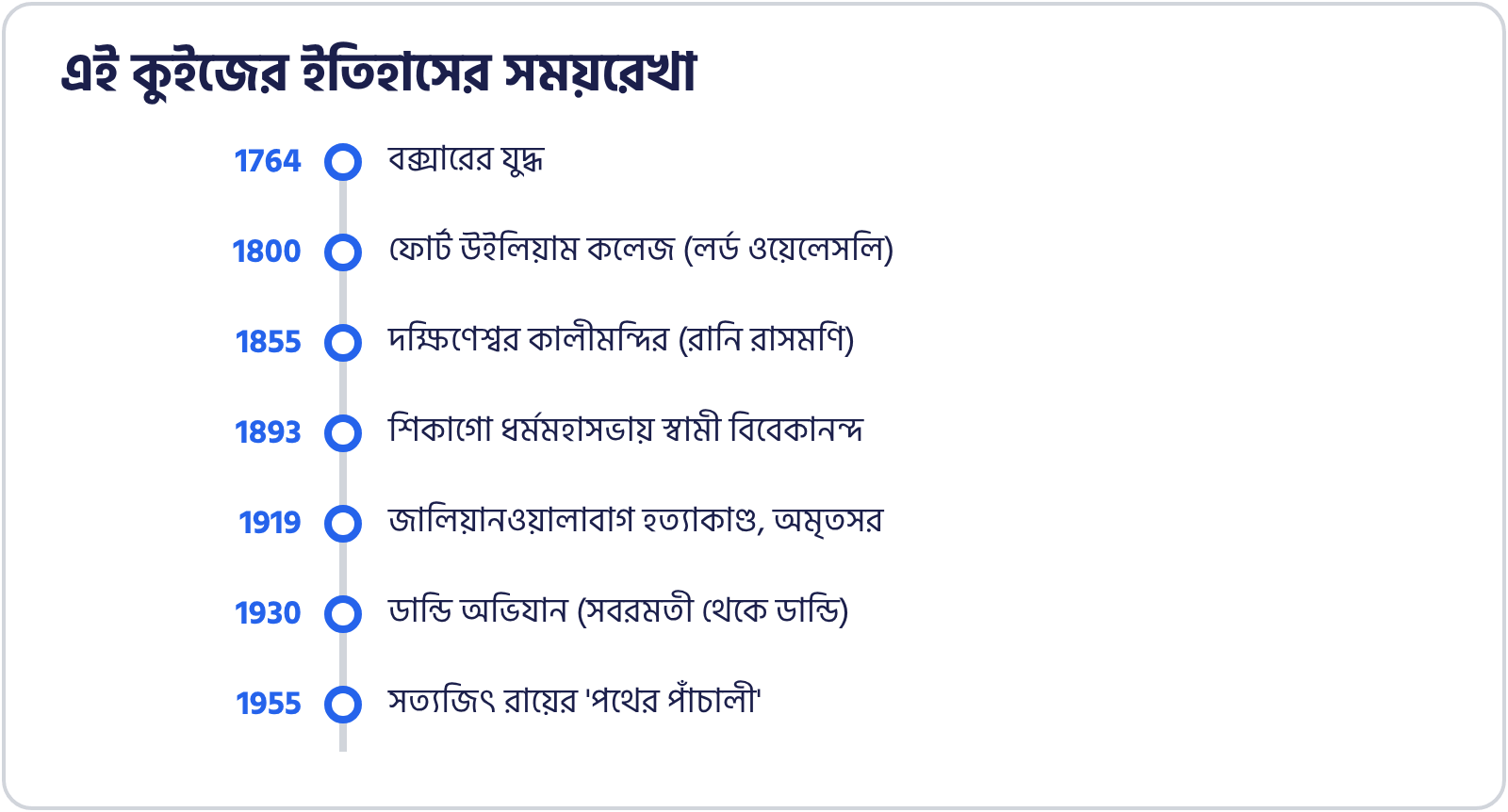
In which year was the Battle of Buxar fought?
Explanation
The Battle of Buxar was fought in 1764: the British under Hector Munro defeated the combined armies of Mir Qasim, Shuja-ud-Daula, the Nawab of Awadh, and the Mughal emperor Shah Alam II. As a result, the Treaty of Allahabad (1765) gave the Company the Diwani of Bengal, Bihar and Orissa. 1757 is Plassey and 1761 the Third Battle of Panipat.
Key Points
- Buxar 1764, the British commander Hector Munro
- Defeated: Mir Qasim, Shuja-ud-Daula, Shah Alam II
- 1765: Treaty of Allahabad, the Diwani
Confusion Points
- 1765 is not the battle but the Treaty of Allahabad that followed it
Memory Tips
- Plassey 57, Buxar 64, Diwani 65
Additional Information
In which city did the Jallianwala Bagh massacre of 1919 take place?
Explanation
On 13 April 1919, the day of Baisakhi, troops fired on a gathering against the Rowlatt Act at Jallianwala Bagh in Amritsar, Punjab, on General Dyer's orders. Rabindranath Tagore gave up his knighthood in protest. Lahore is now in Pakistan; Jalandhar and Ludhiana are other cities of Punjab.
Key Points
- 13 April 1919, the firing ordered by General Dyer
- Background: protests against the Rowlatt Act
- Tagore renounced his knighthood in protest
Memory Tips
- Amritsar, the city of the Golden Temple: Jallianwala Bagh is close to it
Additional Information

From where did Gandhiji begin the Dandi March (Salt Satyagraha) in 1930?
Explanation
On 12 March 1930 Gandhiji set out on foot from the Sabarmati Ashram in Ahmedabad with 78 followers and broke the salt law by making salt at Dandi on the Gujarat coast on 6 April 1930. This began the Civil Disobedience Movement. The Sevagram Ashram came later (1936); Champaran in Bihar was the 1917 satyagraha; Porbandar is Gandhiji's birthplace.
Key Points
- The march began on 12 March 1930 from the Sabarmati Ashram
- Salt law broken at Dandi on 6 April 1930
- It began the Civil Disobedience Movement
Memory Tips
- From Sabarmati to the sea: salt at Dandi
Additional Information
In which year did Swami Vivekananda speak at the Parliament of the World's Religions in Chicago?
Explanation
Swami Vivekananda opened his address at the Parliament of the World's Religions in Chicago on 11 September 1893 with 'Sisters and Brothers of America'. 1886 is the year Sri Ramakrishna passed away, 1897 the founding of the Ramakrishna Mission, and 1902 the year of Vivekananda's death.
Key Points
- Chicago address: 11 September 1893
- 1897: the Ramakrishna Mission founded
- 1902: Vivekananda died at Belur Math
Memory Tips
- 86 the guru's death, 93 Chicago, 97 the Mission, 1902 his death
Additional Information
Which strait separates India and Sri Lanka?
Explanation
The Palk Strait lies between Tamil Nadu and Sri Lanka; to its south is the Gulf of Mannar, with Ram Setu (Adam's Bridge) between the two. The Ten Degree Channel separates the Andaman from the Nicobar Islands and the Eight Degree Channel Minicoy from the Maldives; the Strait of Malacca lies between the Malay Peninsula and Sumatra.
Key Points
- Palk Strait: between Tamil Nadu and Sri Lanka
- Ten Degree Channel: between the Andaman and Nicobar Islands
- Eight Degree Channel: between Minicoy and the Maldives
Memory Tips
- Andaman-Nicobar ten, Minicoy-Maldives eight, Sri Lanka Palk
Additional Information
| Strait / channel | Between |
|---|---|
| Palk Strait | India (Tamil Nadu) and Sri Lanka |
| Ten Degree Channel | Andaman and Nicobar |
| Eight Degree Channel | Minicoy (Lakshadweep) and the Maldives |
| Strait of Malacca | Malay Peninsula and Sumatra |
The Gir National Park, famous for the Asiatic lion, is in which state?
Explanation
The Gir National Park is in the Saurashtra region of Gujarat. Wild Asiatic lions live only in Saurashtra, in and around Gir. Ranthambore in Rajasthan is famous for tigers.
Key Points
- Gir: Saurashtra region of Gujarat
- The only wild home of the Asiatic lion is Gir and its surroundings
- Ranthambore (Rajasthan) is known for tigers
Memory Tips
- Gir and Gujarat both start with G, and the lion
Additional Information
The McMahon Line is the boundary between India and which country?
Explanation
The McMahon Line is the boundary between India (Arunachal Pradesh) and China (Tibet), drawn at the Simla Conference of 1914 and named after Henry McMahon. China does not accept it. The India-Pakistan border is the Radcliffe Line, and the Pakistan-Afghanistan border is the Durand Line.
Key Points
- McMahon Line: 1914, Simla Conference
- India-China boundary along Arunachal Pradesh
- Radcliffe: India-Pakistan; Durand: Pakistan-Afghanistan
Confusion Points
- The Durand Line is not India's border: it lies between Pakistan and Afghanistan
Memory Tips
- McMahon in the high mountains (China), Radcliffe of Partition (Pakistan), Durand for Afghanistan
Additional Information
| Line | Between | Year |
|---|---|---|
| McMahon Line | India and China | 1914 |
| Radcliffe Line | India and Pakistan | 1947 |
| Durand Line | Pakistan and Afghanistan | 1893 |
Which Article of the Constitution of India abolishes untouchability?
Explanation
Article 17 abolishes untouchability and makes its practice in any form forbidden and punishable. Article 14 is equality before law, Article 21 the right to life and personal liberty, and Article 32 the right to constitutional remedies.
Key Points
- Article 17: abolition of untouchability
- It is part of the Right to Equality (Articles 14–18)
- Article 18: abolition of titles
Memory Tips
- Right to Equality 14 to 18: 17 untouchability, 18 titles
Additional Information
| Article | Subject |
|---|---|
| 14 | Equality before law |
| 17 | Abolition of untouchability |
| 21 | Right to life and personal liberty |
| 32 | Right to constitutional remedies |
Which Article of the Constitution of India lists the Fundamental Duties of citizens?
Explanation
The Fundamental Duties are in Part IV-A, Article 51A. The 42nd Amendment of 1976 (on the Swaran Singh Committee's advice) added 10 duties; the 86th Amendment of 2002 added the 11th (to provide opportunities for education to a child of 6 to 14). Article 21A is the right to education, 48A protection of the environment and 39A free legal aid: the last two are Directive Principles.
Key Points
- Fundamental Duties: Part IV-A, Article 51A
- The 42nd Amendment (1976) added 10
- The 86th Amendment (2002) added the 11th
Memory Tips
- Part IV (Directive Principles) ends at Article 51; Part IV-A, Article 51A, follows
Who appoints the Governor of a state?
Explanation
Under Article 155 the Governor is appointed by the President by a warrant under the President's hand and seal. The Governor holds office during the pleasure of the President (Article 156), normally for 5 years. The Governor appoints the Chief Minister, and the Chief Justice of the High Court administers the Governor's oath.
Key Points
- Article 155: the President appoints the Governor
- The Governor appoints the Chief Minister
- The Chief Justice of the High Court administers the Governor's oath
Confusion Points
- The Chief Justice of the High Court administers the oath, but the President appoints
Memory Tips
- President → Governor → Chief Minister: the ladder of appointment
What is the SI unit of electrical resistance?
Explanation
The SI unit of electrical resistance is the ohm (Ω). Ohm's law says $V = IR$, so resistance $R = \frac{V}{I}$: a current of 1 ampere under a potential difference of 1 volt means a resistance of 1 ohm. The ampere is the unit of current, the volt of potential difference and the watt of power.
Key Points
- Resistance is measured in ohms (Ω)
- Ohm's law: $V = IR$
- Power is in watts, current in amperes
Memory Tips
- V = I × R: volts = amperes × ohms
Additional Information
| Quantity | SI unit | Symbol |
|---|---|---|
| Electric current | Ampere | A |
| Potential difference | Volt | V |
| Resistance | Ohm | Ω |
| Power | Watt | W |
Which gland of the body secretes the hormone insulin?
Explanation
Insulin is secreted by the beta cells of the islets of Langerhans in the pancreas; it lowers the level of glucose in the blood. Too little insulin, or insulin that does not work, causes diabetes mellitus. The liver is the largest gland, the thyroid makes thyroxine, and the pituitary is called the 'master gland'.
Key Points
- Insulin: beta cells of the pancreas
- Its job: lowering blood sugar
- Its lack causes diabetes mellitus
Memory Tips
- Pancreas → insulin → sugar control
Lack of iodine in food causes which disease?
Explanation
Iodine is needed to make thyroxine, the hormone of the thyroid gland; without enough of it the thyroid swells, which is goitre. That is why iodine is added to salt. Rickets comes from a lack of vitamin D, scurvy from a lack of vitamin C, and anaemia mainly from a lack of iron.
Key Points
- Iodine is needed to make thyroxine
- Its lack swells the thyroid: goitre
- Iodised salt prevents it
Memory Tips
- Iodine → thyroid → swollen neck (goitre)
Additional Information
| Deficiency | Disease |
|---|---|
| Iodine | Goitre |
| Vitamin D | Rickets |
| Vitamin C | Scurvy |
| Iron | Anaemia |
In which of these media is the speed of sound the greatest?
Explanation
Sound travels fastest in solids, slower in liquids and slowest in gases, because the particles of a solid are close together and tightly bound. In steel sound travels at over about 5,000 m/s, in water at about 1,500 m/s and in air at 20°C at about 343 m/s. Kerosene is a liquid, so much slower than steel.
Key Points
- Speed of sound: solid > liquid > gas
- About 343 m/s in air (20°C)
- Sound cannot travel through a vacuum
Memory Tips
- Solid-liquid-gas: the order in which sound slows down
Additional Information
Approximate speed of sound
Air (20°C) · 343 m/s
Water · 1500 m/s
Steel · 5000 m/s
0/20


Leave a Comment
Commenting as ·