
10 WB TET CDP questions on the meaning of growth, development and maturation, how they differ, Gesell’s twin study and classroom situations. 45 seconds a question.
Growth, Development and Maturation Quiz: WB TET CDP Practice
Quiz challenge
A little practice. A step forward.
10 questions
Learn with explanations
Time per question: 45 sec
0 / 10 completed
--:--
Which change can be measured directly in centimetres or kilograms?
Explanation
Growth is a quantitative, physical change in height, weight and size, so a tape or a scale measures it. Development also has qualitative change, which is observed and assessed. Maturation and socialisation show in behaviour and have no unit of measurement.
Key Points
- Growth = quantitative
- Development = quantitative + qualitative
Memory Tips
- Growth = the tape and the scale
Which statement about growth and development is correct?
Explanation
Physical growth usually stops after adolescence, in early adulthood, while development goes on from the womb to the tomb. The first option swaps the two; growth is only a part of development, so they are not the same; and development covers every aspect, not only the physical.
Key Points
- Growth is a part of development
- Development is holistic: physical, mental, social, emotional, moral
Confusion Points
- Growth = quantitative, development = both; questions often swap them
Memory Tips
- Development = the whole person, the whole life
Additional Information
| Feature | Growth | Development |
|---|---|---|
| Kind of change | Quantitative | Quantitative and qualitative |
| Aspect | Mainly physical: height, weight, size | Every aspect: physical, mental, emotional, social, moral |
| Duration | Stops at a certain age | Lifelong, womb to tomb |
| Measurement | Directly measurable (cm, kg) | Observed and assessed; hard to measure directly |
| Scope | Narrow: a part of development | Broad: includes growth |
A teacher sees that a two-and-a-half-year-old child, though very eager, cannot hold a pencil and write letters. What is the main reason?
Explanation
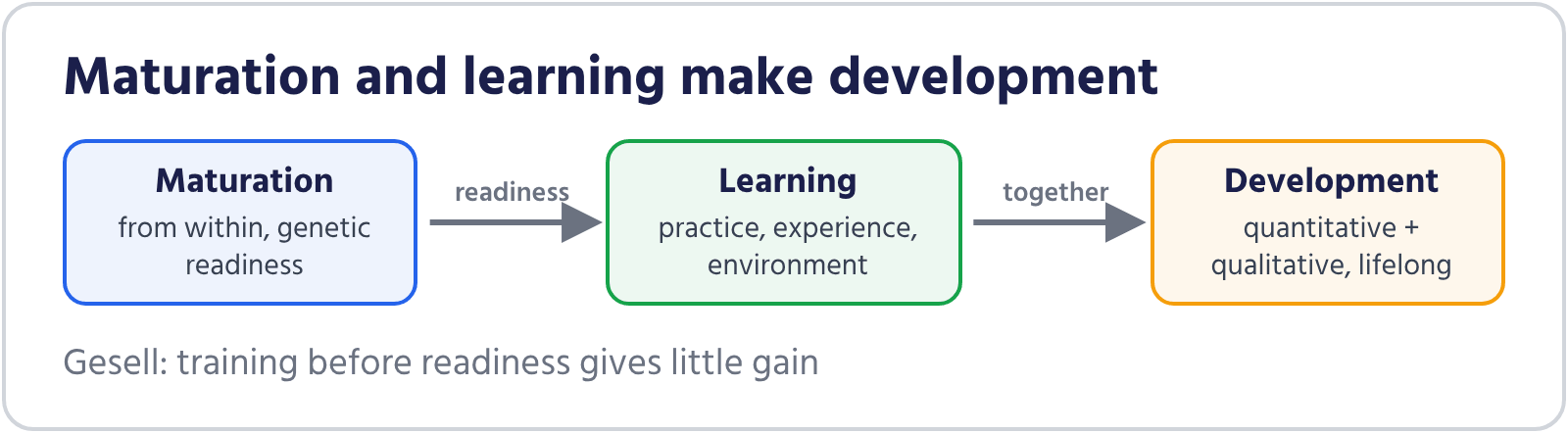
Writing needs fine finger muscles and eye-hand coordination, which come with maturation. The child is eager, so attention is not the problem; before blaming intelligence or method, a teacher checks readiness for the age. Forcing a skill before readiness frustrates the child.
Key Points
- Learning needs the readiness that maturation brings
- Development is proximodistal: finger control comes last
Memory Tips
- Maturation is like ripening fruit: it cannot be pulled ahead
Additional Information
What does Arnold Gesell's co-twin control study show?
Explanation
Gesell trained one twin in stair climbing early and the other later; the later twin caught up almost fully after a short practice. So training ahead of maturational readiness gives little advantage. The study stresses maturation, not learning alone, and it did not measure intelligence.
Key Points
- Gesell = maturation theory
- The task: stair climbing
- The lesson for teaching: teach when the child is ready
Memory Tips
- Twins in the question: think Gesell
Additional Information
A parent says, 'When she grows up, my daughter will learn everything by herself.' For which skill is this NOT true?
Explanation
Walking, standing and crawling come with maturation: a healthy child does them at the right age without training. Swimming is learnt: maturation prepares the body, but without teaching and practice it does not come.
Key Points
- Maturation: same order in every child, no training
- Learning: needs practice and experience
Confusion Points
- Walking is maturation, but cycling or swimming is learning
Additional Information
| Maturation | Learning |
|---|---|
| From within, genetic | From outside, through experience and practice |
| Comes without training | Needs training and effort |
| Same order in every child | Different for each child, depends on environment |
| Examples: sitting, crawling, walking, the changes of puberty | Examples: cycling, swimming, reading, writing |
A Class I teacher notices that children move their shoulders and arms well but cannot do fine work with their fingers. Which principle of development explains this?
Explanation
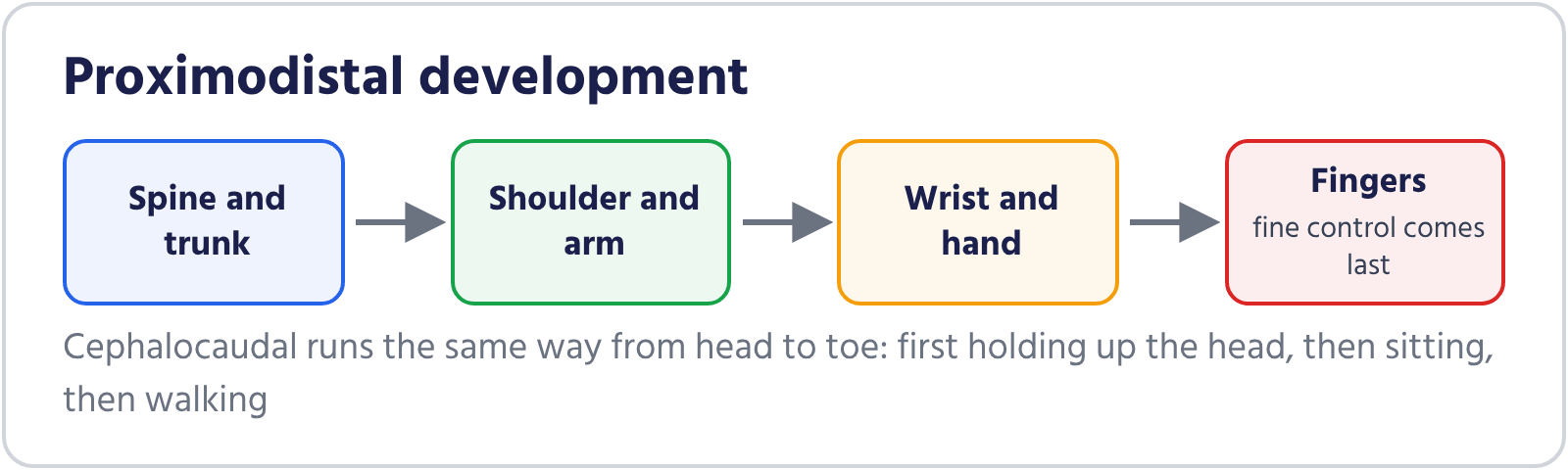
In proximodistal development control comes from the centre of the body outwards: shoulder and arm, then hand, then fingers. Cephalocaudal is the head-to-toe order, while here arm and fingers are compared. The other two options are the reverse of the real principles.
Key Points
- Cephalocaudal: head → feet
- Proximodistal: spine → arm → fingers
Confusion Points
- Top-bottom (head-feet) is cephalocaudal; inside-out (arm-fingers) is proximodistal
Memory Tips
- Head first, fingers last
Additional Information
'Development is not limited to growing larger; it is a progressive series of orderly, coherent changes leading toward maturity.' Whose widely quoted definition is this?
Explanation
This is Elizabeth B. Hurlock's definition, the one most quoted in developmental psychology texts. Gesell is known for maturation theory and the twin study, Piaget for the stages of cognitive development, Skinner for operant conditioning.
Key Points
- Hurlock: development = orderly, coherent changes
- The goal of development is maturity
A pupil has grown much taller in a year, but in group work he still cannot share or cooperate. What should the teacher conclude?
Explanation
Height is a measure of growth, but sharing and cooperation belong to social development. So growth does not bring development in every aspect, and the aspects do not move at the same pace. Environment and experience shape social development, so the teacher gives more chances for group work and cooperation.
Key Points
- Growth does not guarantee development
- The aspects of development do not move at the same pace
- Environment matters a lot in social development
Following the idea of maturation, when should a teacher teach a new skill?
Explanation
Maturation brings readiness to learn; once it is there, learning is quick and enjoyable, while forcing it earlier wastes time and frustrates. Children do not all become ready on the same day (individual differences), and a parent's wish is not a measure of the child's readiness.
Key Points
- Readiness = the right time to learn
- The order of development is the same, but each child's pace differs
Memory Tips
- Readiness first, lesson next
Additional Information
Which statement about maturation is NOT correct?
Explanation
Practice and training produce learning, not maturation; maturation comes from within as the child ages. The other three are correct features of maturation: it is genetic, follows a fixed order and brings readiness for learning.
Key Points
- In 'NOT correct' questions a feature of learning is passed off as maturation
- Maturation = nature; learning = experience
Confusion Points
- The word practice points to learning, not maturation
Additional Information
| Maturation | Learning |
|---|---|
| From within, genetic | From outside, through experience and practice |
| Comes without training | Needs training and effort |
| Same order in every child | Different for each child, depends on environment |
| Examples: sitting, crawling, walking, the changes of puberty | Examples: cycling, swimming, reading, writing |
0/10

Leave a Comment
Commenting as ·