
Photosynthesis and Respiration Quiz: Clerkship 2024 General Studies
A little practice. A step forward.
10 questions on photosynthesis and respiration, 30 seconds each, with an explanation and a memory tip for every answer. 📖 Read the detailed topic
What is the source of the oxygen released in photosynthesis?
The oxygen released comes from water. In the light reaction, light energy splits water (photolysis of water) and oxygen is set free. The oxygen of CO2 goes into glucose and water, so 'carbon dioxide' is wrong.
- Photolysis of water happens in the light reaction, in the grana
- Ruben and Kamen (1941) proved it with a heavy oxygen isotope
- Water appears on both sides of the equation: 12 molecules in, 6 new ones out
- Many think CO2 is split to give O2; the O2 actually comes from water
- The O2 of photosynthesis comes from H2O
Which metal is at the centre of the chlorophyll molecule?
Magnesium (Mg) sits at the centre of the chlorophyll molecule. Iron is found in haemoglobin of blood, which makes 'iron' the main trap. A lack of magnesium turns leaves yellow (chlorosis).
- Chlorophyll: Mg; haemoglobin: Fe
- Chlorophyll absorbs red and blue light and reflects green
- Magnesium deficiency causes chlorosis (yellow leaves)
- Iron in haemoglobin, magnesium in chlorophyll: the two are often swapped
- Green pigment, Mg; red pigment, Fe
In which part of the chloroplast does the dark reaction of photosynthesis take place?
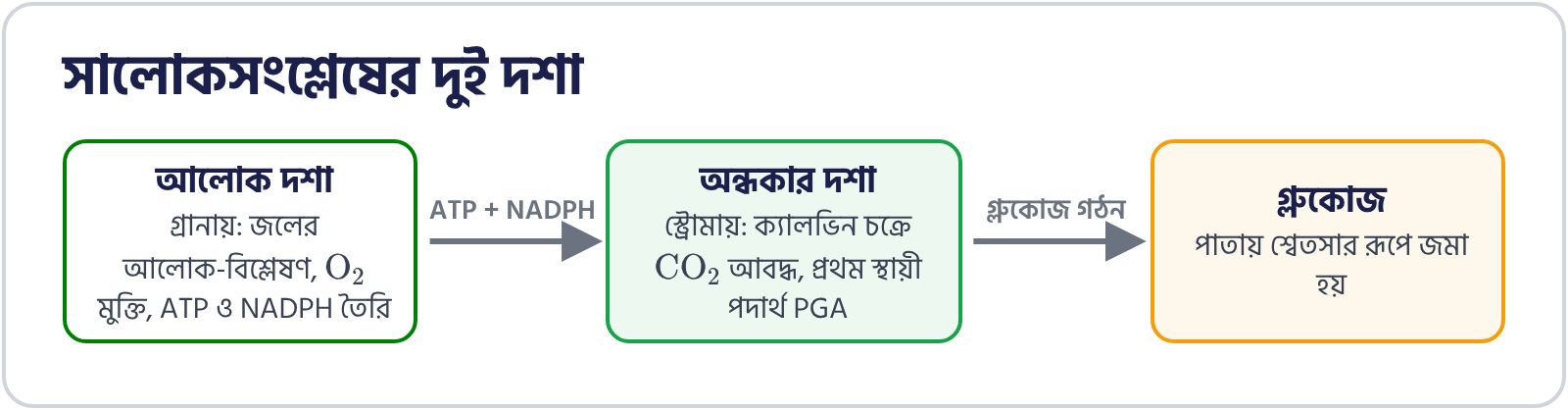
The dark reaction takes place in the stroma, the fluid part of the chloroplast; there CO2 is fixed into glucose using the ATP and NADPH of the light reaction (the Calvin cycle). The grana and their thylakoid membranes carry out the light reaction.
- Light reaction: grana (thylakoids)
- Dark reaction: stroma, the Calvin cycle
- The dark reaction needs no light directly, but it needs ATP and NADPH from the light reaction
- Grana for light, stroma for dark
Where in the cell does glycolysis take place?
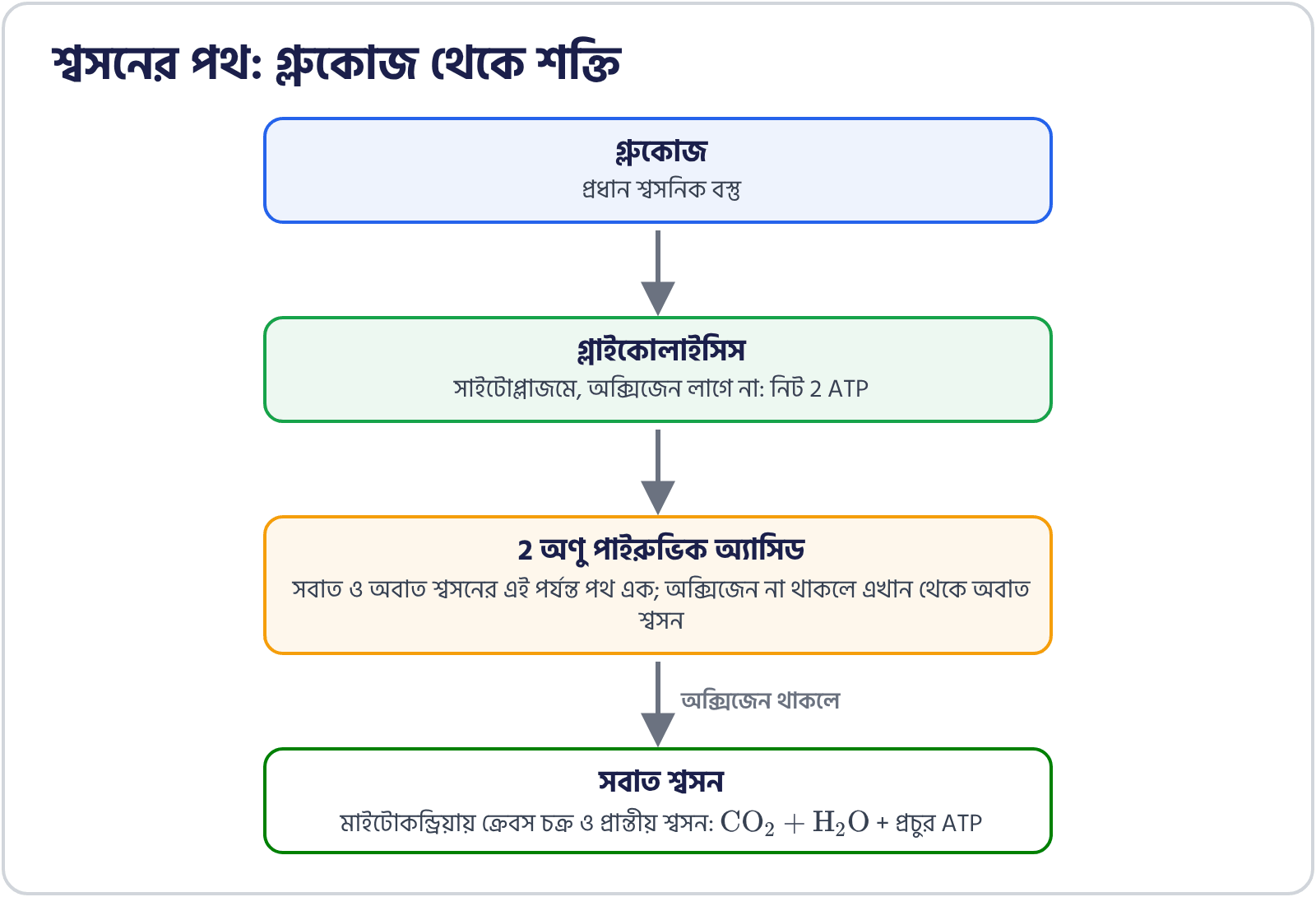
Glycolysis takes place in the cytoplasm, without oxygen; one molecule of glucose is broken into 2 molecules of pyruvic acid. The mitochondrial matrix is where the next step, the Krebs cycle, happens, so it is the wrong answer.
- Glycolysis: cytoplasm, no O2 needed, net 2 ATP
- Krebs cycle: mitochondrial matrix
- Glycolysis is the same in aerobic and anaerobic respiration
- Respiration does not start in the mitochondria: glycolysis, the first step, is in the cytoplasm
- Glycolysis in the cytoplasm, Krebs in the mitochondria
What does yeast produce in anaerobic respiration (alcoholic fermentation)?
Without oxygen, yeast breaks glucose into ethyl alcohol and carbon dioxide; this is alcoholic fermentation. That CO2 is what makes bread dough rise. Lactic acid is made in anaerobic respiration in muscle, not in yeast.
- Yeast: ethyl alcohol + CO2
- Muscle: lactic acid
- Anaerobic respiration is wholly in the cytoplasm and gives little energy
- The products of yeast and of muscle get swapped
- Yeast makes alcohol, muscles make lactic acid
| Where | Products | Example |
|---|---|---|
| Yeast, some bacteria | Ethyl alcohol + CO2 + a little energy | Alcoholic fermentation: bread rises, wine is made |
| Human muscle (hard exercise) | Lactic acid + a little energy | Muscle fatigue and cramp |
| Curd bacteria (Lactobacillus) | Lactic acid | Milk turns into curd |
What is the respiratory quotient (RQ) when the respiratory substrate is a carbohydrate (glucose)?
In the aerobic respiration of glucose 6 molecules of O2 are used and 6 molecules of CO2 released, so RQ = 6 ÷ 6 = 1. It is about 0.7 for fat and about 0.9 for protein, because they need more oxygen to oxidise. Anaerobic respiration takes no oxygen, so its RQ is infinity.
- RQ = CO2 released ÷ O2 taken in
- Carbohydrate 1, protein about 0.9, fat about 0.7
- Organic acids above 1, anaerobic infinity
- Carbohydrate 1, protein 0.9, fat 0.7: the more O2 needed, the lower the RQ
| Respiratory substrate | RQ |
|---|---|
| Carbohydrate (glucose) | 1 |
| Protein | about 0.9 |
| Fat | about 0.7 |
| Organic acids (e.g. malic acid) | more than 1 |
| Anaerobic respiration | infinity (no O2 taken) |
The fatigue in muscles after hard exercise is due to the build-up of which substance?
During hard exercise such as running, muscle cells do not get enough oxygen, so anaerobic respiration turns glucose into lactic acid. Its build-up causes muscle fatigue and cramp. Ethyl alcohol is made by yeast, and urea is a waste of protein metabolism.
- Anaerobic respiration in muscle: glucose to lactic acid
- With rest and oxygen the lactic acid is used again and the fatigue passes
- Citric acid is a compound of the Krebs cycle, not a cause of fatigue
In C3 plants such as rice and wheat, which is the first stable product of the dark reaction of photosynthesis?
In C3 plants the first stable compound formed when CO2 is fixed in the Calvin cycle is the three-carbon 3-phosphoglyceric acid (PGA); its three carbons give the name C3. The four-carbon oxaloacetic acid is the first product in C4 plants (maize, sugarcane). Glucose is the end product, not the first.
- C3 plants: first stable product PGA (3 carbons)
- C4 plants (maize, sugarcane): OAA (4 carbons)
- Pyruvic acid is made in glycolysis during respiration
- OAA belongs to C4 plants, not C3; glucose is the end product, not the first
- The number in the name is the number of carbons: C3 = PGA (3), C4 = OAA (4)
What is the main function of the breathing roots (pneumatophores) of the mangroves of the Sundarbans?
The salty mud of a mangrove has almost no air, so roots cannot get oxygen from it. Some roots grow upward out of the mud and take in oxygen from the air through pores on their surface: these are the breathing roots. Anchoring in the mud is done by stilt roots, not breathing roots.
- Pneumatophores: in mangroves such as sundari, goran and genwa
- Upright roots above the mud, with breathing pores
- Land plants exchange gases through stomata and lenticels
- Stilt roots hold the plant; breathing roots take in air
- Pneumatophore: 'pneuma' means air
In which colour of light is the rate of photosynthesis lowest?
Chlorophyll absorbs hardly any green light and reflects it; that is why leaves look green and why photosynthesis is slowest in green light. Chlorophyll absorbs red and blue light most; the rate is highest in red light, then blue.
- Highest rate: red light, then blue
- Lowest rate: green light
- Leaves look green because green light is reflected
- Thinking green light works best because leaves are green is wrong
- The colour a leaf shows is the colour it does not use
📊 Topic Analysis
10 questions on photosynthesis and respiration, 30 seconds each, with an explanation and a memory tip for every answer.


Leave a Comment
Commenting as ·