
WBPSC Clerkship 2024 Arithmetic Quiz: Mixed Topics, Set 5
A little practice. A step forward.
20 mixed-topic arithmetic questions for WBPSC Clerkship 2024 Part-I, 30 seconds each.
Which of the following numbers is divisible by 11?
Rule for 11: take the sum of the digits in odd places (from the right) and the sum of the digits in even places; if the difference is 0 or a multiple of 11, the number is divisible by 11. For 352616 the odd places give 6 + 6 + 5 = 17 and the even places 1 + 2 + 3 = 6, a difference of 11, so it is divisible. For 736251 the difference is 12, not a multiple of 11.
- A difference of 0, 11, 22 … means divisible by 11
- Count the places from the right
- Rule of 11: add alternate digits, then subtract
| Number | Odd places | Even places | Difference |
|---|---|---|---|
| 352616 | 17 | 6 | 11 ✔ |
| 425186 | 9 | 17 | 8 |
| 834126 | 10 | 14 | 4 |
| 736251 | 6 | 18 | 12 |
If 61*52 is divisible by 9, what is the smallest digit that can replace *?
A number is divisible by 9 when the sum of its digits is a multiple of 9. Here 6 + 1 + 5 + 2 = 14; the next multiple of 9 is 18, so * = 18 − 14 = 4. Putting 3 gives a sum of 17, which is not a multiple of 9.
- Rule of 9: the digit sum is a multiple of 9
- The rule of 3 is the same with multiples of 3
What is $0.\overline{36}$ as a fraction?
When all the decimal digits recur, the recurring block goes in the numerator and as many 9s as there are recurring digits go in the denominator: $0.\overline{36} = \frac{36}{99} = \frac{4}{11}$. $\frac{9}{25}$ is 0.36 without the bar, so it is wrong.
- $0.\overline{ab} = \frac{ab}{99}$
- Reduce by dividing numerator and denominator by their HCF
- 0.36 and $0.\overline{36}$ differ: the first is $\frac{9}{25}$, the second $\frac{4}{11}$
- As many 9s as recurring digits
Which fraction equals $0.2\overline{3}$?
For a mixed recurring decimal, numerator = (all the digits − the non-recurring part), denominator = one 9 for each recurring digit followed by one 0 for each non-recurring digit. So $0.2\overline{3} = \frac{23 - 2}{90} = \frac{21}{90} = \frac{7}{30}$. Choosing $\frac{23}{90}$ means forgetting to subtract the non-recurring 2.
- $0.a\overline{b} = \frac{ab - a}{90}$
- In the denominator, 9s first, then 0s
- Subtract the non-recurring part in the numerator: $\frac{21}{90}$, not $\frac{23}{90}$
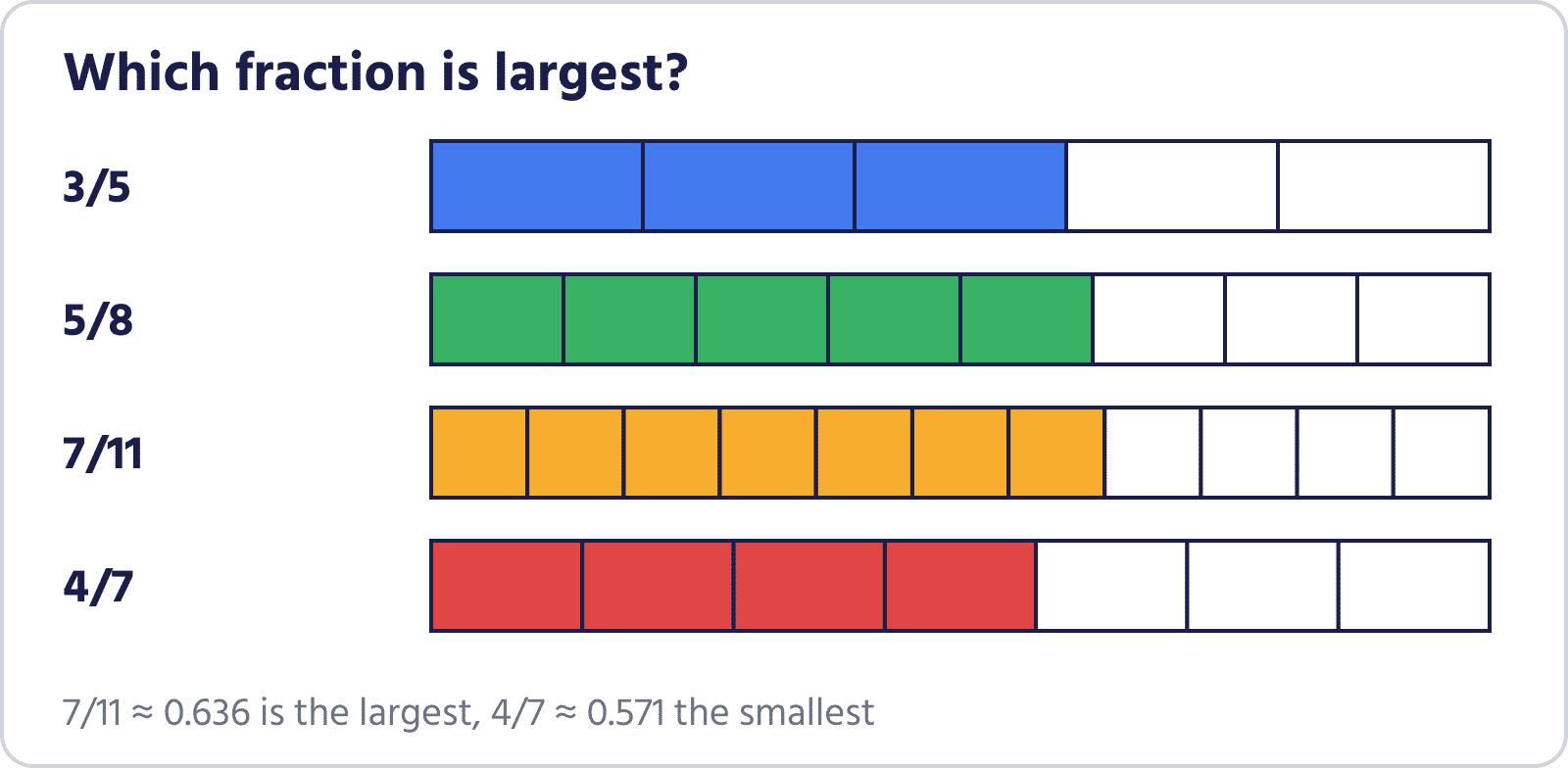
Which is the largest of $\frac{3}{5}, \frac{5}{8}, \frac{7}{11}, \frac{4}{7}$?
As decimals, $\frac{3}{5} = 0.6$, $\frac{5}{8} = 0.625$, $\frac{7}{11} \approx 0.636$ and $\frac{4}{7} \approx 0.571$, so $\frac{7}{11}$ is the largest. $\frac{5}{8}$ is close, but cross-multiplying gives $5 \times 11 = 55 \lt 7 \times 8 = 56$.
- Cross-multiplication is the quickest way to compare two fractions
- When the numerator is the same amount short of the denominator, the fraction with the larger denominator is larger
- $\frac{a}{b}$ vs $\frac{c}{d}$: compare $ad$ and $bc$
What is the value of $0.25 \times 0.4 \div 0.05$?
Working left to right, $0.25 \times 0.4 = 0.1$, then $0.1 \div 0.05 = 2$. To divide by a decimal, multiply both numbers by 100: $10 \div 5 = 2$. Misplacing the decimal point gives 0.2 or 20.
- Multiplication and division have the same rank: go left to right
- When dividing by a decimal, scale both numbers by a power of 10
What is the value of $48 \div 12 \times 3 + 6 - 2$?
In BODMAS, division and multiplication share one rank, so work left to right: $48 \div 12 = 4$, $4 \times 3 = 12$, then $12 + 6 - 2 = 16$. Doing $12 \times 3 = 36$ first and then $48 \div 36$ gives a wrong answer.
- Order: brackets, of, division/multiplication (left to right), addition/subtraction (left to right)
- Division does not always come before multiplication: whichever comes first is done first
- Division and multiplication have equal rank: the one on the left goes first
The HCF of two numbers is 12 and their LCM is 360. If one number is 72, what is the other?
Product of two numbers = HCF × LCM, so the other number $= \frac{12 \times 360}{72} = 60$. Check: 72 and 60 have HCF 12 and LCM 360.
- Product = HCF × LCM (for two numbers only)
- Both numbers are multiples of the HCF
What is the smallest number that leaves a remainder of 5 when divided by 12, 15 and 20?
The LCM of 12, 15 and 20 is 60; a remainder of 5 each time means the number is 60 + 5 = 65. 125, 185 … also work, but 65 is the smallest.
- Same remainder r: LCM + r
- General form: LCM × k + r
- Same remainder → add it to the LCM
What is the HCF of $\frac{2}{3}, \frac{4}{9}, \frac{8}{15}$?
HCF of fractions = HCF of the numerators ÷ LCM of the denominators. The numerators 2, 4, 8 have HCF 2; the denominators 3, 9, 15 have LCM 45; so the answer is $\frac{2}{45}$. $\frac{8}{3}$ is the LCM (LCM of numerators ÷ HCF of denominators).
- HCF = HCF of numerators ÷ LCM of denominators
- LCM = LCM of numerators ÷ HCF of denominators
- The two rules mirror each other: HCF uses the LCM of denominators, LCM uses their HCF
- The HCF is small, so the big one (LCM) goes below
A starts a business with ₹12,000; B joins 3 months later with ₹16,000. If the profit at the end of the year is ₹8,400, what is B's share?
Profit is shared in the ratio of capital × time. A: $12000 \times 12 = 144000$, B: $16000 \times 9 = 144000$, a ratio of 1 : 1. So B gets half of ₹8,400, which is ₹4,200. Using only the capital ratio (3 : 4) gives ₹4,800, which is wrong.
- In compound partnership the ratio is capital × months
- Joining late means fewer months
- B's money was in for 9 months, not 12
| Partner | Capital | Months | Capital × months |
|---|---|---|---|
| A | ₹12,000 | 12 | 1,44,000 |
| B | ₹16,000 | 9 | 1,44,000 |
Ratio 1 : 1, so the profit is split equally
The average age of 30 students is 14 years. When the teacher's age is included, the average rises by 1 year. How old is the teacher?
The students' total age is $30 \times 14 = 420$. With the teacher, 31 people average 15, a total of $31 \times 15 = 465$. The teacher is $465 - 420 = 45$ years old. Shortcut: old average + new count × rise $= 14 + 31 \times 1 = 45$.
- Total = average × count
- New member = old average + (new count × rise in average)
- The rise applies to 31 people, not 30: 45, not 44
- In average questions, find the total first
If A : B = 2 : 3 and B : C = 4 : 5, what is A : B : C?
B appears in both ratios (as 3 and 4), so make it equal: multiply the first ratio by 4 and the second by 3, giving A : B = 8 : 12 and B : C = 12 : 15. So A : B : C = 8 : 12 : 15. Writing 2 : 3 : 5 ignores that B has two different values.
- Make the common term equal in both ratios
- Shortcut: A : B : C = (2 × 4) : (3 × 4) : (3 × 5)
35% of a number is 84. What is 60% of that number?
The number is $84 \times \frac{100}{35} = 240$, and 60% of it is $240 \times \frac{60}{100} = 144$. Directly: $84 \times \frac{60}{35} = 144$.
- Number = part × 100 ÷ percentage
- Two percentages of the same number are in direct ratio: $\frac{60}{35}$
At simple interest a sum doubles in 8 years. What is the annual rate of interest?
Doubling means the interest equals the principal, i.e. 100% interest in 8 years. Rate $= \frac{100}{8} = 12.5\%$. At 8% the interest over 8 years is only 64%.
- If a sum doubles in n years, rate = $\frac{100}{n}\%$
- Simple interest = principal × rate × time ÷ 100
- Tripling means 200% interest, not 300%
- Double = 100% interest, triple = 200% interest
The cost price of 15 articles equals the selling price of 12 articles. What is the profit percentage?
Let each article cost ₹1. Then 12 articles sell for ₹15, a profit of ₹3 on a cost of ₹12: $\frac{3}{12} \times 100 = 25\%$. Dividing the profit by 15 gives 20%, which is wrong.
- Profit% = (difference ÷ number sold) × 100
- Profit is always worked on the cost price
- Divide by the number sold (12), not 15
A shopkeeper marks goods 20% above cost price and gives a 10% discount. What is the profit percentage?
Take the cost as ₹100: the marked price is ₹120, and after 10% off the selling price is $120 \times 0.9 = 108$, a profit of 8%. Simply subtracting 20 − 10 = 10% is wrong because the discount is on the marked price. Formula: $20 - 10 - \frac{20 \times 10}{100} = 8$.
- Discount is on the marked price, profit on the cost price
- Successive changes: $a + b + \frac{ab}{100}$ (negative for a fall)
- Take ₹100 to make percentages easy
How long does a 150 m long train running at 72 km/h take to pass a pole?
To turn km/h into m/s multiply by $\frac{5}{18}$: $72 \times \frac{5}{18} = 20$ m/s. To pass a pole the train covers its own length, so the time is $\frac{150}{20} = 7.5$ seconds.
- km/h → m/s: × $\frac{5}{18}$
- Passing a pole or a person: distance = train's length; passing a platform: train + platform
- 36 km/h = 10 m/s, 72 km/h = 20 m/s
A person goes from A to B at 40 km/h and returns by the same road at 60 km/h. What is the average speed for the whole journey?
For equal distances at two speeds, average speed $= \frac{2xy}{x + y} = \frac{2 \times 40 \times 60}{100} = 48$ km/h. Check: for 120 km the trip out takes 3 hours and back 2 hours, 240 km ÷ 5 hours = 48. 50 is the simple mean, which does not apply here.
- Average speed = total distance ÷ total time
- For equal distances: $\frac{2xy}{x + y}$
- For equal distances the average speed is not the simple mean of the speeds (50)
The length of a rectangle is increased by 20% and its breadth decreased by 20%. What happens to its area?
Taking length and breadth as 100, the new area is $120 \times 80 = 9600$ against 10000 before, i.e. 4% less. Formula: $20 - 20 - \frac{20 \times 20}{100} = -4$. An equal rise and fall never cancel out.
- Area = length × breadth
- x% up and x% down: a net fall of $\frac{x^{2}}{100}\%$
- +20% and −20% do not make 0: the result is 4% less
- x% up then x% down is always a loss
📊 Topic Analysis
20 mixed-topic arithmetic questions for WBPSC Clerkship 2024 Part-I, 30 seconds each.
Related Posts

Social and Educational Reform in 19th-Century Bengal Quiz: Clerkship 2024

Everyday Science Mixed Quiz 5: Sound, Electricity and Household Chemistry, WBPSC Clerkship GS

Diseases, Germs and Vaccines Quiz: Clerkship GS Practice

Leave a Comment
Commenting as ·