
Average, Ratio and Time-Distance Mixed Practice Quiz: WBPSC Clerkship 2024
A little practice. A step forward.
12 questions on average speed, ratio of speeds and combined averages at the level of Clerkship Part-I, each with a worked solution. 📖 Read the detailed topic
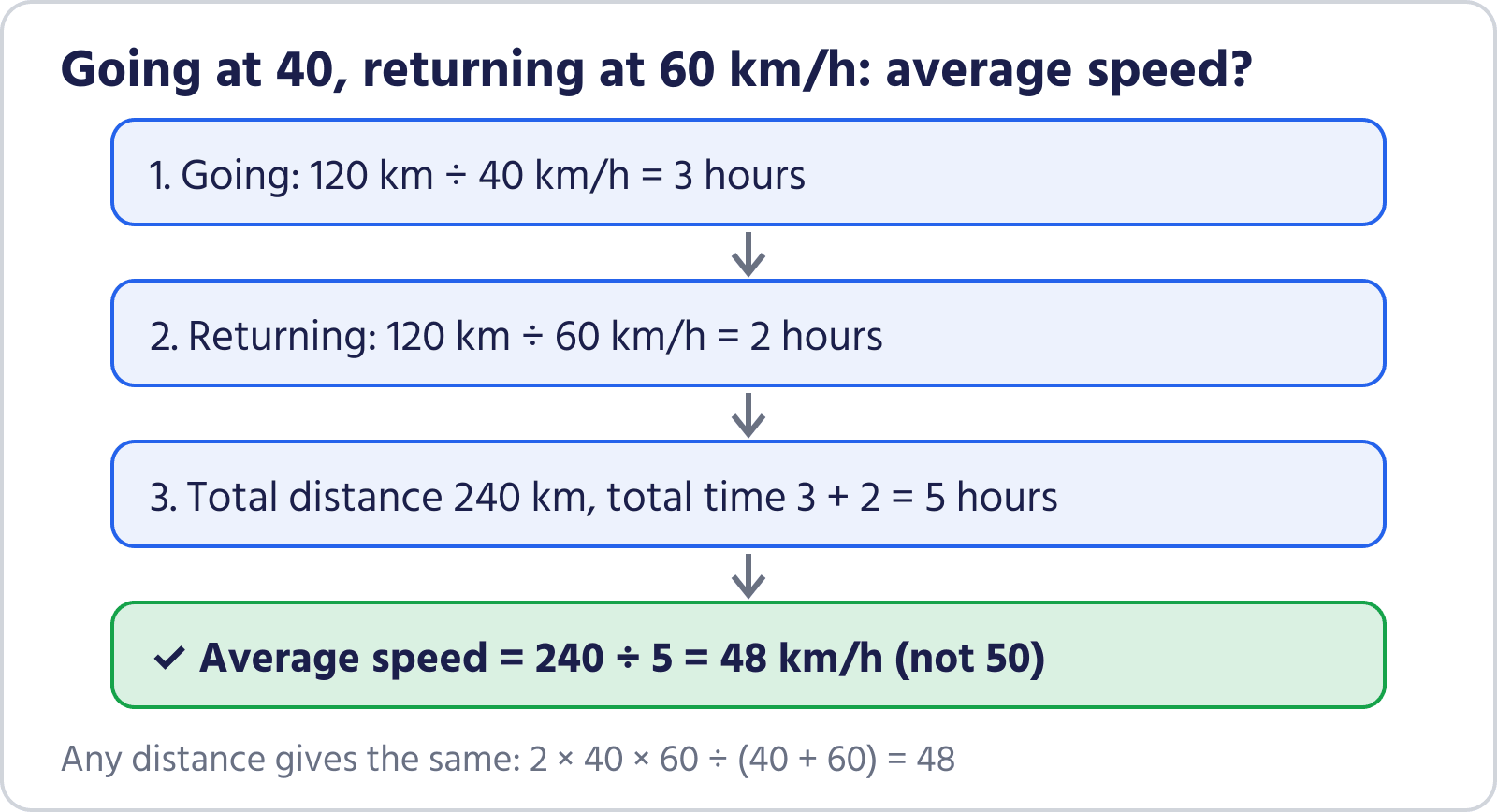
A car goes from A to B at 30 km/h and returns at 20 km/h. What is the average speed for the whole journey?
The distances are equal, so average speed $= \frac{2 \times 30 \times 20}{30 + 20} = \frac{1200}{50} = 24$ km/h. Check: take 60 km; going takes 2 hours, returning 3 hours, $120 \div 5 = 24$. 25 is the simple mean of the speeds, which does not apply to equal distances.
- Equal distances: average speed $= \frac{2xy}{x+y}$
- Average speed = total distance ÷ total time
- Over equal distances the answer is always below the simple mean of the speeds (25)
- Take the LCM of the two speeds as the distance: 60 km here
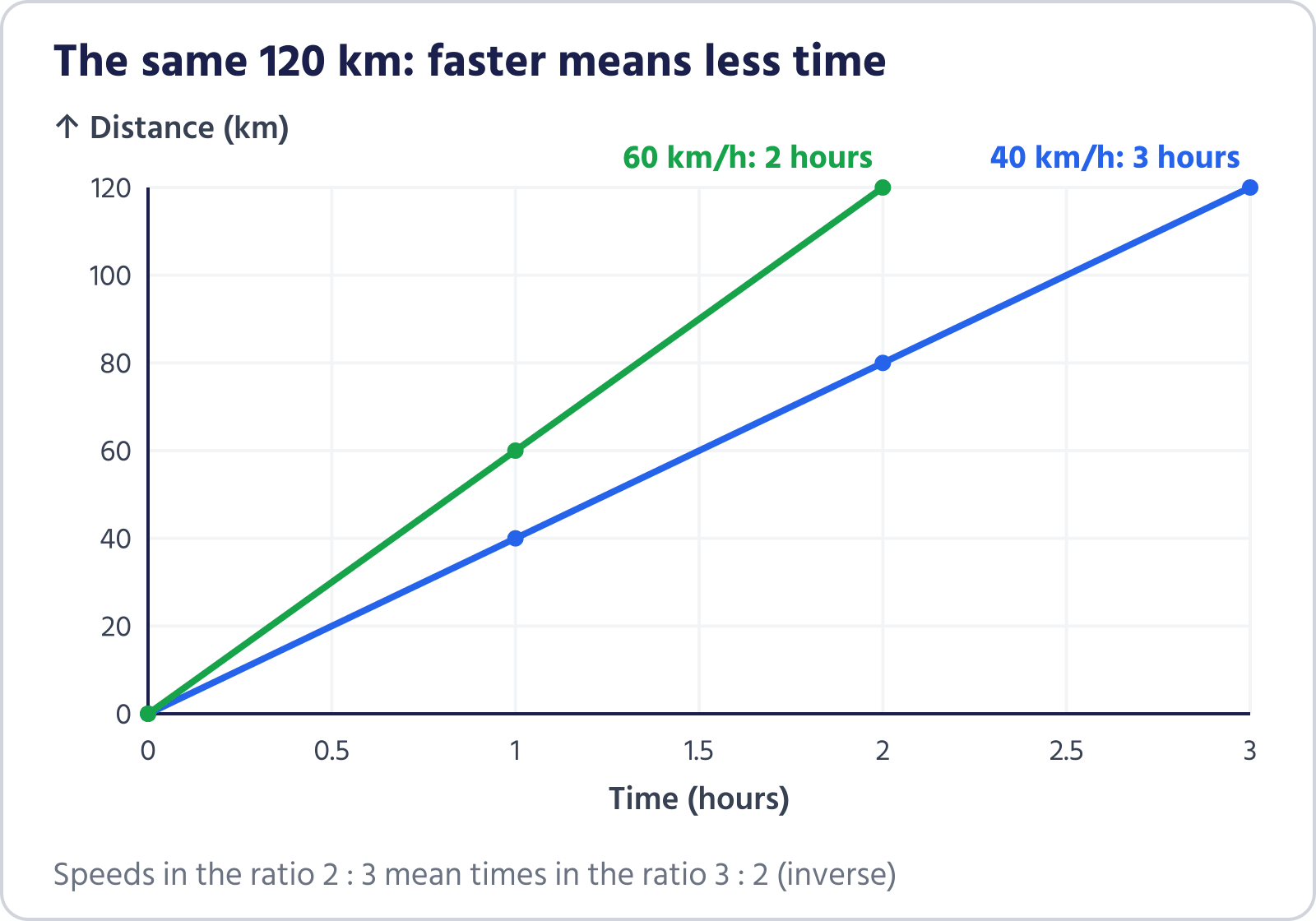
The speeds of two buses are in the ratio 5 : 4. The first bus takes 4 hours for a journey. How long will the second bus take for the same journey?
The distance is the same, so the times are in the inverse ratio 4 : 5. The first bus's 4 parts = 4 hours, so 1 part = 1 hour and the second bus's 5 parts = 5 hours. 3 hours 12 minutes comes from $4 \times \frac{4}{5}$ without inverting the ratio; the slower bus cannot take less time.
- Same distance: speeds $a : b$ mean times $b : a$
- The slower bus takes longer: the answer must exceed 4 hours
- Multiplying without inverting gives 3 hours 12 minutes, which is wrong
- Speed up, time down: invert the ratio
Three numbers are in the ratio 2 : 3 : 5 and their average is 30. What is the largest number?
The average of three numbers is 30, so their sum is $30 \times 3 = 90$. The ratio has $2 + 3 + 5 = 10$ parts, 1 part $= 90 \div 10 = 9$, and the largest is $5 \times 9 = 45$. Check: 18, 27 and 45 add up to 90, average 30.
- Average × count = sum
- Sum ÷ total parts = value of 1 part
- Sum first, then the parts
A man travels for 2 hours at 45 km/h and then for 3 hours at 60 km/h. What is his average speed for the whole journey?
Total distance $2 \times 45 + 3 \times 60 = 90 + 180 = 270$ km, total time 5 hours, average $270 \div 5 = 54$ km/h. 52.5 is the simple mean of the speeds, which holds only for equal times; here more time is spent at 60 km/h, so the average moves towards 60.
- With unequal times, find the distance at each speed
- Only equal times allow the simple mean
- The average leans to the speed held for longer
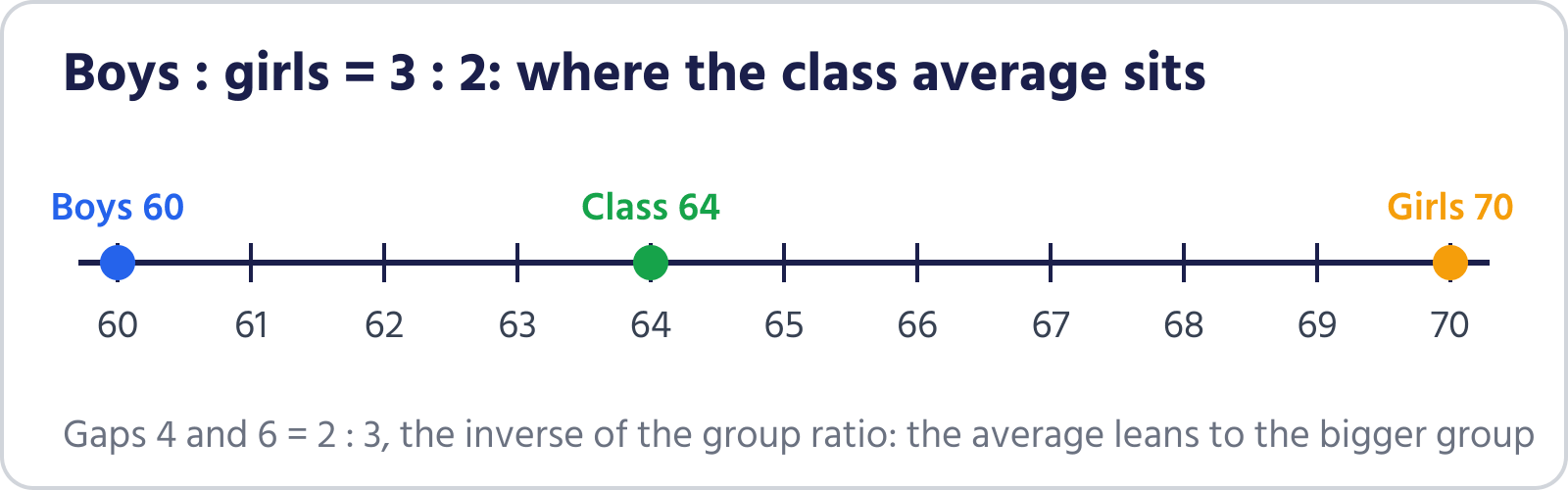
In a class the ratio of boys to girls is 4 : 1. The average weight of the boys is 50 kg and of the girls 40 kg. What is the average weight of the whole class?
Taking the ratio's parts as the numbers, the combined average $= \frac{4 \times 50 + 1 \times 40}{4 + 1} = \frac{240}{5} = 48$ kg. 45 kg is the simple mean of the two averages, right only for equal groups. There are four times as many boys, so the average is close to 50.
- Combined average $= \frac{n_1 A_1 + n_2 A_2}{n_1 + n_2}$
- The parts of the ratio serve as the group sizes
- The simple mean of the two averages (45) is right only for equal groups
- Gap from 50 is 2, from 40 is 8: 2 : 8 = 1 : 4, the inverse of the group ratio
The speeds of two trains are in the ratio 7 : 8. The second train covers 400 km in 4 hours. What is the speed of the first train?
The second train's speed is $400 \div 4 = 100$ km/h, which is 8 parts. 1 part $= 100 \div 8 = 12.5$, so the first train runs at $7 \times 12.5 = 87.5$ km/h. 70 km/h comes from wrongly taking 1 part as 10.
- Find the known train's speed first
- Speed straight from the ratio: $100 \times \frac{7}{8} = 87.5$
- Get 1 part from the term whose value you know
A man divides a distance into three equal parts and covers them at 10 km/h, 20 km/h and 60 km/h respectively. What is his average speed for the whole journey?
Take each part as 60 km (the LCM of 10, 20 and 60). The times are $6 + 3 + 1 = 10$ hours, the total distance 180 km, the average $180 \div 10 = 18$ km/h. 30 km/h is the simple mean of the speeds; over equal distances the slowest speed takes the most time, so the average is much lower.
- Three equal distances: average $= \frac{3}{\frac{1}{x}+\frac{1}{y}+\frac{1}{z}}$
- Take the LCM of the speeds as each part's distance
- The simple mean 30 is the main trap here
- Add the times, add the distances, then divide
Walking at 4 km/h a student reaches school 10 minutes late, and walking at 5 km/h 5 minutes early. How far is the school from home?
The two times differ by $10 + 5 = 15$ minutes $= \frac{1}{4}$ hour. With distance $d$, $\frac{d}{4} - \frac{d}{5} = \frac{d}{20} = \frac{1}{4}$, so $d = 5$ km. Check: 75 minutes at 4 km/h, 60 minutes at 5 km/h, a difference of 15 minutes. Late and early minutes are added, not subtracted.
- Distance $= \frac{xy}{y - x} \times$ time difference (in hours)
- Late and early: add the minutes
- Taking 10 − 5 = 5 minutes gives a wrong answer: once late, once early, so add
- $\frac{4 \times 5}{5 - 4} \times \frac{1}{4} = 5$ km
A car's average speed over a 300 km journey is 50 km/h. It covers the first 150 km at 75 km/h. At what speed did it cover the remaining 150 km?
Total time $300 \div 50 = 6$ hours; the first part takes $150 \div 75 = 2$ hours, leaving 4 hours for 150 km: $150 \div 4 = 37.5$ km/h. 25 km/h comes from thinking "average 50, so the other is $2 \times 50 - 75$"; over equal distances the average speed is not the simple mean.
- Total time = total distance ÷ average speed
- Remaining time = total time − time of the known part
- The 25 km/h trap: the simple mean of speeds fails over equal distances
- Given the average speed, find the total time first
A and B walk the same distance with speeds in the ratio 3 : 4. A takes 20 minutes more than B. How long does B take?
The distance is the same, so the times are in the ratio 4 : 3. The difference of 1 part = 20 minutes, so B's 3 parts = 60 minutes (A's 4 parts = 80 minutes). 80 minutes is A's time; the question asks for B's.
- Speeds 3 : 4 mean times 4 : 3
- Time difference = difference of the ratio's parts
- Check whose time is asked: 80 minutes is A's
- Given a difference, find 1 part first
A bus averages 45 km/h over 4 hours. Its average speed in the first 3 hours was 40 km/h. What was its speed in the last hour?
Total distance in 4 hours $= 45 \times 4 = 180$ km; in the first 3 hours $40 \times 3 = 120$ km. The last hour covers $180 - 120 = 60$ km, so the speed was 60 km/h. 50 km/h comes from "average 45, so the other is $2 \times 45 - 40$", but the times are 3 and 1, not equal.
- Average × time = distance
- Total minus the known part gives the rest
- In average sums: total first, then subtract
A train covers a distance in 50 minutes at 60 km/h. What speed does it need to cover the same distance in 40 minutes?
The times are in the ratio 50 : 40 = 5 : 4, so the speeds are 4 : 5. New speed $= 60 \times \frac{5}{4} = 75$ km/h. Check: the distance is $60 \times \frac{50}{60} = 50$ km, and in 40 minutes $50 \div \frac{2}{3} = 75$ km/h. 48 km/h comes from multiplying without inverting; to take less time the speed must rise.
- Less time means more speed: the ratio is inverted
- Convert minutes to hours: 50 minutes $= \frac{5}{6}$ hour
- New speed = old speed $\times \frac{\text{old time}}{\text{new time}}$
📊 Topic Analysis
12 questions on average speed, ratio of speeds and combined averages at the level of Clerkship Part-I, each with a worked solution.


Leave a Comment
Commenting as ·