
Indian History Mixed Quiz 5: Harappa to Chauri Chaura, WBPSC Clerkship GK
A little practice. A step forward.
20 Indian history questions for WBPSC Clerkship 2024, with explanations.
Who first excavated Harappa in 1921?
Daya Ram Sahni began excavating Harappa in 1921, which is why the Indus Valley Civilisation is also called the Harappan Civilisation. A year later, in 1922, Rakhaldas Banerji discovered Mohenjo-daro. John Marshall was then Director-General of the Archaeological Survey of India and oversaw both.
- Harappa: Daya Ram Sahni, 1921
- Mohenjo-daro: Rakhaldas Banerji, 1922
- Harappa lies on the Ravi, in Punjab, Pakistan
- Harappa and Mohenjo-daro are easily swapped: Sahni dug Harappa, Banerji found Mohenjo-daro
- Daya Ram = Harappa (first, 1921); Rakhaldas = Mohenjo-daro (next, 1922)
Where did Gautama Buddha attain enlightenment?
The Buddha attained enlightenment under a peepal tree (the Bodhi tree) at Bodh Gaya in Bihar, on the bank of the Niranjana. He was born at Lumbini, gave his first sermon at Sarnath and attained mahaparinirvana at Kushinagar. All four are the main Buddhist pilgrim sites.
- Birth: Lumbini (Nepal)
- Enlightenment: Bodh Gaya (Bihar)
- First sermon: Sarnath
- Mahaparinirvana: Kushinagar
- In life order: Lumbini → Bodh Gaya → Sarnath → Kushinagar
| Event | Place |
|---|---|
| Birth | Lumbini |
| Enlightenment | Bodh Gaya |
| First sermon | Sarnath |
| Mahaparinirvana | Kushinagar |
Where was Mahavira, the 24th Tirthankara of Jainism, born?
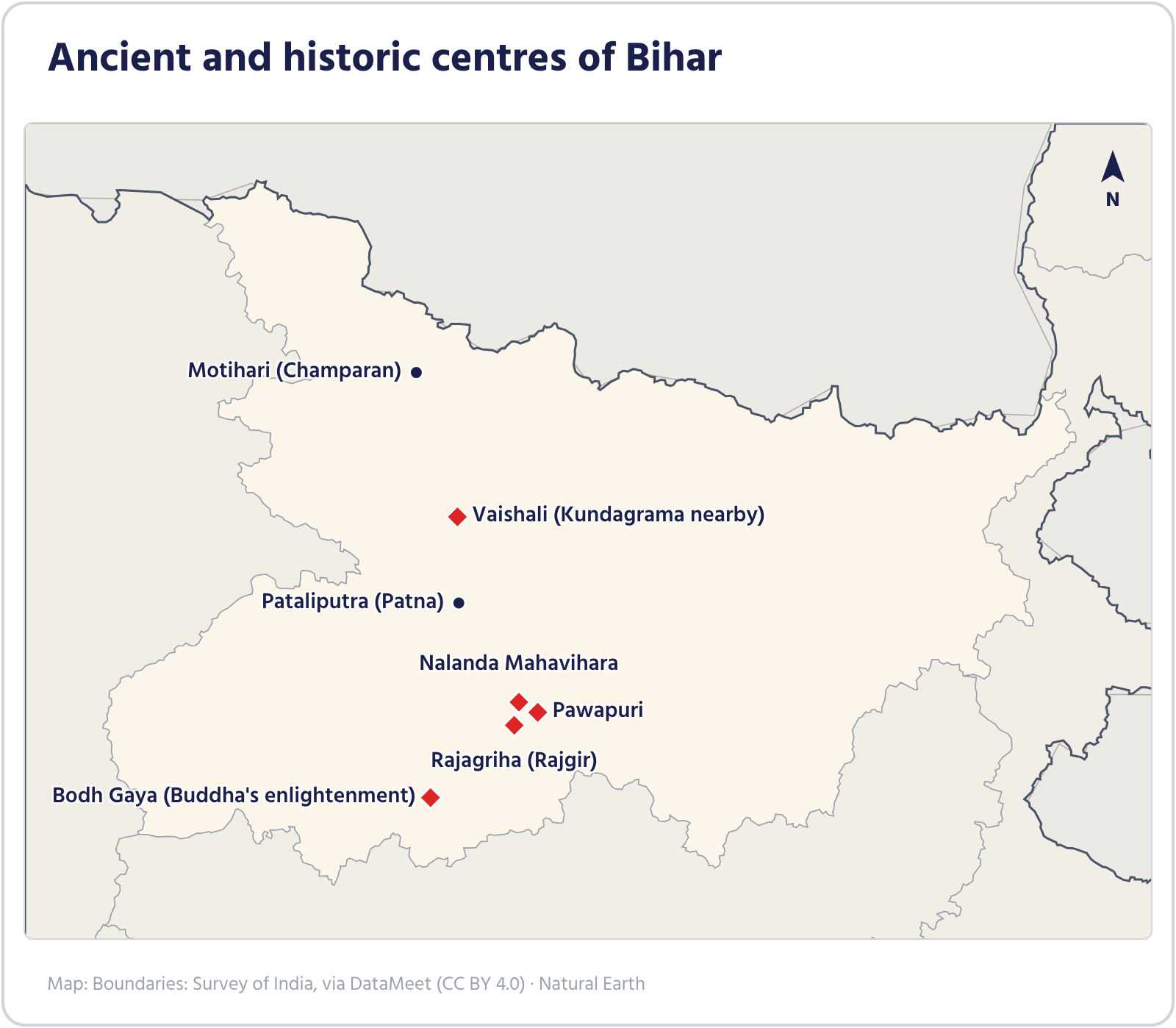
Mahavira was born at Kundagrama near Vaishali. He attained nirvana at Pava (Pawapuri), which is why Pava looks familiar. Lumbini is the Buddha's birthplace, and Rajagriha was the first capital of Magadha.
- Mahavira's birth: Kundagrama (near Vaishali)
- His nirvana: Pawapuri
- His original name was Vardhamana
- Pava is where Mahavira died, not where he was born; Lumbini is the Buddha's birthplace
- Mahavira: begins at Kundagrama, ends at Pava
From which ruler's time is the Gupta Era (319–320 CE) counted?
The Gupta Era is counted from the accession of Chandragupta I in 319–320 CE. He took the title 'Maharajadhiraja' and married the Lichchhavi princess Kumaradevi. Sri Gupta founded the dynasty and Ghatotkacha was his son; Samudragupta was the son of Chandragupta I.
- Gupta Era: 319–320 CE, Chandragupta I
- Founder of the dynasty: Sri Gupta
- Chandragupta I's queen: the Lichchhavi Kumaradevi
- The dynasty's founder (Sri Gupta) is not the ruler who started the era (Chandragupta I)
- Line: Sri Gupta → Ghatotkacha → Chandragupta I → Samudragupta
Under whose patronage was the Fourth Buddhist Council held?
The Fourth Buddhist Council met in Kashmir under the Kushana emperor Kanishka, presided over by Vasumitra. After it Buddhism split into the Hinayana and Mahayana schools. Ajatashatru was patron of the first council and Ashoka of the third; Harshavardhana held an assembly at Kannauj, but it is not one of the four Buddhist councils.
- Fourth council: Kashmir, Kanishka, president Vasumitra
- Followed by the Hinayana-Mahayana split
- Kanishka was a Kushana emperor
- Kings in council order: Ajatashatru → Kalashoka → Ashoka → Kanishka
| Council | Place | Patron | President |
|---|---|---|---|
| First | Rajagriha | Ajatashatru | Mahakassapa |
| Second | Vaishali | Kalashoka | Sabakami |
| Third | Pataliputra | Ashoka | Moggaliputta Tissa |
| Fourth | Kashmir | Kanishka | Vasumitra |
Under which Gupta emperor was Nalanda Mahavihara founded?
Nalanda Mahavihara was founded in the 5th century under the Gupta emperor Kumaragupta I. Later Harshavardhana and the Pala kings endowed it, and Hiuen Tsang studied there. The Pala king Dharmapala founded Vikramashila, not Nalanda.
- Nalanda: Kumaragupta I, 5th century
- Vikramashila: the Pala king Dharmapala
- Hiuen Tsang studied at Nalanda
- Dharmapala founded Vikramashila, not Nalanda
- Kumaragupta → Nalanda; Dharmapala → Vikramashila
Who won the Second Battle of Tarain in 1192?
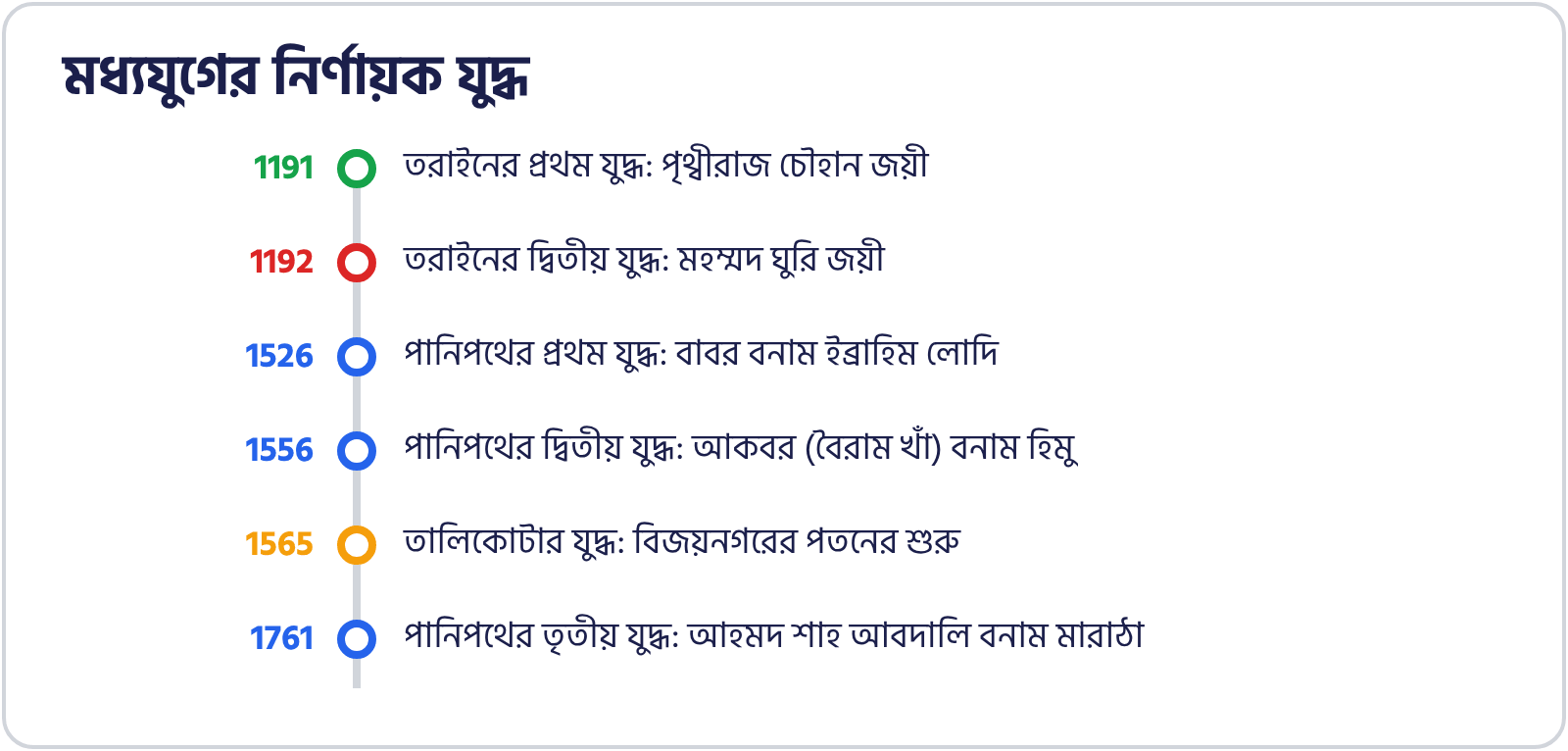
In the Second Battle of Tarain (1192) Muhammad Ghori defeated Prithviraj Chauhan, opening north India to Turkish rule. A year earlier, in the first battle (1191), Prithviraj had won. Qutb-ud-din Aibak was Ghori's general and later the first Sultan of Delhi.
- First Battle of Tarain (1191): Prithviraj won
- Second Battle of Tarain (1192): Muhammad Ghori won
- Tarain is in present-day Haryana
- The two battles had opposite results: 1191 Prithviraj, 1192 Ghori
- Prithviraj the first time, Ghori the second
Which Sultan introduced market control (price regulation)?
To maintain a huge army on low pay, Alauddin Khalji fixed the prices of grain, cloth, horses and other goods. Officials called Shahna-i-Mandi supervised the markets. Muhammad bin Tughlaq is known for his token copper currency and the shift of the capital.
- Market reforms: Alauddin Khalji
- Market superintendent: Shahna-i-Mandi
- The dagh (branding of horses) was also Alauddin's
- Alauddin = army and markets; Muhammad bin Tughlaq = token coins and capital
Who founded the Vijayanagara Empire in 1336?
The brothers Harihara and Bukka of the Sangama dynasty founded the Vijayanagara Empire in 1336 on the Tungabhadra; the ruins of its capital are today's Hampi. Krishnadeva Raya (Tuluva dynasty) was its most famous king, not its founder. Rajendra Chola and Pulakeshin belong to other dynasties.
- Founded 1336 by Harihara and Bukka (Sangama dynasty)
- Capital Vijayanagara, today's Hampi (Karnataka)
- Most famous king: Krishnadeva Raya
- The most famous king (Krishnadeva Raya) is not the founder
The decline of which empire began after the Battle of Talikota in 1565?
At Talikota in 1565 an alliance of the Deccan Sultanates (Bijapur, Ahmadnagar, Golconda, Bidar) defeated Vijayanagara; its capital was sacked and the empire began to decline. These sultanates had grown out of the Bahmani kingdom, so the Bahmanis were forerunners of the winners, not the losers. The Maratha power rose later, in the 17th century.
- Battle of Talikota (Rakshasa-Tangadi): 1565
- Deccan Sultanates' alliance vs Vijayanagara
- Vijayanagara's side was led by Rama Raya
- 1565: Vijayanagara falls, about 230 years after 1336
Whom did Akbar's army defeat in the Second Battle of Panipat in 1556?
In the Second Battle of Panipat (1556) the Mughal army, led by Bairam Khan for the young Akbar, defeated Hemu (Hemachandra Vikramaditya). Ibrahim Lodi lost the first battle (1526) to Babur, and Rana Sangram Singh (Rana Sanga) lost at Khanwa (1527). Sher Shah had died in 1545.
- Second Battle of Panipat: 1556, Akbar vs Hemu
- Mughal commander: Bairam Khan
- Hemu was Adil Shah Suri's general
- Panipat 1-2-3: Lodi (1526), Hemu (1556), Marathas (1761)
Which Mughal emperor built the Buland Darwaza at Fatehpur Sikri?
Akbar built the Buland Darwaza at Fatehpur Sikri to commemorate his conquest of Gujarat (1573). Fatehpur Sikri itself was the capital Akbar built. Shah Jahan's name goes with the Taj Mahal and Delhi's Red Fort and Jama Masjid.
- Buland Darwaza: Akbar, for the conquest of Gujarat
- Fatehpur Sikri: Akbar's capital
- Shah Jahan: Taj Mahal, Delhi's Red Fort
- Everything at Sikri is Akbar's
Who defeated the Marathas in the Third Battle of Panipat in 1761?
In the Third Battle of Panipat (1761) the Afghan ruler Ahmad Shah Abdali (Durrani) defeated the Maratha army led by Sadashivrao Bhau. Nadir Shah was the Persian ruler who invaded Delhi in 1739 and took away the Peacock Throne. Aurangzeb had died in 1707.
- Third Battle of Panipat: 1761
- Ahmad Shah Abdali vs the Marathas (Sadashivrao Bhau)
- Nadir Shah's invasion of Delhi: 1739
- Two invaders from the north-west: Nadir Shah (Persia, 1739) and Abdali (Afghan, 1761)
Who founded the Asiatic Society in Calcutta in 1784?
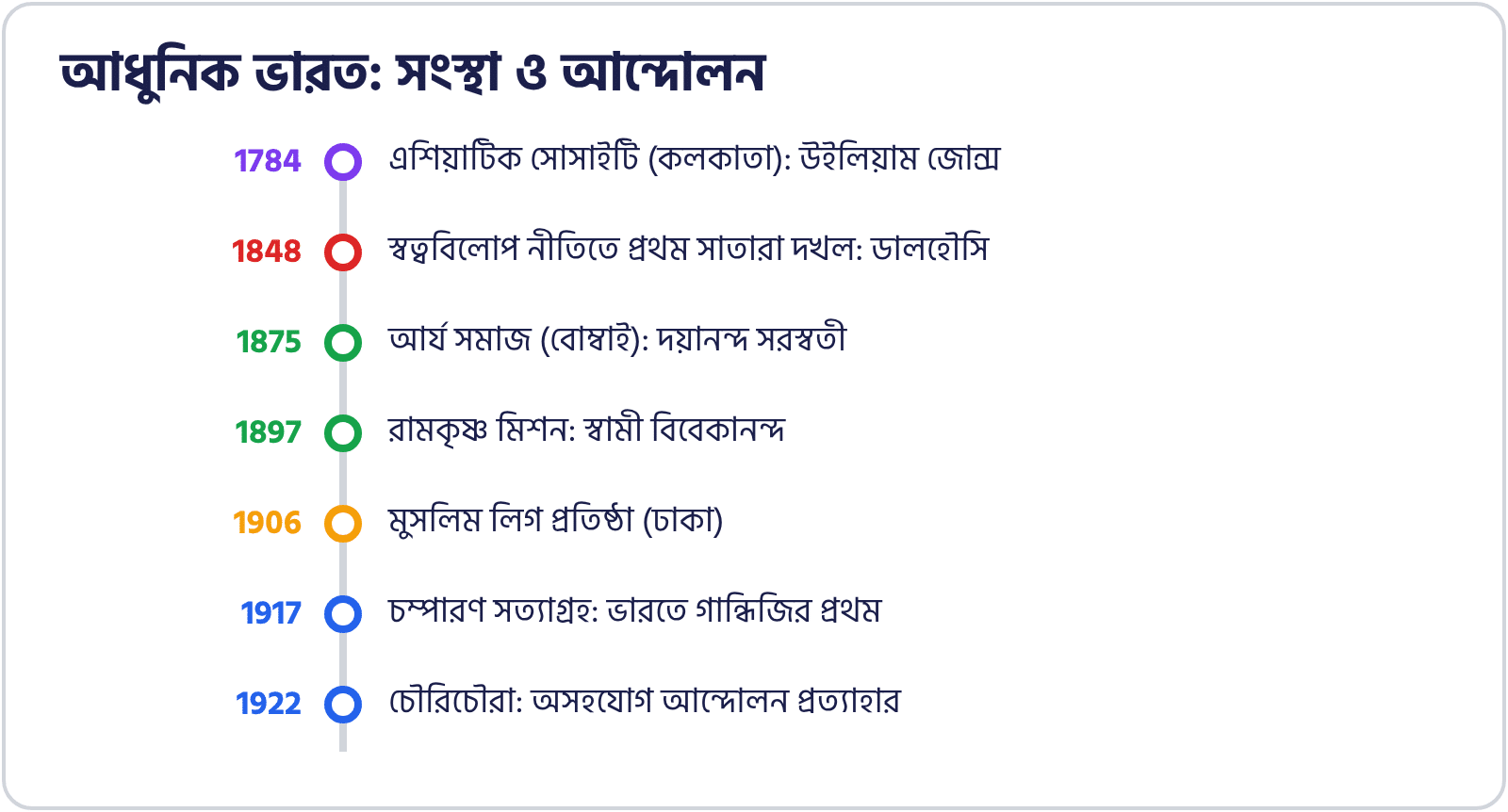
Sir William Jones founded the Asiatic Society in Calcutta in 1784; the Governor-General, Warren Hastings, was its patron, not its founder. James Prinsep, later its secretary, deciphered the Brahmi script. Alexander Cunningham was the first head of the Archaeological Survey of India.
- Asiatic Society: 1784, Calcutta, William Jones
- James Prinsep: deciphered Brahmi
- Cunningham: father of the ASI
- Hastings was the patron, Jones the founder
Which Governor-General annexed princely states under the 'Doctrine of Lapse'?
Under Lord Dalhousie's Doctrine of Lapse, an adopted son of a ruler without a natural heir was not accepted as successor, and the state passed to the Company. Satara (1848), Jhansi, Nagpur and others were annexed this way. Wellesley brought the Subsidiary Alliance, Cornwallis the Permanent Settlement, Bentinck the ban on sati.
- Doctrine of Lapse: Lord Dalhousie
- First annexation: Satara (1848)
- Jhansi and Nagpur were also annexed under it
- Both policies took over princely states: the Subsidiary Alliance was Wellesley's, the Doctrine of Lapse Dalhousie's
- Wellesley = Subsidiary Alliance; Dalhousie = Doctrine of Lapse
Who founded the Arya Samaj in 1875?
Swami Dayananda Saraswati founded the Arya Samaj in Bombay in 1875; his call was 'Go back to the Vedas' and his main book the 'Satyarth Prakash'. Rammohan Roy founded the Brahmo Sabha (1828) and Keshab Chandra Sen led the Brahmo movement. Vivekananda founded the Ramakrishna Mission.
- Arya Samaj: 1875, Bombay, Dayananda Saraswati
- Slogan: 'Go back to the Vedas'
- Book: Satyarth Prakash
- Arya = Vedas = Dayananda
Who founded the Ramakrishna Mission (1897)?
After Sri Ramakrishna's death (1886), his disciple Swami Vivekananda founded the Ramakrishna Mission in 1897, named after his guru. Its headquarters is Belur Math in Howrah. Taking Sri Ramakrishna for the founder because of the name is a common mistake.
- Ramakrishna Mission: 1897, Swami Vivekananda
- Headquarters: Belur Math (Howrah)
- 1893: Vivekananda's speech at the Chicago Parliament of Religions
- The mission bears the guru's name, but the disciple founded it
Where was the All-India Muslim League founded in 1906?
The All-India Muslim League was founded at Dhaka in December 1906, a year after the Partition of Bengal (1905). Lucknow comes to mind because of the Lucknow Pact of 1916, when the Congress and the League made joint demands. At Lahore in 1940 the League passed the Pakistan Resolution.
- Muslim League: 1906, Dhaka
- Lucknow Pact (Congress-League): 1916
- Lahore (Pakistan) Resolution: 1940
- 1905 Partition of Bengal, 1906 League at Dhaka
| Year | Place | Event |
|---|---|---|
| 1906 | Dhaka | Muslim League founded |
| 1916 | Lucknow | Lucknow Pact |
| 1940 | Lahore | Pakistan Resolution |
Which was Gandhiji's first satyagraha in India?
Back from South Africa, Gandhiji led his first satyagraha in India in 1917 at Champaran in Bihar, against the forced indigo cultivation (the tinkathia system). The Ahmedabad mill strike and the Kheda Satyagraha in Gujarat followed in 1918. The Bardoli Satyagraha (1928) was led by Vallabhbhai Patel.
- Champaran (Bihar), 1917: for the indigo farmers
- Ahmedabad mill strike and Kheda: 1918
- Bardoli (1928): Vallabhbhai Patel, given the title 'Sardar'
- Order: Champaran (1917) → Ahmedabad and Kheda (1918)
After the Chauri Chaura incident of 1922, which movement did Gandhiji call off?
In February 1922 an angry crowd at Chauri Chaura in Gorakhpur district (Uttar Pradesh) set a police station on fire and policemen were killed. Because of the violence Gandhiji called off the Non-Cooperation Movement (1920–22). Civil Disobedience began in 1930, Quit India in 1942, and the Swadeshi Movement belongs to the Partition of Bengal (1905).
- Chauri Chaura: Gorakhpur (UP), February 1922
- Non-Cooperation Movement: 1920–22
- Civil Disobedience: 1930; Quit India: 1942
- Non-Cooperation (1920) → Civil Disobedience (1930) → Quit India (1942): about ten years apart
📊 Topic Analysis
20 Indian history questions for WBPSC Clerkship 2024, with explanations.


Leave a Comment
Commenting as ·