
Sentence Improvement Practice Quiz: WBPSC Clerkship 2024 English
A little practice. A step forward.
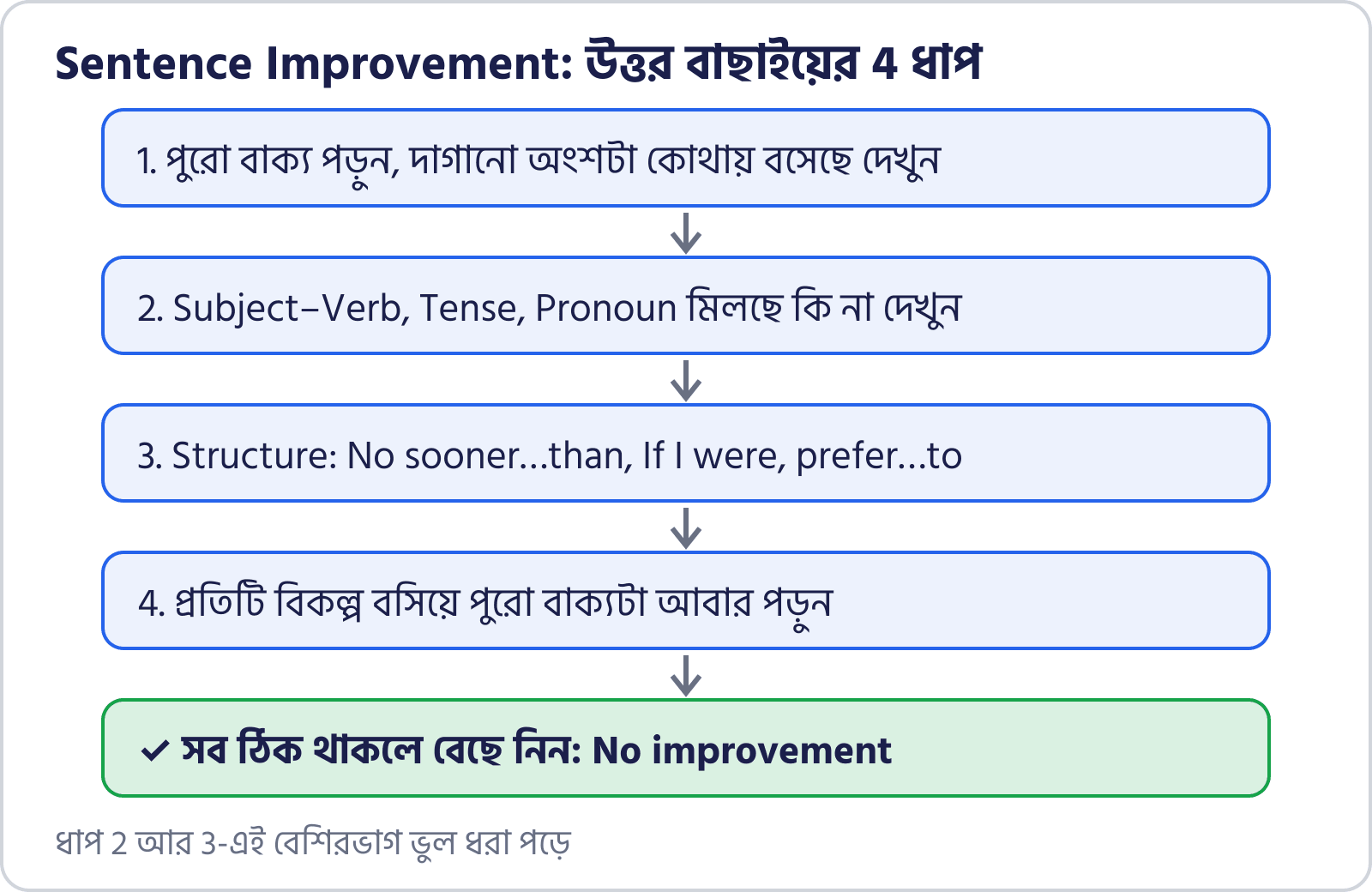
12 Sentence Improvement questions for the English section of WBPSC Clerkship 2024 Part-I. Choose the correct replacement for the quoted part of each sentence, or No improvement if it is already correct. 📖 Read the detailed topic
Choose the correct replacement for the quoted part: No sooner had the train left the station 'when' it began to rain.
No sooner is always paired with than, because sooner is a comparative. When goes with Hardly and Scarcely. Then is an adverb and cannot join two clauses, and that makes no sense here.
- No sooner … than
- Hardly / Scarcely … when (or before)
- Inverted order at the start: No sooner had + subject + V3
- No sooner with when, and Hardly with than: the usual swap examiners set
- Sooner is a comparison, so than; the other two are about time, so when
| Opening | Pair | Example |
|---|---|---|
| No sooner | than | No sooner had he come than it rained. |
| Hardly | when | Hardly had I reached when the bus left. |
| Scarcely | when | Scarcely had the bell rung when they ran out. |
Choose the correct replacement for the quoted part: If I 'was' a bird, I would fly to you.
This is an imaginary, unreal condition (I am not a bird), and such sentences take were with every subject, I included. Am states a real present, which does not fit would fly. Had been is an unreal past, which would need I would have flown.
- If I were … , I would + V1 (unreal present)
- If I had been … , I would have + V3 (unreal past)
- I wish I were … also takes were
- Imagination takes were, for everyone
Choose the correct replacement for the quoted part: It is high time we 'start' working for the examination.
After It is high time, the verb is in the past tense even though the meaning is present: it should have begun already. So started. Will start and have started do not fit this pattern, and start (present) is wrong, so it is not No improvement either.
- It is high time + subject + past tense
- Or It is high time + to + V1: It is high time to start
- Present meaning, past form
- The form is past but the action is now: many keep start because the meaning is present
- High time means it is already late, so the verb is in the past
Choose the correct replacement for the quoted part: Sourav is one of the best 'player' in the team.
One of the is always followed by a plural noun, since it means one among many. So players. Player's is a possessive, and playing is a verb form: neither works as the noun here.
- one of the + plural noun
- The verb stays singular: One of the players is injured
- each of and either of also take a plural noun and a singular verb
- One among many: the noun is many (plural), the verb is one (singular)
Choose the correct replacement for the quoted part: She 'has been living' in Kolkata since 2015.
Since 2015 shows an action that began in the past and is still going on, which takes the present perfect continuous. So has been living is correct. Is living, lives and was living cannot be used with since.
- since + a point of time (2015, Monday, morning)
- for + a length of time (5 years, two hours)
- Both take the present perfect or present perfect continuous
- See since or for, look for has/have been
Choose the correct replacement for the quoted part: Most children prefer sweets 'than' vegetables.
Prefer takes to, not than, when two things are compared: prefer A to B. The same goes for senior, junior, superior and inferior, which come from Latin. For and from do not make this comparison.
- prefer A to B
- senior to, junior to, superior to, inferior to
- But would rather A than B
- Prefer takes to but would rather takes than: the meaning is the same, so they get mixed up
- The -ior words and prefer belong to the to group
Choose the correct replacement for the quoted part: Unless you 'do not work' hard, you will not pass.
Unless already means if not, so adding not makes a double negative and turns the meaning upside down. The right form is Unless you work hard. Will does not go in the condition clause, and did not work has the wrong tense.
- Unless = if not
- No not in the unless clause
- Present in the condition, will in the result
- Unless already has the not inside it
Choose the correct replacement for the quoted part: I asked the stranger where 'did he live'.
This is an indirect question, so the question order (did he live) goes: the subject comes first, then the verb, and did is dropped. The reporting verb asked is in the past, so lived. Does he live keeps the question order, and lived he inverts it.
- Indirect question: wh-word + subject + verb
- do, does and did are dropped
- No question mark at the end
- An indirect question is no longer a question: use statement order
Choose the correct replacement for the quoted part: My sister likes reading, writing and 'to swim'.
Every item in a list must take the same form (parallelism). Reading and writing are both -ing forms, so the third is swimming too. Swim and to swimming break the pattern, and to swimming is ungrammatical as well.
- Items joined by and or in a list take the same form
- -ing, -ing, -ing or to V1, V1, V1
- Both sides of not only … but also match too
- Everyone in a list wears the same uniform
Choose the correct replacement for the quoted part: Hardly had I reached the platform 'than' the train left.
Hardly pairs with when (or before), not than; than goes only with No sooner. Then is an adverb and cannot join two clauses, and as does not fit this pattern.
- Hardly / Scarcely … when
- No sooner … than
- Inverted order after Hardly: Hardly had I …
- H and S are time words: when
| Opening | Pair | Example |
|---|---|---|
| No sooner | than | No sooner had he come than it rained. |
| Hardly | when | Hardly had I reached when the bus left. |
| Scarcely | when | Scarcely had the bell rung when they ran out. |
Choose the correct replacement for the quoted part: Neither the teacher nor the students 'were' present in the hall.
With Neither…nor and Either…or the verb agrees with the nearer subject. Here the subject next to the verb is students, plural, so were is correct. Picking was because of teacher is the trap; is and has been also change the tense.
- Neither … nor, Either … or: the verb agrees with the nearer subject
- Putting the plural subject last also reads better
- Both … and always takes a plural verb
- Choosing a singular verb because the first subject is singular: the rule follows the nearer subject
- With Neither/Either the verb listens to its next-door neighbour
Choose the correct replacement for the quoted part: 'It being a holiday', all the offices were closed.
It being a holiday is an absolute phrase with its own subject (It), so it is correct. Being a holiday would leave the phrase dangling, as if the offices were the holiday. As being is ungrammatical, and Having been changes the meaning.
- The doer of an opening -ing phrase must be the subject of the main clause
- Otherwise give the phrase its own subject: It being, The sun having set
- Or write a clause: As it was a holiday
- Dropping It because it looks extra: without It the phrase dangles
- When a sentence opens with -ing, ask: who is doing it?
📊 Topic Analysis
12 Sentence Improvement questions for the English section of WBPSC Clerkship 2024 Part-I. Choose the correct replacement for the quoted part of each sentence, or No improvement if it is already correct.


Leave a Comment
Commenting as ·