
Food Nutrients and Vitamins Quiz: Clerkship GS Practice
A little practice. A step forward.
10 questions on vitamin deficiency diseases, chemical names, minerals and the energy of food components, at the level of WBPSC Clerkship 2024 Part-I. 📖 Read the detailed topic
Deficiency of vitamin A causes which disease?
Vitamin A (retinol) is needed for the light-sensitive pigment of the retina, so its lack makes it hard to see in dim light: night blindness. A severe lack dries the cornea (xerophthalmia). Beriberi comes from a lack of B1, scurvy from C and rickets from D.
- The chemical name of vitamin A is retinol
- Sources: carrot, ripe papaya, liver, cod liver oil
- Vitamin A is fat-soluble
- A = seeing in the dArk
| Vitamin | Chemical name | Deficiency |
|---|---|---|
| A | Retinol | Night blindness |
| D | Calciferol | Rickets |
| K | Phylloquinone | Blood does not clot easily |
| B1 | Thiamine | Beriberi |
| B12 | Cyanocobalamin | Pernicious anaemia |
| C | Ascorbic acid | Scurvy |
Which of the following vitamins is water-soluble?
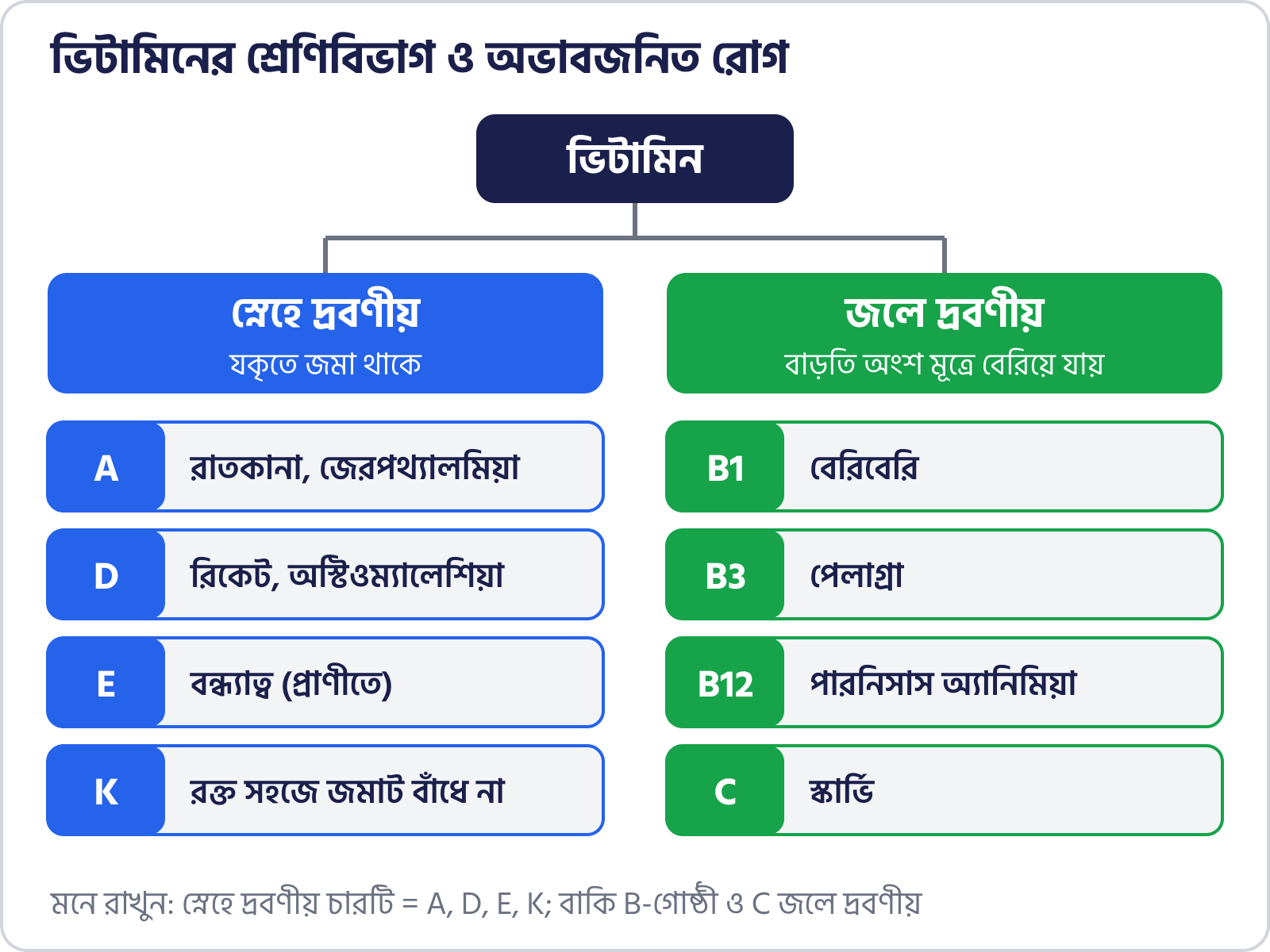
Vitamin C and the B-group vitamins are water-soluble; their excess leaves the body in urine. A, D, E and K are fat-soluble and are stored in the liver.
- Fat-soluble: A, D, E, K
- Water-soluble: B group and C
- Water-soluble vitamins are needed from food every day
- Remember 'ADEK': these four are fat-soluble
Scurvy is caused by a deficiency of which vitamin?
Scurvy is caused by a lack of vitamin C (ascorbic acid): the gums swell and bleed and wounds heal slowly. Amla, lemon, guava and orange are good sources. A lack of vitamin K also causes bleeding, but because the blood does not clot, not scurvy.
- The chemical name of vitamin C is ascorbic acid
- Vitamin C is easily destroyed by heat
- Vitamin C is water-soluble
- Bleeding gums = scurvy (C); blood not clotting = vitamin K
- C = Citrus fruits
| Vitamin | Chemical name | Deficiency |
|---|---|---|
| A | Retinol | Night blindness |
| D | Calciferol | Rickets |
| K | Phylloquinone | Blood does not clot easily |
| B1 | Thiamine | Beriberi |
| B12 | Cyanocobalamin | Pernicious anaemia |
| C | Ascorbic acid | Scurvy |
Rickets in children is caused by a deficiency of which vitamin?
Vitamin D (calciferol) helps the intestine absorb calcium; without it a child's bones become soft and bend: rickets. The same lack in adults causes osteomalacia. Vitamin D is made in the skin in sunlight.
- The chemical name of vitamin D is calciferol
- It is called the 'sunshine vitamin'
- Rickets in children, osteomalacia in adults
- Rickets (children) and osteomalacia (adults) both come from a lack of vitamin D
- D for bones: without it they bend
| Vitamin | Chemical name | Deficiency |
|---|---|---|
| A | Retinol | Night blindness |
| D | Calciferol | Rickets |
| K | Phylloquinone | Blood does not clot easily |
| B1 | Thiamine | Beriberi |
| B12 | Cyanocobalamin | Pernicious anaemia |
| C | Ascorbic acid | Scurvy |
Which vitamin helps the blood to clot?
Vitamin K (phylloquinone) is needed in the liver to make the clotting proteins, so without it a cut keeps bleeding. Green leafy vegetables are its source, and bacteria in the gut also make it. Vitamin E is called the anti-sterility vitamin.
- Vitamin K is fat-soluble
- Gut bacteria make vitamin K
- Calcium is also needed for clotting
- K = Koagulation (the German word for clotting)
Beriberi is caused by a deficiency of which vitamin?
Beriberi is caused by a lack of vitamin B1, thiamine; nerves and muscles weaken and the legs swell. Eating mostly machine-polished rice gives little thiamine. A lack of B2 cracks the corners of the lips, B3 causes pellagra and B12 pernicious anaemia.
- B1 = thiamine, lack causes beriberi
- B3 = niacin, lack causes pellagra
- Hand-pounded rice and pulses are sources of thiamine
- B1 = Beriberi: both start with B
| Vitamin | Chemical name | Deficiency |
|---|---|---|
| B1 | Thiamine | Beriberi |
| B2 | Riboflavin | Cracks at the corners of the lips |
| B3 | Niacin | Pellagra |
| B12 | Cyanocobalamin | Pernicious anaemia |
Which vitamin contains the metal cobalt?
The chemical name of vitamin B12 is cyanocobalamin; the 'cobal' in the name tells you it contains cobalt. Its lack causes pernicious anaemia, a kind of anaemia. B12 comes mainly from animal foods (meat, eggs, milk).
- B12 = cyanocobalamin
- Lack causes pernicious anaemia
- Found mainly in animal foods
- Haemoglobin contains iron; vitamin B12 contains cobalt
- cobalamin = cobalt
About how much energy does 1 gram of fat give the body?
One gram of fat gives about 9 kcal (9.3 kcal), the most of all food components. Carbohydrate and protein give about 4 kcal (4.1 kcal) per gram. So 4 kcal is the answer for carbohydrate or protein, not fat.
- Fat: about 9 kcal per gram
- Carbohydrate and protein: about 4 kcal per gram
- Vitamins, minerals and water give no energy
- 4-4-9: carbohydrate, protein, fat
Energy per gram
A lack of which mineral in the diet causes goitre?
The thyroid gland uses iodine to make the hormone thyroxine; without iodine the gland swells: goitre. That is why iodine is added to table salt. A lack of iron causes anaemia, a lack of calcium weak bones.
- Iodine is needed to make thyroxine
- Iodised salt prevents goitre
- Iron is needed to make haemoglobin
| Mineral | Deficiency |
|---|---|
| Iron | Anaemia |
| Iodine | Goitre |
| Calcium | Weak bones |
A lack of protein alone in a child's diet causes which disease?
A lack of protein alone causes kwashiorkor in children: the belly, hands and feet swell and the hair changes colour. A lack of both protein and total energy causes marasmus. Rickets comes from a lack of vitamin D, pellagra of B3 and goitre of iodine.
- Kwashiorkor: lack of protein only
- Marasmus: lack of both protein and energy
- Protein builds and repairs the body
- In kwashiorkor the body swells; in marasmus the child becomes very thin
📊 Topic Analysis
10 questions on vitamin deficiency diseases, chemical names, minerals and the energy of food components, at the level of WBPSC Clerkship 2024 Part-I.



Leave a Comment
Commenting as ·