
Arithmetic Quick Practice Quiz (Part 4): 20 Questions, WBPSC Clerkship 2024
A little practice. A step forward.
20 mixed arithmetic questions for WBPSC Clerkship 2024 Part-I, 30 seconds each, with explanations and shortcuts.
Which of the following numbers is divisible by 8?
A number is divisible by 8 when the number formed by its last three digits is divisible by 8. For 5,736 the last three digits give 736 = 8 × 92, so it is the answer. None of 124, 348 and 614 is divisible by 8.
- For 4 check the last two digits, for 8 the last three
- 736 ÷ 8 = 92, remainder 0
- 3,124 and 2,348 are divisible by 4 (last two digits 24, 48) but not by 8: the rule for 4 does not settle 8
- 2 → last 1 digit, 4 → last 2 digits, 8 → last 3 digits
| Number | Last three digits | Divided by 8 |
|---|---|---|
| 3,124 | 124 | 15 × 8 = 120, remainder 4 |
| 5,736 | 736 | 92 × 8 = 736, remainder 0 |
| 2,348 | 348 | 43 × 8 = 344, remainder 4 |
| 7,614 | 614 | 76 × 8 = 608, remainder 6 |
The product of two numbers is 2160 and their HCF is 12. What is their LCM?
For two numbers, product = HCF × LCM. So LCM = 2160 ÷ 12 = 180. The rule holds only for two numbers.
- Product = HCF × LCM (for two numbers)
- The LCM is always a multiple of the HCF: 180 = 12 × 15
- For three numbers, product = HCF × LCM does not hold in general
- Check the answer: the LCM must be divisible by the HCF; 160 and 200 are not even divisible by 12
Three bells ring at intervals of 6, 8 and 12 minutes. If they ring together at 10:00 a.m., when will they next ring together?
They ring together again after the LCM of 6, 8 and 12 minutes. 6 = 2 × 3, 8 = $2^{3}$, 12 = $2^{2}$ × 3, so the LCM = $2^{3}$ × 3 = 24. That is 24 minutes after 10:00, at 10:24. They also meet after 48 or 72 minutes, but those are not the next time.
- 'Together again' means the LCM
- LCM: take the highest power of each prime factor
- Cutting into equal largest pieces → HCF; together again / smallest number → LCM
| Bell | Rings after 10:00 (minutes) |
|---|---|
| Every 6 minutes | 6, 12, 18, 24, 30… |
| Every 8 minutes | 8, 16, 24, 32… |
| Every 12 minutes | 12, 24, 36… |
What is the largest number that divides 245 and 1029 leaving a remainder of 5 in each case?
Remove the remainder: 240 and 1024 must be exactly divisible by the number. 240 = $2^{4}$ × 15 and 1024 = $2^{10}$, so their HCF = $2^{4}$ = 16. Check: 245 = 16 × 15 + 5, 1029 = 16 × 64 + 5. 8 also works but is not the largest; 32 does not divide 240.
- Same remainder: subtract it first, then take the HCF
- The divisor must be larger than the remainder (16 > 5)
- Taking the HCF of 245 and 1029 directly, without removing the remainder, gives a wrong answer
- Different remainders: subtract each number's own remainder
Express the mixed recurring decimal $0.1\overline{6}$ as a vulgar fraction.
Rule for a mixed recurring decimal: (all digits after the point − the non-recurring part) ÷ (as many 9s as recurring digits followed by as many 0s as non-recurring digits). So $0.1\overline{6} = \frac{16 - 1}{90} = \frac{15}{90} = \frac{1}{6}$. $\frac{16}{99}$ is $0.\overline{16}$, and $\frac{8}{45}$ comes from forgetting to subtract 1 ($\frac{16}{90}$).
- A 9 for each recurring digit, a 0 for each non-recurring digit
- Check: 1 ÷ 6 = 0.1666…
- $0.\overline{16}$ (both digits recur) and $0.1\overline{6}$ (only 6 recurs) are different numbers
- Do not forget to subtract the non-recurring part in the numerator
$$0.1\overline{6} = \frac{16 - 1}{90} = \frac{15}{90} = \frac{1}{6}$$
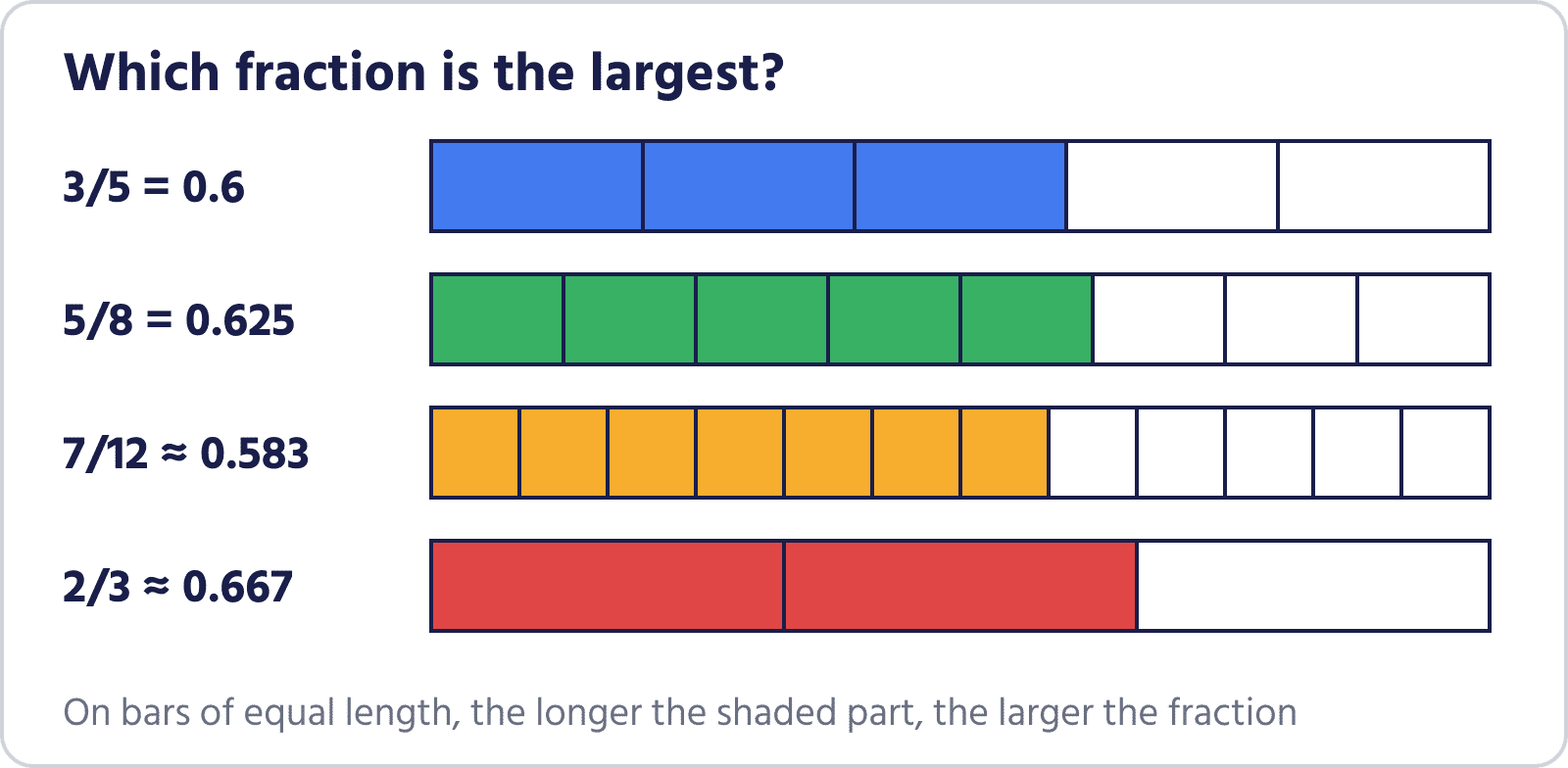
Which of the following fractions is the largest?
Bring all to the common denominator 120 (the LCM of 5, 8, 12 and 3): $\frac{72}{120}$, $\frac{75}{120}$, $\frac{70}{120}$ and $\frac{80}{120}$. The largest numerator is 80, so $\frac{2}{3}$ is the largest. As decimals: 0.6, 0.625, 0.583…, 0.667…
- Use a common denominator and compare numerators, or convert to decimals
- The smallest here is $\frac{7}{12}$
- A larger denominator does not make a larger fraction: $\frac{7}{12}$ has the largest denominator yet is the smallest
- Quick compare of two fractions by cross-multiplying: $\frac{5}{8}$ vs $\frac{2}{3}$: 5 × 3 = 15 and 8 × 2 = 16, so $\frac{2}{3}$ is larger
What is the value of $\frac{1}{2} \div \frac{1}{4} \times \frac{1}{2}$?
Under BODMAS, division and multiplication have equal priority and are done left to right. First $\frac{1}{2} \div \frac{1}{4} = \frac{1}{2} \times 4 = 2$, then $2 \times \frac{1}{2} = 1$. Multiplying first ($\frac{1}{4} \times \frac{1}{2} = \frac{1}{8}$) gives the wrong answer 4.
- Division and multiplication: whichever comes first, left to right
- Dividing by a fraction = multiplying by its reciprocal
- Multiplying first gives 4: division and multiplication rank equal, so whichever comes first from the left is done first
What is the value of 2.5 × 0.04 ÷ 0.2?
Left to right: 2.5 × 0.04 = 0.1 (25 × 4 = 100 with 3 decimal places in all, so 0.100). Then 0.1 ÷ 0.2 = 1 ÷ 2 = 0.5. Miscounting the decimal places gives 0.05 or 5.
- Decimal places in a product = the sum of the decimal places of the factors
- To divide by a decimal, multiply both numbers by 10, 100… until the divisor is whole
- 0.1 ÷ 0.2: multiply both by 10 to get 1 ÷ 2
What single discount is equal to successive discounts of 20% and 10%?
Take ₹100: a 20% discount makes it ₹80, and 10% off that removes ₹8, leaving ₹72. The total discount is ₹28, i.e. 28%. The second discount is on the reduced price, so it is not 20 + 10 = 30%.
- Successive discounts: a + b − $\frac{ab}{100}$ = 20 + 10 − 2 = 28%
- The second discount applies to the price after the first
- Successive discounts do not add: 20% and 10% make 28%, not 30%
- Taking ₹100 makes percentage sums quick
The length of a rectangle is increased by 20% and its breadth decreased by 20%. What happens to its area?
Take length and breadth 10 each: area 100. New length 12, new breadth 8, new area 96. So the area decreases by 4%. By the formula: 20 − 20 − $\frac{20 \times 20}{100}$ = −4%.
- New area = 1.2 × 0.8 = 0.96 times
- Net effect of two changes: x + y + $\frac{xy}{100}$%, with a rise positive and a fall negative
- A 20% rise and a 20% fall do not cancel: the fall acts on the larger figure
- Up x% and down x% (in either order) always means a fall of $\frac{x^{2}}{100}$%
A's income is 25% more than B's. By what percentage is B's income less than A's?
Take B's income as ₹100; A's is ₹125. The difference is ₹25, but now it is compared with A's income: $\frac{25}{125} \times 100 = 20\%$. The base of the comparison is the denominator, so the answer is not 25%.
- Formula: $\frac{r}{100 + r} \times 100$%, here $\frac{25}{125} \times 100 = 20\%$
- 'Less than whom' tells you the denominator
- A being 25% more than B does not mean B is 25% less than A
- 25% more ↔ 20% less, 50% more ↔ 33.33% less: remember the pairs
If A : B = 2 : 3 and B : C = 4 : 5, what is A : B : C?
B must have the same value in both ratios. B is 3 and 4; their LCM is 12. A : B = 2 : 3 = 8 : 12 and B : C = 4 : 5 = 12 : 15. So A : B : C = 8 : 12 : 15. Joining them without matching B gives wrong answers like 2 : 3 : 5.
- Make the common term (here B) equal in both ratios
- Quick rule: A : B : C = (2 × 4) : (3 × 4) : (3 × 5)
- Cross-multiply: scale the first ratio by the second's B (4) and the second by the first's B (3)
The average age of 30 students in a class is 14 years. When the teacher's age is included, the average becomes 15 years. What is the teacher's age?
Total age of the 30 students = 30 × 14 = 420 years. Total with the teacher, 31 people = 31 × 15 = 465 years. Teacher's age = 465 − 420 = 45 years.
- Average × count = total
- New member's value = new average + (old count × rise in average)
- The shortcut adds the new average (15), not the old one (14): 14 + 30 = 44 is wrong
- Shortcut: 15 + 30 × 1 = 45 (new average + old count × rise)
In how many years will ₹2,500 amount to ₹3,400 at 6% simple interest per year?
Interest = 3,400 − 2,500 = ₹900. One year's interest = 2,500 × $\frac{6}{100}$ = ₹150. Time = 900 ÷ 150 = 6 years. By formula: t = $\frac{100 \times I}{P \times r} = \frac{100 \times 900}{2500 \times 6} = 6$.
- Amount − principal = interest
- t = $\frac{100 \times I}{P \times r}$
- Put the interest (₹900) for I in the formula, not the amount (₹3,400)
- Find one year's interest first, then divide the total interest by it
The simple interest on a sum for 5 years is $\frac{2}{5}$ of the sum. What is the rate of interest per year?
Take the sum as ₹100: the interest for 5 years is ₹40, i.e. ₹8 a year. So the rate is 8%. By formula: r × 5 ÷ 100 = $\frac{2}{5}$, so r = 8.
- With a principal of ₹100 the interest reads directly as a percentage
- r = $\frac{100 \times I}{P \times t}$
- $\frac{2}{5}$ = 40%; 40% in 5 years is 8% a year
If the cost price of 15 articles equals the selling price of 12 articles, what is the profit percentage?
Let each cost ₹1. The selling price of 12 = the cost of 15 = ₹15. The cost of those 12 is ₹12, so the profit is ₹3. Profit% = $\frac{3}{12} \times 100 = 25\%$. Dividing the profit by the selling price 15 gives the wrong answer 20%.
- Profit% is always on the cost price
- Formula: $\frac{15 - 12}{12} \times 100$%
- The denominator is the number sold (12), not 15
- If the CP of x articles = the SP of y articles, profit% = $\frac{x - y}{y} \times 100$
A shopkeeper marks his goods 25% above the cost price and allows a discount of 10%. What is his profit percentage?
Take the cost price as ₹100; the marked price is ₹125. A 10% discount removes ₹12.50, so the selling price is ₹112.50. Profit = ₹12.50, i.e. 12.5%. Not 25 − 10 = 15%, because the discount is on the marked price.
- Discount is on the marked price, profit on the cost price
- Formula: 25 − 10 − $\frac{25 \times 10}{100}$ = 12.5%
- The mark-up and the discount percentages cannot simply be subtracted: 25% − 10% = 15% is wrong
- Start from a cost price of ₹100: 100 → 125 → 112.50
Two trains, 150 m and 100 m long, run towards each other on parallel tracks at 50 km/h and 40 km/h. How long will they take to cross each other completely?
Moving in opposite directions, the relative speed = 50 + 40 = 90 km/h = 90 × $\frac{5}{18}$ = 25 m/s. The distance to cover is the sum of the lengths = 150 + 100 = 250 m. Time = 250 ÷ 25 = 10 seconds. In the same direction the relative speed would be 10 km/h and it would take 90 seconds.
- Opposite directions: add the speeds; same direction: subtract
- km/h to m/s: × $\frac{5}{18}$
- Distance = the sum of the two trains' lengths
- Mixing up same-direction and opposite-direction relative speed gives wrong answers like 90 seconds
- 90 km/h = 25 m/s, 36 km/h = 10 m/s, 72 km/h = 20 m/s: learn the familiar pairs
| Direction | Relative speed | Time (250 m) |
|---|---|---|
| Opposite | 50 + 40 = 90 km/h = 25 m/s | 10 seconds |
| Same | 50 − 40 = 10 km/h = $\frac{25}{9}$ m/s | 90 seconds |
A joins a business with ₹4,000 for 12 months and B with ₹6,000 for 6 months. If the year's profit is ₹7,000, what is A's share?
When the periods differ, profit is shared in the ratio of capital × time. A: 4,000 × 12 = 48,000; B: 6,000 × 6 = 36,000. The ratio is 48 : 36 = 4 : 3. A's share = 7,000 × $\frac{4}{7}$ = ₹4,000. Using only the capital ratio 2 : 3 gives the wrong ₹2,800.
- Profit ratio = ratio of capital × time
- B's share = 7,000 × $\frac{3}{7}$ = ₹3,000
- More money does not mean more profit: time counts too; here B put in more yet gets less
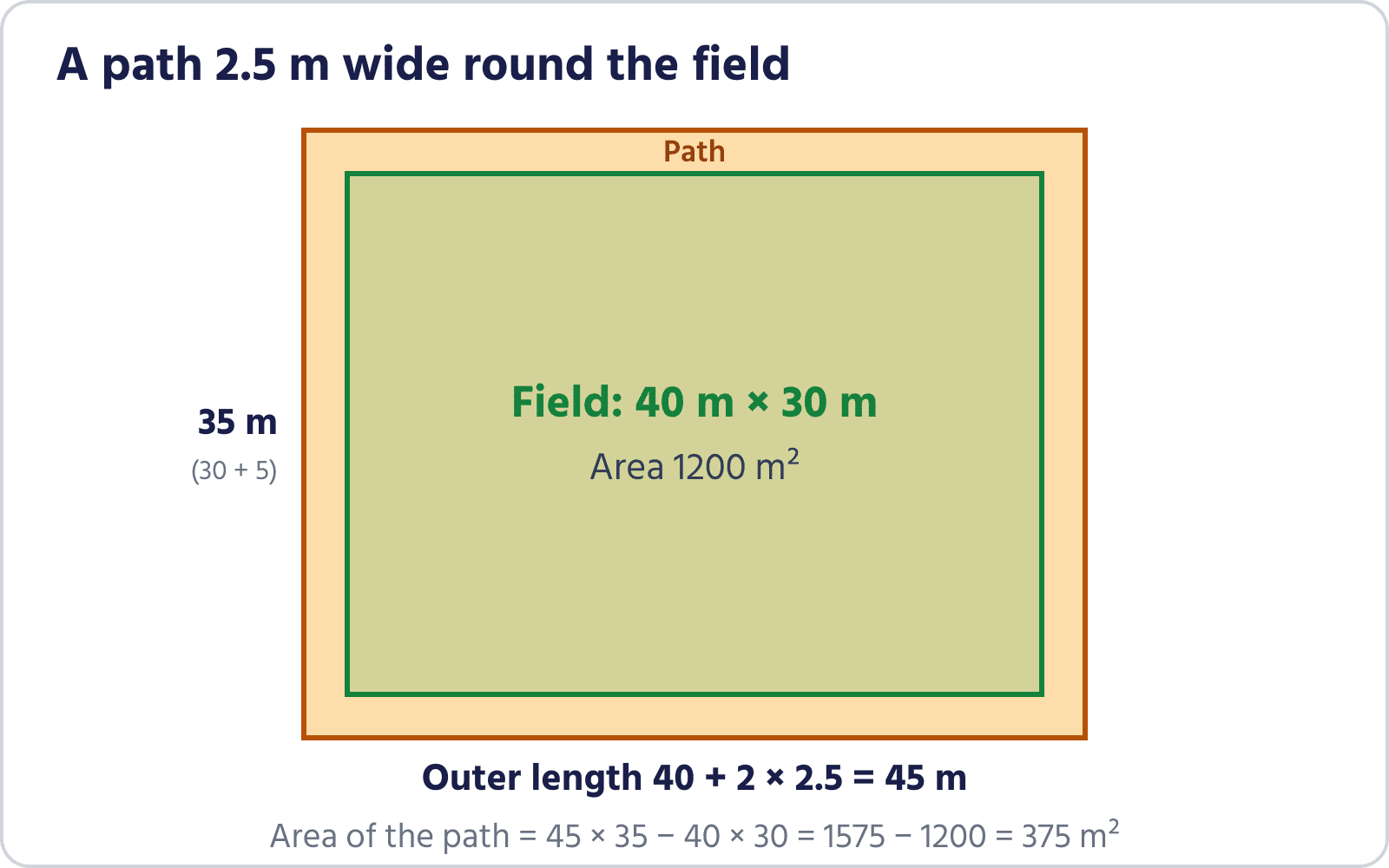
A rectangular field 40 m long and 30 m wide has a path 2.5 m wide all round it on the outside. What is the area of the path?
With the path, the outer rectangle is 40 + 2 × 2.5 = 45 m by 30 + 2 × 2.5 = 35 m, area 1575 m². The field is 40 × 30 = 1200 m². Area of the path = 1575 − 1200 = 375 m². Adding 2.5 only once to each side (42.5 × 32.5) gives a wrong answer.
- Outside path: its width is added twice to both length and breadth
- Formula: 2w(l + b + 2w) = 2 × 2.5 × (40 + 30 + 5) = 375
- The path is on both sides, so the length grows by 5 m, not 2.5 m
- Path inside: subtract 2w; path outside: add 2w
📊 Topic Analysis
20 mixed arithmetic questions for WBPSC Clerkship 2024 Part-I, 30 seconds each, with explanations and shortcuts.



Leave a Comment
Commenting as ·