
Indian Agriculture and Major Crops Quiz: Clerkship 2024
A little practice. A step forward.
10 questions on kharif, rabi and zaid crops, soils, leading states and the farm revolutions, 30 seconds each, with an explanation and map after every answer. 📖 Read the detailed topic
Which of the following is a rabi crop?
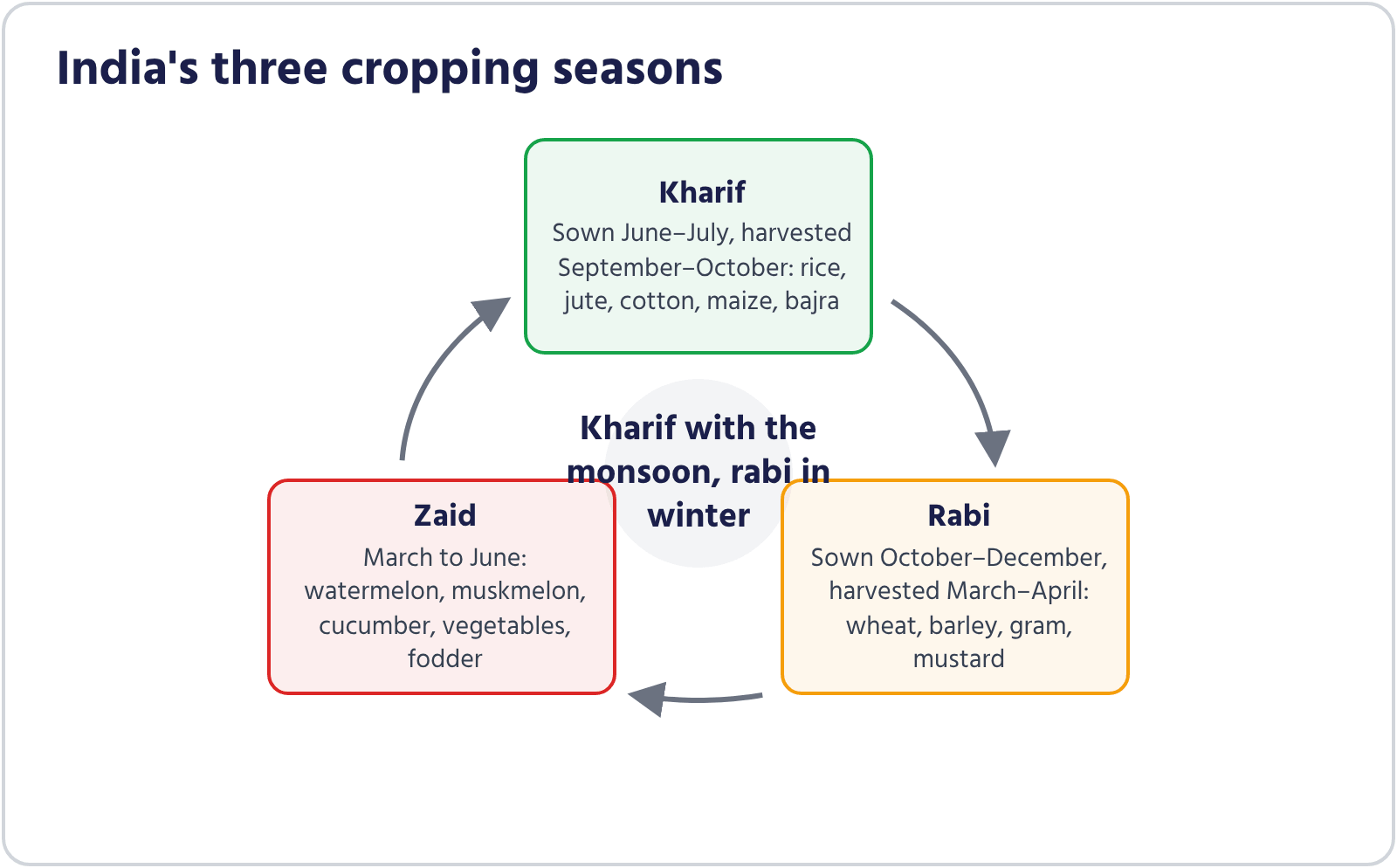
Wheat is sown at the start of winter (October–December) and harvested in March–April, so it is a rabi crop. Rice, jute and cotton are sown with the monsoon: they are kharif crops.
- Rabi: wheat, barley, gram, peas, mustard
- Kharif: rice, jute, cotton, maize, bajra
- Rabi = winter sunshine: wheat, gram, mustard
Which crop is called the 'golden fibre'?
Jute's fibre is golden and valuable, so it is called the golden fibre. West Bengal is India's leading jute state, with jute mills along both banks of the Hooghly. Cotton, silk and hemp are fibres too, but none has this name.
- Jute is a kharif crop that needs a hot, humid climate
- It grows best on flood-plain alluvium renewed every year
- West Bengal is first in jute
- Golden fibre = Golden Bengal's jute
| Fibre | Known as | Soil | Main states |
|---|---|---|---|
| Jute | The golden fibre | Flood-plain alluvium renewed every year | West Bengal, Bihar, Assam |
| Cotton | India is believed to be the original home of the cotton plant | Black (regur) soil | Maharashtra, Gujarat, Madhya Pradesh |
| Silk | An animal fibre: rearing silkworms (sericulture) | Mulberry is grown for the worms | Karnataka, West Bengal |
Which soil is best suited to cotton?
The black or regur soil of the Deccan, formed from lava, holds moisture for long, so cotton does well even with little rain; it is also called black cotton soil. Alluvial soil suits rice, wheat and jute, while laterite and red soils are not as good for cotton.
- Cotton is a kharif crop that takes 6–8 months to mature
- It needs high temperature, light rain, bright sunshine and at least 210 frost-free days
- Maharashtra, Gujarat and Madhya Pradesh are leading states
- Black soil = white cotton

Which state is first in tea production in India?
Assam produces the most tea in India; the warm, humid Brahmaputra valley and its slopes suit tea. Darjeeling and Jalpaiguri in West Bengal, the Nilgiris in Tamil Nadu and Kerala also grow tea, but less than Assam.
- Tea is a plantation crop
- It needs well-drained sloping land, soil rich in humus and rain spread over the year
- Darjeeling tea is famous for its flavour
- Darjeeling tea is the most famous, but Assam grows the most tea
- Assam's tea, Karnataka's coffee, Kerala's rubber
Where did coffee cultivation first begin in India?
Coffee was first grown in India on the Baba Budan Hills in Karnataka, with the Arabica variety. Karnataka is still first in coffee. The Nilgiris grow both coffee and tea but it did not begin there, and Anai Mudi is the highest peak of south India.
- Karnataka is first in coffee, followed by Kerala and Tamil Nadu
- Coffee grows on warm, humid hill slopes in shade
- India grows mainly Arabica and Robusta coffee
- Baba Budan = the father of Indian coffee
Which of the following is a zaid crop?
Crops grown in the short summer season between the rabi harvest and the kharif sowing are called zaid crops; watermelon, muskmelon and cucumber are examples. Wheat and mustard are rabi crops and rice is a kharif crop.
- Zaid: watermelon, muskmelon, cucumber, vegetables, fodder
- The season runs roughly from March to June
- Zaid = juicy summer fruit
The Green Revolution mainly raised the production of which crops?
From the late 1960s, high-yielding variety (HYV) seeds, chemical fertilisers and irrigation sharply raised the yield of wheat and rice: this is the Green Revolution. Oilseeds had a separate Yellow Revolution, and cotton, jute, tea and coffee were not its main crops.
- M. S. Swaminathan is called the father of the Green Revolution in India
- Punjab, Haryana and western Uttar Pradesh gained most
- Wheat saw the biggest early gains
- Green fields = grain, white = milk, yellow = oilseeds, blue = fish
| Revolution | Production of |
|---|---|
| Green | Food grains (wheat, rice) |
| White | Milk |
| Yellow | Oilseeds |
| Blue | Fish |
What kind of farming is 'jhum' cultivation of north-east India?
In jhum, a patch of forest is cut and burnt and farmed for a few years; when the soil loses its fertility the farmers move to a new patch, so it is shifting cultivation. It is practised in the hills of Assam, Meghalaya, Mizoram and Nagaland. Plantation farming grows one crop on a large estate, and terrace farming cuts steps into a hill slope.
- Jhum is also called slash-and-burn farming
- It causes deforestation and soil erosion
- Jhum and terrace farming are both hill farming, but jhum moves to new land while terraces stay in place
Which state is first in rubber production in India?
Rubber is an equatorial crop that needs a temperature above 25°C and more than 200 cm of rain. Kerala's hot, humid climate suits it best, so Kerala is first in rubber. Tamil Nadu and Karnataka grow some, far less, and Assam is known for tea.
- Rubber is a plantation crop
- Tamil Nadu and Karnataka follow Kerala
- Rubber is a key industrial raw material
- Assam's tea, Karnataka's coffee, Kerala's rubber
How do pulse crops improve soil fertility?
Pulses are leguminous plants: Rhizobium bacteria in their root nodules fix nitrogen from the air in the soil. So pulses restore fertility and are grown in rotation with other crops. They do not add phosphorus or potassium, and higher acidity would harm the soil.
- India is the largest producer and consumer of pulses
- Arhar, moong and urad are kharif; gram, peas and masur are rabi
- Pulses are the soil's nitrogen post office: they take it from the air and deliver it to the soil
📊 Topic Analysis
10 questions on kharif, rabi and zaid crops, soils, leading states and the farm revolutions, 30 seconds each, with an explanation and map after every answer.


Leave a Comment
Commenting as ·