
Spotting the Error Practice Quiz: WBPSC Clerkship 2024 English
A little practice. A step forward.
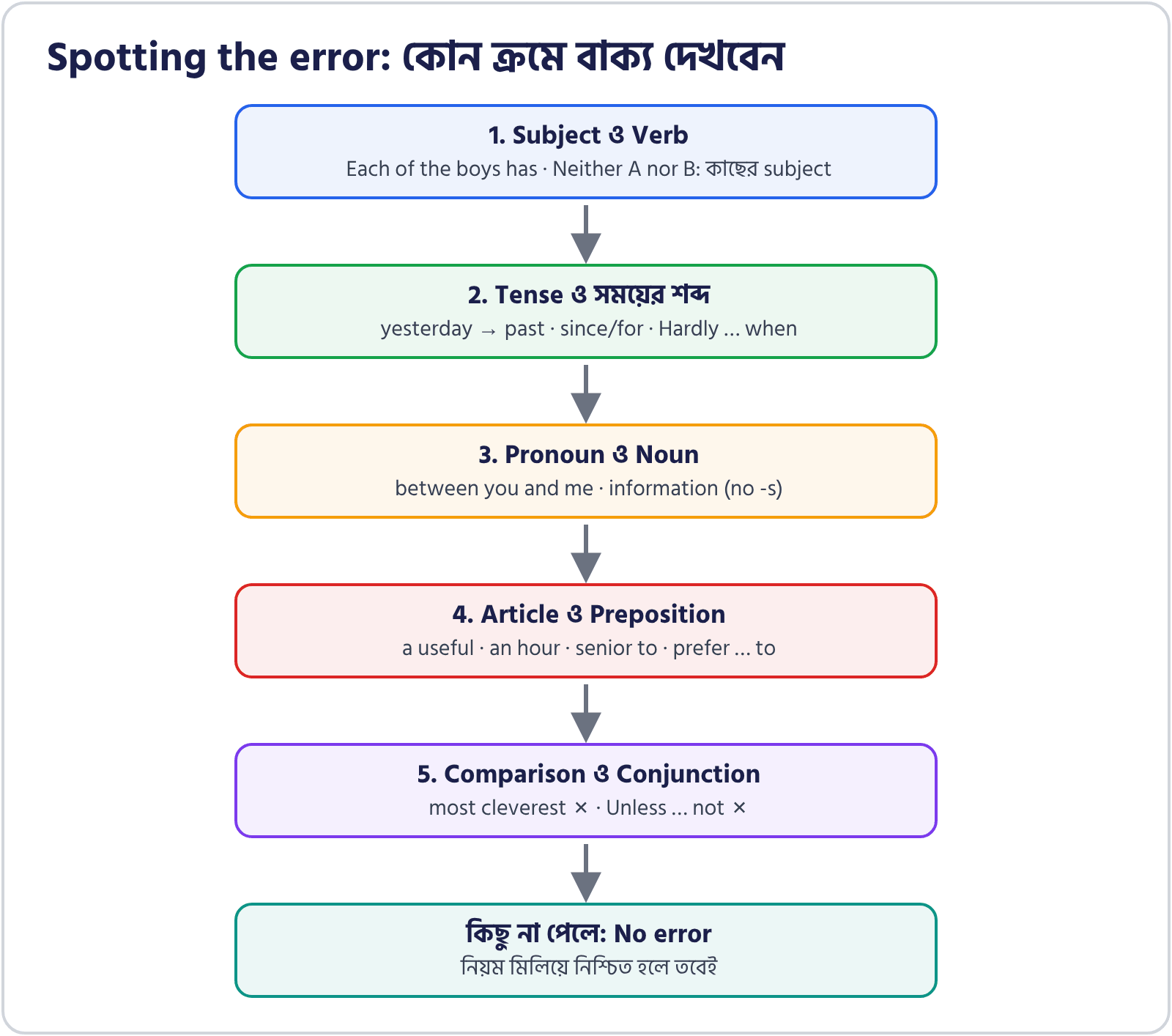
Clerkship 2024 Part-I English, spotting the error: which part of each sentence has an error, or is there no error? Every answer explains the rule. 📖 Read the detailed topic
Which part of the sentence has an error? Each of the boys / have been given / a new book. / No error
The subject is Each; of the boys only describes it. Each always takes a singular verb, so have been given should be has been given. The first part is correct, because Each of is followed by a plural noun (boys).
- Each, Every, Either, Neither take a singular verb
- Each of + plural noun + singular verb
- Correct: Each of the boys has been given a new book.
- Seeing boys and choosing have is the trap: the verb agrees with Each.
- Each means every one taken separately: so has.
Which part of the sentence has an error? The cattle / are grazing / in the field. / No error
Cattle looks singular, but it is always plural and takes a plural verb. So are grazing is correct, and in the field is correct too. The sentence has no error.
- cattle, police, people, poultry are always plural
- cattle never takes -s (cattles is wrong)
- Thinking it should be is grazing and choosing the second part is the trap.
Which part of the sentence has an error? She has been / living in Kolkata / since five years. / No error
Five years is a length of time, so it takes for, not since. Since goes before the point when something began: since 2020, since Monday. has been living (present perfect continuous) is correct, because she still lives there.
- since + a starting point (since 2020, since morning)
- for + a length of time (for five years, for two hours)
- Correct: She has been living in Kolkata for five years.
- How long? → for. Since when? → since.
Which part of the sentence has an error? Between you and I, / the plan / will not work. / No error
Between is a preposition, and a pronoun after a preposition takes the object form: me, him, her, us, them. So between you and I should be between you and me. The other two parts are correct.
- After a preposition use the object form: me, him, her, us, them
- between you and me, for him and me, with her and me
- you and I sounds polite, so many think it is correct; after a preposition it is not.
- Drop you and read it: between I sounds wrong, between me is right.
Which part of the sentence has an error? My uncle gave me / an useful / piece of advice. / No error
Whether we use a or an depends on the first sound of the next word, not its spelling. useful begins with a y sound, which is not a vowel sound, so it is a useful. piece of advice is correct, because advice has no plural.
- a useful, a university, a European, a one-day match
- an hour, an honest man, an MLA, an SDO
- Listen, don't look: if the first sound is a vowel sound, use an.
| Word | First sound | Article |
|---|---|---|
| useful | y (you) | a |
| hour | ow (silent h) | an |
| European | y (you) | a |
| MLA | e (em) | an |
| one | w (won) | a |
Which part of the sentence has an error? Hardly had I reached / the station / than the train left. / No error
Hardly and Scarcely pair with when (or before), not than. than goes with No sooner. So than the train left should be when the train left. Since Hardly begins the sentence, had I reached (inverted order) is correct.
- Hardly/Scarcely … when
- No sooner … than
- Correct: Hardly had I reached the station when the train left.
- Mixing up No sooner … than with Hardly … when is the best-known trap.
- No sooner has a comparative (sooner), so than; Hardly has none, so when.
Which part of the sentence has an error? He told that / he would come / the next day. / No error
told needs an object, the person told: He told me that. Without one, write He said that. In indirect speech he would come and the next day are correct.
- told + person + that (He told me that …)
- said + that (He said that …)
- In indirect speech tomorrow → the next day, will → would
- Tell someone, say something.
Which part of the sentence has an error? Neither the teacher / nor the students / was present. / No error
When Neither … nor joins two subjects, the verb agrees with the nearer one. Here the nearer subject is the students (plural), so was should be were. The same rule holds for Either … or.
- Neither A nor B / Either A or B: the verb agrees with B
- Correct: Neither the teacher nor the students were present.
- Neither the students nor the teacher was present is also correct
- Treating Neither as always singular: alone it is, but in Neither … nor the nearer subject decides.
- The verb listens to its nearest neighbour.
Which part of the sentence has an error? He gave me / many informations / about the exam. / No error
Information is uncountable: it has no plural (informations), and it takes much or a lot of, not many. Correct: He gave me much (or a lot of) information about the exam. The same holds for advice, furniture, luggage and equipment.
- Uncountable: information, advice, furniture, luggage, equipment, scenery
- To count them: a piece of information, two pieces of advice
- many + countable, much + uncountable
- You cannot count it, so no -s.
| Wrong | Correct |
|---|---|
| many informations | much information |
| advices | pieces of advice |
| furnitures | furniture / pieces of furniture |
| luggages | luggage |
| sceneries | scenery |
Which part of the sentence has an error? The Ganga / is a holy river / of India. / No error
The names of rivers take the, so The Ganga is correct. It is one river, so is a holy river is correct. Country names do not take the, so of India is correct too. The sentence has no error.
- the + rivers, seas, oceans, mountain ranges: the Ganga, the Bay of Bengal, the Himalayas
- No the with countries, cities, single peaks: India, Kolkata, Mount Everest
- Exceptions: the USA, the UK, the Netherlands
- Thinking it should be the India and choosing the third part: country names take no the.
| Takes the | No the |
|---|---|
| the Ganga (river) | India (country) |
| the Himalayas (range) | Mount Everest (single peak) |
| the Bay of Bengal (bay) | Kolkata (city) |
| the Indian Ocean (ocean) | Asia (continent) |
Which part of the sentence has an error? Unless you do not work hard, / you will not / pass the exam. / No error
Unless means if … not, so it is negative in itself. Adding not after it makes a double negative and turns the meaning around. Correct: Unless you work hard, you will not pass the exam. The not in the second part is correct, as it belongs to the main clause.
- Unless = if … not
- Unless and lest never take not
- Correct: Unless you work hard, you will not pass the exam.
- Unless already hides a not inside it.
Which part of the sentence has an error? Ten kilometres / is a long distance / to walk. / No error
A whole amount of distance, money or time, taken as one unit, takes a singular verb: Ten kilometres is, Five hundred rupees is, Two hours is. So is a long distance is correct. The sentence has no error.
- Distance, money or time as one amount: singular verb
- Ten kilometres is a long distance; Five hundred rupees is enough
- Seeing the -s of kilometres and wanting are: the whole distance is a single amount.
📊 Topic Analysis
Clerkship 2024 Part-I English, spotting the error: which part of each sentence has an error, or is there no error? Every answer explains the rule.


Leave a Comment
Commenting as ·