
Commonly Confused Words Quiz: WBPSC Clerkship 2024 English
A little practice. A step forward.
12 correct-usage questions on advice/advise, affect/effect, stationary/stationery, lie/lay and more, each answer with its rule. 📖 Read the detailed topic
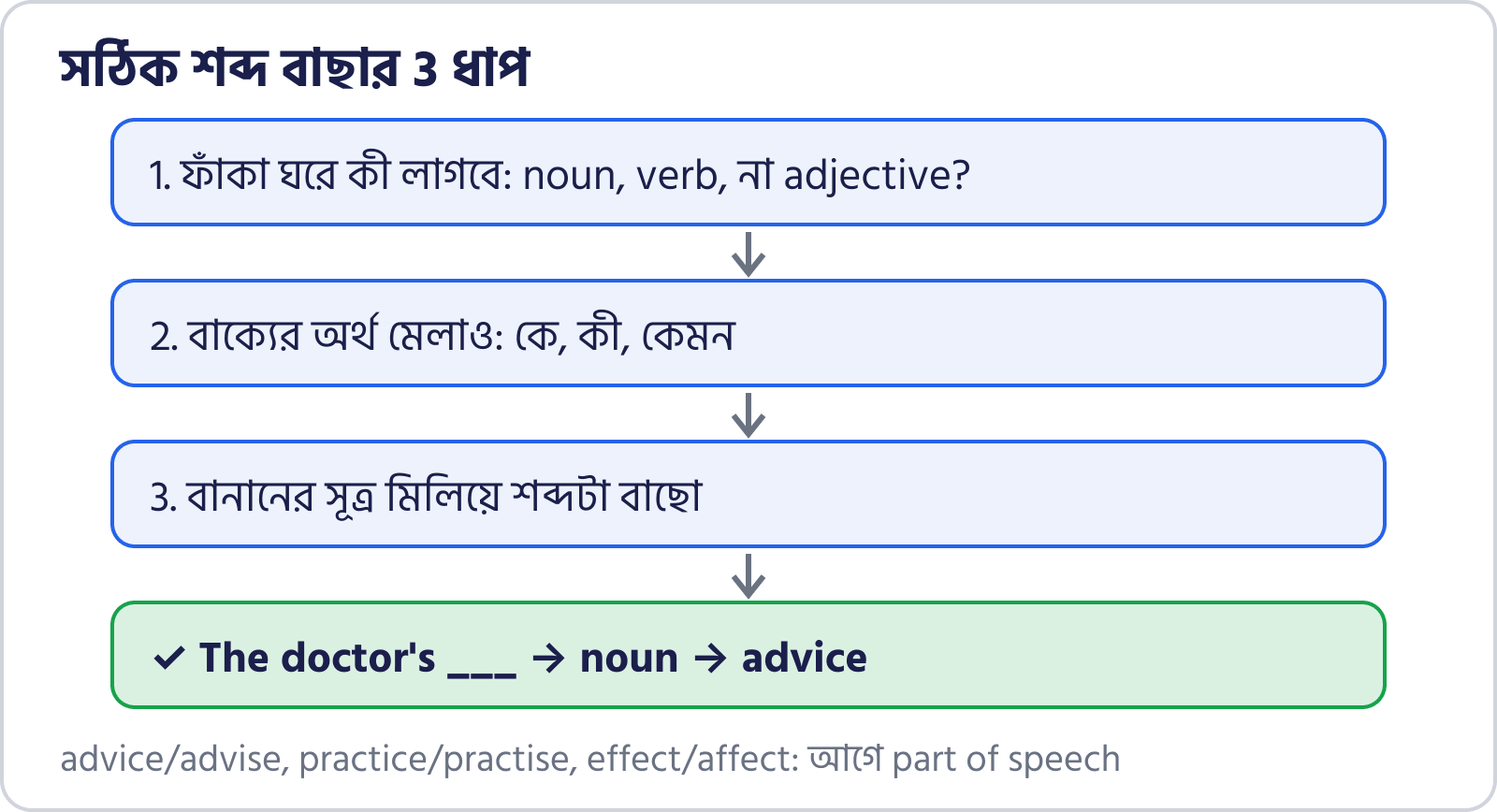
Choose the correct word: The doctor's ___ helped him recover quickly.
After the possessive doctor's we need a noun, and the noun for a suggestion is advice. Advise is the verb and advised its past tense. Advice is uncountable, so advices is wrong.
- advice = noun, advise = verb
- a noun follows a possessive ('s), a or the
- advice is uncountable: a piece of advice
- Advice is uncountable, so 'advices' is wrong; say 'pieces of advice'
- Noun with c, verb with s: advice/advise, practice/practise
Choose the correct word: Rising prices ___ the poor the most.
The sentence needs a verb meaning 'to influence', which is affect. The subject prices is plural, so the verb takes no s; affects is for a singular subject. Effect as a verb means 'to bring about', which does not fit.
- affect = to influence (verb)
- effect = result (noun); as a verb, 'to bring about'
- a plural subject takes a verb without s
- Affects is the right word but the wrong form: prices is plural, so check subject-verb agreement too
- Affect = Action (verb), Effect = End result (noun)
Choose the correct word: The shop sells pens, paper and other ___.
Writing materials such as pens and paper are stationery. Stationary is an adjective meaning 'not moving'. Stationery is an uncountable noun, so it has no plural.
- stationery = writing materials (uncountable noun)
- stationary = not moving (adjective)
- Both sound the same; only the e and the a differ
- stationEry: E for Envelope; stationAry: A for At rest
Choose the correct word: The ___ of our school is very strict about discipline.
The head of a school is a person, the principal. A principle is a rule or belief, not a person; principles is its plural and does not fit the singular is. Principally is an adverb meaning 'mainly'.
- principal = head of a school; as an adjective, 'main'
- principle = a rule or belief
- The principal is your pal (a person); a principle is a rule (both end in -le)
Choose the correct word: Everyone came to the meeting ___ Ramesh.
The sentence means everyone came but Ramesh, and the word for 'leaving out' is except. Accept means to receive, expect means to look forward to, and an excerpt is a passage from a text.
- except = leaving out (preposition)
- accept = to receive (verb)
- EXcept = EXclude
Choose the correct pair: These shoes are so ___ that you may ___ one on the way.
The first blank describes the shoes, so it needs the adjective loose (not tight). The second follows may, so it needs the verb lose. Each of the other pairs puts at least one word in the wrong place.
- loose = not tight (adjective)
- lose = to fail to keep (verb): lose, lost, lost
- a verb follows may, can, will
- With two blanks, check both: options with one right and one wrong word are the usual trap
- Loose has an extra o, like extra room in loose shoes; lose has lost one o
Choose the correct word: Yesterday he was tired, so he ___ on the bed for an hour.
The meaning is 'rested' and there is no object, so the verb is lie, whose past tense is lay. Laid is the past of lay (to put), which needs an object. Lied is the past of lying (telling an untruth), and lain is a past participle that needs has or had.
- lie (rest): lie, lay, lain
- lay (put): lay, laid, laid
- lie (untruth): lie, lied, lied
- The past of lie and the present of lay are the same word, lay: the classic trap
- The past of resting is lay: 'Yesterday I lay down'
| Verb | Meaning | Past | Past participle |
|---|---|---|---|
| lie | to rest, recline (no object) | lay | lain |
| lie | to tell an untruth | lied | lied |
| lay | to put something down (takes an object) | laid | laid |
Choose the correct word: Please ___ the files on my table.
The files is an object: they are to be put down, so the verb is lay. After please the base form of the verb is used, which is lay. Lie (rest) takes no object, and lain and lying are not base forms.
- lay + object: lay the files, lay the table
- lie takes no object
- a request or command uses the base form
- Lay = Place (both have an a)
| Verb | Meaning | Past | Past participle |
|---|---|---|---|
| lie | to rest, recline (no object) | lay | lain |
| lie | to tell an untruth | lied | lied |
| lay | to put something down (takes an object) | laid | laid |
Choose the correct word: All ___ must wear their identity cards in the office.
The staff of an office as a group are its personnel. Personal is an adjective meaning 'private'; personals and personality (character) do not mean staff. Personnel takes a plural verb, hence 'must wear their'.
- personnel = staff (noun)
- personal = private (adjective)
- Personnel has two n's: many people
Choose the correct word: At the function, he sat ___ his mother.
The meaning is 'next to his mother', which is beside. Besides means 'in addition to' (Besides English, she knows Hindi). Aside means 'to one side' and is not followed directly by a noun; besides of is not correct English.
- beside = next to
- besides = in addition to
- One s changes the meaning: beside is next to, besides is in addition to
- The extra s in besides = something more
Choose the correct word: The officer paid her a ___ for her neat handwriting.
The officer praised her neat handwriting, and praise is a compliment (to pay a compliment). A complement is something that completes. After a we need a noun, so complimentary (adjective) and complemented (verb) do not fit.
- compliment = praise
- complement = something that completes
- complimentary can also mean free (a complimentary pass)
- complIment: I like it; complEment: complEte
Choose the correct word: Rahul is very ___; he never wastes money.
Someone who never wastes money is economical (thrifty). Economic means 'relating to the economy' (economic growth). Economics is a subject and economy a country's system of money; both are nouns and cannot follow very.
- economical = thrifty, saving money
- economic = relating to the economy
- Both are adjectives, so choose by meaning, not by form
- economicAL: a thrifty person or thing (an economical car)
📊 Topic Analysis
12 correct-usage questions on advice/advise, affect/effect, stationary/stationery, lie/lay and more, each answer with its rule.


Leave a Comment
Commenting as ·