
Metals, Non-metals and Alloys Quiz: WBPSC Clerkship GS
A little practice. A step forward.
10 questions on metals, non-metals, the reactivity series, rusting, ores and alloys for WBPSC Clerkship Part-I everyday science, each with an explanation. 📖 Read the detailed topic
Which of the following metals is a liquid at ordinary temperature?
Mercury (Hg) is the only metal that is liquid at ordinary temperature, which is why it is used in thermometers. Bromine is also a liquid, but it is a non-metal. Sodium is a soft solid metal and tungsten has the highest melting point of all metals.
- Liquid metal: mercury
- Liquid non-metal: bromine
- Mercury melts at about −39°C, the lowest of all metals
- If the question says 'metal', the answer is mercury; bromine is liquid but not a metal
- The liquid pair: mercury the metal, bromine the non-metal
Brass is an alloy of what?
Brass is an alloy of copper and zinc. Copper with tin makes bronze, and iron with carbon makes steel. Copper, zinc and nickel together make German silver.
- Brass = copper + zinc
- Bronze = copper + tin
- Bell metal = bronze with more tin
- Both brass and bronze contain copper; the only difference is zinc versus tin
- Brass has zinc, bronze has tin
| Alloy | Components | Use |
|---|---|---|
| Brass | Copper + zinc | Utensils, taps, musical instruments |
| Bronze | Copper + tin | Statues, medals, coins |
| Bell metal | Copper + tin (more tin) | Plates, bowls, bells |
| Gun metal | Copper + tin + zinc | Gears, bearings |
| German silver | Copper + zinc + nickel (no silver) | Utensils, decorative items |
| Stainless steel | Iron + chromium + nickel (+ a little carbon) | Kitchenware, surgical instruments |
| Solder | Lead + tin | Joining electrical wires (low melting point) |
Which of the following non-metals conducts electricity?
Graphite is a form of carbon in which one electron of each carbon atom is free to move, so it conducts electricity and is used for electrodes. Diamond is carbon too, but all its electrons are held in bonds, so it is a poor conductor. Sulphur and phosphorus are poor conductors like most non-metals.
- Graphite: a non-metal that conducts, used in pencil leads and electrodes
- Diamond: the hardest natural substance, a poor conductor
- Diamond and graphite are both allotropes of carbon
- Diamond and graphite are both carbon, but only graphite conducts electricity
Which metal is the most abundant in the Earth's crust?
Aluminium is the most abundant metal in the Earth's crust, followed by iron. Among all elements, though, oxygen comes first in the crust, then silicon, then aluminium. The main ore of aluminium is bauxite.
- Most abundant metal in the crust: aluminium; second: iron
- Most abundant element in the crust: oxygen
- Ore of aluminium: bauxite
- 'Metal' means aluminium; 'element' means oxygen
In galvanisation, iron is coated with which metal to prevent rusting?
Galvanisation is coating iron or steel with zinc. Zinc is above iron in the reactivity series, so even if the coating is scratched the zinc corrodes first and the iron is protected. A tin coating is called tin plating, while chromium or nickel coatings are applied by electroplating.
- Galvanisation = zinc on iron
- Rusting needs both oxygen and water
- Rust: hydrated iron(III) oxide
- Tin plating and galvanisation are different: galvanisation uses zinc
- Galvanised roofing sheets are iron coated with zinc
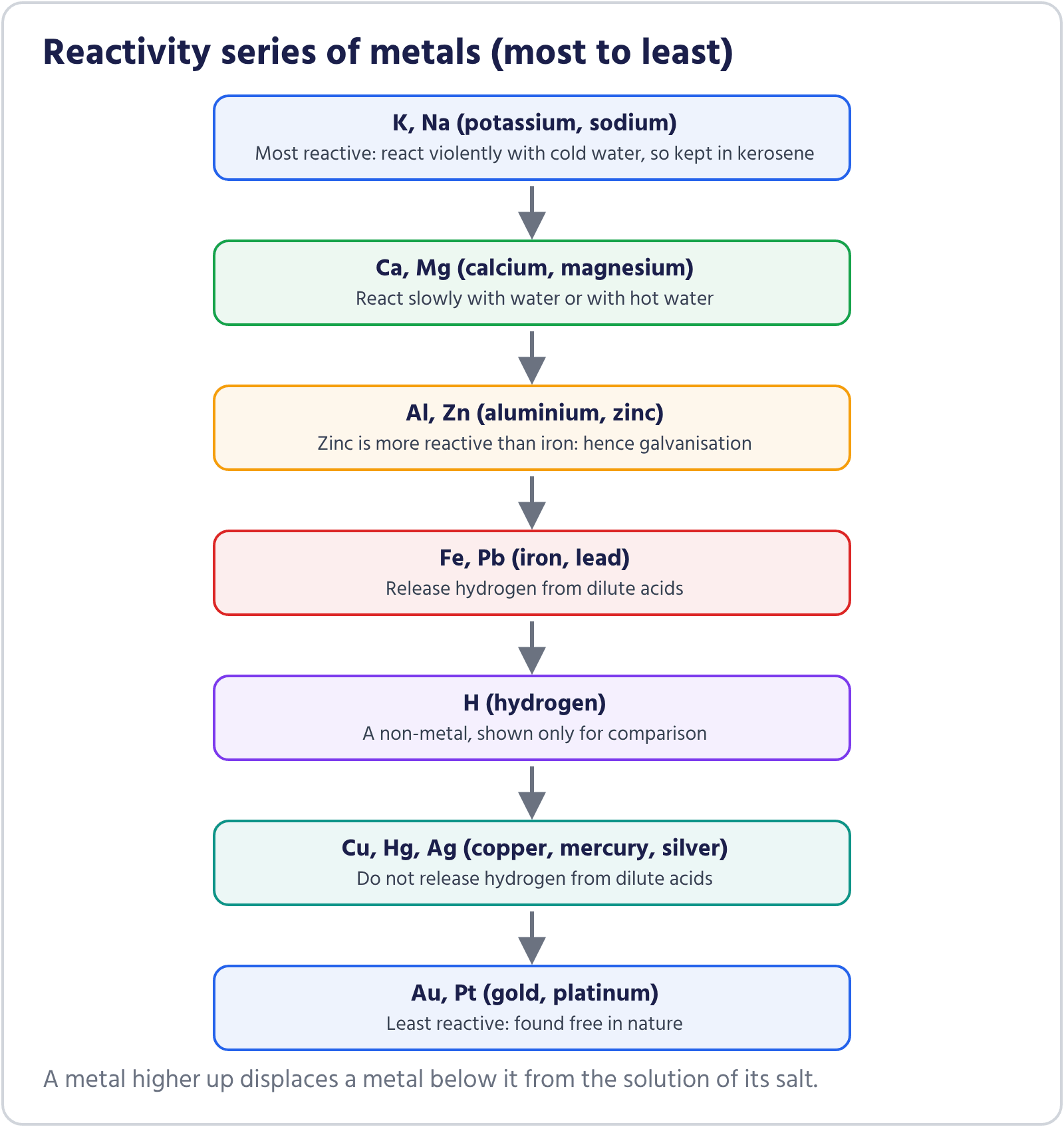
Which of the following elements is stored under kerosene?
Sodium is a highly reactive metal: it reacts quickly with oxygen and moisture in air and can catch fire in water, so it is kept under kerosene. White phosphorus catches fire by itself in air, so it is kept under water. Mercury and magnesium need no such storage.
- Sodium and potassium: under kerosene
- White phosphorus: under water
- Sodium has 1 electron in its outer shell and gives it up easily
- Both sodium and phosphorus are dangerous, but one goes in kerosene and the other in water
- Sodium in kerosene, phosphorus in water

Which of the following metals is the best conductor of electricity?
Silver is the best conductor of electricity among all metals, followed closely by copper, then gold and aluminium. Silver is expensive, so household wiring uses copper, which conducts almost as well and costs far less. Gold is the most malleable and ductile metal, not the best conductor.
- Best conductor: silver; second: copper
- Most malleable and ductile: gold
- Copper in wiring: cheap and almost as good
- Because wires are made of copper, many think copper is the best conductor; it is silver
Which of the following metals is NOT present in German silver?
German silver is an alloy of copper, zinc and nickel; it is named for its silvery look, but it contains no silver at all. It is used for utensils and decorative items.
- German silver = copper + zinc + nickel
- Despite the name, it has no silver
- Picking 'silver' because of the name is the trap here
- Silver in the name, no silver inside
| Alloy | Components | Use |
|---|---|---|
| Brass | Copper + zinc | Utensils, taps, musical instruments |
| Bronze | Copper + tin | Statues, medals, coins |
| Bell metal | Copper + tin (more tin) | Plates, bowls, bells |
| Gun metal | Copper + tin + zinc | Gears, bearings |
| German silver | Copper + zinc + nickel (no silver) | Utensils, decorative items |
| Stainless steel | Iron + chromium + nickel (+ a little carbon) | Kitchenware, surgical instruments |
| Solder | Lead + tin | Joining electrical wires (low melting point) |
Which metal is used to make the filament of an electric bulb?
A bulb filament glows by getting very hot, so it needs a metal that does not melt easily. Tungsten has the highest melting point of all metals (about 3422°C), so filaments are made of it. Nichrome is not a metal but an alloy of nickel and chromium, used in heater and iron coils.
- Highest melting point: tungsten
- Heater coils: nichrome (nickel + chromium)
- Lowest melting point: mercury
- Tungsten in bulbs, nichrome in heaters: both get hot, so they get mixed up
Bauxite is the main ore of which metal?
Bauxite is the main ore of aluminium; alumina is extracted from it and aluminium is obtained by electrolysis. The ores of iron are haematite and magnetite, of copper copper pyrites, and of zinc zinc blende.
- Bauxite → aluminium
- Haematite → iron
- Galena → lead, cinnabar → mercury
| Metal | Main ore |
|---|---|
| Aluminium (Al) | Bauxite |
| Iron (Fe) | Haematite, magnetite |
| Copper (Cu) | Copper pyrites (chalcopyrite) |
| Zinc (Zn) | Zinc blende |
| Lead (Pb) | Galena |
| Mercury (Hg) | Cinnabar |
📊 Topic Analysis
10 questions on metals, non-metals, the reactivity series, rusting, ores and alloys for WBPSC Clerkship Part-I everyday science, each with an explanation.


Leave a Comment
Commenting as ·