
Time and Distance Practice Quiz: WBPSC Clerkship 2024
A little practice. A step forward.
12 questions on time and distance: unit conversion, average speed, trains, meeting and chasing, late and early, and speed ratios, each with its full working. 📖 Read the detailed topic
90 km/h is equal to how many m/s?
To change km/h to m/s multiply by $\frac{5}{18}$: $90 \times \frac{5}{18} = 5 \times 5 = 25$ m/s. 324 comes from wrongly multiplying by $\frac{18}{5}$. The m/s figure is always the smaller one.
- km/h → m/s: $\times \frac{5}{18}$
- m/s → km/h: $\times \frac{18}{5}$
- Going to the smaller unit (m/s), use the smaller fraction: 5 on top, 18 below.
| km/h | m/s |
|---|---|
| 36 | 10 |
| 54 | 15 |
| 72 | 20 |
| 90 | 25 |
A car moves at 20 m/s. What is its speed in km/h?
To change m/s to km/h multiply by $\frac{18}{5}$: $20 \times \frac{18}{5} = 4 \times 18 = 72$ km/h. 5.56 comes from multiplying by $\frac{5}{18}$ instead.
- m/s → km/h: $\times \frac{18}{5}$
- 20 m/s = 72 km/h is a pair worth remembering
| km/h | m/s |
|---|---|
| 36 | 10 |
| 54 | 15 |
| 72 | 20 |
| 90 | 25 |
A man covers 15 km in 2 hours 30 minutes. What is his speed?
2 hours 30 minutes = 2.5 hours. Speed $= \frac{15}{2.5} = 6$ km/h. 7.5 comes from ignoring the 30 minutes, and an answer near 6.5 from taking 2 h 30 min as 2.3 hours.
- Speed = distance ÷ time
- 30 minutes = 0.5 hour, 15 minutes = 0.25 hour
- 2 hours 30 minutes is 2.5 hours, not 2.3 hours.
A man goes to a place at 30 km/h and returns at 20 km/h. What is his average speed for the whole journey?
For the same distance at two speeds, average speed $= \frac{2xy}{x+y} = \frac{2 \times 30 \times 20}{50} = \frac{1200}{50} = 24$ km/h. 25 is the simple mean, which is wrong because more time is spent at the lower speed. Check: for 60 km, 2 + 3 = 5 hours, 120 ÷ 5 = 24.
- Same distance: average speed $= \frac{2xy}{x+y}$
- Average speed = total distance ÷ total time
- The simple mean of the two speeds (25) is not the average speed.
A train 200 m long runs at 72 km/h. How long will it take to cross a platform 160 m long?
Speed $= 72 \times \frac{5}{18} = 20$ m/s. It must cover train + platform $= 200 + 160 = 360$ m, so time $= \frac{360}{20} = 18$ seconds. 10 seconds leaves out the platform, 8 seconds leaves out the train.
- Crossing a platform: distance = train + platform
- In train sums, change the speed to m/s first
- A pole: only the train's length; a platform: both lengths added.
Two trains 120 m and 180 m long run in opposite directions at 50 km/h and 58 km/h. How long will they take to cross each other?
In opposite directions the relative speed is $50 + 58 = 108$ km/h $= 108 \times \frac{5}{18} = 30$ m/s. The distance is the sum of the lengths, $120 + 180 = 300$ m, so time $= \frac{300}{30} = 10$ seconds. 135 seconds comes from subtracting the speeds (8 km/h), the same-direction rule.
- Opposite directions: add the speeds
- Two trains crossing: add both lengths
- Opposite = add, same direction = subtract.
Two towns are 300 km apart. Two cars start at the same time from the two towns towards each other at 45 km/h and 55 km/h. After how long will they meet?
Moving towards each other, the relative speed is $45 + 55 = 100$ km/h, so time $= \frac{300}{100} = 3$ hours. 30 hours comes from subtracting the speeds ($55 - 45 = 10$). They meet $45 \times 3 = 135$ km from the first town.
- Towards each other: time = distance ÷ (sum of speeds)
- Meeting point = one car's speed × time
The same idea as the lesson's Example 4: 360 km at 50 and 40 km/h, meeting after $\frac{360}{90} = 4$ hours, 200 km from A.
A thief runs away at 8 km/h. 15 minutes later a policeman starts chasing from the same spot at 10 km/h. How long after the policeman starts will he catch the thief?
In 15 minutes the thief is $8 \times \frac{1}{4} = 2$ km ahead. The relative speed is $10 - 8 = 2$ km/h, so it takes $\frac{2}{2} = 1$ hour. 1 hour 15 minutes is the time from the thief's start; the question asks from the policeman's start.
- Same direction: subtract the speeds
- Time to catch = head start ÷ relative speed
- Check whose start the time is counted from: the policeman's (1 hour) or the thief's (1 hour 15 minutes).
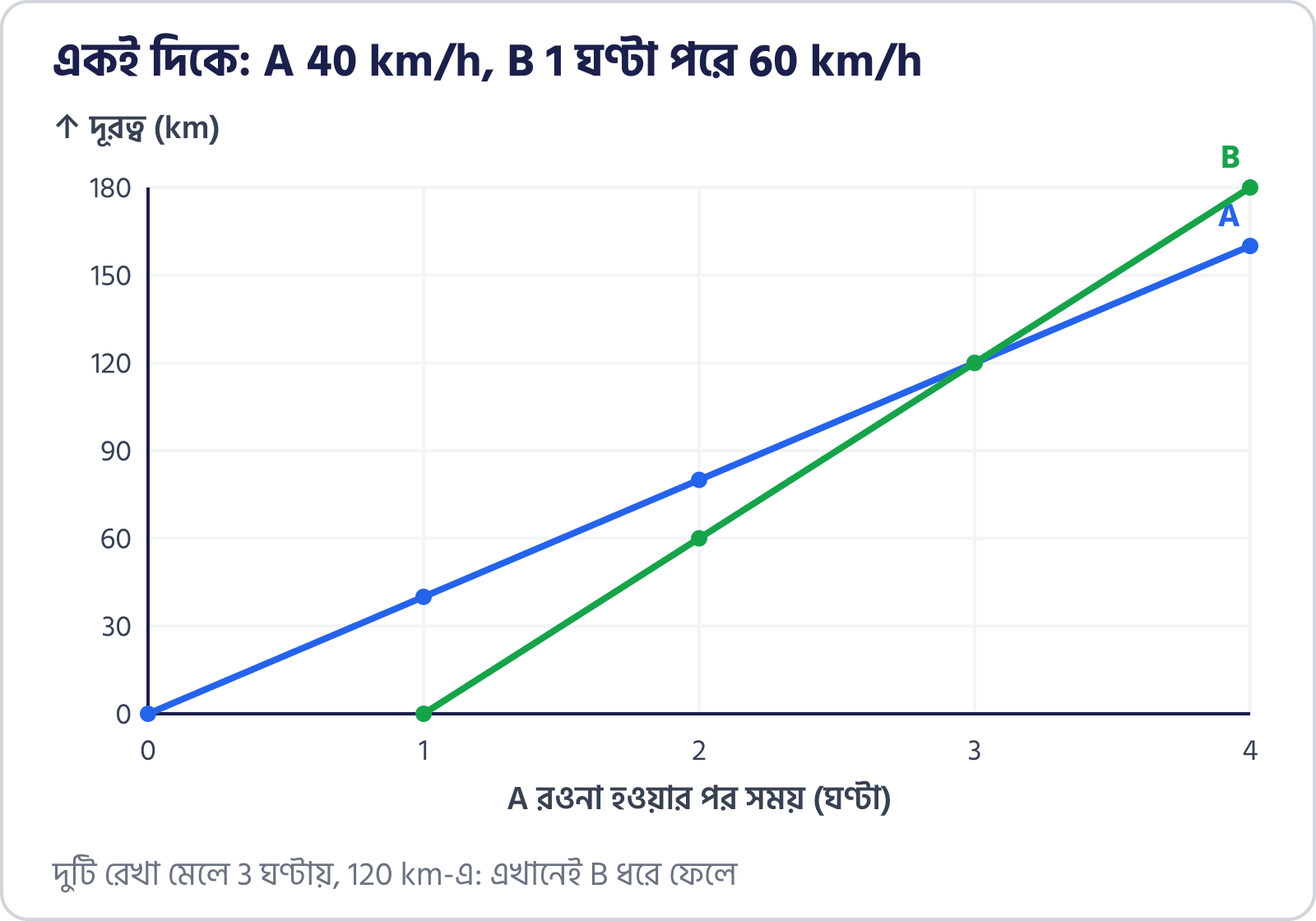
The graph is the lesson's Example 5 (in Bengali): the same rule, head start ÷ relative speed.
Walking at $\frac{4}{5}$ of his usual speed, a man reaches office 10 minutes late. What is his usual time?
The distance is the same, so at $\frac{4}{5}$ of the speed the time becomes $\frac{5}{4}$ times. The extra time, $\frac{1}{4}$ of the usual time, is 10 minutes, so the usual time is 40 minutes. 50 minutes is the new (late) time.
- For a fixed distance, speed and time are inversely proportional
- Speed $\frac{a}{b}$ times means time $\frac{b}{a}$ times
- Flip the fraction: four-fifths of the speed means five-fourths of the time.
Walking at 4 km/h a student reaches school 5 minutes late, and at 5 km/h he is 10 minutes early. How far is the school from his home?
The two times differ by $5 + 10 = 15$ minutes $= \frac{1}{4}$ hour. $\frac{d}{4} - \frac{d}{5} = \frac{d}{20} = \frac{1}{4}$, so $d = 5$ km. Check: 75 minutes at 4 km/h, 60 minutes at 5 km/h, a difference of 15 minutes.
- Late + early = the total difference in time
- Shortcut: $d = \frac{s_1 \times s_2}{s_2 - s_1} \times$ difference
- Add the minutes late and early; do not subtract them (10 − 5 = 5 minutes is wrong).
The speeds of A and B are in the ratio 3 : 4. A takes 20 minutes more than B to cover the same distance. How long does B take?
The distance is the same, so the times are in the inverse ratio, 4 : 3. The difference of 1 part is 20 minutes, so B's time, 3 parts, is 60 minutes = 1 hour, and A's is 80 minutes. 80 minutes is A's time, not B's.
- For the same distance, the ratio of times is the inverse of the ratio of speeds
- Use the difference in parts to find one part
- Turn the speed ratio upside down to get the time ratio.
A train passes a pole in 15 seconds and a platform 100 m long in 25 seconds. What is the length of the train?
The extra 100 m (the platform) took $25 - 15 = 10$ seconds more, so the speed is $\frac{100}{10} = 10$ m/s. Passing a pole covers the train's own length: $10 \times 15 = 150$ m. Check: $\frac{150 + 100}{10} = 25$ seconds.
- Time to pass a pole × speed = length of the train
- The difference of the two times is the platform's extra time
- Divide the platform by the difference in time to get the speed.
📊 Topic Analysis
12 questions on time and distance: unit conversion, average speed, trains, meeting and chasing, late and early, and speed ratios, each with its full working.


Leave a Comment
Commenting as ·