
Simple Interest Quiz: WBPSC Clerkship 2024
A little practice. A step forward.
12 simple interest sums for the WBPSC Clerkship 2024 arithmetic paper, each with a worked explanation. 📖 Read the detailed topic
What is the simple interest on ₹4,000 at 6% per annum for 2 years?
$I = \frac{4000 \times 6 \times 2}{100} = 480$. ₹240 is the interest for only 1 year. The other two options fit no formula.
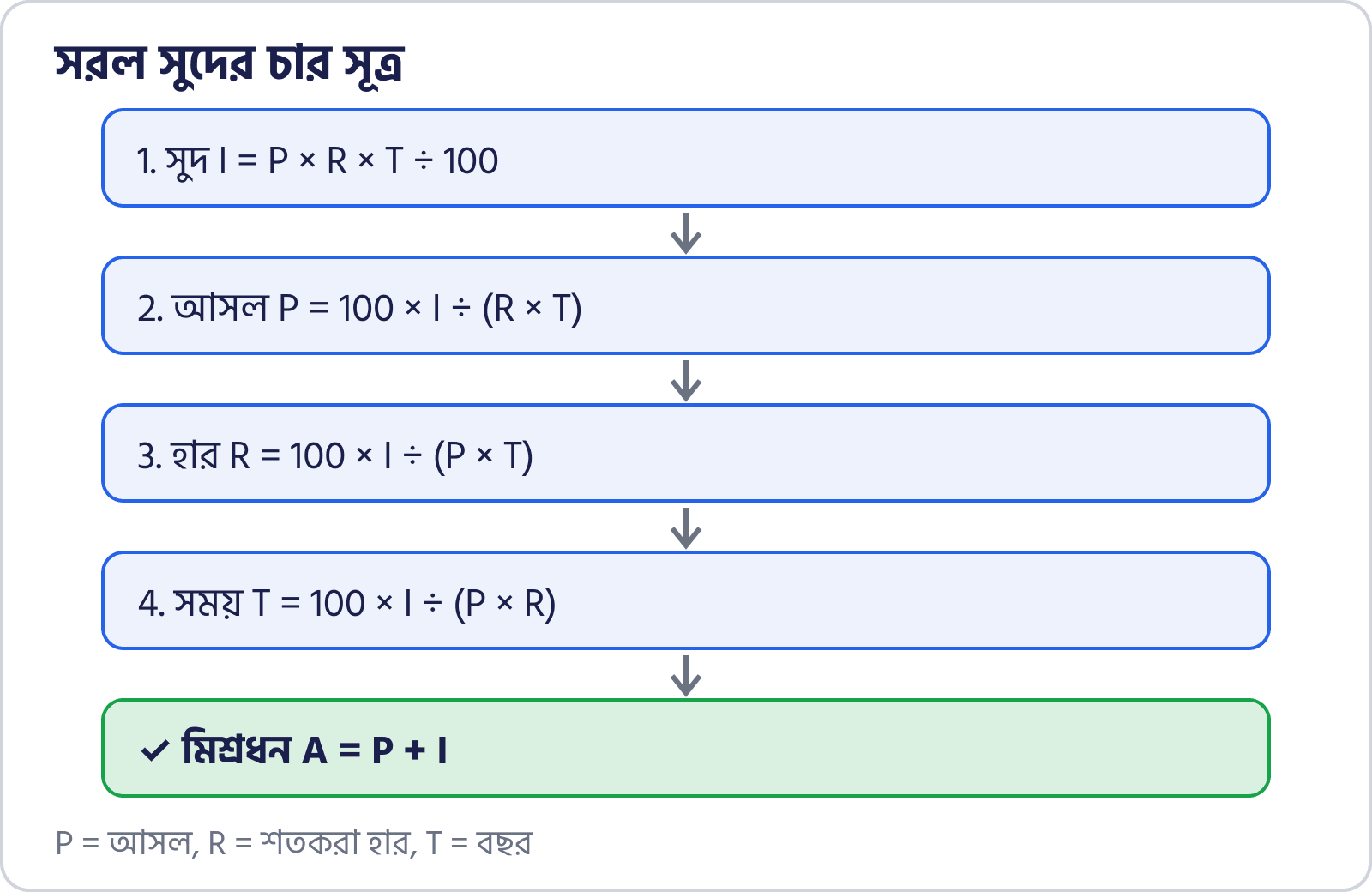
- Interest = principal × rate × years ÷ 100
- Yearly interest is ₹240, so 2 years give ₹480
- Find 1 year's interest first, then multiply by the years
What is the amount on ₹7,500 at 8% per annum simple interest after 4 years?
$I = \frac{7500 \times 8 \times 4}{100} = 2400$. Amount = ₹7,500 + ₹2,400 = ₹9,900. ₹2,400 is only the interest, not the amount.
- Amount = principal + interest
- Check what the question asks for first
- Interest and amount differ: interest ₹2,400, amount ₹9,900
- Do not stop at the interest: look for 'amount' in the last line
The simple interest on ₹2,400 for 2 years is ₹288. What is the rate per annum?
$R = \frac{100 \times 288}{2400 \times 2} = \frac{28800}{4800} = 6$. Check: 6% of ₹2,400 is ₹144 a year, so ₹288 in 2 years.
- R = 100 × I ÷ (P × T)
- You can verify by putting the answer back
- Interest for one year ÷ principal × 100 = rate
In how many years will ₹5,000 earn ₹1,600 simple interest at 8% per annum?
$T = \frac{100 \times 1600}{5000 \times 8} = \frac{160000}{40000} = 4$. One year's interest is ₹400, so ₹1,600 takes 4 years.
- T = 100 × I ÷ (P × R)
- One year's interest is ₹400
- Divide: total interest ÷ one year's interest
At 7% simple interest per annum the interest in 3 years is ₹945. What is the principal?
$P = \frac{100 \times 945}{7 \times 3} = \frac{94500}{21} = 4500$. Check: 7% of ₹4,500 is ₹315, and ₹945 in three years.
- P = 100 × I ÷ (R × T)
- R × T = 21, so principal = interest ÷ 21 × 100
- Divide first to keep numbers small: 945 ÷ 21 = 45
What is the simple interest on ₹9,000 at 10% per annum for 8 months?
8 months = $\frac{8}{12} = \frac{2}{3}$ year. $I = \frac{9000 \times 10 \times \frac{2}{3}}{100} = 600$. ₹900 is the interest for a full year.
- Convert months to years by dividing by 12
- One year's interest is ₹900
- Putting T = 8 gives ₹7,200: always convert months to years
- 8 months = two-thirds of a year's interest
A sum doubles itself in 8 years at simple interest. What is the rate per annum?
If it doubles, interest = principal, so $R \times T = 100$. $R = \frac{100}{8} = 12.5$. At 12% the 8-year interest is only 96% of the principal.
- For doubling, R × T = 100
- For tripling, R × T = 200
- 100 ÷ years = rate
What is the simple interest on ₹12,000 at 7.5% per annum for 2 years?
$I = \frac{12000 \times 7.5 \times 2}{100} = 1800$. It is ₹900 a year, so ₹1,800 in two years. ₹900 is the one-year answer.
- 7.5% means ₹7.5 on every ₹100
- One year's interest is ₹900
- Do 12000 ÷ 100 = 120 first, then multiply by 7.5 × 2
A sum doubles in 5 years at simple interest. In how many years will it become three times at the same rate?
Doubling in 5 years means interest = principal in 5 years, so the rate is 20%. To triple, interest must be twice the principal: $T = \frac{200}{20} = 10$ years.
- To become n times, interest = (n − 1) × principal
- If doubling takes t years, tripling takes 2t
- Tripling needs interest of twice the principal, not three times (the principal is already there)
- Double → triple: time doubles
₹10,000 is split into two parts invested at 5% and 8% simple interest. The total yearly interest is ₹680. What is the part at 5%?
Let the 5% part be x. Then $0.05x + 0.08(10000 - x) = 680$, so $800 - 0.03x = 680$ and $x = 4000$. Check: 5% of ₹4,000 is ₹200, 8% of ₹6,000 is ₹480, total ₹680. ₹6,000 is the 8% part.
- All at 8% would give ₹800
- Each ₹1 moved to 5% lowers the interest by 3 paise
- The question asks for the 5% part; ₹6,000 is the 8% part
- Assume all at the higher rate, then divide the shortfall by the rate difference: 120 ÷ 0.03
The simple interest on ₹15,000 in 9 months is ₹1,350. What is the rate per annum?
9 months = $\frac{3}{4}$ year. $R = \frac{100 \times 1350}{15000 \times \frac{3}{4}} = \frac{135000}{11250} = 12$. Check: 12% of ₹15,000 is ₹1,800 a year, and three-quarters of that is ₹1,350.
- Convert months to years first
- 12% a year is 1% a month
- One year's interest = 1,350 ÷ 0.75 = ₹1,800
A sum becomes ₹6,000 in 2 years and ₹6,500 in 3 years at simple interest. What is the rate per annum?
The difference ₹500 is one year's interest. Interest for 2 years is ₹1,000, so the principal is ₹6,000 − ₹1,000 = ₹5,000. Rate = $\frac{500}{5000} \times 100 = 10$%.
- The difference of amounts in consecutive years = one year's interest
- Principal = amount − interest
- Difference → one year's interest → principal → rate
📊 Topic Analysis
12 simple interest sums for the WBPSC Clerkship 2024 arithmetic paper, each with a worked explanation.




Leave a Comment
Commenting as ·