
Everyday Science Mixed Quiz 4: Body, Microbes, Light and Heat, WBPSC Clerkship GS
A little practice. A step forward.
20 everyday science questions for the General Studies paper of WBPSC Clerkship Part-I: the human body, vitamins and diseases, microbes in food, light, heat, plants and instruments.
Which part of the eye controls the amount of light entering it?
The iris is the coloured part of the eye; it contracts and expands to change the size of the pupil, the opening at its centre, and so controls how much light enters. In bright light the pupil becomes small, in the dark it widens. The image forms on the retina, while the cornea and lens bend the light to focus it.
- The iris changes the size of the pupil
- Retina: the screen where the image forms
- Cornea: the clear front layer of the eye
- Iris = a camera's aperture, retina = the camera's film
Which blood cells mainly help the blood to clot?
When we get a cut, platelets gather at the wound and start the clotting of blood. Red blood cells carry oxygen with the help of haemoglobin, and white blood cells fight germs. Plasma is not a cell at all but the liquid part of blood.
- Platelets: clotting
- Red cells: carry oxygen
- White cells: fight infection
- Red carries, white fights, platelets plug
Which is the largest gland in the human body?
The liver is the largest gland in the human body; it makes bile, which helps digest fats. The thyroid is the largest endocrine gland, in the neck, and the pituitary is called the 'master gland' because it controls other glands. The largest organ, however, is the skin.
- Largest gland: liver
- The liver makes bile, stored in the gall bladder
- Pituitary: the master gland
- Largest gland = liver, but largest organ = skin; 'master gland' = pituitary
- Largest gland the liver, largest organ the skin
Which vitamin is needed for the clotting of blood?
Vitamin K is needed in the liver to make the clotting proteins (such as prothrombin); without it bleeding from a cut does not stop easily. Lack of vitamin A causes night blindness, of C scurvy, and of D rickets.
- Vitamin K: blood clotting
- Green leafy vegetables contain vitamin K
- A, D, E and K are fat-soluble
- K for 'Koagulation', the German word for clotting
Deficiency of which vitamin causes beriberi?
Lack of vitamin B1, thiamine, causes beriberi, which weakens the nerves and the heart. It is seen where highly polished rice is the main food, because thiamine lies in the outer layer of the grain. Lack of vitamin C causes scurvy and of D rickets.
- Lack of B1 (thiamine): beriberi
- Hand-pounded rice, pulses and cereals contain thiamine
- Vitamins B and C are water-soluble
- BeriBeri has two Bs: vitamin B1
Malaria is spread by the bite of which mosquito?
Malaria is caused by Plasmodium, a single-celled protozoan that enters the human body through the bite of the female Anopheles mosquito. Male mosquitoes do not feed on blood but on plant juices, so they do not spread disease. Aedes spreads dengue and Culex filariasis.
- Malaria parasite: Plasmodium (a protozoan)
- Only female mosquitoes feed on blood
- Dengue: Aedes mosquito, a virus
- Malaria is a protozoan disease (Anopheles), dengue a viral one (Aedes): both are mosquito-borne, so they get mixed up
- Aedes bites by day: dengue; Anopheles: malaria
| Mosquito | Disease it spreads |
|---|---|
| Female Anopheles | Malaria |
| Aedes (Aedes aegypti) | Dengue, chikungunya, Zika |
| Culex | Filariasis, Japanese encephalitis |
What is done to milk in pasteurisation?
In pasteurisation milk is heated to a set temperature (for example about 72 °C for 15 seconds, or about 63 °C for 30 minutes) and then cooled quickly. This kills most harmful germs without changing the taste as boiling does. The process is named after Louis Pasteur.
- Heat, then cool fast: pasteurisation
- Aim: to kill harmful microbes
- Named after Louis Pasteur
- Pasteur: heat, then chill
Which microbe turns milk into curd?
Lactobacillus bacteria turn lactose, the sugar in milk, into lactic acid; the acid sets the milk protein into curd and gives it its sour taste. Yeast makes bread rise, Rhizobium fixes nitrogen in roots, and penicillin comes from Penicillium.
- Lactobacillus: lactose to lactic acid
- The sour taste of curd is lactic acid
- A spoon of old curd starts a new batch
- Lacto means milk: Lactobacillus, the milk microbe
| Microbe | Everyday role |
|---|---|
| Lactobacillus (bacterium) | Turns milk into curd |
| Yeast (fungus) | Makes bread and idli-dosa batter rise |
| Rhizobium (bacterium) | Fixes nitrogen in root nodules of legumes |
| Penicillium (mould) | The antibiotic penicillin |
Yeast makes bread or idli batter rise. Which gas does this?
Yeast is a single-celled fungus; it breaks down the sugar in the dough (fermentation) and gives off carbon dioxide and a little alcohol. The gas bubbles are trapped and the dough rises, so bread becomes soft and spongy. No oxygen, nitrogen or hydrogen is produced here.
- Yeast: a single-celled fungus
- Fermentation gives CO2 and alcohol
- Baking soda also gives CO2 when heated
- The holes in bread are CO2 bubbles
| Microbe | Everyday role |
|---|---|
| Lactobacillus (bacterium) | Turns milk into curd |
| Yeast (fungus) | Makes bread and idli-dosa batter rise |
| Rhizobium (bacterium) | Fixes nitrogen in root nodules of legumes |
| Penicillium (mould) | The antibiotic penicillin |
Which lens is used to correct myopia (short sight)?
In myopia the image of a distant object forms in front of the retina, so distant things look blurred. A concave lens spreads the light a little, pushing the image back onto the retina. Hypermetropia (near things blurred) is corrected with a convex lens.
- Myopia: image in front of the retina
- A concave lens is diverging
- Hypermetropia: convex lens
- Short sight (myopia) needs concave; long sight (hypermetropia) needs convex
- Myopia: a minus-power (concave) lens; plus power is convex
| Defect | Problem | Corrective lens |
|---|---|---|
| Myopia (short sight) | Distant objects blurred | Concave lens |
| Hypermetropia (long sight) | Near objects blurred | Convex lens |
| Presbyopia (old age) | Both near and far vision affected with age | Bifocal lens |
| Astigmatism | Lines in one direction blurred | Cylindrical lens |
Why does water stay cool in a clay pot in summer?
A clay pot has countless tiny pores; water seeps through them and evaporates from the outer surface. The latent heat needed for evaporation is taken from the pot and the water inside, so the water cools. Our body cools when sweat dries for the same reason.
- Evaporation causes cooling
- The latent heat is taken from the water
- The pot cools more on a dry, breezy day
- Drying sweat cools us; the pot 'sweats' too
Which mode of heat transfer does a thermos flask prevent?
A thermos flask has a vacuum between its two glass walls; with no medium there, conduction and convection hardly happen. The shiny silvered walls reflect radiant heat back. So the flask cuts down all three modes as far as possible, keeping hot things hot and cold things cold.
- Vacuum: stops conduction and convection
- Silvered walls: reflect radiation
- Invented by James Dewar (the Dewar flask)
- Thermos: three out of three
| Mode of heat transfer | What in the flask stops it |
|---|---|
| Conduction | The vacuum between the two walls, glass and the cork stopper |
| Convection | The vacuum (no air) and the tight stopper |
| Radiation | The shiny silvered walls |
A carrot is a modified form of which part of the plant?
A carrot is a tap root swollen with stored food (a modified root), with no nodes or buds on it. Radish, beetroot and sweet potato are roots too. Potato, ginger and onion, however, are modified stems, because they bear buds ('eyes').
- Carrot, radish, beetroot, sweet potato: roots
- Potato, ginger, turmeric, onion: stems
- Buds mean a stem, no buds a root
- A potato grows underground but is a stem; a sweet potato is a root
- Has 'eyes'? a stem (potato). No eyes? a root (carrot)
In the root nodules of which plant do Rhizobium bacteria fix nitrogen from the air?
Leguminous plants such as pea, gram, moong and soybean have Rhizobium bacteria in their root nodules. They turn the nitrogen of the air into compounds plants can use, so these crops make the soil more fertile. Rice, wheat and maize are cereals, not legumes.
- Rhizobium: in root nodules of legumes
- Nitrogen fixation enriches the soil
- Hence pulses are grown in crop rotation
- Pulse plants are the soil's fertiliser factory
| Microbe | Everyday role |
|---|---|
| Lactobacillus (bacterium) | Turns milk into curd |
| Yeast (fungus) | Makes bread and idli-dosa batter rise |
| Rhizobium (bacterium) | Fixes nitrogen in root nodules of legumes |
| Penicillium (mould) | The antibiotic penicillin |
How many chambers does the human heart have?
The human heart has 4 chambers: two atria above and two ventricles below. The right side sends the deoxygenated blood from the body to the lungs; the left side sends the oxygenated blood from the lungs to the whole body. A fish's heart has 2 chambers and a frog's 3.
- 2 atria + 2 ventricles = 4 chambers
- The left ventricle has the thickest wall
- Fish 2, frog 3, birds and mammals 4
- Fish, frog, human: 2, 3, 4
What is the structural and functional unit of the kidney?
Each kidney has about a million nephrons; they filter the blood, separating wastes and extra water to form urine. The neuron is the unit of the nervous system, the alveolus is an air sac of the lung, and the villus is the absorbing part of the small intestine.
- Nephron: the unit of the kidney
- Neuron: the unit of the nervous system
- Alveolus: gas exchange in the lungs
- Nephron (kidney) and neuron (nerve) sound alike but do different jobs
- Nephro = kidney, neuro = nerve
Which instrument is used to test the purity of milk?
A lactometer measures the specific gravity of milk; adding water lowers it, so adulteration shows up. A hygrometer measures humidity of the air, a hydrometer the specific gravity of liquids in general, and a thermometer temperature.
- Lactometer: specific gravity of milk
- Hygrometer: relative humidity
- A lactometer is a special kind of hydrometer
- Hygrometer (humidity) and hydrometer (liquids) differ by one letter
- Lacto = milk, hygro = moisture, hydro = water
| Instrument | Measures |
|---|---|
| Lactometer | Purity of milk (specific gravity) |
| Hygrometer | Relative humidity of air |
| Hydrometer | Specific gravity of liquids |
| Barometer | Atmospheric pressure |
| Thermometer | Temperature |
Why does a spoon dipped in water, or a pencil in a glass of water, look bent?
When light passes from water into air its speed changes and its path bends; this is refraction. So the part under water appears a little higher than it is and the spoon looks broken or bent. Splitting into seven colours in a prism is dispersion, and the blue sky is due to scattering.
- Light bending as it changes medium: refraction
- This is also why a pond looks shallower than it is
- An image in a mirror: reflection
- Refraction: the ray 'fractures' at the surface
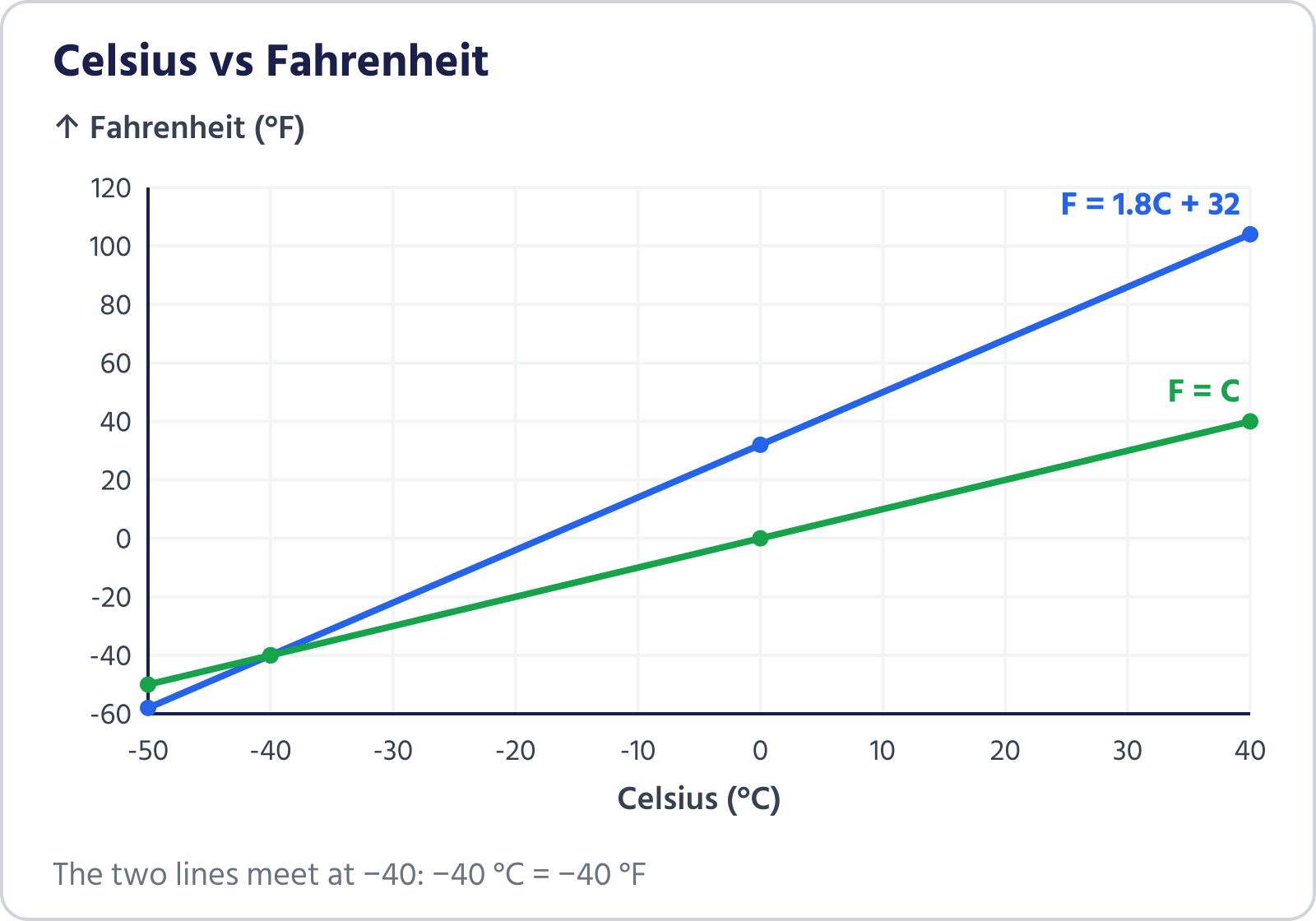
At what temperature do the Celsius and Fahrenheit scales read the same?
The formula is $F = \frac{9}{5}C + 32$. Setting $F = C$ gives $C = \frac{9}{5}C + 32$, so $-\frac{4}{5}C = 32$ and $C = -40$. So −40 °C = −40 °F, while 0 °C is 32 °F.
- $F = \frac{9}{5}C + 32$
- Water freezes at 0 °C = 32 °F and boils at 100 °C = 212 °F
- Normal body temperature is about 37 °C = 98.6 °F
- The two scales shake hands at −40
Who discovered penicillin, the first antibiotic?
In 1928 Alexander Fleming noticed that the mould Penicillium was killing the bacteria around it; this is how penicillin was discovered. Edward Jenner developed the smallpox vaccine, Louis Pasteur the rabies vaccine and pasteurisation, and Robert Koch identified the germs of tuberculosis and cholera.
- Penicillin: Fleming, 1928
- Penicillin comes from the Penicillium mould
- Smallpox vaccine: Jenner
- Fleming's mould: penicillin; Jenner's jab: smallpox
📊 Topic Analysis
20 everyday science questions for the General Studies paper of WBPSC Clerkship Part-I: the human body, vitamins and diseases, microbes in food, light, heat, plants and instruments.


Leave a Comment
Commenting as ·