
Digestive System and Blood Circulation Quiz: Clerkship GS
A little practice. A step forward.
10 questions on the human digestive system and blood circulation, at the level of WBPSC Clerkship 2024 Part-I. 30 seconds a question, with an explanation for every answer. 📖 Read the detailed topic
Which is the largest gland of the human body?
The liver is the largest gland of the body; it makes bile, stores glycogen and forms urea. The pancreas is the second largest gland and a mixed gland. The thyroid is the largest endocrine (ductless) gland, and the spleen is not a gland but a lymphoid organ.
- The liver makes bile; bile is stored in the gall bladder
- The liver stores glucose as glycogen
- Largest endocrine gland: thyroid
- Largest gland = liver, but largest endocrine gland = thyroid
The salivary enzyme ptyalin starts the digestion of which nutrient?
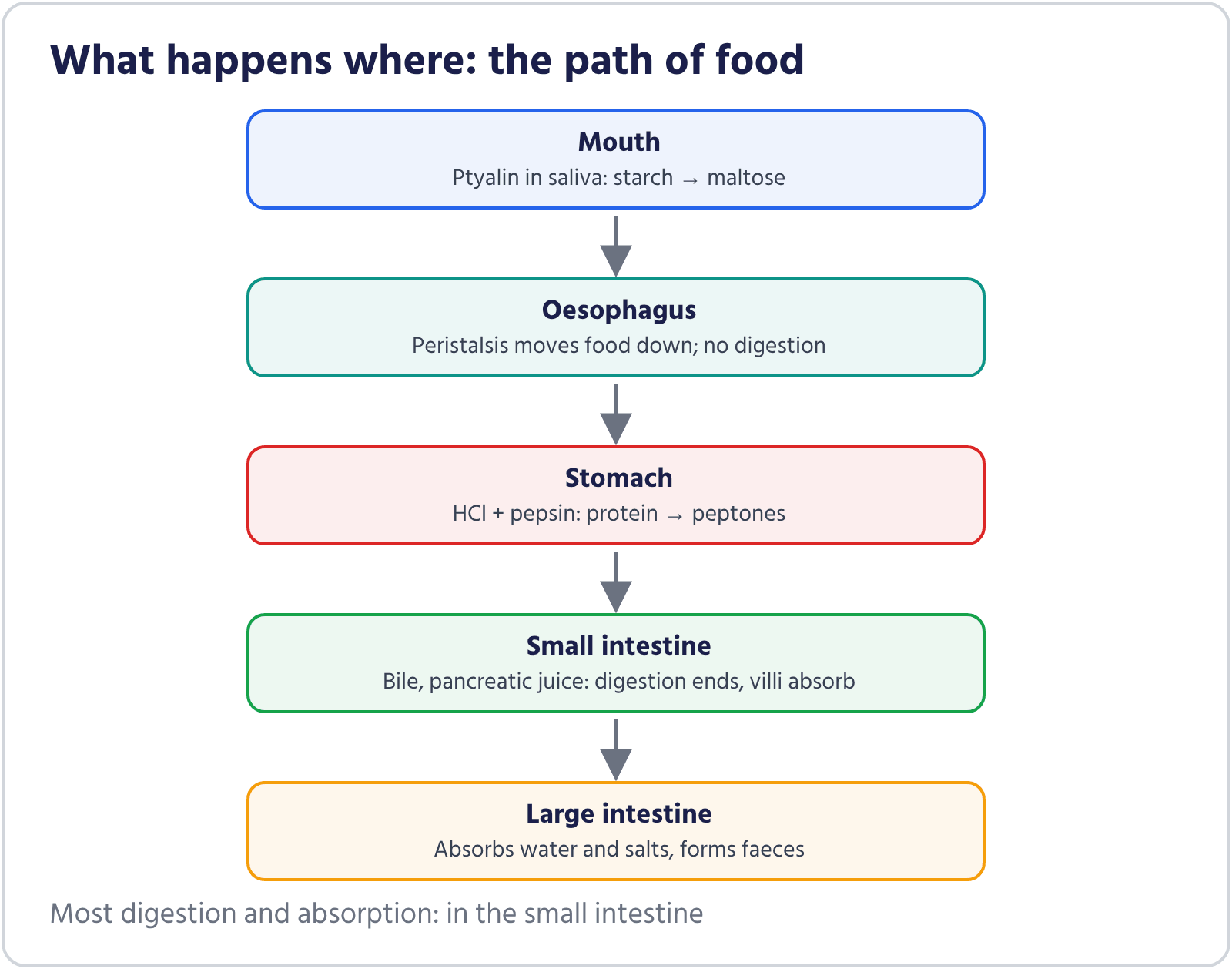
Ptyalin (salivary amylase) begins breaking starch into maltose in the mouth itself. Protein digestion starts in the stomach with pepsin, and fat is digested mainly in the small intestine with the help of bile and lipase.
- Humans have 3 pairs of salivary glands; the parotid is the largest
- Starch ends up as glucose
- No digestion takes place in the oesophagus
- Mouth: starch; stomach: protein; small intestine: everything finishes
Where is the bile made by the liver stored?
The liver makes bile and it is stored in the gall bladder; when food arrives, bile is poured into the duodenum. Bile has no enzyme: bile salts emulsify fat into tiny droplets. Bile only mixes with food in the duodenum, it is not stored there.
- Bile has no enzyme
- Bile salts emulsify fat
- Bile pigments: bilirubin and biliverdin
- Bile is made in the liver and stored in the gall bladder: both are asked separately
Where does most absorption of food take place?
Digestion is completed and almost all digested food is absorbed in the small intestine; the finger-like villi on its wall multiply the absorbing surface. The large intestine mainly absorbs water and salts, and the stomach absorbs little besides some water, alcohol and a few drugs.
- The small intestine is the longest part of the alimentary canal, about 6 m
- Its three parts: duodenum, jejunum, ileum
- Large intestine: absorbs water and salts
Length of the intestines (approx.)
Which food does the stomach enzyme pepsin break down?
Pepsin breaks proteins into peptones. The stomach's HCl turns inactive pepsinogen into active pepsin and provides the acidic medium pepsin needs. Starch is broken by ptyalin and amylase, fat by lipase, and humans cannot digest cellulose.
- HCl kills germs and turns pepsinogen into pepsin
- Rennin curdles milk casein (in infants)
- Mucus protects the stomach wall from acid
| Enzyme | Where | Breaks down |
|---|---|---|
| Ptyalin | Saliva (mouth) | Starch |
| Pepsin | Stomach | Protein |
| Trypsin | Pancreatic juice | Protein |
| Lipase | Pancreatic juice | Fat |
Which part is called the 'pacemaker' of the heart?
Every heartbeat starts from the SA (sino-atrial) node in the wall of the right atrium, so it is the natural pacemaker. The AV node passes that signal from the atria to the ventricles but does not start the beat. The left ventricle pumps blood to the body, and valves stop blood flowing backwards.
- The SA node lies in the right atrium
- An adult heart beats about 72 times a minute at rest
- Normal blood pressure is about 120 mm Hg systolic and 80 mm Hg diastolic
- The SA node starts the beat; the AV node passes it to the ventricles
What is the average lifespan of a human red blood cell?
A human red blood cell lives about 120 days. It is made in the red bone marrow and old cells are broken down mainly in the spleen, which is why the spleen is called the 'graveyard of RBCs'. A mature RBC has no nucleus; its haemoglobin carries oxygen.
- RBCs are made in the red bone marrow
- A mature RBC has no nucleus
- Haemoglobin contains iron
- A red cell lives roughly 4 months (120 days)
| Cell | Job | Fact to remember |
|---|---|---|
| Red blood cell | Carries O₂ | Lives about 120 days, no nucleus |
| White blood cell | Fights disease | Has a nucleus |
| Platelet | Blood clotting | Needs vitamin K and calcium |
Which blood group is called the 'universal donor'?
Group O red cells carry neither the A nor the B antigen, so the antibodies in other groups' plasma do not clump them: O can give blood to everyone. Group AB plasma has no antibodies, which makes AB the universal recipient, not the donor.
- The ABO blood groups were discovered by Karl Landsteiner
- AB = universal recipient
- The safest donor is O negative (no Rh factor either)
- Universal donor O and universal recipient AB are often swapped in the options
- O gives, AB takes
| Group | Antigen on RBC | Antibody in plasma |
|---|---|---|
| A | A | Anti-B |
| B | B | Anti-A |
| AB | A and B | None |
| O | None | Anti-A and anti-B |
Which blood vessel brings oxygenated blood from the lungs to the heart?
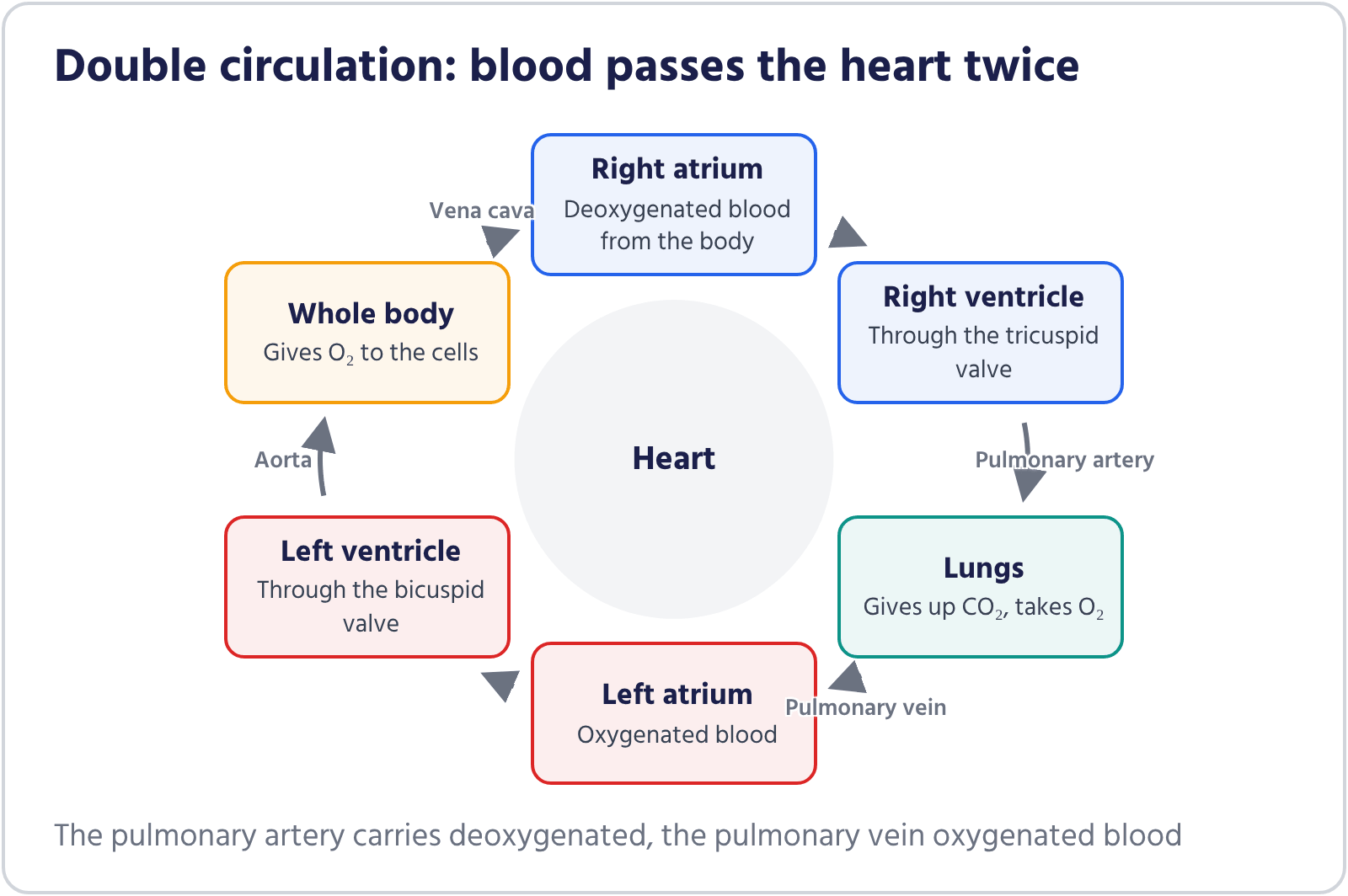
The pulmonary vein brings oxygenated blood from the lungs to the left atrium: it is the only vein that carries oxygenated blood. The pulmonary artery goes the other way, taking deoxygenated blood from the right ventricle to the lungs. The vena cava returns the body's deoxygenated blood to the right atrium, and the aorta sends oxygenated blood from the left ventricle to the body.
- Arteries carry blood away from the heart, veins bring it back
- Largest artery: aorta; largest vein: vena cava
- Humans have double circulation: pulmonary and systemic
- The pulmonary artery carries deoxygenated and the pulmonary vein oxygenated blood: the reverse of the usual rule
- Artery = away: judge by direction, not by oxygen
Which valve lies between the left atrium and the left ventricle of the heart?
The two-flapped bicuspid or mitral valve lies between the left atrium and the left ventricle. The three-flapped tricuspid valve lies between the right atrium and the right ventricle. The two semilunar valves guard the openings of the pulmonary artery and the aorta, which leave the ventricles.
- The heart has four chambers: two atria and two ventricles
- The left ventricle has the thickest wall
- Valves stop blood flowing backwards
- Tri on the right, bi on the left
📊 Topic Analysis
10 questions on the human digestive system and blood circulation, at the level of WBPSC Clerkship 2024 Part-I. 30 seconds a question, with an explanation for every answer.


Leave a Comment
Commenting as ·