
WBPSC Clerkship 2024: West Bengal and GK Mixed Quiz (Round 4, 20 Questions)
A little practice. A step forward.
20 questions on West Bengal and general knowledge for WBPSC Clerkship 2024 Part-I, round 4.
Bakreshwar, famous for its hot springs, is in which district of West Bengal?
Bakreshwar is in Birbhum district; its many hot springs and its Shiva temple make it a place of pilgrimage. A thermal power station of the same name stands there too. Bankura and Purulia are neighbouring plateau districts, but Bakreshwar is not in them.
- Bakreshwar: Birbhum district
- Known for hot springs and a Shiva temple
- The Bakreshwar Thermal Power Station is also in Birbhum
- Bakreshwar's hot water, Birbhum's soil: B for B

Who founded the Pala dynasty of Bengal?
Around 750 CE, to end Bengal's long anarchy (matsyanyaya), Gopala was chosen king; he founded the Pala dynasty. Dharmapala and Devapala were the powerful Pala kings after him. Shashanka was the king of Gauda before the Pala age, with his capital at Karnasuvarna.
- Gopala: founder of the Pala dynasty, c. 750 CE
- Dharmapala founded the Vikramashila mahavihara
- Shashanka: king of Gauda, capital Karnasuvarna (Murshidabad)
- Shashanka is the first great king of Bengal, but he did not found the Palas
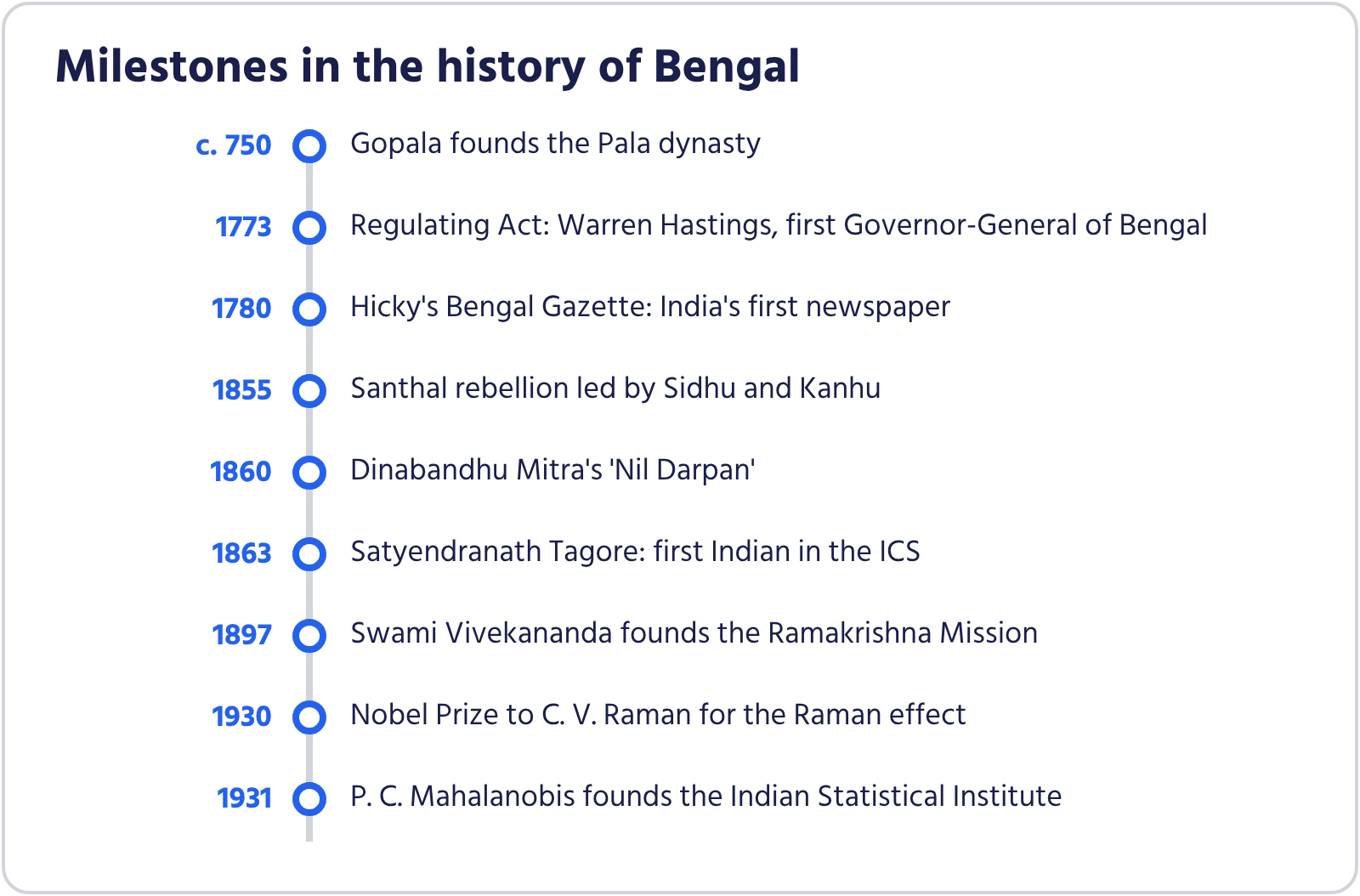
Who wrote 'Nil Darpan', the play on the plight of the indigo farmers?
'Nil Darpan' (1860) was written by Dinabandhu Mitra; set against the indigo planters' oppression and the Indigo Revolt, it caused a stir. Rev. James Long was jailed for publishing its English translation. That translation is believed to be Michael Madhusudan Dutt's, which is why his name is the trap here.
- Nil Darpan: Dinabandhu Mitra, 1860
- Background: the Indigo Revolt (1859–60)
- The English translation was published by Rev. James Long
- Madhusudan is linked with the English translation, not the original play
Who started the 'Bengal Gazette', India's first newspaper, published from Calcutta in 1780?
In 1780 James Augustus Hicky brought out the 'Bengal Gazette' from Calcutta, known as Hicky's Bengal Gazette and India's first newspaper. Buckingham started the 'Calcutta Journal' later (1818). William Carey was a Serampore missionary; Ram Mohan Roy is linked with 'Sambad Kaumudi'.
- Bengal Gazette: 1780, James Augustus Hicky
- India's first newspaper, from Calcutta
- Ram Mohan Roy: Sambad Kaumudi
- Hicky's Gazette = the first; remember it as 'Hicky 1780'
Who was the first Indian to join the Indian Civil Service (ICS)?
Satyendranath Tagore, Rabindranath Tagore's elder brother, passed the ICS examination in 1863 and became the first Indian civilian. Surendranath Banerjee and R. C. Dutt passed later, in 1869. Subhas Chandra Bose passed in 1920 but resigned in 1921.
- Satyendranath Tagore: first Indian in the ICS (passed 1863)
- He was Rabindranath's elder brother
- Subhas Bose resigned from the ICS (1921)
- Subhas Bose passed the ICS but never served; he was not the first
Who founded the Ramakrishna Mission?
In 1897 Swami Vivekananda founded the Ramakrishna Mission in the name of his guru Sri Ramakrishna; its headquarters is Belur Math in Howrah. Sri Ramakrishna had died in 1886, so he was not the founder. Keshab Chandra Sen and Debendranath Tagore were leaders of the Brahmo movement.
- Ramakrishna Mission: 1897, Swami Vivekananda
- Headquarters: Belur Math (Howrah)
- Debendranath and Keshab: the Brahmo Samaj
- The mission bears Ramakrishna's name, but his disciple Vivekananda founded it
On the banks of which river does the North Bengal city of Siliguri stand?
Siliguri grew on the banks of the Mahananda; the Mahananda Wildlife Sanctuary lies next to the city. The Teesta flows east of Siliguri towards Jalpaiguri. The Torsa is the river of Cooch Behar and Alipurduar, the Jaldhaka of Jalpaiguri and Cooch Behar.
- Siliguri: on the Mahananda
- Teesta: past Jalpaiguri town
- Torsa: Cooch Behar
- The Teesta is the best-known river of North Bengal, but Siliguri is on the Mahananda
'Amar Sonar Bangla', written by Rabindranath Tagore, is the national anthem of which country?
Tagore wrote 'Amar Sonar Bangla' in 1905, during the protests against the Partition of Bengal; independent Bangladesh adopted it as its national anthem. India's national anthem 'Jana Gana Mana' is also Tagore's, so he wrote the anthems of two countries.
- Amar Sonar Bangla: national anthem of Bangladesh
- Jana Gana Mana: national anthem of India
- Both were written by Rabindranath Tagore
- Two anthems, one poet: Jana Gana Mana for India, Amar Sonar Bangla for Bangladesh
Who founded the Indian Statistical Institute in Kolkata?
In 1931 Prasanta Chandra Mahalanobis set up the Indian Statistical Institute (ISI) in Kolkata; he also shaped India's Second Five-Year Plan. Jagadish Chandra Bose founded the Bose Institute (1917) and Meghnad Saha the Saha Institute of Nuclear Physics. Satyendra Nath Bose is famous for Bose–Einstein statistics, but he did not found the ISI.
- ISI: 1931, P. C. Mahalanobis
- Mahalanobis shaped the Second Five-Year Plan
- Bose Institute: Jagadish Chandra Bose, 1917
- 'Statistics' tempts you towards S. N. Bose (Bose–Einstein statistics), but the ISI is Mahalanobis's
| Institute (Kolkata) | Founder |
|---|---|
| Indian Statistical Institute (1931) | P. C. Mahalanobis |
| Bose Institute (1917) | Jagadish Chandra Bose |
| Saha Institute of Nuclear Physics | Meghnad Saha |
| Indian Association for the Cultivation of Science (1876) | Mahendralal Sircar |
Who led the Santhal rebellion (Hul) of 1855?
On 30 June 1855 at Bhognadih the Santhals, led by Sidhu and Kanhu Murmu, rose (the Hul) against moneylenders, landlords and British rule. Birsa Munda led the Munda rising (Ulgulan, 1899–1900). Titu Mir built the bamboo fort at Narkelberia (1831); Dudu Miyan led the Faraizi movement.
- Santhal rebellion: 1855, Sidhu and Kanhu
- Began at Bhognadih on 30 June (Hul Day)
- Birsa Munda: the Ulgulan, 1899–1900
- Birsa Munda's Ulgulan and the Santhal Hul are two different tribal risings
In which year did C. V. Raman win the Nobel Prize in Physics for the 'Raman effect', discovered in Kolkata?
Working at the Indian Association for the Cultivation of Science in Kolkata, C. V. Raman discovered the Raman effect in the scattering of light in 1928 and won the Nobel Prize in Physics in 1930. The day of the discovery, 28 February, is now National Science Day. 1913 is Tagore's Nobel for literature, 1979 Mother Teresa's Peace Prize.
- Raman effect discovered: 1928
- Nobel Prize in Physics: 1930
- 28 February: National Science Day
- 1928 is the discovery, 1930 the Nobel: do not mix them up
Under the Regulating Act of 1773, who became the first Governor-General of Bengal?
The Regulating Act of 1773 made the Governor of Bengal the Governor-General, and Warren Hastings became the first Governor-General of Bengal. Under the Charter Act of 1833 Lord William Bentinck became the first Governor-General of India. Robert Clive was Governor of Bengal, and Cornwallis introduced the Permanent Settlement (1793).
- First Governor-General of Bengal: Warren Hastings (1773)
- First Governor-General of India: Lord William Bentinck (1833)
- First Viceroy: Lord Canning (1858)
- 'Of Bengal' is Hastings, 'of India' is Bentinck, the first Viceroy is Canning
| Title | Who | Under |
|---|---|---|
| First Governor-General of Bengal | Warren Hastings | Regulating Act, 1773 |
| First Governor-General of India | Lord William Bentinck | Charter Act, 1833 |
| First Viceroy of India | Lord Canning | Government of India Act, 1858 |
What is the minimum age to stand for the office of President of India?
Under Article 58 of the Constitution the minimum age for the President is 35 years; it is 35 for the Vice-President too. A member of the Lok Sabha must be 25, a member of the Rajya Sabha 30. The Constitution sets no minimum age of 40 for any of these posts.
- President: minimum 35 years (Article 58)
- Vice-President: 35 years
- Lok Sabha 25, Rajya Sabha 30 years
- 25 – 30 – 35: Lok Sabha, Rajya Sabha, President, rising by five
| Post | Minimum age |
|---|---|
| Member of Lok Sabha / Legislative Assembly | 25 years |
| Member of Rajya Sabha / Legislative Council | 30 years |
| President | 35 years |
| Vice-President | 35 years |
Which Constitutional Amendment made the right to education of children aged 6 to 14 (Article 21A) a Fundamental Right?
The 86th Constitutional Amendment of 2002 added Article 21A, making free and compulsory education for all children aged 6–14 a Fundamental Right; the Right to Education Act, 2009 followed from it. The 44th Amendment removed the right to property from the Fundamental Rights, and the 73rd gave panchayats constitutional status.
- 86th Amendment (2002): Article 21A, right to education
- Right to Education Act: 2009
- 73rd Amendment: Panchayati Raj
| Amendment | Main change |
|---|---|
| 42nd (1976) | 'Socialist', 'Secular' in the Preamble; Fundamental Duties |
| 44th (1978) | Right to property removed from Fundamental Rights |
| 73rd (1992) | Panchayati Raj |
| 86th (2002) | Right to education, Article 21A |
Which is the longest river of peninsular India?
At about 1465 km the Godavari is the longest river of peninsular India; it rises at Trimbakeshwar near Nashik in Maharashtra and flows into the Bay of Bengal. The Krishna comes next in length. The Narmada is the longest of the west-flowing rivers and falls into the Arabian Sea.
- Godavari: longest river of peninsular India, about 1465 km
- Source: Trimbakeshwar (Nashik); mouth: Bay of Bengal
- Narmada: the longest west-flowing river
- The Narmada is the longest west-flowing river, not the longest peninsular river

In which Indian state is the Nathu La pass?
Nathu La is in Sikkim; it links Sikkim with Tibet in China, and a branch of the old Silk Route passed through it. Shipki La in Himachal Pradesh also leads to Tibet, so the two get mixed up. Arunachal's well-known pass is Bum La.
- Nathu La: Sikkim, link to Tibet
- Shipki La: Himachal Pradesh
- Bum La: Arunachal Pradesh
Which is the southernmost point of India?
India's southernmost point is Indira Point on Great Nicobar Island in the Andaman and Nicobar Islands. Kanyakumari is the southernmost point of the mainland, not of the whole country. Rameswaram is an island town in Tamil Nadu; Port Blair (now Sri Vijaya Puram) is the capital of the Andaman and Nicobar Islands.
- Southernmost point: Indira Point (Great Nicobar)
- Southernmost point of the mainland: Kanyakumari
- Indira Point was earlier called Pygmalion Point
- 'Of India' is Indira Point; 'of the mainland' is Kanyakumari
Which lens is used to correct myopia (short-sightedness)?
In myopia the image of a distant object forms in front of the retina, so far things look blurred; a concave (diverging) lens spreads the light so the image falls on the retina. Hypermetropia (long-sightedness) needs a convex lens, presbyopia often a bifocal, astigmatism a cylindrical lens.
- Myopia: far objects blurred, image in front of the retina
- Correction: concave lens
- Hypermetropia: convex lens
- Myopia – Minus lens (concave); Hypermetropia – Plus lens (convex)
| Defect | What goes wrong | Lens |
|---|---|---|
| Myopia | Far objects blurred | Concave |
| Hypermetropia | Near objects blurred | Convex |
| Presbyopia | Near vision weakens with age | Often bifocal |
| Astigmatism | Uneven blurring | Cylindrical |
Which vitamin is made in our skin when it is exposed to sunlight?
Vitamin D is made in the skin when it is exposed to the sun's ultraviolet rays, which is why it is called the 'sunshine vitamin'. It helps the body absorb calcium; its deficiency causes rickets in children. Vitamins A, C and K come mainly from food (bacteria in the gut also make some vitamin K).
- Vitamin D: made in the skin in sunlight
- Role: calcium absorption, strong bones
- Deficiency: rickets (children), osteomalacia (adults)
| Vitamin | Deficiency disease |
|---|---|
| A | Night blindness |
| B1 | Beriberi |
| C | Scurvy |
| D | Rickets |
| K | Blood does not clot properly |
In which city is the Indian Museum (1814), India's oldest and largest museum?
The Indian Museum was founded in Kolkata in 1814 on the initiative of the Asiatic Society; it is the oldest and largest museum in India, known locally as the 'Jadughar'. The Government Museum in Chennai dates from 1851, the National Museum in New Delhi from 1949.
- Indian Museum: Kolkata, 1814
- Founded on the Asiatic Society's initiative
- National Museum, New Delhi: 1949
- The National Museum in Delhi is the national one, but the oldest is Kolkata's Indian Museum
📊 Topic Analysis
20 questions on West Bengal and general knowledge for WBPSC Clerkship 2024 Part-I, round 4.


Leave a Comment
Commenting as ·