
Europeans in India and the Battle of Plassey Quiz: WBPSC Clerkship GK
A little practice. A step forward.
10 questions on the arrival of the Europeans and the Battle of Plassey, each with an explanation. 📖 Read the detailed topic
Which was the first European trading nation to come to India?
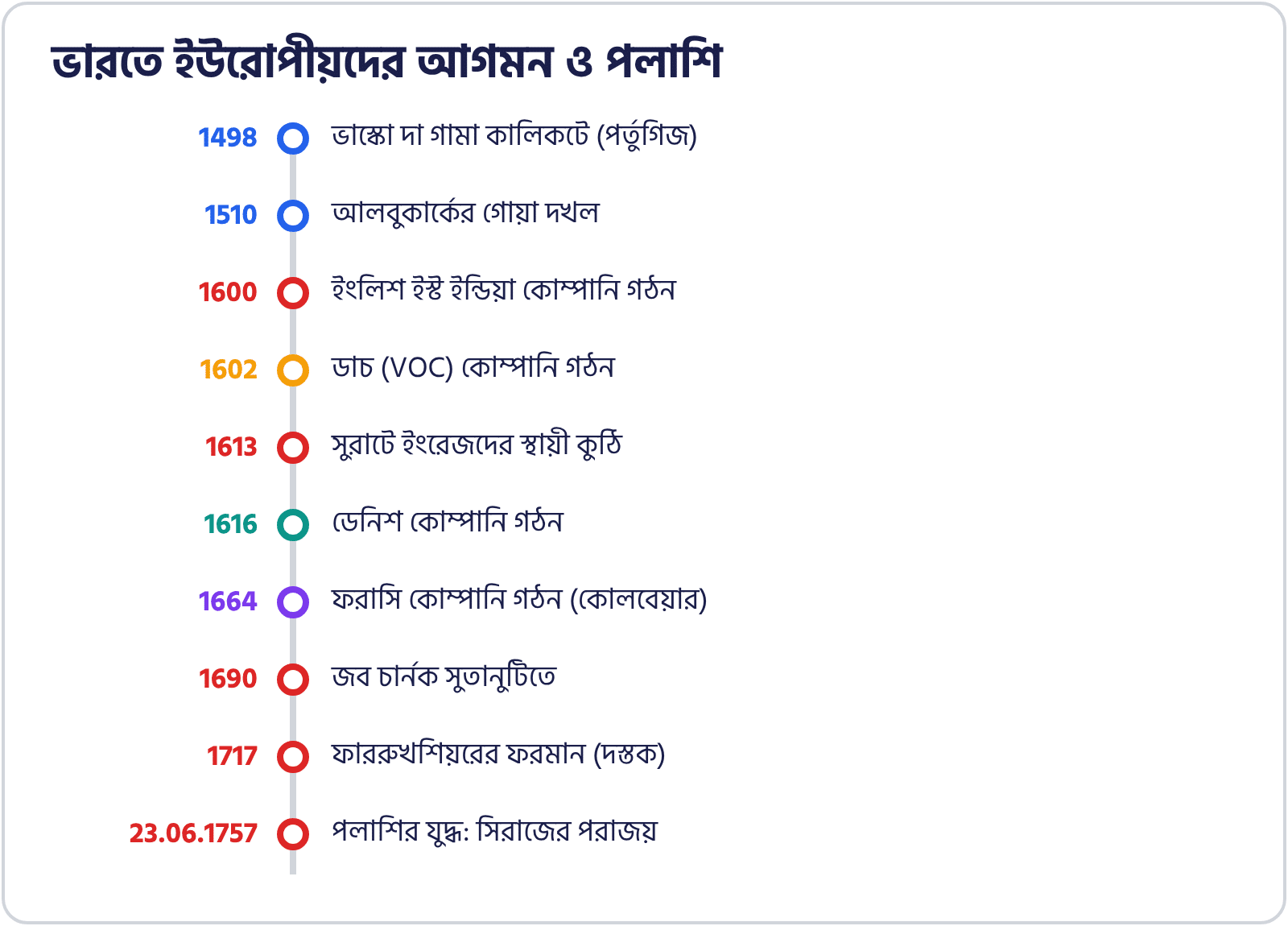
In 1498 the Portuguese navigator Vasco da Gama reached Calicut and opened the sea route to India. The Dutch, English and French came about a century or more later. The Portuguese were the first to come and the last to leave, in 1961.
- Order of arrival: Portuguese → Dutch → English → Danes → French
- Goa, Daman and Diu became part of India in 1961
- P-D-E-D-F: Portuguese, Dutch, English, Danes, French
At which Indian port did Vasco da Gama arrive in 1498?
Vasco da Gama sailed round the Cape of Good Hope and reached Calicut on the Malabar coast, ruled by the Zamorin. Goa came to the Portuguese later, in 1510. Surat is known for the first permanent English factory.
- The ruler of Calicut: the Zamorin
- Calicut is today's Kozhikode in Kerala

Who captured Goa from the Sultan of Bijapur in 1510?
The Portuguese governor Afonso de Albuquerque captured Goa in 1510, and Goa became the Portuguese headquarters. Almeida was the first Portuguese viceroy (1505), known for the Blue Water Policy. Bartolomeu Dias reached the Cape of Good Hope but never came to India.
- First viceroy: Almeida (Blue Water Policy)
- Capture of Goa: Albuquerque, 1510
- Almeida = first viceroy; Albuquerque = conqueror of Goa. Both names start with 'Al'
In which year did the English East India Company receive its charter from Queen Elizabeth I?
Queen Elizabeth I granted the Company its charter to trade in the East on 31 December 1600. 1602 is the Dutch Company (VOC), 1616 the Danish and 1664 the French.
- English 1600, Dutch 1602, Danish 1616, French 1664
- Permanent English factory at Surat: 1613
- The English Company was formed before the Dutch one, yet in the order of arrival in India the Dutch come first
| Nation | Company formed | First or main factory | Headquarters |
|---|---|---|---|
| Portuguese | (royal venture) | Calicut, Cochin | Goa |
| Dutch | 1602 (VOC) | Masulipatnam (1605) | Pulicat, later Nagapattinam |
| English | 1600 | Surat (permanent, 1613) | Surat, later Bombay, Madras, Calcutta |
| Danes | 1616 | Tranquebar (1620) | Tranquebar, Serampore |
| French | 1664 | Surat (1668) | Pondicherry |
Serampore in Bengal was a settlement of which European nation?
Serampore was a Danish settlement; the Danes sold it to the English in 1845. On the Hooghly the French held Chandernagore, the Dutch Chinsurah and the Portuguese Hooghly (Bandel).
- The other Danish settlement: Tranquebar (Tamil Nadu)
- In 1845 the Danes sold their Indian settlements to the English
- Chandernagore (French) and Chinsurah (Dutch) are neighbouring towns: they are the ones most often mixed up
- Upstream from Calcutta: English → Danes → French → Dutch → Portuguese
| Nation | Main settlement in Bengal |
|---|---|
| Portuguese | Hooghly (Bandel) |
| Dutch | Chinsurah |
| English | Calcutta (Sutanuti) |
| French | Chandernagore |
| Danes | Serampore |
On whose initiative was the French East India Company formed in 1664?
The French Company was formed in 1664 on the initiative of Colbert, minister of King Louis XIV. Dupleix later became governor at Pondicherry and fought the English in the Carnatic Wars. Lally lost the Battle of Wandiwash in 1760.
- First French factory: Surat (1668)
- Headquarters: Pondicherry; in Bengal, Chandernagore
Who set up the English settlement at Sutanuti on the Hooghly in 1690?
Job Charnock, a Company servant, settled at Sutanuti in 1690; in 1698 the Company bought the zamindari of Sutanuti, Gobindapur and Kalikata. Hawkins (1608) and Thomas Roe (1615) were English envoys at Jahangir's court. Clive was the commander at Plassey.
- The three villages: Sutanuti, Gobindapur, Kalikata (1698)
- Fort William was built here
On which date was the Battle of Plassey fought?
The Battle of Plassey was fought on 23 June 1757 at Plassey on the Bhagirathi. Siraj had taken Calcutta in June 1756, the Treaty of Alinagar was signed on 9 February 1757, and the Battle of Buxar came on 22 October 1764.
- Plassey is now in Nadia district
- Siraj's capital: Murshidabad
- "23 জুনে 57, বাংলা গেল ইংরেজের হাতে"
| Date | Event |
|---|---|
| June 1756 | Siraj takes Calcutta (Alinagar) |
| 9 February 1757 | Treaty of Alinagar |
| 23 June 1757 | Battle of Plassey |
| 22 October 1764 | Battle of Buxar |
| 1765 | Treaty of Allahabad: the Diwani |
Which of Siraj's commanders held back his troops at Plassey and later became Nawab of Bengal?
The commander-in-chief Mir Jafar plotted with the English and kept his troops out of the fight; after the battle Clive made him Nawab. Mir Madan and Mohanlal were Siraj's loyal commanders; Mir Madan was killed in the battle. Mir Qasim, Mir Jafar's son-in-law, became Nawab in 1760 and fought at Buxar.
- The plotters: Mir Jafar, Jagat Seth, Umichand, Rai Durlabh
- Loyal: Mir Madan, Mohanlal
- Mir Madan (loyal, killed at Plassey) and Mir Jafar (traitor) both begin with 'Mir'
| Item | Fact |
|---|---|
| Date | 23 June 1757 |
| Place | Plassey (Palashi), on the Bhagirathi, now in Nadia district |
| Nawab of Bengal | Siraj-ud-Daulah |
| English commander | Robert Clive |
| Traitors | Mir Jafar, Jagat Seth, Umichand, Rai Durlabh |
| Nawab's loyal commanders | Mir Madan, Mohanlal |
| Result | Mir Jafar made Nawab; British dominance in Bengal begins |
Which Mughal emperor's farman of 1717 gave the English duty-free trade in Bengal?
Emperor Farrukhsiyar's farman of 1717 let the English trade in Bengal free of duty for Rs 3,000 a year; it is called the Magna Carta of the Company. Jahangir allowed the factory at Surat (1613), and Shah Alam II granted the Diwani in 1765.
- The misuse of this farman's dastaks was one cause of Plassey
- Diwani: Shah Alam II, 1765
📊 Topic Analysis
10 questions on the arrival of the Europeans and the Battle of Plassey, each with an explanation.


Leave a Comment
Commenting as ·