
Social and Educational Reform in 19th-Century Bengal Quiz: Clerkship 2024
A little practice. A step forward.
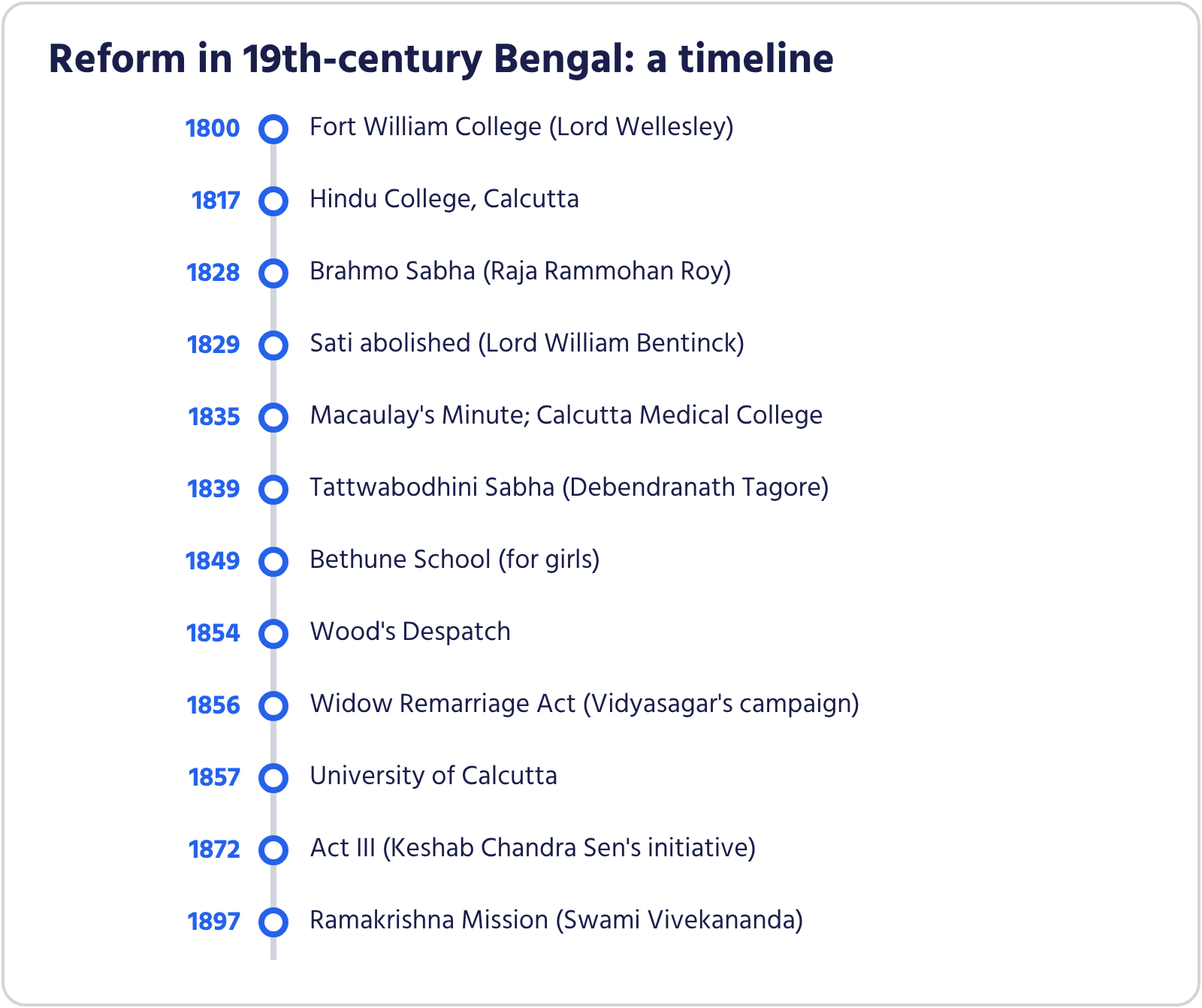
Rammohan, Vidyasagar, Derozio, Macaulay’s Minute, Wood’s Despatch: 10 questions on what the notes teach, each with an explanation. 📖 Read the detailed topic
Under which Governor-General was the practice of Sati abolished by law?
On 4 December 1829 Lord William Bentinck issued Regulation XVII, which banned Sati. It followed a long campaign by Raja Rammohan Roy. The Widow Remarriage Act (1856) was passed under Lord Canning, and Lord Wellesley founded Fort William College in 1800.
- Abolition of Sati: 1829, Regulation XVII
- Leader of the campaign: Raja Rammohan Roy
- Radhakanta Deb's Dharma Sabha (1830) opposed the law
- Sati abolished = Bentinck (1829); Widow Remarriage Act = under Canning (1856). Do not mix them up.
- Bentinck's two years: 1829 Sati abolished, 1835 English education.
| Year | Law or event | Whose campaign or initiative |
|---|---|---|
| 1829 | Abolition of Sati (Regulation XVII), under Lord William Bentinck | Raja Rammohan Roy |
| 1856 | Widow Remarriage Act (Act XV), under Lord Canning | Ishwar Chandra Vidyasagar |
| 1872 | Native Marriage Act (Act III) | Keshab Chandra Sen |
In which year was the Hindu Widows' Remarriage Act passed?
The Hindu Widows' Remarriage Act (Act XV) was passed in 1856 after Ishwar Chandra Vidyasagar's campaign. 1829 is the year Sati was abolished, 1835 is the year of Macaulay's Minute, and the Native Marriage Act (Act III) was passed in 1872.
- The law: Act XV of 1856
- Leader of the campaign: Ishwar Chandra Vidyasagar
- Vidyasagar became Principal of Sanskrit College in 1851
- 27 years apart: 1829 Sati abolished, 1856 Widow Remarriage Act.
| Year | Law or event | Whose campaign or initiative |
|---|---|---|
| 1829 | Abolition of Sati (Regulation XVII), under Lord William Bentinck | Raja Rammohan Roy |
| 1856 | Widow Remarriage Act (Act XV), under Lord Canning | Ishwar Chandra Vidyasagar |
| 1872 | Native Marriage Act (Act III) | Keshab Chandra Sen |
In which year was Hindu College founded in Calcutta?
Hindu College was founded in 1817; David Hare and Radhakanta Deb were among those behind it. It was renamed Presidency College in 1855. 1800 is the year of Fort William College, 1824 of Sanskrit College in Calcutta and 1857 of the University of Calcutta.
- Hindu College: 1817
- Renamed Presidency College in 1855
- Derozio joined it as a teacher in 1826
| Year | Institution | Name linked with it |
|---|---|---|
| 1781 | Calcutta Madrasa | Warren Hastings |
| 1800 | Fort William College | Lord Wellesley |
| 1817 | Hindu College | David Hare, Radhakanta Deb |
| 1818 | Serampore College | Carey, Marshman, Ward |
| 1824 | Sanskrit College, Calcutta | Government initiative |
| 1835 | Calcutta Medical College | Lord William Bentinck |
| 1849 | Bethune School | Drinkwater Bethune |
| 1857 | University of Calcutta | On the recommendation of Wood's Despatch |
Who led the 'Young Bengal' group?
The rationalist students of Derozio, a young teacher of Hindu College, came to be known as Young Bengal. He founded the Academic Association in 1828. David Hare helped found Hindu College, William Carey belonged to the Serampore Mission and Alexander Duff was a Scottish missionary educator.
- Derozio joined Hindu College in 1826
- Academic Association: 1828
- He had to leave the college in 1831 and died the same year
- Derozio = Young Bengal = Academic Association: remember the three together.
Who founded the Tattwabodhini Sabha in 1839?
Debendranath Tagore founded the Tattwabodhini Sabha in 1839, and the Tattwabodhini Patrika came out in 1843 with Akshay Kumar Datta as editor. Rammohan Roy founded the Brahmo Sabha (1828), Keshab Chandra Sen the Brahmo Samaj of India (1866), and Shibnath Shastri and others the Sadharan Brahmo Samaj (1878).
- Tattwabodhini Sabha: 1839, Debendranath Tagore
- Tattwabodhini Patrika: 1843, editor Akshay Kumar Datta
- Debendranath led the Brahmo movement after Rammohan
| Year | Organisation | Leader |
|---|---|---|
| 1828 | Brahmo Sabha | Raja Rammohan Roy |
| 1839 | Tattwabodhini Sabha | Debendranath Tagore |
| 1866 | Brahmo Samaj of India | Keshab Chandra Sen |
| 1878 | Sadharan Brahmo Samaj | Shibnath Shastri, Ananda Mohan Bose |
Which of these is called the 'Magna Carta' of English education in India?
Charles Wood's Despatch of 1854 recommended a complete structure of education from the primary stage to the university, so it is called the Magna Carta of English education in India. Macaulay's Minute only argued for English as the medium, the Charter Act of 1813 set aside Rs 1 lakh a year for education, and the Hunter Commission came later, in 1882.
- Wood's Despatch: 1854, Charles Wood
- On its recommendation, universities at Calcutta, Bombay and Madras in 1857
- It recommended an education department in every province
- 13, 35, 54, 82: Charter Act, Macaulay, Wood, Hunter. Remember them in rising order.
| Year | Document | Main point |
|---|---|---|
| 1813 | Charter Act | Rs 1 lakh a year for education |
| 1835 | Macaulay's Minute | Western education through English |
| 1854 | Wood's Despatch | A full structure from primary school to university |
| 1882 | Hunter Commission | Review of primary and secondary education |
In which year was the University of Calcutta founded?
The University of Calcutta was founded in 1857 on the recommendation of Wood's Despatch (1854); universities were set up at Bombay and Madras in the same year. 1835 is the year of Calcutta Medical College and 1849 of Bethune School. 1854 is the year of the recommendation, not of the founding.
- University of Calcutta: 1857
- Bombay and Madras universities in the same year
- In 1883 Kadambini Ganguly and Chandramukhi Basu became the first women graduates
- 1854 = Wood's Despatch (the recommendation); 1857 = the university founded.
Who brought out the newspaper 'Sambad Kaumudi'?
Raja Rammohan Roy brought out the Bengali weekly 'Sambad Kaumudi' in 1821 and wrote in it against Sati. Ishwar Chandra Gupta's paper was 'Sambad Prabhakar', Harish Chandra Mukherjee's was the 'Hindoo Patriot', and 'Samachar Darpan' came out from Serampore under Marshman's editorship.
- Sambad Kaumudi: 1821, in Bengali
- Rammohan's Persian paper: Mirat-ul-Akhbar (1822)
- Samachar Darpan: 1818, Serampore Mission
| Paper | Year | Name linked with it |
|---|---|---|
| Samachar Darpan | 1818 | Marshman (Serampore Mission) |
| Sambad Kaumudi | 1821 | Raja Rammohan Roy |
| Sambad Prabhakar | 1831 | Ishwar Chandra Gupta |
| Tattwabodhini Patrika | 1843 | Debendranath Tagore, Akshay Kumar Datta |
| Hindoo Patriot | 1853 | Harish Chandra Mukherjee |
Who founded the Ramakrishna Mission in 1897?
Swami Vivekananda founded the Ramakrishna Mission in 1897 in the name of his guru Sri Ramakrishna; its ideal is service to man as service to God. Sri Ramakrishna died in 1886, before the Mission was founded. Keshab Chandra Sen and Bijoy Krishna Goswami were linked with the Brahmo movement.
- Ramakrishna Mission: 1897
- Vivekananda spoke at the Chicago Parliament of Religions in 1893
- Sri Ramakrishna died in 1886
- The Mission bears Ramakrishna's name, but its founder is Vivekananda.
- 1893 = the Chicago address; 1897 = the Mission founded.
How much did the Charter Act of 1813 set aside each year for the education of Indians?
The Charter Act of 1813 asked the East India Company to spend Rs 1 lakh a year on the education of Indians. It was the Company's first official grant for education. Whether the money should go to Oriental or Western learning became the Orientalist-Anglicist controversy, which was settled by Macaulay's Minute in 1835.
- Charter Act: 1813
- Grant: Rs 1 lakh a year
- The General Committee of Public Instruction was formed in 1823
| Year | Document | Main point |
|---|---|---|
| 1813 | Charter Act | Rs 1 lakh a year for education |
| 1835 | Macaulay's Minute | Western education through English |
| 1854 | Wood's Despatch | A full structure from primary school to university |
| 1882 | Hunter Commission | Review of primary and secondary education |
📊 Topic Analysis
Rammohan, Vidyasagar, Derozio, Macaulay’s Minute, Wood’s Despatch: 10 questions on what the notes teach, each with an explanation.
Related Posts

Everyday Science Mixed Quiz 5: Sound, Electricity and Household Chemistry, WBPSC Clerkship GS

Diseases, Germs and Vaccines Quiz: Clerkship GS Practice

India Geography Mixed Quiz 5: Himalayan Ranges, Passes, Rivers, Dams, Lakes and Channels (Clerkship 2024)

Leave a Comment
Commenting as ·