
Everyday Science Mixed Quiz 5: Sound, Electricity and Household Chemistry, WBPSC Clerkship GS
A little practice. A step forward.
WBPSC Clerkship 2024 Part-I General Studies: 20 everyday science questions, each with an explanation.
In which of the following media is the speed of sound the greatest?
Sound travels through the vibration of particles, so the more closely and firmly the particles are bound, the faster it travels. In steel sound moves at about 5,960 m/s, in water about 1,498 m/s and in air only about 346 m/s. A vacuum has no particles, so sound cannot travel there at all.
- Speed of sound: solids > liquids > gases
- Sound is a mechanical wave and needs a medium
- There is no air on the Moon, so astronauts talk by radio
- Light is fastest in a vacuum, but sound cannot travel through a vacuum at all
- Solid-liquid-gas: sound goes from fast to slow; light is the reverse (fastest in a vacuum)
| Medium | Speed of sound (m/s, approx.) |
|---|---|
| Air (25°C) | 346 |
| Water (distilled, 25°C) | 1,498 |
| Iron | 5,950 |
| Steel | 5,960 |
Source: NCERT Class 9, chapter on Sound
Speed of sound in different media
In which unit is the loudness of sound measured?
The loudness level of sound is measured in decibels (dB). The hertz (Hz) is the unit of frequency, which sets the pitch of a sound, not its loudness. The watt is the unit of power and the newton the unit of force.
- Loudness: decibel (dB)
- Frequency or pitch: hertz (Hz)
- Humans usually hear sounds from 20 Hz to 20,000 Hz
- Decibel = loudness, hertz = frequency; mixing them up is the most common slip
To hear a distinct echo, what is the approximate minimum distance needed in air between the listener and the reflecting surface?
The sensation of a sound stays in the ear for about 0.1 s, so the echo must return at least 0.1 s later to be heard separately. In that time the sound goes and comes back, so the distance is $d = \frac{v \times t}{2} = \frac{344 \times 0.1}{2} = 17.2$ m, that is about 17 m. 34 m is the total path there and back, not the one-way distance.
- The sensation of sound persists for about 0.1 s
- Sound touches the reflector and returns, so the path is twice the distance
- Bats and SONAR make use of echoes
- 34 m is the round trip; the question asks for the distance to the reflector, so half: about 17 m
Working: taking the speed of sound in air as $v = 344$ m/s, in $t = 0.1$ s sound travels $344 \times 0.1 = 34.4$ m. That path goes to the reflector and back, so the reflector is $34.4 \div 2 = 17.2$ m away. In warmer air the speed rises, and so does this distance, slightly.
What is the frequency of the alternating current (AC) supplied to homes in India?
Household electricity in India is alternating current with a frequency of 50 Hz: it goes through 50 full cycles of reversing its direction every second. 60 Hz is used in some countries such as the USA. The number 220 belongs to the voltage (220 V), not the frequency.
- Household AC in India: frequency 50 Hz
- Voltage and frequency are different: volts and hertz
- AC can be stepped up or down easily with a transformer, which helps to send it far
- 220 is the voltage, not the frequency; 60 Hz is the American value
The '1 unit' of electricity shown on an electricity bill is equal to what?
One unit on the bill is 1 kilowatt-hour (kWh): the energy used when a 1,000-watt appliance runs for 1 hour. It is the commercial unit of energy, $1 \text{ kWh} = 3.6 \times 10^{6}$ joules. The kilowatt and the watt are units of power, not energy; the joule is a unit of energy but far too small for a bill.
- 1 unit = 1 kWh = 3.6 million joules
- Energy = power × time
- The watt is the unit of power, the joule the SI unit of energy
- Kilowatt (power) and kilowatt-hour (energy) are different: the bill charges for energy
Example: a 1,000 W heater used for 2 hours a day uses $1 \text{ kW} \times 2 \text{ h} = 2$ kWh, that is 2 units. In 30 days, $2 \times 30 = 60$ units.
An electric motor (such as the motor of a fan) converts which energy into which?
A motor takes electrical energy and turns, that is, it converts electrical energy into mechanical energy; fans, mixers and pumps all work this way. A generator (dynamo) does exactly the reverse: mechanical energy into electrical energy. A battery or cell converts chemical energy into electrical energy.
- Motor: electrical → mechanical
- Generator or dynamo: mechanical → electrical
- Battery: chemical → electrical
- A motor and a generator do opposite jobs; the first option describes a generator
- A motor 'eats' electricity and turns; a generator turns and 'makes' electricity
Which acid causes the burning pain of an ant bite?
An ant's sting contains formic acid (methanoic acid), which is also found in the hairs of nettle leaves. Applying a mild base such as baking soda neutralises the acid and eases the pain. Citric acid is in lemons, acetic acid in vinegar and lactic acid in sour curd.
- Ants and nettles: formic (methanoic) acid
- Remedy: a mild base such as baking soda
- Acid + base = salt + water (neutralisation)
- 'Formica' is Latin for ant, so the ant's acid is formic
| Found in | Acid |
|---|---|
| Ant and nettle stings | Formic (methanoic) acid |
| Vinegar | Acetic (ethanoic) acid |
| Lemon, orange | Citric acid |
| Sour curd, tired muscles | Lactic acid |
| Tamarind | Tartaric acid |
| Stomach | Hydrochloric acid |
Which acid is produced in our stomach?
Glands in the stomach wall secrete hydrochloric acid (HCl); it kills germs in food and activates pepsin, the enzyme that digests protein. Too much acid causes acidity, and a mild base such as milk of magnesia (magnesium hydroxide) neutralises it as an antacid. Sulphuric and nitric acids are strong industrial acids, not made in the body.
- Stomach acid: hydrochloric acid (HCl)
- Its work: kills germs, activates pepsin
- Antacids: mild bases such as milk of magnesia and baking soda
| Found in | Acid |
|---|---|
| Ant and nettle stings | Formic (methanoic) acid |
| Vinegar | Acetic (ethanoic) acid |
| Lemon, orange | Citric acid |
| Sour curd, tired muscles | Lactic acid |
| Tamarind | Tartaric acid |
| Stomach | Hydrochloric acid |
What is the chemical name of bleaching powder, used to disinfect water?
The chemical name of bleaching powder is calcium oxychloride (CaOCl₂); it is made by the action of chlorine on dry slaked lime. Its chlorine kills germs, so it is used to treat drinking water and well water, and also to bleach cloth. Calcium carbonate is limestone, calcium sulphate is in gypsum, and sodium chloride is common salt.
- Bleaching powder: CaOCl₂, calcium oxychloride
- Made from slaked lime [Ca(OH)₂] and chlorine
- Uses: disinfecting water, bleaching
| Common name | Chemical name | Formula | Use |
|---|---|---|---|
| Baking soda | Sodium bicarbonate | NaHCO₃ | Raising cakes and bread, antacid |
| Washing soda | Sodium carbonate (with ten water molecules) | Na₂CO₃·10H₂O | Washing clothes, softening hard water |
| Bleaching powder | Calcium oxychloride | CaOCl₂ | Disinfecting water, bleaching cloth |
| Plaster of Paris | Calcium sulphate hemihydrate | CaSO₄·½H₂O | Plaster for broken bones, statues, ceiling designs |
| Gypsum | Calcium sulphate dihydrate | CaSO₄·2H₂O | Cement, making Plaster of Paris |
Which mineral is heated to make Plaster of Paris?
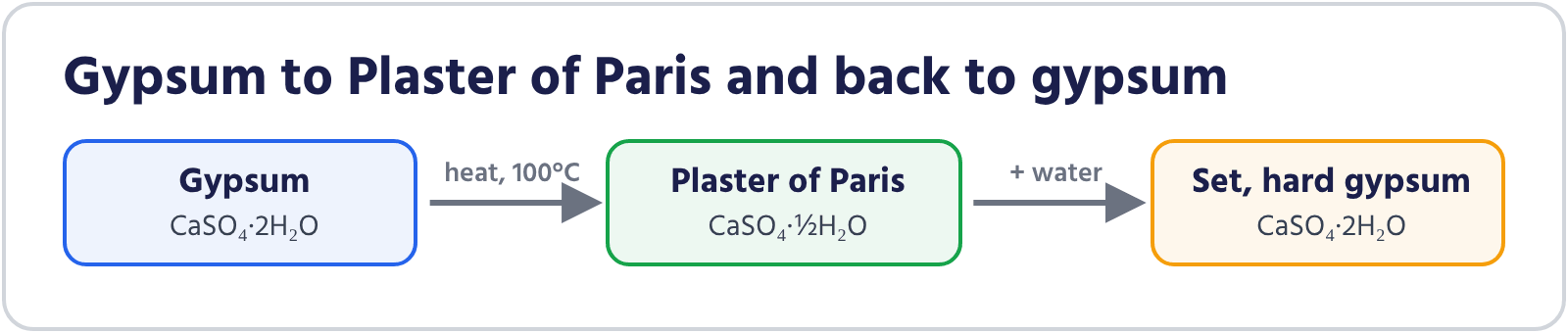
When gypsum (CaSO₄·2H₂O) is heated at about 373 K (100°C) it loses part of its water and becomes Plaster of Paris (CaSO₄·½H₂O). Mixed with water, Plaster of Paris turns back into gypsum and sets hard, which is why it holds broken bones in place and is used for statues. Limestone gives lime, bauxite aluminium and haematite iron.
- Gypsum → heat → Plaster of Paris
- Plaster of Paris + water → hard, set gypsum
- Uses: plaster for bones, statues, toys, ceiling designs
| Common name | Chemical name | Formula | Use |
|---|---|---|---|
| Baking soda | Sodium bicarbonate | NaHCO₃ | Raising cakes and bread, antacid |
| Washing soda | Sodium carbonate (with ten water molecules) | Na₂CO₃·10H₂O | Washing clothes, softening hard water |
| Bleaching powder | Calcium oxychloride | CaOCl₂ | Disinfecting water, bleaching cloth |
| Plaster of Paris | Calcium sulphate hemihydrate | CaSO₄·½H₂O | Plaster for broken bones, statues, ceiling designs |
| Gypsum | Calcium sulphate dihydrate | CaSO₄·2H₂O | Cement, making Plaster of Paris |
What is the chemical name of washing soda?
Washing soda is sodium carbonate with ten molecules of water (Na₂CO₃·10H₂O); it is used for washing clothes and softening hard water. Sodium bicarbonate (NaHCO₃) is baking soda, used in cooking. Sodium chloride is common salt and sodium hydroxide is caustic soda.
- Washing soda: Na₂CO₃·10H₂O
- Baking soda: NaHCO₃
- Caustic soda: NaOH
- Washing soda (sodium carbonate) and baking soda (sodium bicarbonate) sound alike but do different jobs
- Washing soda is the 'carbonate', baking soda the 'bi'-carbonate
| Common name | Chemical name | Formula | Use |
|---|---|---|---|
| Baking soda | Sodium bicarbonate | NaHCO₃ | Raising cakes and bread, antacid |
| Washing soda | Sodium carbonate (with ten water molecules) | Na₂CO₃·10H₂O | Washing clothes, softening hard water |
| Bleaching powder | Calcium oxychloride | CaOCl₂ | Disinfecting water, bleaching cloth |
| Plaster of Paris | Calcium sulphate hemihydrate | CaSO₄·½H₂O | Plaster for broken bones, statues, ceiling designs |
| Gypsum | Calcium sulphate dihydrate | CaSO₄·2H₂O | Cement, making Plaster of Paris |
Which gas is commonly used in fire extinguishers?
Carbon dioxide does not burn and does not help other things burn, and being heavier than air it covers the fire like a blanket and cuts it off from oxygen. That is why fire extinguishers use it; it is also safe on electrical fires where water is not. Oxygen helps burning, while hydrogen and methane are themselves flammable.
- CO₂: non-flammable, does not support burning, heavier than air
- A fire needs fuel, heat and oxygen
- Water on an electrical or oil fire is dangerous
| Gas | Common name or use |
|---|---|
| Nitrous oxide (N₂O) | Laughing gas, mild anaesthesia |
| Solid carbon dioxide | Dry ice |
| Carbon dioxide | Fire extinguishers, soda water |
| Butane and propane | Main components of LPG |
| Ethyl mercaptan | Added to LPG for its smell |
| Ethylene | The fruit-ripening hormone |
When cooking gas (LPG) leaks, the strong smell comes from which compound?
LPG is mainly butane and propane, which have no smell of their own. So that a leak can be noticed, a little strong-smelling ethyl mercaptan (a sulphur compound) is added. Methane is the main part of CNG and biogas, and carbon monoxide, though poisonous, has no smell.
- LPG: mainly butane and propane, odourless
- Ethyl mercaptan is added for the smell
- If you smell gas, close the regulator and do not use switches or flames
- Butane is in LPG, but the smell is not butane's: it is the added mercaptan's
| Gas | Common name or use |
|---|---|
| Nitrous oxide (N₂O) | Laughing gas, mild anaesthesia |
| Solid carbon dioxide | Dry ice |
| Carbon dioxide | Fire extinguishers, soda water |
| Butane and propane | Main components of LPG |
| Ethyl mercaptan | Added to LPG for its smell |
| Ethylene | The fruit-ripening hormone |
Which gas is known as 'laughing gas'?
Breathing nitrous oxide (N₂O) brings mild drowsiness and a laughing mood, hence the name laughing gas; it has been used for mild anaesthesia in dentistry. Nitric oxide (NO) and nitrogen dioxide (NO₂) are other oxides of nitrogen, linked to air pollution and acid rain. Ammonia is a pungent, alkaline gas.
- Laughing gas: nitrous oxide, N₂O
- Use: mild anaesthesia
- NO and NO₂: pollutants, causes of acid rain
- Nitrous (N₂O) and nitric (NO) sound alike; laughing gas is nitrous
| Gas | Common name or use |
|---|---|
| Nitrous oxide (N₂O) | Laughing gas, mild anaesthesia |
| Solid carbon dioxide | Dry ice |
| Carbon dioxide | Fire extinguishers, soda water |
| Butane and propane | Main components of LPG |
| Ethyl mercaptan | Added to LPG for its smell |
| Ethylene | The fruit-ripening hormone |
What mainly causes the hardness (temporary and permanent) of water?
Water with dissolved salts of calcium and magnesium is hard: soap does not lather in it and scum forms. Their bicarbonates cause temporary hardness, removed simply by boiling; their chlorides and sulphates cause permanent hardness, which needs a chemical such as washing soda. Sodium and potassium salts do not make water hard.
- Cause of hardness: Ca and Mg salts
- Temporary hardness (bicarbonates): removed by boiling
- Permanent hardness (chlorides, sulphates): removed with washing soda
Which is the smallest bone in the human body?
The stapes (shaped like a stirrup), one of the three tiny bones of the middle ear, is the smallest bone in the body, only about 3 mm long. The three middle-ear bones (malleus, incus, stapes) carry the vibrations of sound to the inner ear. The femur (thigh bone) is the longest and strongest bone; the radius is in the arm and the tibia in the leg.
- Smallest bone: stapes (middle ear)
- Longest bone: femur (thigh)
- An adult human has 206 bones
- Smallest is the stapes, longest the femur: check whether the question says 'smallest' or 'longest'
- The ear's three bones: hammer (malleus), anvil (incus), stirrup (stapes)
Which plant hormone helps fruits ripen?
Ethylene is a gaseous plant hormone that ripens fruit; that is why raw fruit kept beside ripe fruit ripens faster. Auxin controls the growth of stems and roots and their bending towards light, gibberellin makes stems longer, and cytokinin helps cell division.
- Ethylene: a gaseous hormone, ripens fruit
- Auxin: growth and bending towards light
- Gibberellin: stem length; cytokinin: cell division
- Ethylene is the only gaseous hormone, and it is the one that ripens fruit
| Plant hormone | Main role |
|---|---|
| Auxin | Growth of stem and root, bending towards light |
| Gibberellin | Stem lengthening, seed germination |
| Cytokinin | Cell division |
| Ethylene | Fruit ripening |
| Abscisic acid | Stops growth, leaf fall |
Which gases are mainly responsible for acid rain?
Burning coal, petrol and diesel releases sulphur dioxide and oxides of nitrogen into the air; these combine with water vapour to form sulphuric and nitric acids that come down with the rain. Acid rain damages marble monuments such as the Taj Mahal and makes soil and water bodies acidic. CFCs cause the depletion of the ozone layer, not acid rain.
- Acid rain: from SO₂ and oxides of nitrogen
- They come down as sulphuric and nitric acids
- Damage: marble monuments, soil, aquatic life
- CFCs = ozone depletion; SO₂ and oxides of nitrogen = acid rain
What does an anemometer measure?
An anemometer measures wind speed; a common anemometer has a few cups that spin in the wind, and the rate of spinning gives the speed. Air pressure is measured by a barometer, humidity by a hygrometer and rainfall by a rain gauge. A weather station keeps all of these together.
- Anemometer: wind speed
- Wind vane: direction of the wind
- Greek 'anemos' means wind
| Instrument | Measures |
|---|---|
| Anemometer | Wind speed |
| Barometer | Atmospheric pressure |
| Hygrometer | Humidity of the air |
| Rain gauge | Amount of rainfall |
| Seismograph | Earthquake vibrations |
| Lactometer | Purity of milk (specific gravity) |
A 'light-year' is a unit of what?
A light-year is the distance light travels in a vacuum in one year, so it is a unit of distance, not time. Light travels at about $3 \times 10^{8}$ m/s, so one light-year is about $9.46 \times 10^{15}$ m. It is used for the huge distances to the stars.
- Light-year: a unit of distance
- 1 light-year ≈ $9.46 \times 10^{15}$ m
- Sunlight takes about 8 minutes 20 seconds to reach the Earth
- The word 'year' makes it sound like time, but it is a distance
📊 Topic Analysis
WBPSC Clerkship 2024 Part-I General Studies: 20 everyday science questions, each with an explanation.


Leave a Comment
Commenting as ·