
Clerkship 2024 Practice Quiz: Fractions, Part 2
A little practice. A step forward.
12 new questions on the LCM and HCF of fractions, lowest terms, complex fractions and ‘fraction of the remainder’ sums, each with a worked explanation. 📖 Read the detailed topic
What is $\frac{144}{180}$ in its lowest terms?
The HCF of 144 and 180 is 36. Dividing both terms by 36 gives $\frac{144 \div 36}{180 \div 36} = \frac{4}{5}$. 4 and 5 share no common factor, so this is the lowest form. Check: $5 \times 36 = 180$ and $4 \times 36 = 144$.
- In lowest terms the HCF of numerator and denominator is 1
- Dividing both terms by their HCF gives the lowest form in one step
- Cancelling by 2 and 3 step by step gives the same result: 144 and 180 → 72 and 90 → 36 and 45 → 4 and 5
- First try the difference of the two numbers (36 here): the HCF is always a factor of the difference
What is the LCM of $\frac{2}{3}$, $\frac{4}{9}$ and $\frac{5}{6}$?
LCM of fractions = LCM of the numerators ÷ HCF of the denominators. The LCM of 2, 4, 5 is 20 and the HCF of 3, 9, 6 is 3, so the answer is $\frac{20}{3}$. $\frac{10}{9}$ comes from wrongly taking the LCM (18) of the denominators as well; $\frac{1}{18}$ is their HCF.
- LCM of fractions = LCM of numerators ÷ HCF of denominators
- Reduce every fraction to its lowest terms before using the formula
- The LCM divided by each fraction must give a whole number
- For the LCM: LCM on top, HCF below; taking the LCM in both places gives $\frac{10}{9}$, which is wrong
| Fraction | $\frac{20}{3}$ divided by it |
|---|---|
| $\frac{2}{3}$ | $\frac{20}{3} \times \frac{3}{2} = 10$ |
| $\frac{4}{9}$ | $\frac{20}{3} \times \frac{9}{4} = 15$ |
| $\frac{5}{6}$ | $\frac{20}{3} \times \frac{6}{5} = 8$ |
Check: all three quotients are whole numbers
What is the HCF of $\frac{3}{4}$, $\frac{9}{10}$ and $\frac{15}{16}$?
HCF of fractions = HCF of the numerators ÷ LCM of the denominators. The HCF of 3, 9, 15 is 3 and the LCM of 4, 10, 16 is 80, so the answer is $\frac{3}{80}$. $\frac{45}{2}$ is their LCM, and $\frac{3}{2}$ comes from wrongly taking the HCF of the denominators as well.
- HCF of fractions = HCF of numerators ÷ LCM of denominators
- The HCF is never larger than any of the fractions
- Check: $\frac{3}{4} \div \frac{3}{80} = 20$, $\frac{9}{10} \div \frac{3}{80} = 24$, $\frac{15}{16} \div \frac{3}{80} = 25$
- What is asked goes on top, its opposite below: for the HCF, HCF on top and LCM below
What is the value of $2 + \frac{1}{3 + \frac{1}{4}}$?
Start from the bottom: $3 + \frac{1}{4} = \frac{13}{4}$. Its reciprocal is $\frac{4}{13}$, so the value is $2 + \frac{4}{13} = \frac{26 + 4}{13} = \frac{30}{13}$. $\frac{15}{7}$ comes from taking the bottom as 3 + 4 = 7, and $\frac{29}{12}$ from adding $\frac{1}{3}$ and $\frac{1}{4}$ separately; both are wrong.
- A complex (continued) fraction is always simplified from the lowest part upwards
- Dividing 1 by a fraction just inverts it: $1 \div \frac{13}{4} = \frac{4}{13}$
- As a mixed number the answer is $2\frac{4}{13}$
- $\frac{1}{3 + \frac{1}{4}}$ is not $\frac{1}{3} + \frac{1}{4}$: the first is $\frac{4}{13}$, the second $\frac{7}{12}$
$\frac{1}{5}$ of a pole is in the mud, $\frac{3}{8}$ of the remainder is in water and 10 metres stand above the water. How long is the pole?
$\frac{1}{5}$ is in the mud, so $\frac{4}{5}$ remains. The part in water is $\frac{3}{8}$ of that remainder: $\frac{4}{5} \times \frac{3}{8} = \frac{3}{10}$. Above the water is $1 - \frac{1}{5} - \frac{3}{10} = \frac{1}{2}$ of the pole = 10 metres, so the pole is 20 metres. Check: 4 in mud, 16 left, $\frac{3}{8}$ of it = 6 in water, 10 metres above.
- A fraction 'of the remainder' must first be turned into a fraction of the whole pole (by multiplying)
- All parts add up to 1: $\frac{1}{5} + \frac{3}{10} + \frac{1}{2} = 1$
- Divide the given length by the fraction it stands for to get the whole length
- $\frac{3}{8}$ is of the remaining $\frac{4}{5}$, not of the whole pole; $1 - \frac{1}{5} - \frac{3}{8}$ gives a wrong answer
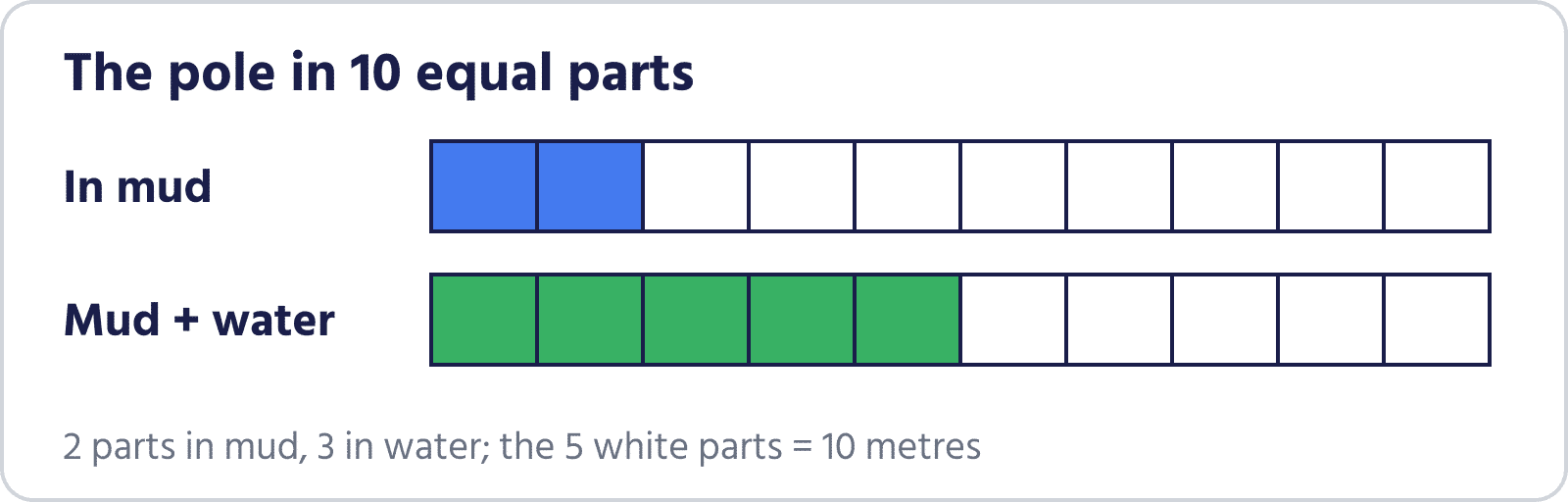
- Take the pole as 10 equal parts: 2 in mud, 3 in water, 5 above = 10 metres, so 1 part = 2 metres
The denominator of a fraction is 4 more than its numerator. If 1 is subtracted from both the numerator and the denominator, the fraction becomes $\frac{1}{3}$. What is the fraction?
Let the numerator be x, so the denominator is x + 4. Then $\frac{x - 1}{x + 3} = \frac{1}{3}$, so 3x − 3 = x + 3 and x = 3. The fraction is $\frac{3}{7}$; check: $\frac{3 - 1}{7 - 1} = \frac{2}{6} = \frac{1}{3}$. The other options also have a denominator 4 more than the numerator, but subtracting 1 gives $\frac{4}{8}$, $\frac{6}{10}$ and $\frac{0}{4}$, none of which is $\frac{1}{3}$.
- Call the numerator x, write the denominator in x, then cross-multiply
- In an MCQ, testing the options against the condition is the fastest way
- Subtracting the same number from numerator and denominator changes the value of a fraction
- Test the second condition on the options first: the one that fits is the answer
Instead of dividing a number by $\frac{3}{4}$, a student multiplied it by $\frac{3}{4}$ by mistake. His answer was 21 less than the correct answer. What is the number?
If the number is x, the correct answer is $x \div \frac{3}{4} = \frac{4x}{3}$ and the wrong one is $\frac{3x}{4}$. The difference is $\frac{4x}{3} - \frac{3x}{4} = \frac{16x - 9x}{12} = \frac{7x}{12} = 21$, so x = 36. Check: $36 \times \frac{4}{3} = 48$ and $36 \times \frac{3}{4} = 27$, a difference of 21.
- Dividing by $\frac{3}{4}$ means multiplying by $\frac{4}{3}$
- Dividing by a proper fraction makes a number larger, multiplying makes it smaller
- The difference as a fraction: $\frac{4}{3} - \frac{3}{4} = \frac{7}{12}$
- For $\frac{a}{b}$ the difference is $\frac{b^{2} - a^{2}}{ab}$ of the number: here $\frac{16 - 9}{12} = \frac{7}{12}$
What is the value of $\frac{1}{6} + \frac{1}{12} + \frac{1}{20} + \frac{1}{30}$?
Each denominator is a product of two consecutive numbers: $6 = 2 \times 3$, $12 = 3 \times 4$, $20 = 4 \times 5$, $30 = 5 \times 6$. So each term splits: $\frac{1}{6} = \frac{1}{2} - \frac{1}{3}$, $\frac{1}{12} = \frac{1}{3} - \frac{1}{4}$ and so on. The middle terms cancel, leaving $\frac{1}{2} - \frac{1}{6} = \frac{1}{3}$. Check with the common denominator 60: $\frac{10 + 5 + 3 + 2}{60} = \frac{20}{60} = \frac{1}{3}$.
- $\frac{1}{n(n+1)} = \frac{1}{n} - \frac{1}{n+1}$
- In such a sum only the first and the last terms survive; the middle ones cancel
- If time allows, confirm once with the LCM
- Answer = $\frac{1}{\text{first}} - \frac{1}{\text{last}}$: here $\frac{1}{2} - \frac{1}{6}$
$$\left(\frac{1}{2} - \frac{1}{3}\right) + \left(\frac{1}{3} - \frac{1}{4}\right) + \left(\frac{1}{4} - \frac{1}{5}\right) + \left(\frac{1}{5} - \frac{1}{6}\right) = \frac{1}{2} - \frac{1}{6} = \frac{1}{3}$$
What fraction of 2 hours is 45 minutes?
First use the same unit: 2 hours = 120 minutes. The fraction is $\frac{45}{120}$; dividing both terms by 15 gives $\frac{3}{8}$. $\frac{3}{4}$ comes from using 1 hour (60 minutes), and $\frac{9}{20}$ from treating an hour as 100 minutes and dividing 45 by 100; both are wrong.
- 'What fraction of B is A' means A ÷ B, with both in the same unit first
- 1 hour = 60 minutes, not 100
- Always give the answer in lowest terms
- 45 minutes is $\frac{3}{4}$ of 1 hour but $\frac{3}{8}$ of 2 hours: check what the whole is
The difference between $\frac{3}{4}$ and $\frac{2}{3}$ of a number is 15. What is the number?
The two parts differ by $\frac{3}{4} - \frac{2}{3} = \frac{9 - 8}{12} = \frac{1}{12}$. So $\frac{1}{12}$ of the number is 15 and the number is $15 \times 12 = 180$. Check: $\frac{3}{4}$ of 180 = 135 and $\frac{2}{3}$ of 180 = 120, a difference of 15.
- The difference of two parts of one number = the difference of the fractions × the number
- $\frac{3}{4} - \frac{2}{3} = \frac{1}{12}$
- Divide the value of a part by its fraction to get the whole number
- Subtract the fractions first, then divide once: no need for two separate sums
What is the value of $3\frac{1}{3} \times 1\frac{4}{5} \div 2\frac{1}{4}$?
Change the mixed numbers to improper fractions: $\frac{10}{3} \times \frac{9}{5} \div \frac{9}{4}$. The first two give $\frac{90}{15} = 6$; then invert the divisor and multiply: $6 \times \frac{4}{9} = \frac{24}{9} = \frac{8}{3} = 2\frac{2}{3}$. Multiplying without inverting gives $6 \times \frac{9}{4} = 13\frac{1}{2}$, which is wrong.
- Change mixed numbers to improper fractions before multiplying or dividing
- When × and ÷ stand side by side, work from left to right
- Only the fraction right after the ÷ sign is inverted
- Whole parts and fractions cannot be multiplied separately: $3\frac{1}{3} \times 1\frac{4}{5}$ is not $3 \times 1$ and $\frac{1}{3} \times \frac{4}{5}$
$\frac{4}{7}$ of the students in a class are girls. If there are 18 boys, how many girls are there?
Girls are $\frac{4}{7}$, so boys are $1 - \frac{4}{7} = \frac{3}{7}$ of the class = 18. So $\frac{1}{7}$ of the class is 6 and the girls number $4 \times 6 = 24$. 42 is the total strength ($7 \times 6$), which the question does not ask for.
- When one part is given, the other part = 1 − that fraction
- Find the value of 1 part first, then multiply by the number of parts needed
- Girls : boys = 4 : 3
- 18 is the number of boys, not the total; and the question asks for the girls (24), not the total (42)
📊 Topic Analysis
12 new questions on the LCM and HCF of fractions, lowest terms, complex fractions and ‘fraction of the remainder’ sums, each with a worked explanation.


Leave a Comment
Commenting as ·