
Divisibility Part 2: Remainders and Missing Digits Practice Quiz (Clerkship)
A little practice. A step forward.
12 questions on remainder shortcuts, two missing digits, counting multiples and the 1001 trick, each answer worked out. 📖 Read the detailed topic
What is the remainder when 7,53,284 is divided by 9?
The digit sum is 7 + 5 + 3 + 2 + 8 + 4 = 29. 29 divided by 9 leaves 2 ($29 = 9 \times 3 + 2$), so the number also leaves 2.
- Remainder by 9 = remainder of the digit sum
- Keep adding digits: 2 + 9 = 11, 1 + 1 = 2
- Reduce to one digit; if you reach 9, the remainder is 0
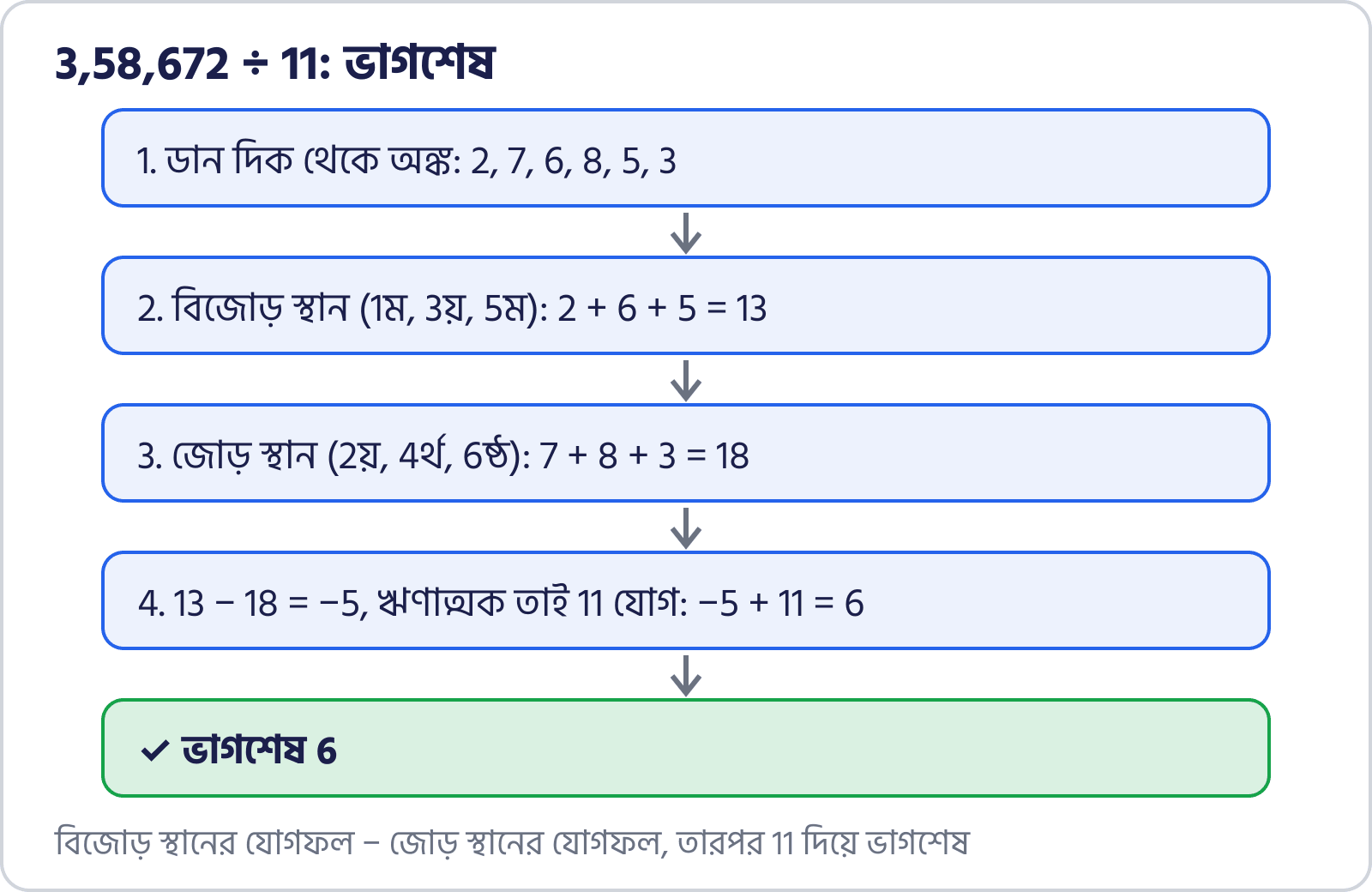
What is the remainder when 5,73,926 is divided by 11?
From the right the digits are 6, 2, 9, 3, 7, 5. Odd places: 6 + 9 + 7 = 22; even places: 2 + 3 + 5 = 10. 22 − 10 = 12, and 12 divided by 11 leaves 1. Subtracting the other way (10 − 22) gives the wrong answer 10.
- Remainder = (odd-place sum − even-place sum), reduced by 11
- Count places from the rightmost digit
- Subtracting odd from even gives 11 minus the true remainder (10 here)
- Odd places first, then subtract the even ones
A number divided by 357 leaves remainder 39. What is the remainder when it is divided by 17?
357 = 17 × 21, so 17 is a factor of 357. The number = 357 × quotient + 39, and the first part is divisible by 17. $39 = 17 \times 2 + 5$, so the remainder is 5. 22 comes from stopping at 39 − 17, but 22 is still larger than 17.
- If the new divisor is a factor of the old one, just divide the old remainder
- A remainder is always smaller than the divisor
- First check that 17 divides 357 exactly
Example: 396 = 357 + 39, and $396 = 17 \times 23 + 5$: remainder 5.
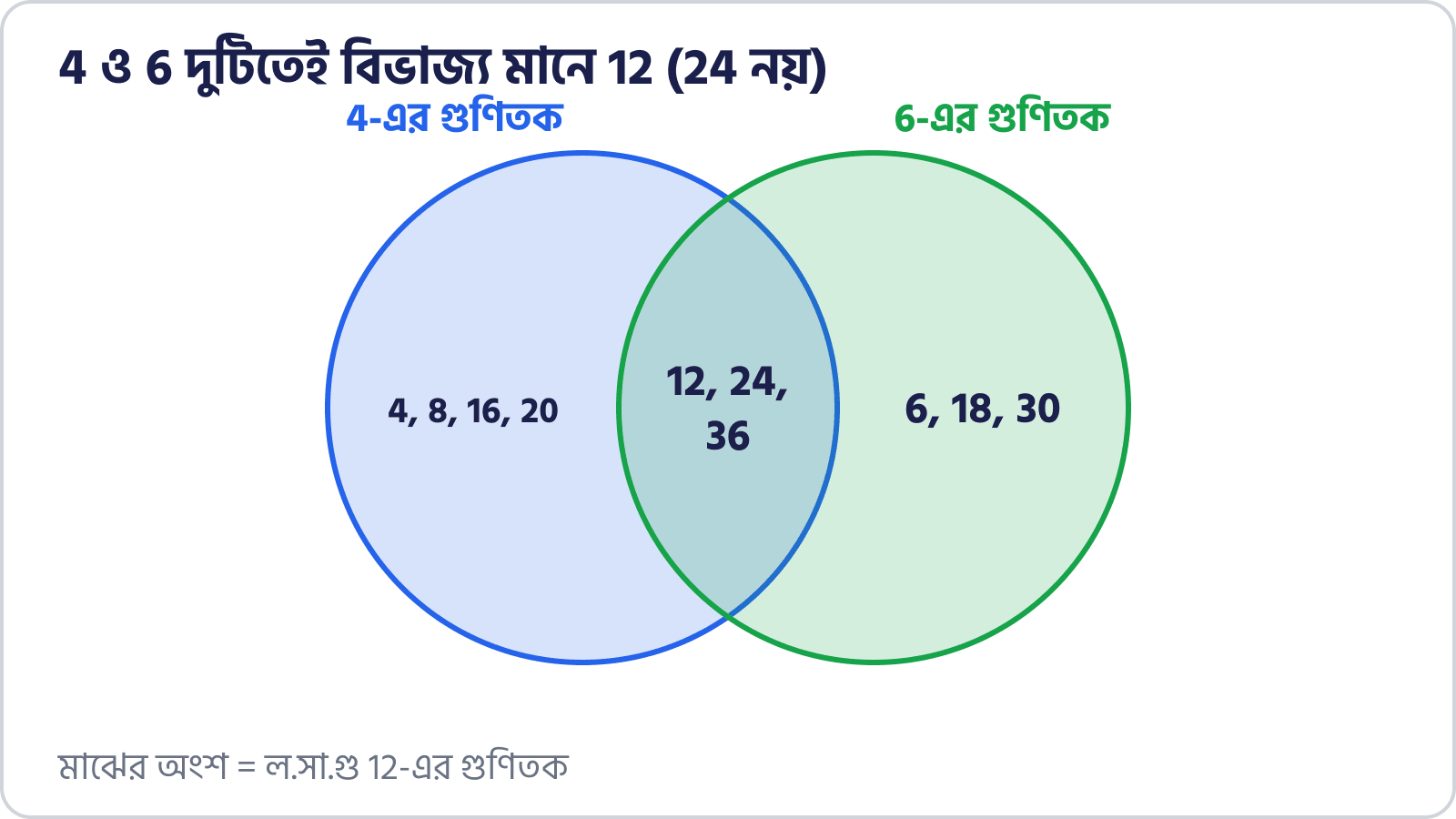
How many numbers from 1 to 300 are divisible by both 4 and 6?
Divisible by both 4 and 6 means divisible by their LCM, 12. $300 = 12 \times 25$, so there are 25 such numbers. Taking 4 × 6 = 24 gives 12 and misses numbers like 12, 36 and 60.
- Divisible by both = divisible by their LCM
- Multiples of d from 1 to n = the whole part of n divided by d
- 4 and 6 are not co-prime, so use the LCM 12, not the product 24
- LCM, not the product
How many numbers between 200 and 600 are divisible by 9?
From 1 to 600 there are 66 multiples of 9 ($600 = 9 \times 66 + 6$); from 1 to 199 there are 22 ($199 = 9 \times 22 + 1$). 66 − 22 = 44. Check: the first multiple is 207 and the last 594, and $\frac{594 - 207}{9} + 1 = 44$.
- Multiples from a to b = (up to b) − (up to a − 1)
- Neither 200 nor 600 is a multiple of 9, so including the ends changes nothing
- Find the first and last multiples: (last − first) ÷ 9 + 1
- Up to 600: 66
- Up to 199: 22
- Between: 66 − 22 = 44
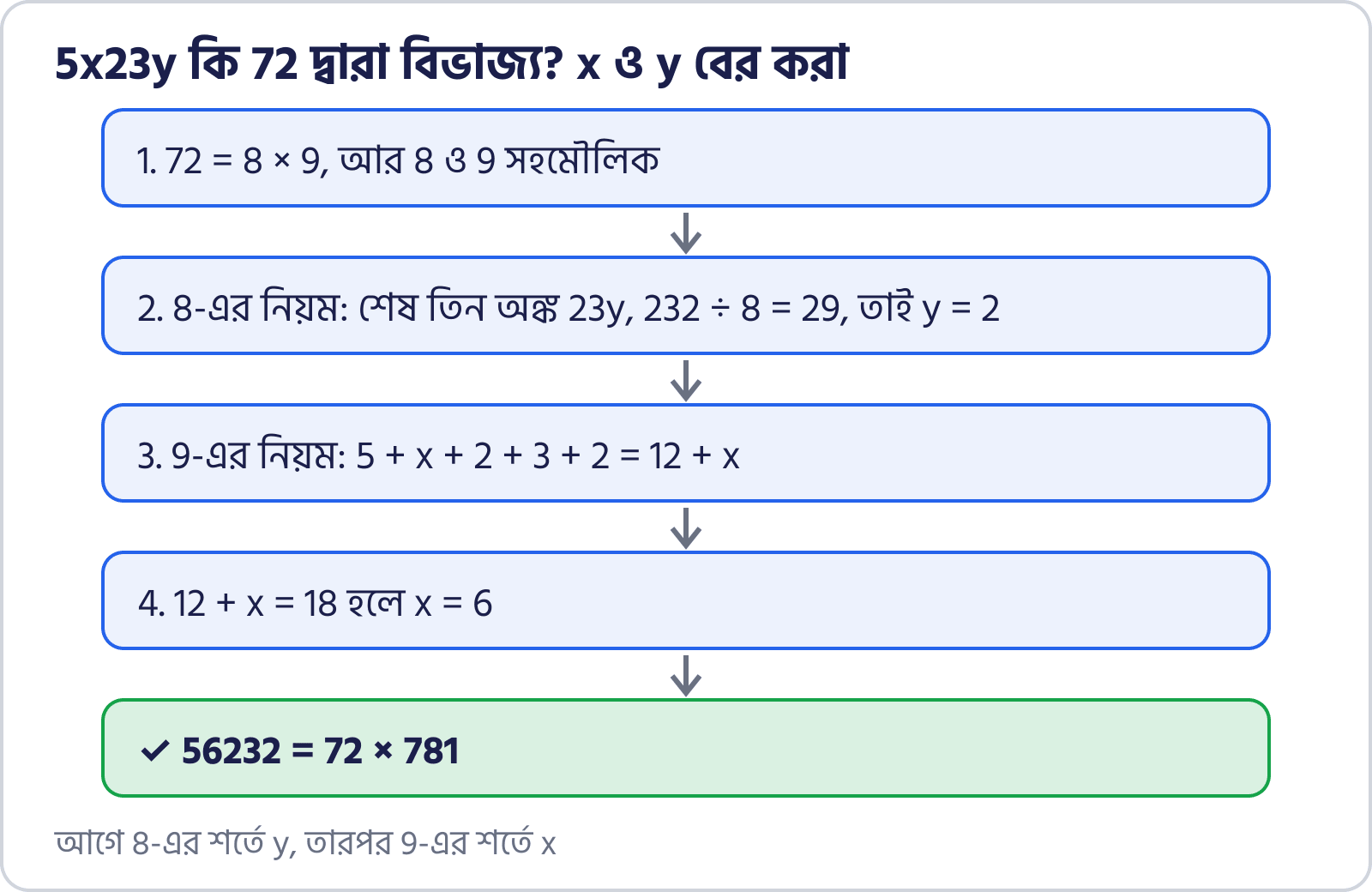
If 2x58y is divisible by 72, what are x and y?
72 = 8 × 9. Rule of 8: the last three digits 58y; 580 divided by 8 leaves 4, so y = 4 (584 = 8 × 73). Rule of 9: 2 + x + 5 + 8 + 4 = 19 + x, which is 27 when x = 8. The number is 28584 = 72 × 397.
- 72 = 8 × 9: both conditions must hold
- Use the condition with one unknown first
- y from 8 first, then x from 9
If 84x5 is divisible by 45, what is x?
45 = 5 × 9. The last digit is 5, so the rule of 5 holds. For 9, 8 + 4 + x + 5 = 17 + x must be a multiple of 9, so x = 1 (17 + 1 = 18). 8415 = 45 × 187.
- 45 = 5 × 9
- A last digit of 0 or 5 satisfies the rule of 5
- The next multiple of 9 after 17 is 18: x = 18 − 17
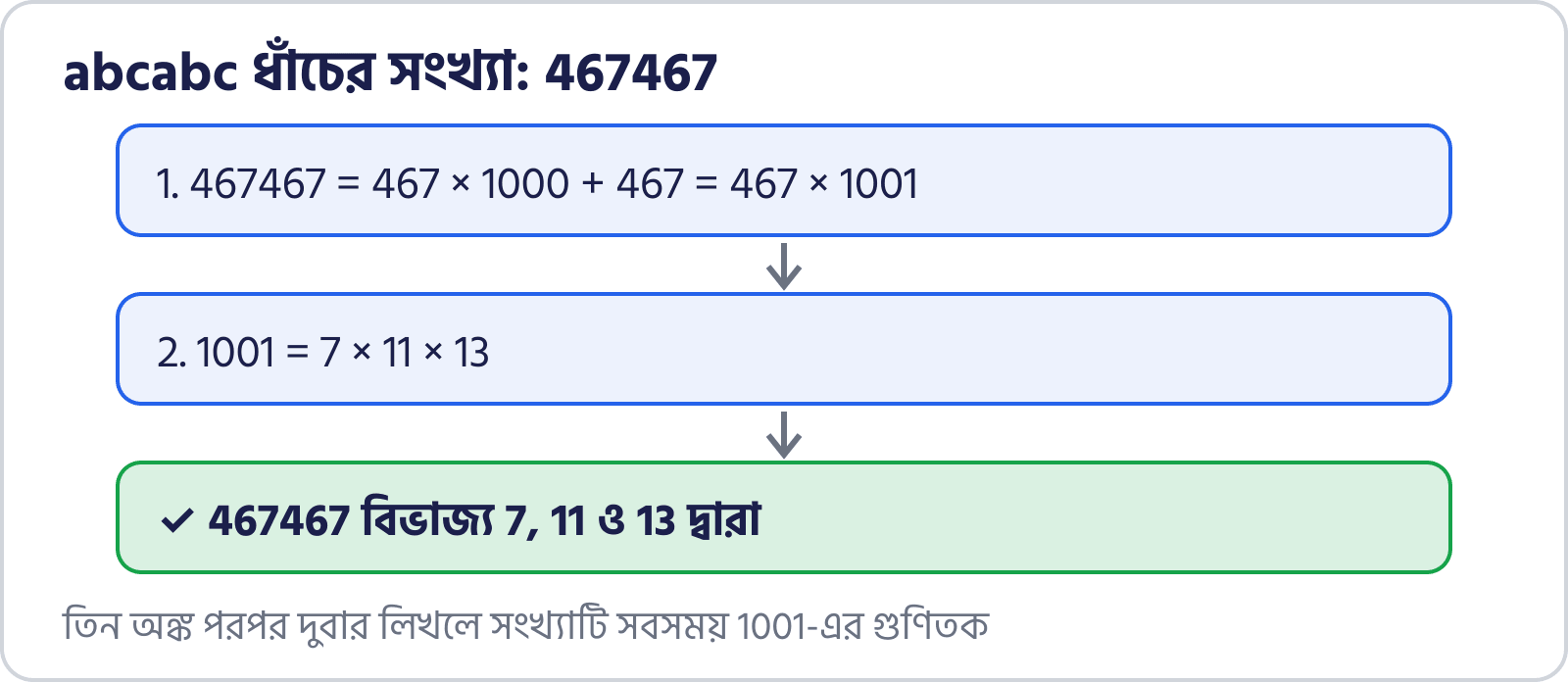
538538 is divisible by which of these?
538538 = 538 × 1001, and 1001 = 7 × 11 × 13, so the number is divisible by 13: 538538 = 13 × 41426. Division by 17, 19 or 23 leaves a remainder.
- abcabc = abc × 1001
- 1001 = 7 × 11 × 13
- 1001: 7, 11 and 13 together
Numbers like 111, 222, 333 … 999 (three equal digits) are always divisible by which of these?
Such a number = a × 111, and 111 = 3 × 37, so all of them are divisible by 37 (e.g. 222 = 37 × 6). 777 is divisible by 7 but 111 is not; 111 is not divisible by 11 or 13.
- aaa = a × 111 = a × 3 × 37
- Always divisible by 3 and 37
- One example (777 ÷ 7) working is not 'always'; test with 111
- 111 = 3 × 37
The sum of a two-digit number and the number formed by reversing its digits is always divisible by
The number is 10a + b, the reverse 10b + a, and the sum 11a + 11b = $11(a + b)$, so it is always divisible by 11, e.g. 47 + 74 = 121. 9 belongs to the difference: $9(a - b)$.
- ab + ba = 11(a + b)
- ab − ba = 9(a − b)
- The sum goes with 11, the difference with 9: the two are often swapped
- Sum → 11, difference → 9
What is the smallest number to be subtracted from 7415 so that the result is divisible by 11?
From the right the digits are 5, 1, 4, 7. Odd places: 5 + 4 = 9; even places: 1 + 7 = 8; the difference is 1, so the remainder is 1. Subtract the remainder itself: 7414 = 11 × 674. 10 (11 − 1) would answer the question for adding.
- To subtract: the answer is the remainder
- To add: the answer is divisor − remainder
- Adding and subtracting questions have different answers: read the question again
- Subtract the remainder; add divisor − remainder
Which of these numbers is divisible by 24?
24 = 3 × 8. All four have digit sums that are multiples of 3, so the rule of 8 decides. The last three digits are 516, 436, 248 and 084; only 248 = 8 × 31. So 7,248 = 24 × 302. The other three are divisible by 12, not 24.
- 24 = 3 × 8 (not 4 × 6)
- For 8, look at the last three digits
- Divisible by 4 and 6 does not mean divisible by 24; it only guarantees 12
- 24: 3 and 8
📊 Topic Analysis
12 questions on remainder shortcuts, two missing digits, counting multiples and the 1001 trick, each answer worked out.


Leave a Comment
Commenting as ·