
10 questions on the centres and leaders, causes, dates and results of the Revolt of 1857. 30 seconds per question.
Revolt of 1857 Quiz: Clerkship 2024 History
Quiz challenge
A little practice. A step forward.
10 questions
Learn with explanations
Time per question: 30 sec
0 / 10 completed
--:--
Where did the Revolt of 1857 begin with the rising of the sepoys?
Explanation
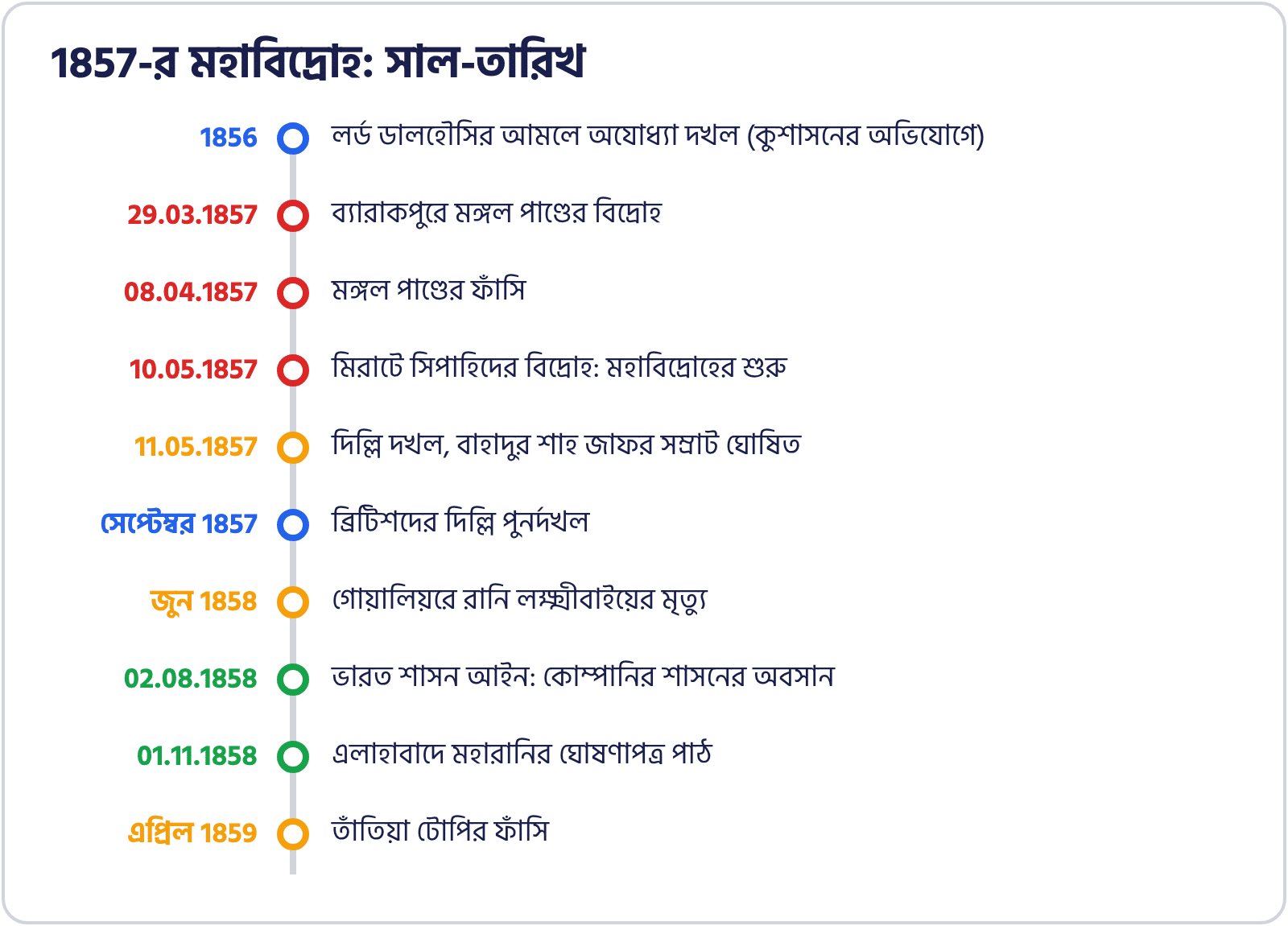
On 10 May 1857 the sepoys at Meerut killed their officers and marched to Delhi; this is taken as the start of the revolt. Delhi fell to them the next day, 11 May. Kanpur and Lucknow became major centres later, not the starting point.
Key Points
- Start: Meerut, 10 May 1857
- Delhi taken on 11 May, Bahadur Shah Zafar proclaimed emperor
- Earlier, on 29 March, Mangal Pandey's attack at Barrackpore
Confusion Points
- Barrackpore (Mangal Pandey, March) came first, but the revolt is dated from Meerut (10 May)
Memory Tips
- Meerut and Mutiny both begin with M
Additional Information

Where did the sepoy Mangal Pandey attack British officers?
Explanation
On 29 March 1857 Mangal Pandey of the 34th Bengal Native Infantry attacked British officers at Barrackpore in Bengal. He was hanged on 8 April 1857. The rising at Meerut came later, on 10 May.
Key Points
- Barrackpore, 29 March 1857
- 34th Bengal Native Infantry
- Hanged on 8 April 1857
Memory Tips
- Mangal Pandey: Barrackpore in Bengal (both B)
Additional Information
Who led the Revolt of 1857 at Lucknow?
Explanation
Begum Hazrat Mahal led the revolt at Lucknow (Awadh) and proclaimed her son Birjis Qadr Nawab of Awadh. Rani Lakshmibai led at Jhansi, Nana Saheb at Kanpur and Khan Bahadur Khan at Bareilly.
Key Points
- Lucknow: Begum Hazrat Mahal
- Her son Birjis Qadr proclaimed Nawab of Awadh
- Awadh had been annexed in 1856 on grounds of misrule
Memory Tips
- Lucknow's palaces (mahal): Begum Hazrat Mahal
Additional Information
| Centre | Leader |
|---|---|
| Delhi | Bahadur Shah Zafar, Bakht Khan |
| Kanpur | Nana Saheb, Tantia Tope |
| Lucknow | Begum Hazrat Mahal |
| Jhansi | Rani Lakshmibai |
| Jagdishpur (Bihar) | Kunwar Singh |
| Bareilly | Khan Bahadur Khan |
| Faizabad | Maulavi Ahmadullah |
Who was the elderly leader of the revolt at Jagdishpur in Bihar?
Explanation
Kunwar Singh, the zamindar of Jagdishpur near Arrah in Bihar, led the revolt at about 80 years of age. Tantia Tope was Nana Saheb's general, Bakht Khan the military leader at Delhi and Maulavi Ahmadullah the leader at Faizabad.
Key Points
- Bihar (Jagdishpur, Arrah): Kunwar Singh
- About 80 years old during the revolt
Memory Tips
- Kunwar Singh: the old lion of Bihar
Additional Information
| Centre | Leader |
|---|---|
| Delhi | Bahadur Shah Zafar, Bakht Khan |
| Kanpur | Nana Saheb, Tantia Tope |
| Lucknow | Begum Hazrat Mahal |
| Jhansi | Rani Lakshmibai |
| Jagdishpur (Bihar) | Kunwar Singh |
| Bareilly | Khan Bahadur Khan |
| Faizabad | Maulavi Ahmadullah |
Who was the Governor-General of India during the Revolt of 1857?
Explanation
Lord Canning (1856–1862) was Governor-General during the revolt and became the first Viceroy after 1858. Lord Dalhousie left in 1856, though his Doctrine of Lapse was one cause of the revolt. Lytton and Ripon came much later.
Key Points
- Lord Canning: Governor-General from 1856
- First Viceroy from 1858
- Dalhousie: Doctrine of Lapse, before the revolt
Confusion Points
- Dalhousie's policies caused the revolt, but Canning ruled during it
Memory Tips
- Canning: the cannon year 1857
Additional Information
| Governor-General | Remember |
|---|---|
| Lord Dalhousie (1848–1856) | Doctrine of Lapse, annexation of Awadh in 1856 |
| Lord Canning (1856–1862) | During the revolt; first Viceroy from 1858 |
| Lord Lytton (1876–1880) | Delhi Durbar of 1877 |
| Lord Ripon (1880–1884) | Local self-government, Ilbert Bill |
What was the immediate cause of the Revolt of 1857?
Explanation
The cartridges of the new Enfield rifle were rumoured to be greased with cow and pig fat and had to be bitten open, which angered both Hindu and Muslim sepoys. The Doctrine of Lapse and the annexation of Awadh were long-term political causes, not the immediate one. The Permanent Settlement (1793) was a land revenue system.
Key Points
- Immediate cause: the Enfield rifle cartridges
- Rumour of cow and pig fat
- Political causes: Doctrine of Lapse, annexation of Awadh
Confusion Points
- 'Immediate cause' is not the same as a political cause: if the question says immediate, the answer is the cartridge
Memory Tips
- Immediate cause = the spark = the cartridge
Who called the Revolt of 1857 'India's First War of Independence'?
Explanation
V. D. Savarkar called it India's first war of independence in his book 'The Indian War of Independence, 1857'. R. C. Majumdar held that it was neither the first, nor national, nor a war of independence. S. N. Sen wrote 'Eighteen Fifty-Seven' for the government at the centenary.
Key Points
- Savarkar: First War of Independence
- R. C. Majumdar: neither first, nor national, nor a war of independence
- S. N. Sen: 'Eighteen Fifty-Seven'
Memory Tips
- Savarkar and Swadhinata (independence) both start with S
Who led the Revolt of 1857 at Kanpur?
Explanation
Nana Saheb, the adopted son of Peshwa Baji Rao II whose pension the British had stopped, led the revolt at Kanpur, helped by Tantia Tope and Azimullah Khan. Bakht Khan led at Delhi, Begum Hazrat Mahal at Lucknow and Kunwar Singh in Bihar.
Key Points
- Kanpur: Nana Saheb
- Adopted son of Peshwa Baji Rao II
- Aides: Tantia Tope, Azimullah Khan
Memory Tips
- Remember Kanpur's pair together: Nana Saheb and his general Tantia Tope
Additional Information
| Centre | Leader |
|---|---|
| Delhi | Bahadur Shah Zafar, Bakht Khan |
| Kanpur | Nana Saheb, Tantia Tope |
| Lucknow | Begum Hazrat Mahal |
| Jhansi | Rani Lakshmibai |
| Jagdishpur (Bihar) | Kunwar Singh |
| Bareilly | Khan Bahadur Khan |
| Faizabad | Maulavi Ahmadullah |
With which Governor-General is the Doctrine of Lapse associated?
Explanation
Lord Dalhousie applied the Doctrine of Lapse, refusing to recognise adopted heirs: Satara (1848) was the first state taken, then Jhansi (1853) and Nagpur (1854). Wellesley is known for the Subsidiary Alliance and Cornwallis for the Permanent Settlement. The doctrine was given up in the Queen's Proclamation under Lord Canning.
Key Points
- Dalhousie: Doctrine of Lapse
- First annexation: Satara, 1848
- Jhansi 1853, Nagpur 1854; Awadh 1856 on grounds of misrule
Confusion Points
- Awadh was annexed under Dalhousie, but for misrule, not under the Doctrine of Lapse
Memory Tips
- Dalhousie: D for Doctrine
Additional Information
| Governor-General | Remember |
|---|---|
| Lord Dalhousie (1848–1856) | Doctrine of Lapse, annexation of Awadh in 1856 |
| Lord Canning (1856–1862) | During the revolt; first Viceroy from 1858 |
| Lord Lytton (1876–1880) | Delhi Durbar of 1877 |
| Lord Ripon (1880–1884) | Local self-government, Ilbert Bill |
Where did Lord Canning read out the Queen's Proclamation on 1 November 1858?
Explanation
On 1 November 1858 Lord Canning read Queen Victoria's Proclamation at a durbar in Allahabad. It gave up the Doctrine of Lapse, recognised the princes' right to adopt heirs and promised not to interfere in religion. Calcutta was the capital, but the proclamation was read at Allahabad.
Key Points
- Date: 1 November 1858, place: Allahabad
- Read by Lord Canning
- The Government of India Act 1858 ended Company rule
Confusion Points
- Calcutta was the capital, so many answer Calcutta; the answer is Allahabad
Memory Tips
- Proclamation = announcement: announced at Allahabad (both A)
Additional Information
0/10


Leave a Comment
Commenting as ·