
20 new Indian history questions for the General Studies paper of WBPSC Clerkship 2024 Part-I, each answer explained.
Indian History Mixed Quiz 6: Harappa to Azad Hind, WBPSC Clerkship GK
Quiz challenge
A little practice. A step forward.
20 questions
Learn with explanations
Time per question: 30 sec
0 / 20 completed
--:--
Which metal was unknown to the people of the Harappan civilisation?
Explanation
The Harappan civilisation was a copper-bronze age culture: copper, bronze, gold and silver were in use, but no trace of iron has been found. Iron spread in India in the later Vedic age.
Key Points
- Harappan civilisation = copper-bronze age
- Bronze was made by mixing tin with copper
- Iron came into use in the later Vedic age
In which Veda is the Gayatri Mantra found?
Explanation
The Gayatri Mantra is in the third mandala of the Rigveda; it is addressed to the sun god Savitr, which is why it is also called the Savitri mantra. The Rigveda is the oldest of the four Vedas.
Key Points
- Gayatri Mantra: Rigveda, mandala 3
- Deity: Savitr (the sun)
- The Rigveda is the oldest Veda
Additional Information
| Veda | Main content |
|---|---|
| Rigveda | Hymns to the gods; the oldest |
| Samaveda | Chanted hymns; the source of Indian music |
| Yajurveda | Rules and formulas of sacrifice |
| Atharvaveda | Charms, healing, daily life |
According to the Buddhist text Anguttara Nikaya, how many Mahajanapadas were there in north India in the sixth century BCE?
Explanation
The Anguttara Nikaya lists 16 Mahajanapadas, such as Magadha, Kosala, Vatsa, Avanti, Anga and Kashi. Magadha finally became the strongest of them; its first capital was Rajagriha.
Key Points
- Sixteen Mahajanapadas: Anguttara Nikaya
- The strongest: Magadha
- Magadha's first capital Rajagriha, later Pataliputra
Who deciphered the Brahmi script of Ashoka's inscriptions in 1837?
Explanation
James Prinsep, secretary of the Asiatic Society, deciphered the Brahmi script in 1837, which made Ashoka's inscriptions readable. William Jones founded the Asiatic Society, Cunningham was the first head of the Archaeological Survey of India, and the Indus civilisation was discovered under John Marshall.
Key Points
- Brahmi deciphered: James Prinsep, 1837
- Ashoka's inscriptions call him 'Devanampiya Piyadasi'
Confusion Points
- Cunningham = first head of the Archaeological Survey; Prinsep = deciphered the script
From which year is the Saka era counted?
Explanation
The Saka era begins in 78 CE; it is usually linked with the accession of the Kushan emperor Kanishka. India's national calendar is based on the Saka era. 57 BCE begins the Vikram Samvat, 320 the Gupta era and 606 the Harsha era.
Key Points
- Saka era: 78 CE, linked with Kanishka
- India's national calendar follows the Saka era
Confusion Points
- Vikram Samvat 57 BCE, Saka era 78 CE: the two are easily mixed up
Additional Information
| Era | Begins | Linked ruler |
|---|---|---|
| Vikram Samvat | 57 BCE | King Vikramaditya, by tradition |
| Saka era | 78 CE | Kanishka |
| Gupta era | 319–320 CE | Chandragupta I |
| Harsha era | 606 CE | Harshavardhana |
Who wrote the play 'Abhijnanashakuntalam'?
Explanation
Abhijnanashakuntalam is Kalidasa's play; by tradition he was one of the nine gems at the court of the Gupta emperor Chandragupta II. Banabhatta wrote the Harshacharita, Bhasa the Svapnavasavadattam and Shudraka the Mrichchhakatikam.
Key Points
- Kalidasa: Abhijnanashakuntalam, Meghadutam, Raghuvamsham
- One of Chandragupta II's nine gems (by tradition)
Additional Information
| Author | Work | Age or patron |
|---|---|---|
| Kalidasa | Abhijnanashakuntalam, Meghadutam | Chandragupta II |
| Banabhatta | Harshacharita, Kadambari | Harshavardhana |
| Bhasa | Svapnavasavadattam | Early Sanskrit dramatist |
| Shudraka | Mrichchhakatikam | Early Sanskrit dramatist |
During whose reign did the Chinese traveller Hiuen Tsang visit India?
Explanation
Hiuen Tsang (Xuanzang) came to India in the seventh century during Harshavardhana's reign and studied at Nalanda; his travel account is the 'Si-Yu-Ki'. Fa-Hien came under Chandragupta II, and Megasthenes to Chandragupta Maurya's court.
Key Points
- Hiuen Tsang: reign of Harshavardhana, seventh century
- Studied at Nalanda
- Account: Si-Yu-Ki
Confusion Points
- Fa-Hien = Chandragupta II; Hiuen Tsang = Harshavardhana
Memory Tips
- H with H: Hiuen Tsang came to Harsha
Which Pala king founded the Vikramashila Mahavihara?
Explanation
The Pala king Dharmapala (late eighth century) founded the Vikramashila Mahavihara. The dynasty's founder was Gopala, chosen after the anarchy of matsyanyaya; Devapala was Dharmapala's son.
Key Points
- Vikramashila: Dharmapala
- Founder of the Pala dynasty: Gopala
- The Palas were patrons of Buddhism
Confusion Points
- Gopala founded the dynasty, not Vikramashila
Who wrote the 'Gita Govinda'?
Explanation
The Gita Govinda is a Sanskrit poem by Jayadeva, who is held to have been the court poet of the Sena king Lakshmana Sena. Chandidas and Vidyapati were Vaishnava lyric poets, and Krittibas wrote the Ramayana in Bengali.
Key Points
- Gita Govinda: Jayadeva, in Sanskrit
- Court poet of Lakshmana Sena
- Krittibas: the Bengali Ramayana
Razia Sultan of Delhi was the daughter of which Sultan?
Explanation
Razia was the daughter of Iltutmish; she was the first and only woman ruler of the Delhi Sultanate (1236–1240). Iltutmish himself named her his heir in place of his sons.
Key Points
- Razia: the only woman ruler of the Delhi Sultanate
- Reign 1236–1240
- Father Iltutmish, Slave dynasty
During which Sultan's reign did the Moroccan traveller Ibn Battuta come to India?
Explanation
Ibn Battuta reached Delhi in 1333 under Muhammad bin Tughlaq, who made him the qazi of Delhi. His travel account, the 'Rihla', tells much about the Tughlaq age.
Key Points
- Ibn Battuta: a traveller from Morocco
- Came under Muhammad bin Tughlaq, became qazi of Delhi
- Account: Rihla
Between whom was the Battle of Chausa fought in 1539?
Explanation
At Chausa in 1539 Sher Khan (later Sher Shah) defeated Humayun, and after the Battle of Kannauj (Bilgram) in 1540 Humayun had to leave India. Babur fought Rana Sanga at Khanwa (1527), and Akbar's army fought Hemu at the Second Battle of Panipat (1556).
Key Points
- Chausa 1539: Humayun defeated by Sher Khan
- Kannauj/Bilgram 1540: Humayun loses the throne
- Humayun regained Delhi in 1555
Additional Information
| Battle | Year | Between | Winner |
|---|---|---|---|
| Khanwa | 1527 | Babur and Rana Sanga | Babur |
| Chausa | 1539 | Humayun and Sher Khan | Sher Khan |
| Kannauj (Bilgram) | 1540 | Humayun and Sher Khan | Sher Khan |
| Second Panipat | 1556 | Akbar and Hemu | Akbar (led by Bairam Khan) |
For which Mughal emperor was the Peacock Throne (Takht-e-Taus) made?
Explanation
The Peacock Throne was made for Shah Jahan, whose reign was the height of Mughal splendour and who also built the Taj Mahal. Nadir Shah of Persia carried it away when he sacked Delhi in 1739.
Key Points
- Peacock Throne: Shah Jahan
- Taken away by Nadir Shah in 1739
- Shah Jahan also built the Taj Mahal and the Red Fort
On which Mughal emperor's order was the ninth Sikh Guru, Tegh Bahadur, executed (1675)?
Explanation
Guru Tegh Bahadur, the ninth Sikh Guru, was executed in Delhi in 1675 on Aurangzeb's order. Earlier, in 1606, the fifth Guru, Arjan Dev, was executed under Jahangir.
Key Points
- Guru Tegh Bahadur: ninth Guru, 1675, Aurangzeb
- Guru Arjan Dev: fifth Guru, 1606, Jahangir
- Tenth and last human Guru: Guru Gobind Singh
Confusion Points
- Arjan Dev (fifth) = Jahangir; Tegh Bahadur (ninth) = Aurangzeb
Who fought together against the English in the Battle of Buxar in 1764?
Explanation
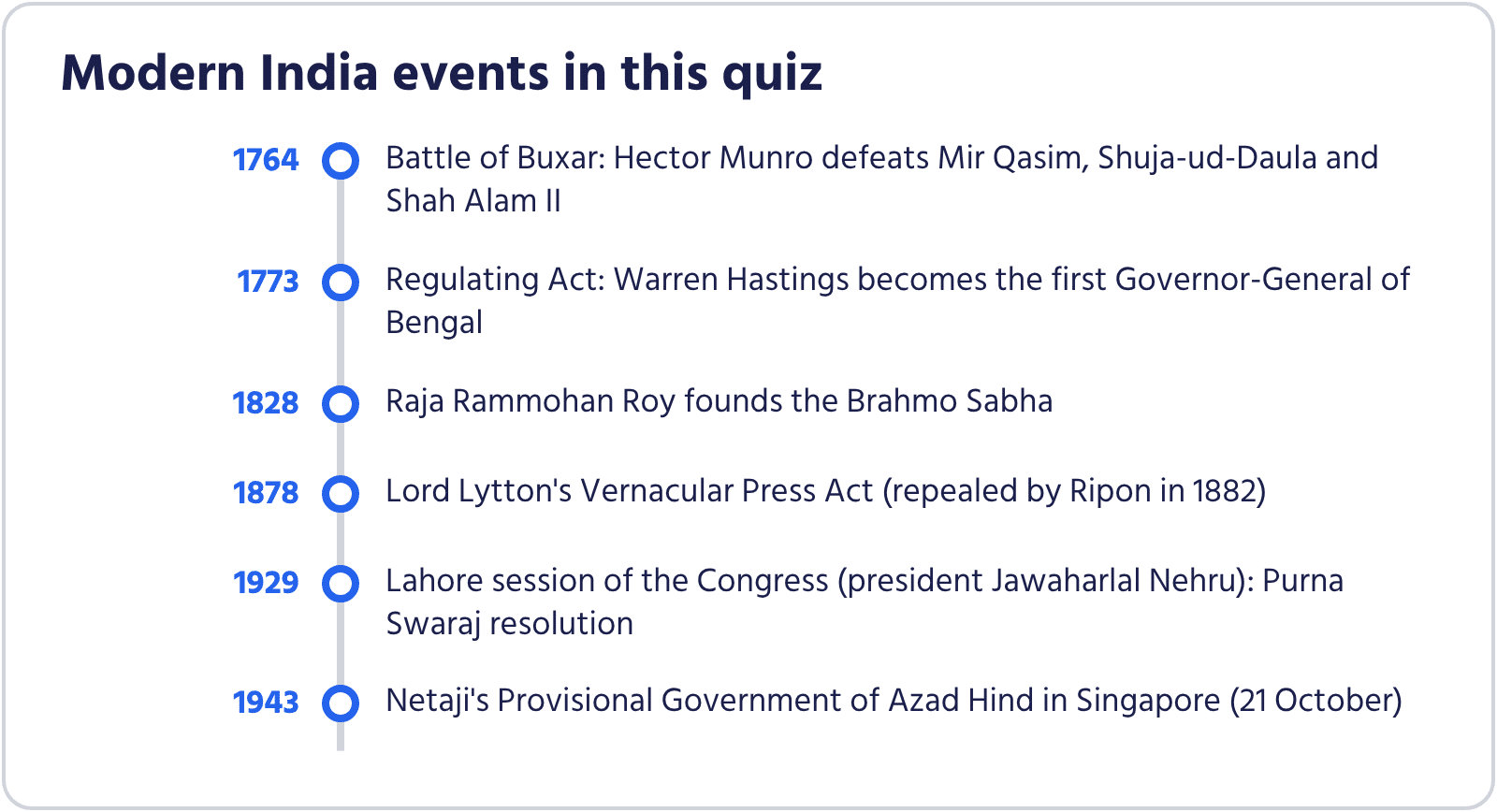
At Buxar (1764) the combined army of Mir Qasim, Nawab of Bengal, Shuja-ud-Daula, Nawab of Awadh, and the Mughal emperor Shah Alam II was defeated by the English under Hector Munro. By the Treaty of Allahabad (1765) that followed, the Company got the Diwani of Bengal, Bihar and Orissa.
Key Points
- Buxar 1764: English commander Hector Munro
- Defeated alliance: Mir Qasim, Shuja-ud-Daula, Shah Alam II
- Result: Treaty of Allahabad (1765), the Diwani
Additional Information
Under the Regulating Act (1773), who became the first Governor-General of Bengal?
Explanation
The Regulating Act of 1773 turned the Governor of Bengal into a Governor-General, and Warren Hastings was the first. Under the Charter Act of 1833 Lord William Bentinck became the first Governor-General of India, and in 1858 Lord Canning became the first Viceroy. Clive was Governor of Bengal, never Governor-General.
Key Points
- First Governor-General of Bengal: Warren Hastings (1773)
- First Governor-General of India: Bentinck (1833)
- First Viceroy: Lord Canning (1858)
Confusion Points
- First Governor-General 'of Bengal' is Hastings; 'of India' is Bentinck
Additional Information
| Office | First holder | Act and year |
|---|---|---|
| Governor-General of Bengal | Warren Hastings | Regulating Act, 1773 |
| Governor-General of India | Lord William Bentinck | Charter Act, 1833 |
| Viceroy | Lord Canning | Government of India Act, 1858 |
Who founded the Brahmo Sabha in 1828?
Explanation
Raja Rammohan Roy founded the Brahmo Sabha in Calcutta in 1828; it later became known as the Brahmo Samaj. After Rammohan, Debendranath Tagore led it, and Keshab Chandra Sen later broke away to form the Brahmo Samaj of India.
Key Points
- Brahmo Sabha 1828: Raja Rammohan Roy
- Worship of one God, against idol worship
- After Rammohan's campaign, Bentinck banned sati in 1829
Additional Information
Under which Viceroy was the Vernacular Press Act (1878) passed?
Explanation
Lord Lytton brought in this Act in 1878 to gag the Indian-language press. Lord Ripon repealed it in 1882; the Ilbert Bill controversy (1883) also belongs to Ripon's time.
Key Points
- Vernacular Press Act 1878: Lord Lytton
- Repealed 1882: Lord Ripon
- The Delhi Durbar of 1877 was also under Lytton
Confusion Points
- Lytton passed it, Ripon repealed it: a common mix-up
Additional Information
Who presided over the 1929 Lahore session of the Congress, where the Purna Swaraj resolution was adopted?
Explanation
Jawaharlal Nehru presided over the Lahore session of 1929; there complete independence (Purna Swaraj) was declared the Congress's goal, and 26 January 1930 was observed as Independence Day. The previous year's Calcutta session (1928) was presided over by his father, Motilal Nehru.
Key Points
- Lahore 1929: president Jawaharlal Nehru, Purna Swaraj
- 26 January 1930: first Independence Day observed
- The Constitution came into force on 26 January 1950 to mark that day
Confusion Points
- Calcutta 1928 = Motilal Nehru; Lahore 1929 = Jawaharlal Nehru
Additional Information
Where did Netaji Subhas Chandra Bose proclaim the Provisional Government of Free India (Azad Hind) on 21 October 1943?
Explanation
Netaji proclaimed the Azad Hind government in Singapore on 21 October 1943 and led the Indian National Army. In Berlin he had earlier set up the Free India Centre; the Azad Hind government's headquarters later moved to Rangoon.
Key Points
- Azad Hind government: Singapore, 21 October 1943
- Slogans: 'Dilli Chalo', 'Jai Hind'
- In 1943 Rash Behari Bose handed the INA over to Netaji
Additional Information
0/20


Leave a Comment
Commenting as ·