
10 questions on unseen passages and reading comprehension: question types, reading strategies, classroom situations and words and grammar from a sample passage.
Unseen Passage Quiz: WB TET Bengali Comprehension Practice
Quiz challenge
A little practice. A step forward.
10 questions
Learn with explanations
Time per question: 45 sec
0 / 10 completed
--:--
In the exam hall, which is the most effective first step for answering questions on an unseen passage?
Explanation
Glancing at the questions first tells you what to look for while reading; then a careful reading of the whole passage gives both the main idea and the facts. Matching options without reading loses the context, and reading aloud or repeatedly wastes time.
Key Points
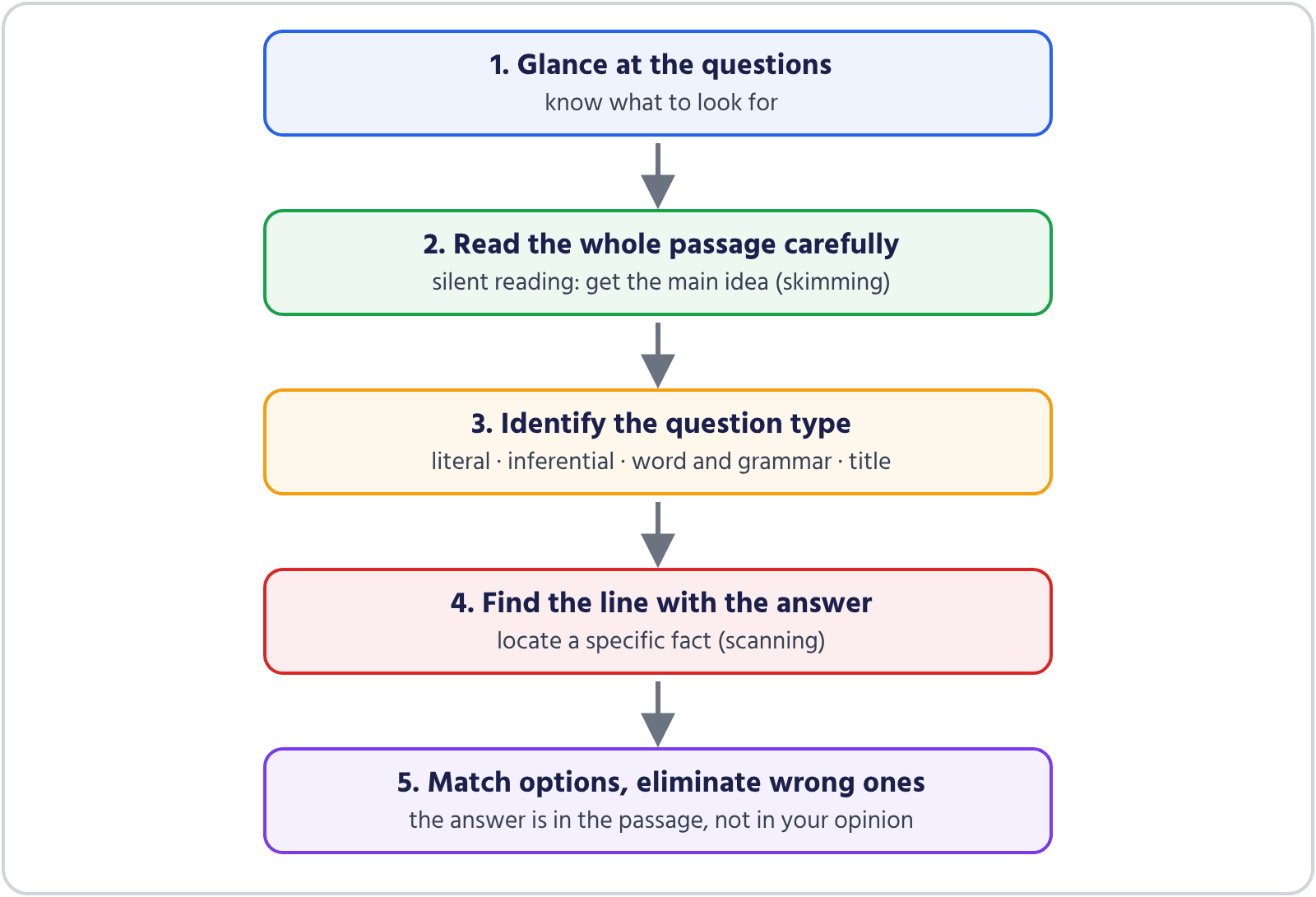
- Order: glance at questions → read the whole passage → identify the type → find the line → eliminate
- Silent reading is faster and better for understanding in the exam
Memory Tips
- Question, Read, Type, Find, Eliminate
Additional Information
What is the strategy of looking only for one specific date in a passage, without reading the whole text again, called?
Explanation
Running your eyes over a text to find a specific fact (a name, date or number) is scanning. Skimming is a quick read to get the main idea of the whole text. Summarising is writing a summary and paraphrasing is saying it in your own words: neither is a search strategy.
Key Points
- Scanning: finding a specific fact (useful for literal questions)
- Skimming: getting the main idea (useful for title and main-idea questions)
Confusion Points
- Both skimming and scanning are fast reading; they differ in purpose: main idea versus a specific fact
Memory Tips
- sc-anning = s-earch; sk-imming = sk-y view, the whole from above
Additional Information
| Strategy | Purpose | Question type |
|---|---|---|
| Skimming | Main idea of the whole text | Title, main idea |
| Scanning | Finding a specific fact | Who, what, when, where |
| Intensive reading | Understanding meaning in detail | Inferential, why |
Passage: "A few years ago the river's water was clear; now the waste and plastic of the market are piling up on its banks. The old boatman had said, 'The river cannot speak, so you must speak for it.'" Which of these questions is inferential?
Explanation
Why the boatman said this is not written in the passage: the river is being polluted and cannot protest by itself, so people must protect it, and that has to be inferred from the text. The answers to the other three (waste and plastic, clear, the old boatman) are written word for word, so they are literal questions.
Key Points
- A literal question's answer is written in the text
- Inferential questions usually come as "why" or "what is meant"
Memory Tips
- You can point to it with a finger = literal; you must work it out = inferential
Passage: "Last winter the students of the village school, together with their teacher, cleaned the river bank." Question: "Who cleaned the river bank?" What level of comprehension question is this?
Explanation
The answer (the school's students, with their teacher) is written directly in the sentence, so it is a literal question. In an inferential question the answer has to be worked out from the text, in an evaluative one the reader gives their own judgement, and appreciation asks the reader to respond to the beauty of the language or feeling.
Key Points
- Barrett's taxonomy: literal, reorganisation, inferential, evaluation, appreciation
- Who, what, when and where questions are usually literal
Additional Information
| Level | Sample question |
|---|---|
| Literal | Who cleaned the bank? |
| Inferential | Why did the boatman ask them to speak for the river? |
| Evaluative | Was the students' work right? Give your opinion. |
| Appreciation | How did you feel about the line 'The river cannot speak'? |
When choosing a suitable title for an unseen passage, which option should be chosen?
Explanation
A title briefly expresses the central idea of the whole text. The name of one part or event is too narrow, and a general name that goes beyond the text is too broad: both are wrong. Containing a hard word is no test of a title.
Key Points
- The central idea is often in the first or last sentence
- A title is short and fits the whole text
Confusion Points
- An option taken from one part of the passage may be true but is too narrow as a title
Riya in Class 3 reads her Bengali textbook aloud fluently but cannot say what she has read when asked afterwards. What is the most suitable step for the teacher?
Explanation
Riya can decode fluently; what she lacks is comprehension. A purpose set before reading makes her read for meaning, and questions and discussion afterwards build the understanding. Reading aloud more or copying practises the skill she already has, and memorising word meanings does not build the meaning of the whole text.
Key Points
- Fluent reading is not the same as understanding
- Purposeful reading (a question before reading) improves comprehension
- Discussion after reading: retelling the meaning in her own words
Confusion Points
- Reading aloud checks pronunciation and fluency, not understanding
To improve reading comprehension in class, what is the main advantage of silent reading over reading aloud?
Explanation
In silent reading the reader does not have to attend to pronunciation, so they can focus on meaning and read faster. Hearing pronunciation and voice are advantages of reading aloud. Silent reading does not keep everyone at one speed: each child reads at their own pace.
Key Points
- Silent reading: understanding and speed; it is also how you read in the exam hall
- Reading aloud: pronunciation, intonation, fluency
Additional Information
| Reading aloud | Silent reading | |
|---|---|---|
| Main aim | Pronunciation, fluency | Understanding meaning |
| Speed | Slower | Faster |
| Useful for | Beginning to read in the early grades | Comprehension, independent reading |
Who introduced the five-step SQ3R reading method: Survey, Question, Read, Recite, Review?
Explanation
The SQ3R reading method was given by the American educational psychologist Francis P. Robinson in his book 'Effective Study'. Bloom gave the taxonomy of educational objectives, Barrett a taxonomy of reading comprehension levels, and Piaget the stages of cognitive development.
Key Points
- S = Survey, Q = Question
- 3R = Read, Recite, Review
Confusion Points
- Barrett's taxonomy is also about reading, but it describes levels of understanding, not a study method
Passage: "Last winter the students of the village school (বিদ্যালয়) cleaned the river bank." Which is the correct sandhi split of the Bengali word "বিদ্যালয়"?
Explanation
বিদ্যা + আলয় = বিদ্যালয়: the vowels আ + আ merge into আ (a vowel sandhi). আলয় means a house or place, so বিদ্যালয় is the house of learning (বিদ্যা). "বিদ্যা + লয়" is wrong, as লয় means destruction, and "বিদ্য" or "বিদ" do not give this meaning as separate words.
Key Points
- আ + আ = আ: বিদ্যা + আলয় = বিদ্যালয়
- By the same rule: দেব + আলয় = দেবালয় (অ + আ = আ)
Memory Tips
- আলয় = house: বিদ্যালয়, দেবালয়, হিমালয়
While reading a passage, Class 4 children get stuck on an unfamiliar word. What is the best way for the teacher to build their reading comprehension?
Explanation
Guessing meaning from context makes the child an independent reader, and the exam's unseen passages need exactly this skill. Giving the meaning at once leaves the child no chance to think, skipping the word leaves the meaning incomplete, and writing the spelling does not explain the meaning. If needed, the guess can then be checked with a dictionary or the teacher.
Key Points
- Guessing meaning from context: the skill of independent reading
- Constructivist approach: the child builds meaning, the teacher facilitates
0/10


Leave a Comment
Commenting as ·