
10 questions from the first chapter of WB TET Environmental Studies: biotic, abiotic and social environment, food chains and EVS pedagogy.
Biotic, Abiotic and Social Environment Quiz: WB TET EVS Practice
Quiz challenge
A little practice. A step forward.
10 questions
Learn with explanations
Time per question: 45 sec
0 / 10 completed
--:--
Which of the following is an abiotic component of the environment?
Explanation
Sunlight has no life, so it is an abiotic (physical) component and the main source of all energy. Bacteria and fungi are living decomposers and algae are living producers, so all three are biotic.
Key Points
- Abiotic: light, water, air, soil, temperature, minerals
- Biotic: plants, animals, fungi, bacteria
- Micro-organisms are biotic too
Memory Tips
- The abiotic five: Light, Water, Air, Soil, Temperature
Which of the following acts as a decomposer in an ecosystem?
Explanation
A mushroom is a fungus; fungi and bacteria break down dead bodies and return minerals to the soil, so they are decomposers. The frog and the grasshopper are consumers and grass is a producer.
Key Points
- Decomposers: bacteria and fungi
- Without decomposers minerals would not return to the soil
- Producers make their own food, consumers eat others
Confusion Points
- The Bengali name of the mushroom contains the word 'frog', but it is a fungus, not an animal
Additional Information
| Organism | Role |
|---|---|
| Grass | Producer |
| Grasshopper | Primary consumer |
| Frog | Secondary consumer |
| Mushroom | Decomposer |
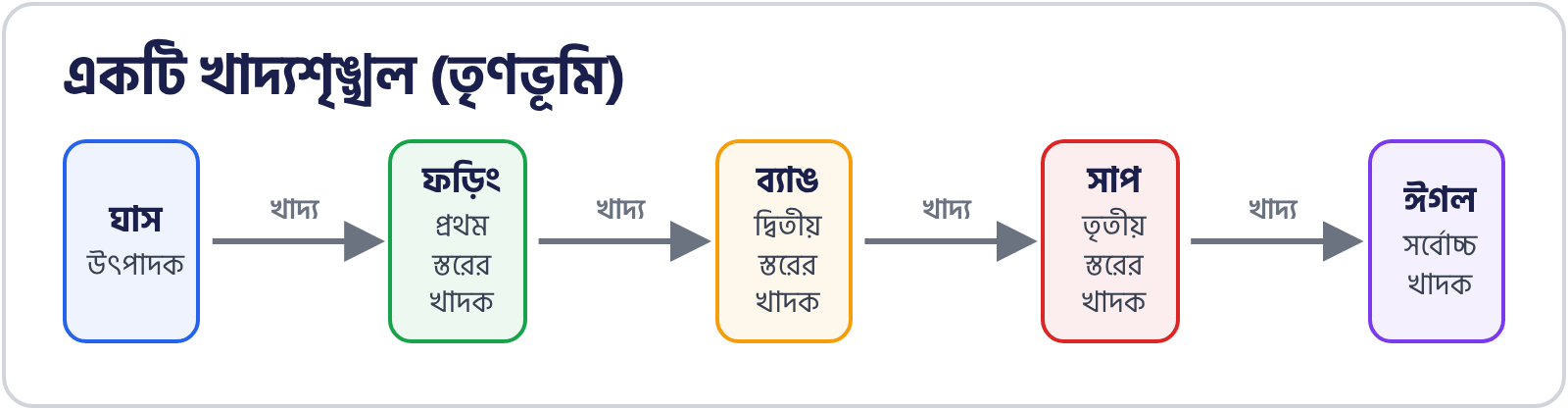
Food chain: Grass → Grasshopper → Frog → Snake → Eagle. At which level is the frog?
Explanation
The chain starts with the producer, grass; the grasshopper eats grass, so it is the primary consumer. The frog eats the grasshopper, so it is the secondary consumer, and the snake that eats the frog is the tertiary consumer.
Key Points
- A food chain always starts with a producer
- The arrow points from the food to the eater
- Each step is a trophic level
Confusion Points
- The frog is the third organism in the chain but the secondary consumer: the producer is not counted as a consumer
Memory Tips
- Count from after the producer: primary, secondary, tertiary consumer
Additional Information
Who first used the term 'Ecosystem'?
Explanation
The British botanist A. G. Tansley coined the term Ecosystem in 1935. Ernst Haeckel coined Ecology in 1866; Darwin is known for evolution and Linnaeus for binomial nomenclature.
Key Points
- Ecology: Ernst Haeckel, 1866
- Ecosystem: A. G. Tansley, 1935
- Ecosystem = biotic + abiotic components working together
Confusion Points
- Ecology is Haeckel's word, Ecosystem is Tansley's: mixing them up is the most common mistake
Memory Tips
- H before T: Haeckel's Ecology first, Tansley's Ecosystem later
Which activity is most suitable for teaching biotic and abiotic components in class III?
Explanation
On the garden walk children observe, list and sort things themselves, so the concept grows from their own experience. EVS learning starts from the child's familiar surroundings. The other three are teacher-centred or rely on rote learning.
Key Points
- EVS: known to unknown, concrete to abstract
- Observing and classifying are core EVS skills
- Field trips, projects and surveys suit EVS
A child says, 'Clouds are living because they move and grow.' What is the teacher's most suitable response?
Explanation
A child's misconception comes from the child's own reasoning; correcting it through questions and comparison lets the child build the new idea, which is the heart of constructivism. Just saying it is wrong, repeated writing or 'read the book' does not remove the reason behind the misconception.
Key Points
- 'Whatever moves is alive' is a common misconception
- Features of living things: breathing, feeding, growth, reproduction
- A misconception is a chance to learn, not a reason to punish
According to NCF 2005, what is integrated in Environmental Studies for classes III to V?
Explanation
Under NCF 2005, EVS in classes III to V is an integrated subject combining science, social science and environmental education. In classes I and II there is no separate EVS: environmental themes are woven into language and mathematics.
Key Points
- EVS = science + social science + environmental education
- Classes I–II: woven into language and mathematics
- Classes III–V: a separate integrated subject
Confusion Points
- 'Mathematics and language' is about classes I and II, not classes III to V
While teaching the social environment, a child says that she lives with her grandparents, so she has no 'family of mother and father'. What should the teacher do?
Explanation
Children's families differ: nuclear, joint, raised by grandparents. EVS aims to teach respect for this diversity, so giving examples of many families and keeping the child part of the class is right. Calling the textbook picture the only right one, avoiding the topic or seating her apart all exclude the child.
Key Points
- A child's first social environment is the family
- Diversity in family structure is normal
- An inclusive classroom leaves no child out
What is the best way to check whether children have understood food chains?
Explanation
To build a new chain from local organisms the child must identify the producer, think about who eats whom and draw the arrows the right way, that is, apply the concept. Writing the definition, copying the picture or spelling only test memory.
Key Points
- Understanding shows in application, not memorisation
- In Bloom's taxonomy, Apply is above Remember
- Examples from familiar surroundings make learning meaningful
Additional Information
Which of the following is a part of the social environment?
Explanation
The neighbourhood puja is a festival and custom made by people, so it belongs to the social-cultural environment. River water and rain are abiotic and forest trees are biotic: all three belong to the natural environment.
Key Points
- Social environment: family, school, neighbours, festivals, language, customs
- Natural environment = biotic + abiotic
- The social environment is made by people
Memory Tips
- Given by nature or built by people? Built by people means social environment
0/10


Leave a Comment
Commenting as ·