
10 questions from the notes on environment and pollution: polluting gases, acid rain, the ozone layer, heavy-metal diseases, biomagnification and environmental treaties.
Environment and Pollution Quiz: Clerkship GS Practice
Quiz challenge
A little practice. A step forward.
10 questions
Learn with explanations
Time per question: 30 sec
0 / 10 completed
--:--
Carbon monoxide is poisonous because in the blood it:
Explanation
Carbon monoxide binds haemoglobin far more readily than oxygen, forming carboxyhaemoglobin. Haemoglobin can then no longer carry oxygen, so the cells are starved of it. The other options are not what CO does.
Key Points
- CO comes from incomplete burning and vehicle exhaust
- CO + haemoglobin = carboxyhaemoglobin
- A coal stove in a closed room is dangerous
Additional Information
| Pollutant | Main source | Main harm |
|---|---|---|
| Carbon monoxide (CO) | Incomplete burning, vehicle exhaust | Binds haemoglobin as carboxyhaemoglobin; blood carries less oxygen |
| Sulphur dioxide (SO₂) | Burning coal, thermal power plants | Acid rain, breathing trouble |
| Oxides of nitrogen (NO, NO₂) | Vehicle engines, high-temperature burning | Acid rain, photochemical smog |
| Chlorofluorocarbons (CFC) | Old refrigerators, ACs, sprays | Ozone layer depletion |
| Carbon dioxide (CO₂) | Burning fossil fuels, deforestation | Greenhouse effect, global warming |
What is the main cause of depletion of the ozone layer in the stratosphere?
Explanation
CFCs rise into the stratosphere, where UV rays break them and release chlorine atoms; one chlorine atom destroys many ozone molecules. CO₂ and methane are greenhouse gases that cause global warming; SO₂ causes acid rain.
Key Points
- The ozone layer absorbs ultraviolet rays
- Ozone is measured in Dobson Units
- The big ozone hole is over Antarctica
Confusion Points
- CO₂ is the main global-warming gas, not the ozone destroyer
Memory Tips
- "Ozone: CFC; acid rain: SO and NO"
Which gases are mainly responsible for acid rain?
Explanation
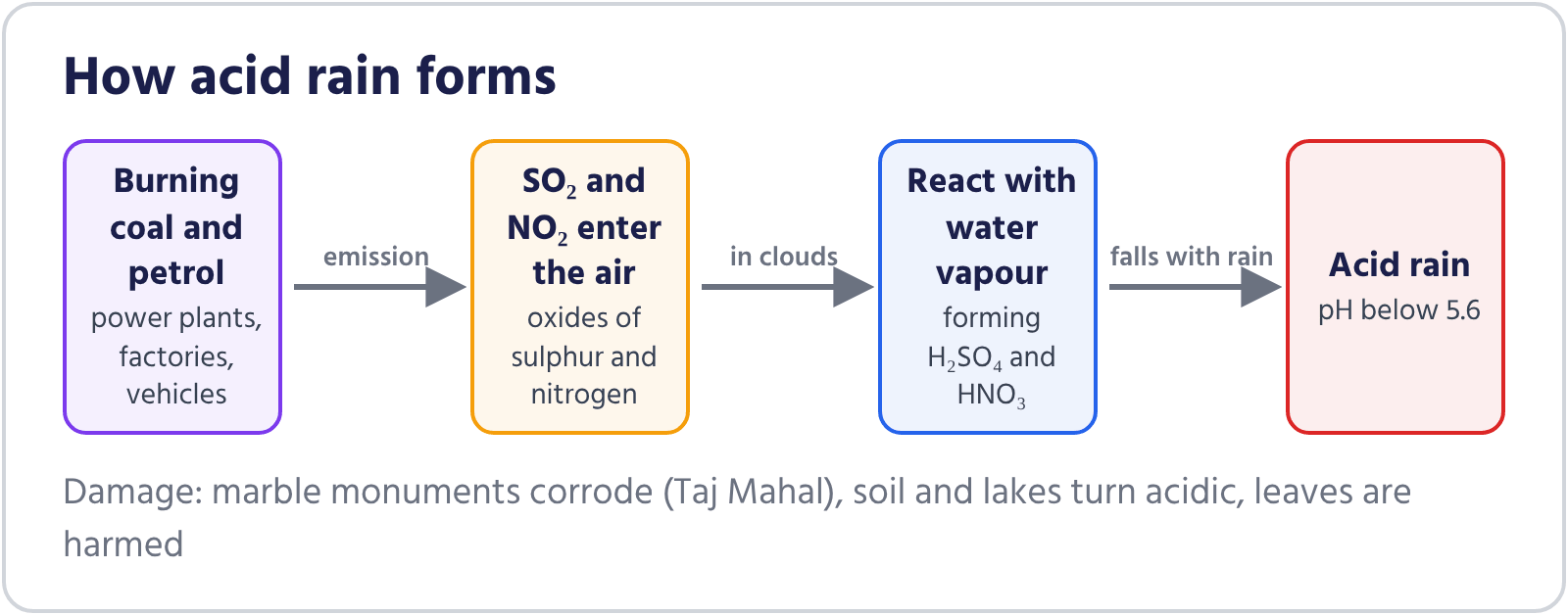
Burning coal and petrol releases SO₂ and oxides of nitrogen. They react with water vapour to form sulphuric and nitric acid, which come down with the rain. CO and methane do not form these acids.
Key Points
- SO₂ gives sulphuric acid, NO₂ gives nitric acid
- Sources: power plants, factories, vehicles
- Marble decay of the Taj Mahal: stone cancer
Additional Information
Rain is called acid rain when its pH is below:
Explanation
Normal rain dissolves a little CO₂ from the air, so its pH is about 5.6, not a neutral 7. A pH lower than that means extra acid, which is acid rain. 7 is neutral and 8.5 is alkaline.
Key Points
- pH 7 is neutral, below 7 acidic, above 7 alkaline
- Normal rain has a pH of about 5.6
Confusion Points
- The limit is 5.6, not 7: normal rain is already slightly acidic
Additional Information
Minamata disease is caused by pollution with which metal?
Explanation
In Minamata Bay, Japan, mercury from a factory's waste built up in fish, and people who ate the fish suffered nerve damage: Minamata disease. Cadmium causes itai-itai disease and arsenic causes blackfoot disease.
Key Points
- Mercury (Hg) = Minamata
- Cadmium (Cd) = itai-itai
- Both diseases were first seen in Japan
Confusion Points
- Both are Japanese diseases: Minamata is mercury, itai-itai is cadmium
Memory Tips
- "M for Mercury and Minamata"
Additional Information
| Pollutant | Disease / harm | Remember |
|---|---|---|
| Mercury (Hg) | Minamata disease | Minamata Bay, Japan; from eating contaminated fish |
| Cadmium (Cd) | Itai-itai disease | Japan; brittle bones and severe pain |
| Arsenic (As) | Arsenicosis, blackfoot disease | Tube-well water in many West Bengal districts |
| Fluoride | Fluorosis | Stained teeth, bent bones |
| Nitrate | Blue baby syndrome | Less oxygen in an infant's blood, bluish skin |
| Lead (Pb) | Plumbism | Damage to the nerves and brain |
An excess of which pollutant in drinking water causes "blue baby syndrome" in infants?
Explanation
Too much nitrate in water stops an infant's haemoglobin from carrying oxygen, and the skin turns bluish: blue baby syndrome. The nitrate comes mostly from chemical fertilisers. Fluoride causes fluorosis and arsenic causes arsenicosis.
Key Points
- Source of nitrate: chemical fertilisers
- Fluoride = fluorosis (teeth and bones)
- Arsenic = arsenicosis, blackfoot disease
Memory Tips
- Nitrate and blue baby: N for Nitrate, N for newborn
Additional Information
| Pollutant | Disease / harm | Remember |
|---|---|---|
| Mercury (Hg) | Minamata disease | Minamata Bay, Japan; from eating contaminated fish |
| Cadmium (Cd) | Itai-itai disease | Japan; brittle bones and severe pain |
| Arsenic (As) | Arsenicosis, blackfoot disease | Tube-well water in many West Bengal districts |
| Fluoride | Fluorosis | Stained teeth, bent bones |
| Nitrate | Blue baby syndrome | Less oxygen in an infant's blood, bluish skin |
| Lead (Pb) | Plumbism | Damage to the nerves and brain |
Which gas leaked in the Bhopal gas tragedy of 1984?
Explanation
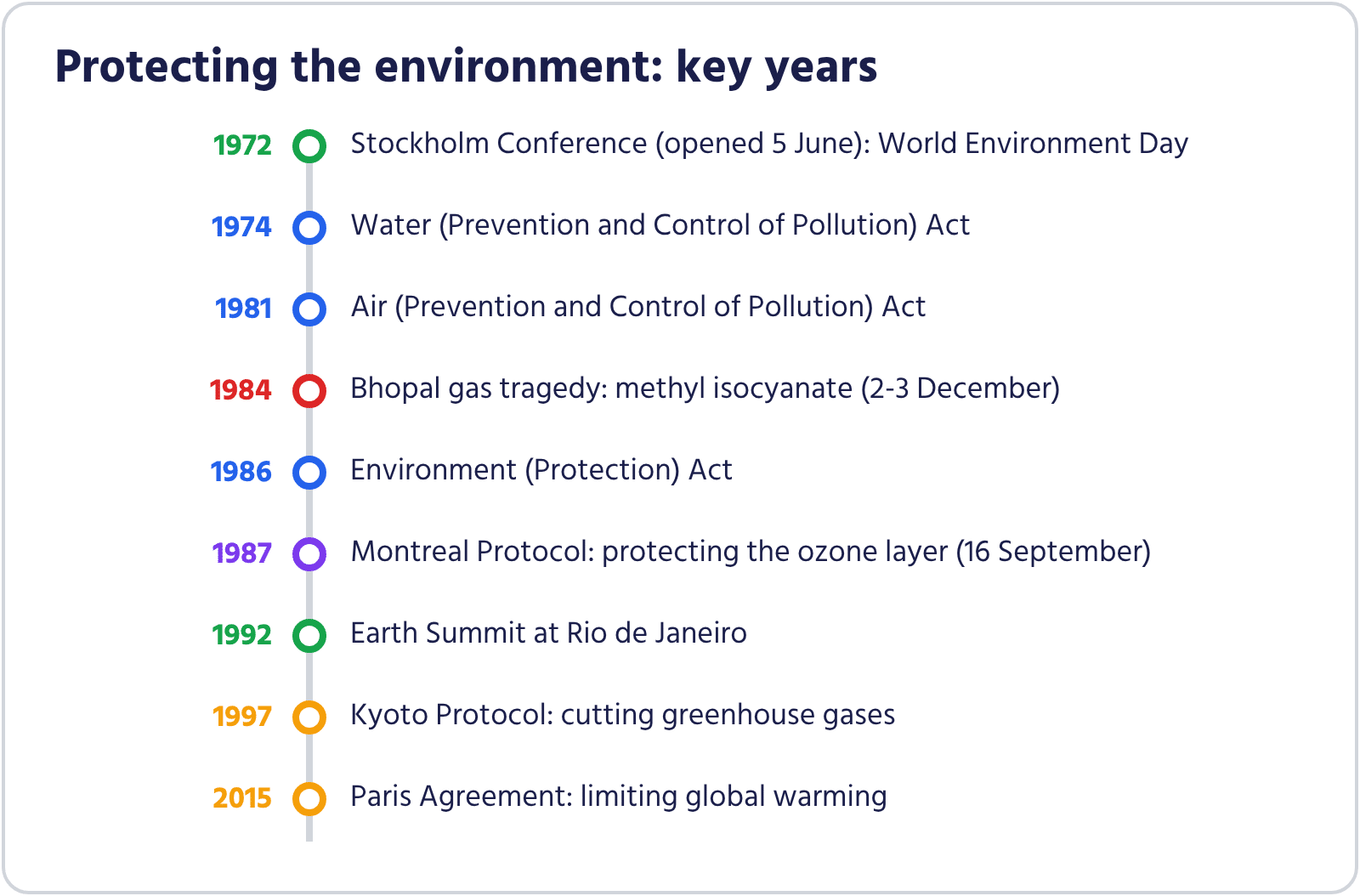
On the night of 2-3 December 1984, methyl isocyanate (MIC) leaked from Union Carbide's pesticide plant in Bhopal and killed thousands of people. It is India's worst industrial disaster. The Environment (Protection) Act followed in 1986.
Key Points
- Date: 2-3 December 1984
- Plant: Union Carbide
- 2 December is National Pollution Control Day
Additional Information
Which organism is a biological indicator of sulphur dioxide pollution in the air?
Explanation
Lichens (an alga and a fungus living together) are very sensitive to SO₂, so they do not grow in the polluted air of cities. Where lichens grow, the air is relatively clean. Moss and ferns are not used as this indicator.
Key Points
- Lichen = alga + fungus
- Lichens disappear as SO₂ rises
- Coliform bacteria (E. coli) indicate faecal pollution of water
Confusion Points
- Lichen indicates air quality, coliform indicates water quality: do not mix them up
In a food chain, which organism carries the highest concentration of a pesticide like DDT?
Explanation
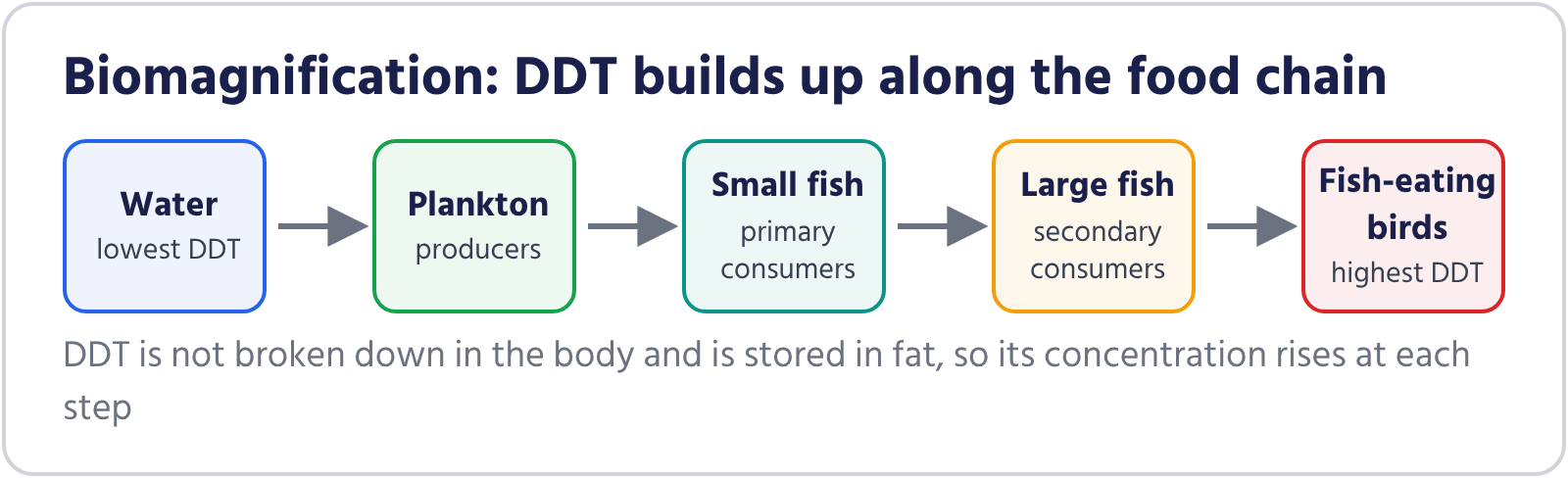
DDT is not broken down in the body and is stored in fat, so its concentration rises at every step of the food chain: this is biomagnification. The fish-eating bird at the end of the chain therefore carries the most DDT. Plankton and water plants are at the start of the chain and carry the least.
Key Points
- Biomagnification: rising concentration along the chain
- DDT is non-biodegradable
- DDT makes birds' eggshells thin
Additional Information
The Montreal Protocol (1987) was adopted to:
Explanation
The Montreal Protocol was adopted on 16 September 1987 to phase out ozone-depleting substances such as CFCs; that is why 16 September is World Ozone Day. The treaties on greenhouse gases are the Kyoto Protocol (1997) and the Paris Agreement (2015).
Key Points
- Montreal Protocol: phasing out ozone-depleting substances
- Kyoto (1997): greenhouse gases
- 16 September is World Ozone Day
Confusion Points
- Montreal is about ozone, Kyoto about greenhouse gases: they are often swapped
Memory Tips
- Montreal = the umbrella overhead (ozone); Kyoto = carbon
Additional Information
0/10


Leave a Comment
Commenting as ·