
12 simplification questions on decimals, square roots, algebraic identities, continued fractions and recurring decimals, each with the full working.
Simplification Part 2 Practice Quiz: Decimals, Identities and Continued Fractions, WBPSC Clerkship 2024
Practice session
A little practice. A step forward.
12 questions
Learn with explanations
At your own pace
0 / 12 completed
00:00
What is the value of $0.6 \times 0.5 + 2.4 \div 0.8$?
Explanation
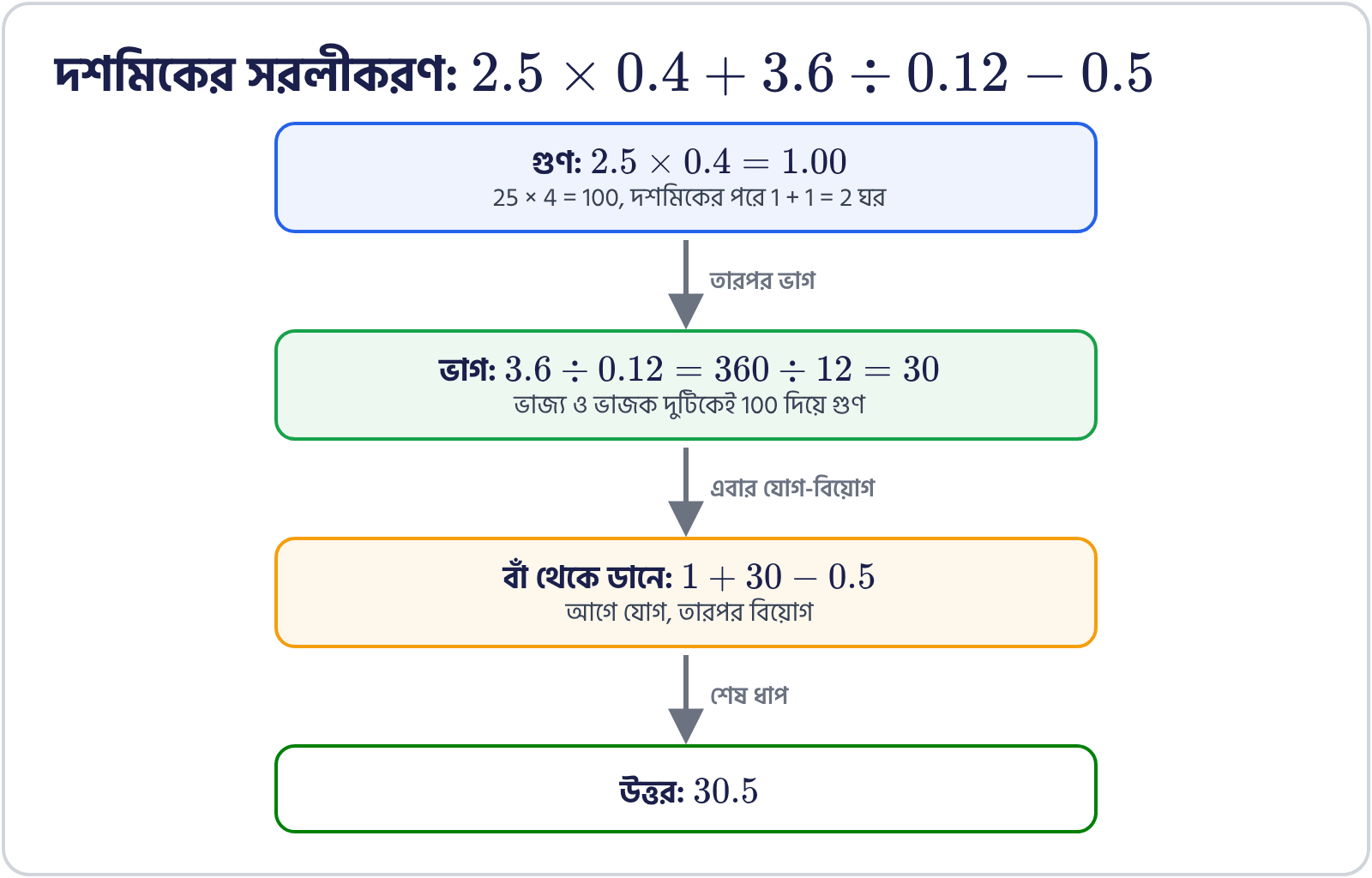
Multiply and divide first: $0.6 \times 0.5 = 0.30$ and $2.4 \div 0.8 = 24 \div 8 = 3$. Then add: $0.3 + 3 = 3.3$. Working straight left to right ($0.3 + 2.4 = 2.7$, then $2.7 \div 0.8$) gives 3.375, which breaks BODMAS.
Key Points
- Multiplication and division come before addition
- In decimal division, multiply both numbers by 10
Additional Information
What is the value of $\sqrt{196} + 3^{3} \div 9 - 4$?
Explanation
Orders first: $\sqrt{196} = 14$ and $3^{3} = 27$. Then divide: $27 \div 9 = 3$. Finally $14 + 3 - 4 = 13$. Forgetting the final − 4 gives 17.
Key Points
- Powers and roots come before division and multiplication
- $3^{3} = 27$, not $3 \times 3 = 9$
Confusion Points
- $3^{3}$ means $3 \times 3 \times 3 = 27$; many write $3 \times 3 = 9$ by mistake
What is the value of $\frac{(4.6)^{2} - (2.4)^{2}}{4.6 - 2.4}$?
Explanation
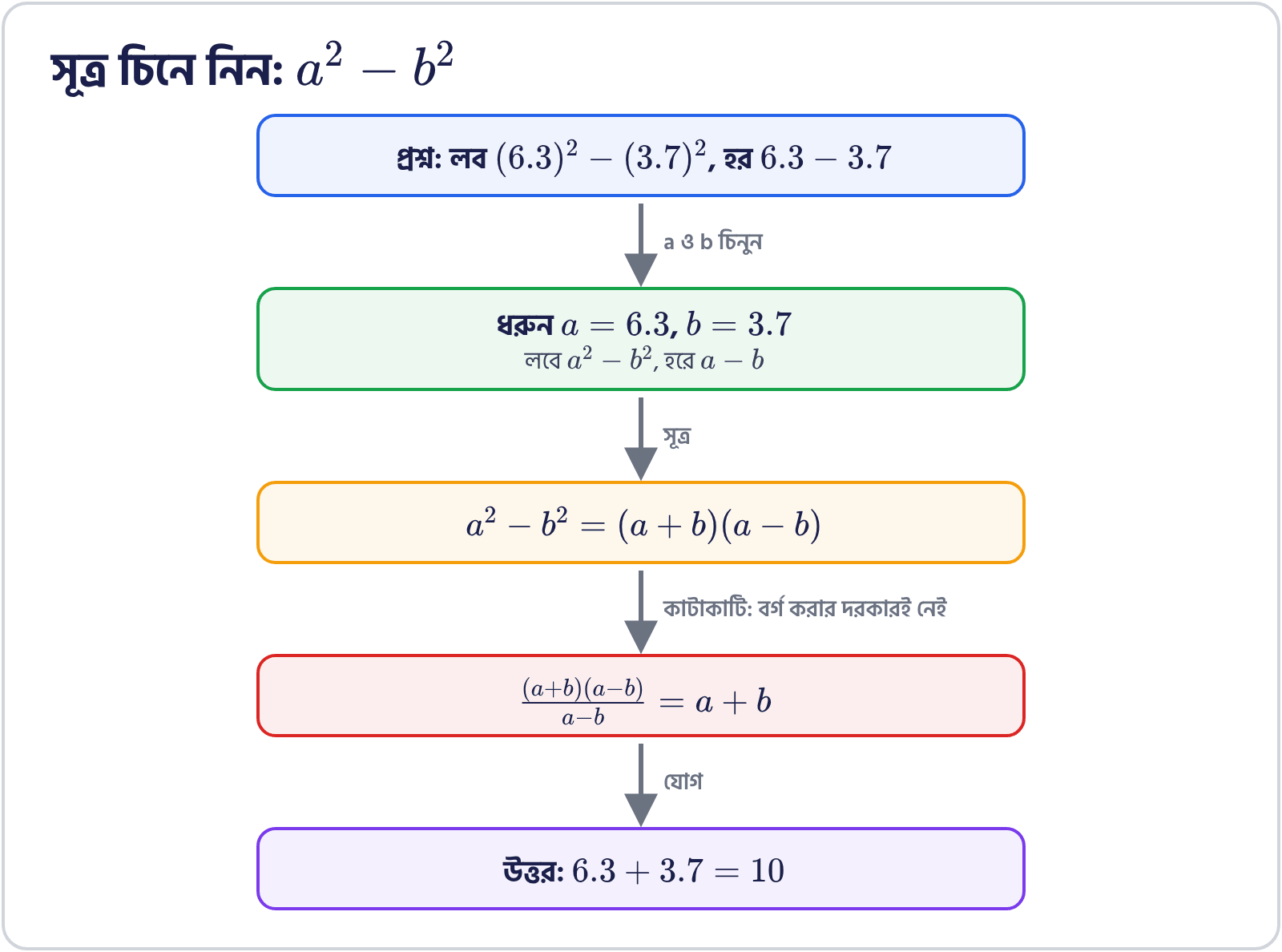
The numerator is $a^{2} - b^{2} = (a + b)(a - b)$ with $a = 4.6$, $b = 2.4$. Cancelling $(a - b)$ leaves $a + b = 4.6 + 2.4 = 7$. 2.2 is $a - b$ and 4.84 is $(2.2)^{2}$: both come from misusing the identity.
Key Points
- $a^{2} - b^{2} = (a + b)(a - b)$
- Over $a - b$, the answer is $a + b$
Memory Tips
- Difference of squares ÷ difference = sum
Additional Information
What is the value of $(5.3)^{2} + 2 \times 5.3 \times 4.7 + (4.7)^{2}$?
Explanation
This is $a^{2} + 2ab + b^{2} = (a + b)^{2}$ with $a = 5.3$, $b = 4.7$. So the value is $(5.3 + 4.7)^{2} = 10^{2} = 100$. Writing 10 forgets the square, and 0.36 is $(a - b)^{2}$, which a minus sign in the middle term would give.
Key Points
- $(a + b)^{2} = a^{2} + 2ab + b^{2}$
- When a + b is a whole number, the answer is an easy square
Additional Information
| Identity | How to spot it |
|---|---|
| $a^{2} - b^{2} = (a + b)(a - b)$ | Difference of two squares over a sum or difference |
| $(a + b)^{2} = a^{2} + 2ab + b^{2}$ | A middle term $2 \times a \times b$, all signs + |
| $(a - b)^{2} = a^{2} - 2ab + b^{2}$ | A middle term $- 2 \times a \times b$ |
| $a^{3} + b^{3} = (a + b)(a^{2} - ab + b^{2})$ | Sum of cubes over a three-term expression |
What is the value of $(7.5)^{2} - 2 \times 7.5 \times 2.5 + (2.5)^{2}$?
Explanation
The middle term is subtracted, so this is $(a - b)^{2}$ with $a = 7.5$, $b = 2.5$. The value is $(7.5 - 2.5)^{2} = 5^{2} = 25$. Check: $56.25 - 37.5 + 6.25 = 25$. 100 comes from using $(a + b)^{2}$, and 5 from forgetting to square.
Key Points
- $(a - b)^{2} = a^{2} - 2ab + b^{2}$
- Choose the identity by the sign of the middle term
Confusion Points
- $(a + b)^{2}$ and $(a - b)^{2}$ differ only in the sign of the middle $2ab$
Additional Information
| Identity | How to spot it |
|---|---|
| $a^{2} - b^{2} = (a + b)(a - b)$ | Difference of two squares over a sum or difference |
| $(a + b)^{2} = a^{2} + 2ab + b^{2}$ | A middle term $2 \times a \times b$, all signs + |
| $(a - b)^{2} = a^{2} - 2ab + b^{2}$ | A middle term $- 2 \times a \times b$ |
| $a^{3} + b^{3} = (a + b)(a^{2} - ab + b^{2})$ | Sum of cubes over a three-term expression |
What is the value of $1 + \frac{1}{1 + \frac{1}{1 + \frac{1}{2}}}$?
Explanation
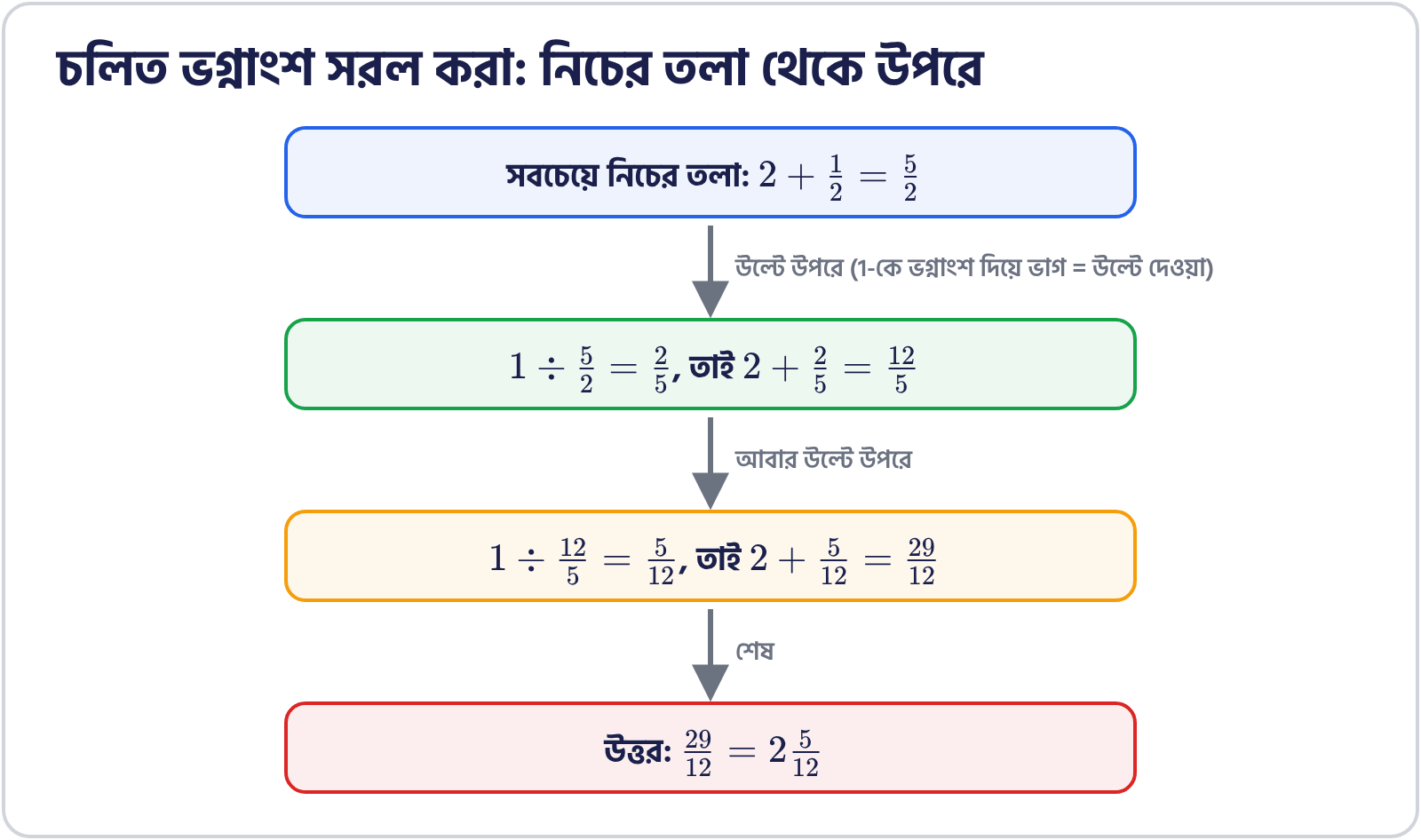
Start at the bottom: $1 + \frac{1}{2} = \frac{3}{2}$, flip to $\frac{2}{3}$; then $1 + \frac{2}{3} = \frac{5}{3}$, flip to $\frac{3}{5}$; finally $1 + \frac{3}{5} = \frac{8}{5}$. $\frac{5}{3}$ is a middle step: stopping there is the mistake.
Key Points
- A continued fraction is simplified from the bottom up
- $1 \div \frac{p}{q} = \frac{q}{p}$
Memory Tips
- Two moves per level: add, then flip
Additional Information
What is the value of $3 - \frac{1}{3 - \frac{1}{3}}$?
Explanation
From the bottom: $3 - \frac{1}{3} = \frac{8}{3}$, flipped to $\frac{3}{8}$. Finally $3 - \frac{3}{8} = \frac{24}{8} - \frac{3}{8} = \frac{21}{8} = 2\frac{5}{8}$. $\frac{27}{8}$ comes from adding instead of subtracting.
Key Points
- Watch the sign (+ or −) at every level
- $\frac{21}{8} = 2\frac{5}{8}$
Additional Information
If $96 \div ? \times 4 = 32$, what is the value of ?
Explanation
Division and multiplication go left to right, so the expression is $\frac{96}{?} \times 4 = \frac{384}{?}$. From $\frac{384}{?} = 32$, $? = 384 \div 32 = 12$. Check: $96 \div 12 = 8$, $8 \times 4 = 32$. 3 comes from $96 \div 32$, forgetting the multiplication.
Key Points
- Division and multiplication rank equal, left to right
- Check by putting the answer back
Confusion Points
- $96 \div ? \times 4$ does not mean $96 \div (? \times 4)$
What is the value of $0.\overline{6} + 0.\overline{7}$?
Explanation
$0.\overline{6} = \frac{6}{9}$ and $0.\overline{7} = \frac{7}{9}$. The sum is $\frac{13}{9} = 1\frac{4}{9} = 1.\overline{4}$. 1.3 comes from adding only the first digits ($0.6 + 0.7$), which does not work for recurring decimals.
Key Points
- $0.\overline{a} = \frac{a}{9}$
- $0.\overline{ab} = \frac{ab}{99}$
Confusion Points
- $0.\overline{6}$ and 0.6 differ: the first is $\frac{2}{3}$, the second $\frac{3}{5}$
What is the value of $1.5 \times 0.04 \div 0.003$?
Explanation
Left to right: $1.5 \times 0.04 = 0.060$ (15 × 4 = 60, with 1 + 2 = 3 decimal places). Then $0.060 \div 0.003$: multiply both by 1000 to get $60 \div 3 = 20$. Miscounting the places gives 2 or 200.
Key Points
- In multiplication the decimal places add up
- In division multiply both numbers by the same power of 10
Additional Information
What is the value of $\sqrt{0.0081} + \sqrt{0.16}$?
Explanation
A square root halves the decimal places: $\sqrt{0.0081} = 0.09$ (four places become two) and $\sqrt{0.16} = 0.4$. The sum is $0.09 + 0.4 = 0.49$. Taking $\sqrt{0.0081}$ as 0.9 gives 1.3, which is wrong because $0.9 \times 0.9 = 0.81$.
Key Points
- A square root halves the number of decimal places
- Check: $0.09 \times 0.09 = 0.0081$
Confusion Points
- $\sqrt{0.81} = 0.9$, but $\sqrt{0.0081} = 0.09$
What is the value of $\frac{(0.8)^{3} + (0.2)^{3}}{(0.8)^{2} - 0.8 \times 0.2 + (0.2)^{2}}$?
Explanation
The identity is $a^{3} + b^{3} = (a + b)(a^{2} - ab + b^{2})$. The denominator is exactly $a^{2} - ab + b^{2}$, so the answer is $a + b = 0.8 + 0.2 = 1$. Check: numerator $0.512 + 0.008 = 0.52$, denominator $0.64 - 0.16 + 0.04 = 0.52$. 0.52 is the numerator or denominator, not the quotient.
Key Points
- $a^{3} + b^{3} = (a + b)(a^{2} - ab + b^{2})$
- $a^{3} - b^{3} = (a - b)(a^{2} + ab + b^{2})$
Memory Tips
- Sum of cubes: minus in the middle below; difference of cubes: plus in the middle
Additional Information
| Identity | How to spot it |
|---|---|
| $a^{2} - b^{2} = (a + b)(a - b)$ | Difference of two squares over a sum or difference |
| $(a + b)^{2} = a^{2} + 2ab + b^{2}$ | A middle term $2 \times a \times b$, all signs + |
| $(a - b)^{2} = a^{2} - 2ab + b^{2}$ | A middle term $- 2 \times a \times b$ |
| $a^{3} + b^{3} = (a + b)(a^{2} - ab + b^{2})$ | Sum of cubes over a three-term expression |
0/12


Leave a Comment
Commenting as ·