
10 questions on integers and rational numbers: sign rules, comparison, inverses and classroom situations, each answer worked out step by step.
Integers and Rational Numbers Quiz: WB TET Upper Primary Maths
Practice session
A little practice. A step forward.
10 questions
Learn with explanations
At your own pace
0 / 10 completed
00:00
What is the value of $(-12) \div (-3) \times (-2)$?
Explanation
Division and multiplication have equal priority, so work from left to right: $(-12) \div (-3) = 4$, then $4 \times (-2) = -8$. Multiplying first gives $(-3) \times (-2) = 6$ and $(-12) \div 6 = -2$, which is wrong. There are 3 negative signs (odd), so the result is negative.
Key Points
- Division and multiplication go left to right
- An odd number of negative signs makes a product or quotient negative
Confusion Points
- Multiplying first gives −2: neither operation comes first, the order is left to right
Additional Information
Which of the following is NOT a rational number?
Explanation
$\sqrt{2}$ cannot be written as $\frac{p}{q}$; its decimal form never ends and never repeats, so it is irrational. 0 $= \frac{0}{1}$ is rational, $-\frac{5}{7}$ is already in $\frac{p}{q}$ form, and $0.\overline{3} = \frac{1}{3}$ is a recurring decimal, so it is rational.
Key Points
- Rational: $\frac{p}{q}$ with integers p, q and $q \neq 0$
- Terminating or recurring decimals are rational
- Non-terminating, non-recurring decimals are irrational
Confusion Points
- A never-ending decimal is not always irrational: a recurring one ($0.\overline{3}$) is rational
Which statement about $-\frac{3}{4}$ and $-\frac{5}{6}$ is correct?
Explanation
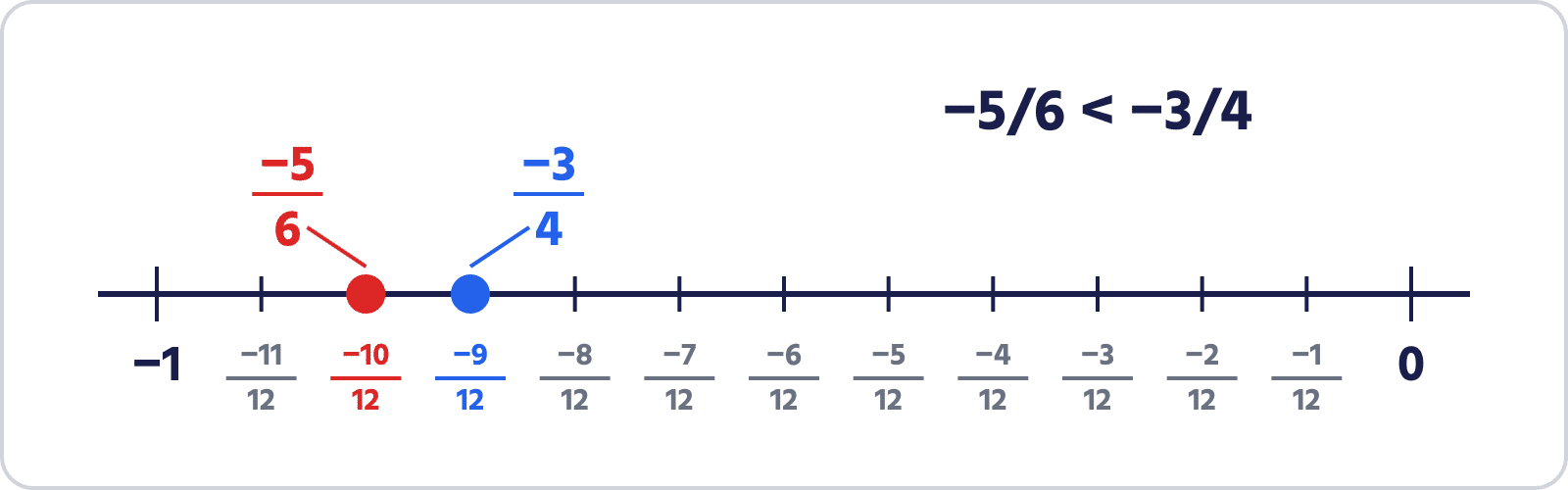
With the LCM 12: $-\frac{3}{4} = -\frac{9}{12}$ and $-\frac{5}{6} = -\frac{10}{12}$. Since $-9 \gt -10$, $-\frac{3}{4} \gt -\frac{5}{6}$. The first and third options say the same wrong thing in two ways: they carry the order of positive numbers over to negatives.
Key Points
- Bring both to the same denominator and compare numerators
- On the number line, the number to the right is greater
Confusion Points
- $\frac{5}{6} \gt \frac{3}{4}$ does not make $-\frac{5}{6}$ greater; with negatives the order flips
Memory Tips
- Negatives flip: the one bigger without its sign is the smaller with it
Additional Information
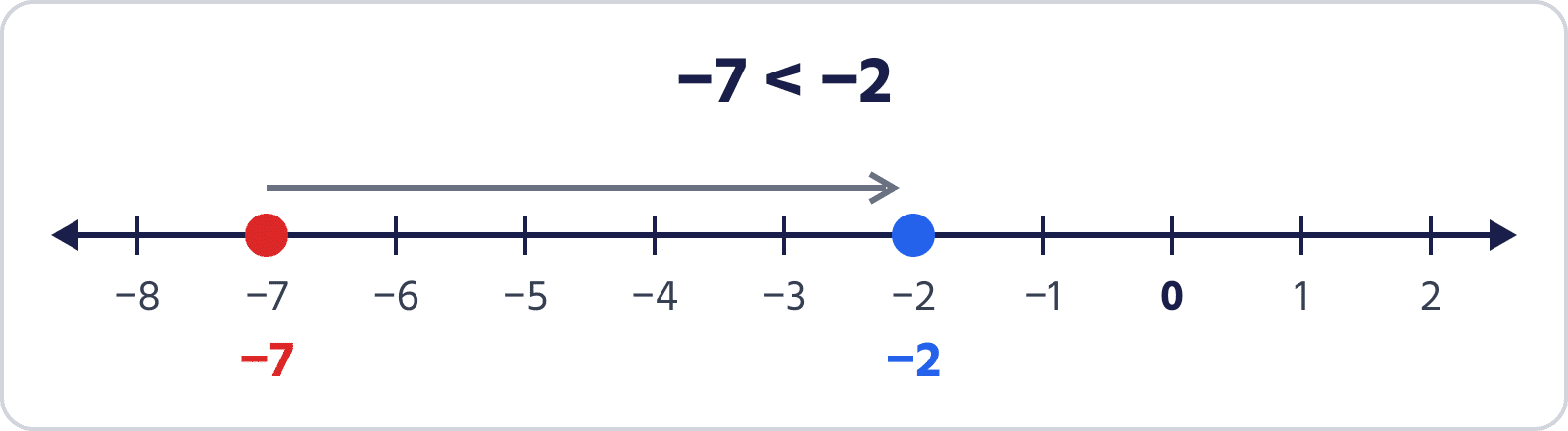
A Class VI student writes $-7 \gt -2$ "because 7 is bigger than 2". What should the teacher do first?
Explanation
The student has carried the order of natural numbers over to negatives; it is a misconception, not carelessness. On a number line (or a thermometer) she sees for herself that −2 lies to the right, so it is greater. Memorising or more sums do not change the idea, and showing the mistake to the class discourages the child.
Key Points
- A mistake is a clue to the child's thinking: find its cause first
- Concrete models for negatives: the number line, a thermometer
Additional Information
Which teaching-learning material (TLM) best shows the meaning of $(-3) - (-5)$?
Explanation
−3 is 3 negative counters. To take away 5 negatives, first add 2 zero pairs (+1 and −1); taking away 5 negatives leaves 2 positives, so $(-3) - (-5) = 2$. A calculator gives the answer but not the reason; a geometry box and a times-table chart have nothing to do with the idea.
Key Points
- Zero pair: one +1 and one −1 make 0
- Subtracting is adding the opposite: $(-3) + 5 = 2$
What is the multiplicative inverse (reciprocal) of $-\frac{2}{3}$?
Explanation
The multiplicative inverse is the number whose product with it is 1: $-\frac{2}{3} \times \left(-\frac{3}{2}\right) = 1$. Taking $\frac{3}{2}$ gives −1, so the sign stays. $\frac{2}{3}$ is the additive inverse (the sum is 0).
Key Points
- Multiplicative inverse: product 1, same sign
- Additive inverse: sum 0, opposite sign
- 0 has no multiplicative inverse
Confusion Points
- The additive inverse ($\frac{2}{3}$) and the multiplicative inverse ($-\frac{3}{2}$) are different
Additional Information
| Number | Additive inverse | Multiplicative inverse |
|---|---|---|
| $-\frac{2}{3}$ | $\frac{2}{3}$ | $-\frac{3}{2}$ |
| 5 | −5 | $\frac{1}{5}$ |
| 0 | 0 | None |
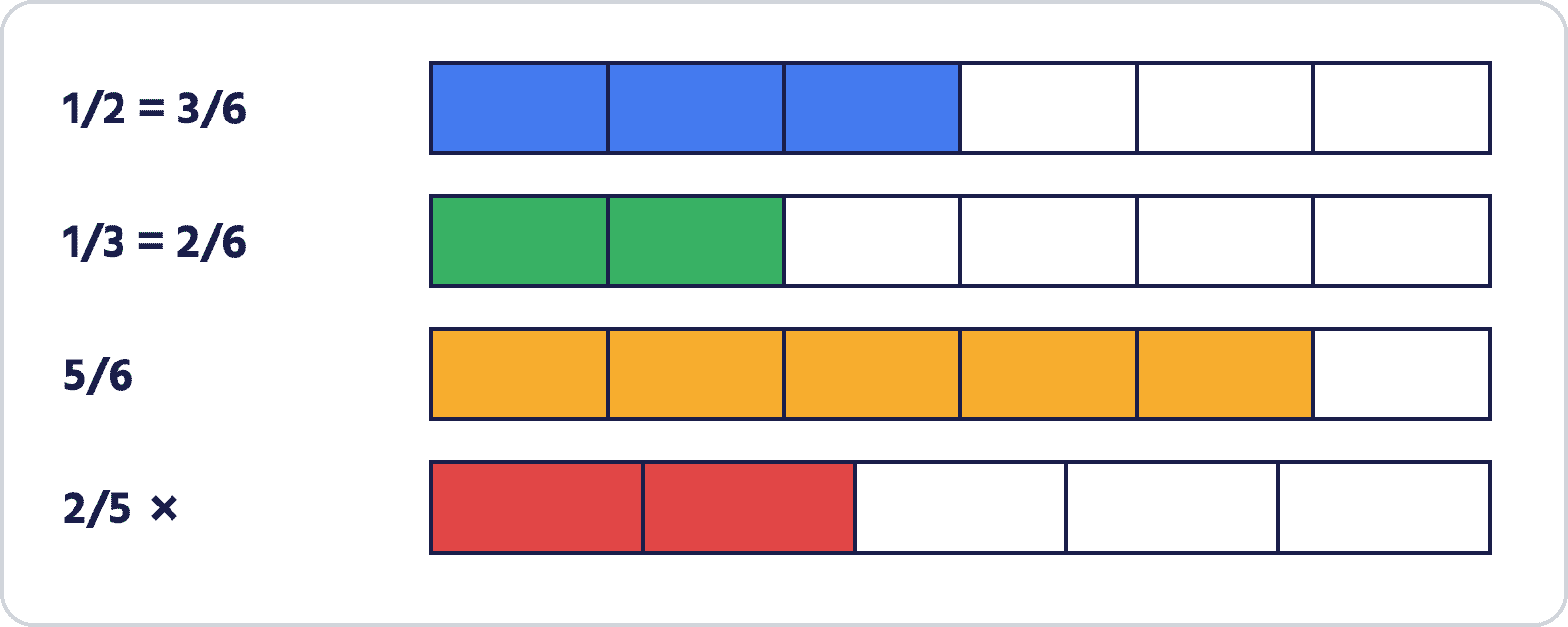
A student writes $\frac{1}{2} + \frac{1}{3} = \frac{2}{5}$. What is the cause and the right remedy?
Explanation
The student has applied whole-number addition to fractions: numerator plus numerator, denominator plus denominator. The right answer is $\frac{3}{6} + \frac{2}{6} = \frac{5}{6}$. The bars show that $\frac{2}{5}$ is smaller than $\frac{1}{2}$ itself, so it cannot be the sum; this corrects the idea itself. One mistake is no ground to assume dyscalculia.
Key Points
- Adding fractions needs a common denominator first
- Estimate to check: the sum of two positive numbers is bigger than each
Additional Information
Which rational number lies between $\frac{1}{3}$ and $\frac{1}{2}$?
Explanation
In twelfths: $\frac{1}{3} = \frac{4}{12}$ and $\frac{1}{2} = \frac{6}{12}$, so $\frac{5}{12}$ lies exactly between (it is also their mean). $\frac{1}{4} = 0.25$ and $\frac{2}{7} \approx 0.29$ are both less than $\frac{1}{3} \approx 0.33$; $\frac{3}{5} = 0.6$ is more than $\frac{1}{2}$.
Key Points
- The mean of two rational numbers always lies between them
- There are infinitely many rational numbers between any two
Memory Tips
- Take the mean: $\frac{1}{2}(a + b)$
A teacher begins negative numbers with temperatures below zero, floors below the ground in a lift and depths below sea level. Which principle is this?
Explanation
Starting from contexts the child knows and moving step by step to the number line and the rule is the principle of concrete to abstract (known to unknown). In the deductive method the rule comes first, which did not happen here, and rote learning plays no part. This way the child understands what a negative number means, not just its sign.
Key Points
- Maxims of teaching: known to unknown, concrete to abstract, simple to complex
- Contexts for negatives: temperature, floors, sea level, profit and loss
"Why is the product of two negative numbers positive?" What is the best way to teach this in class?
Explanation
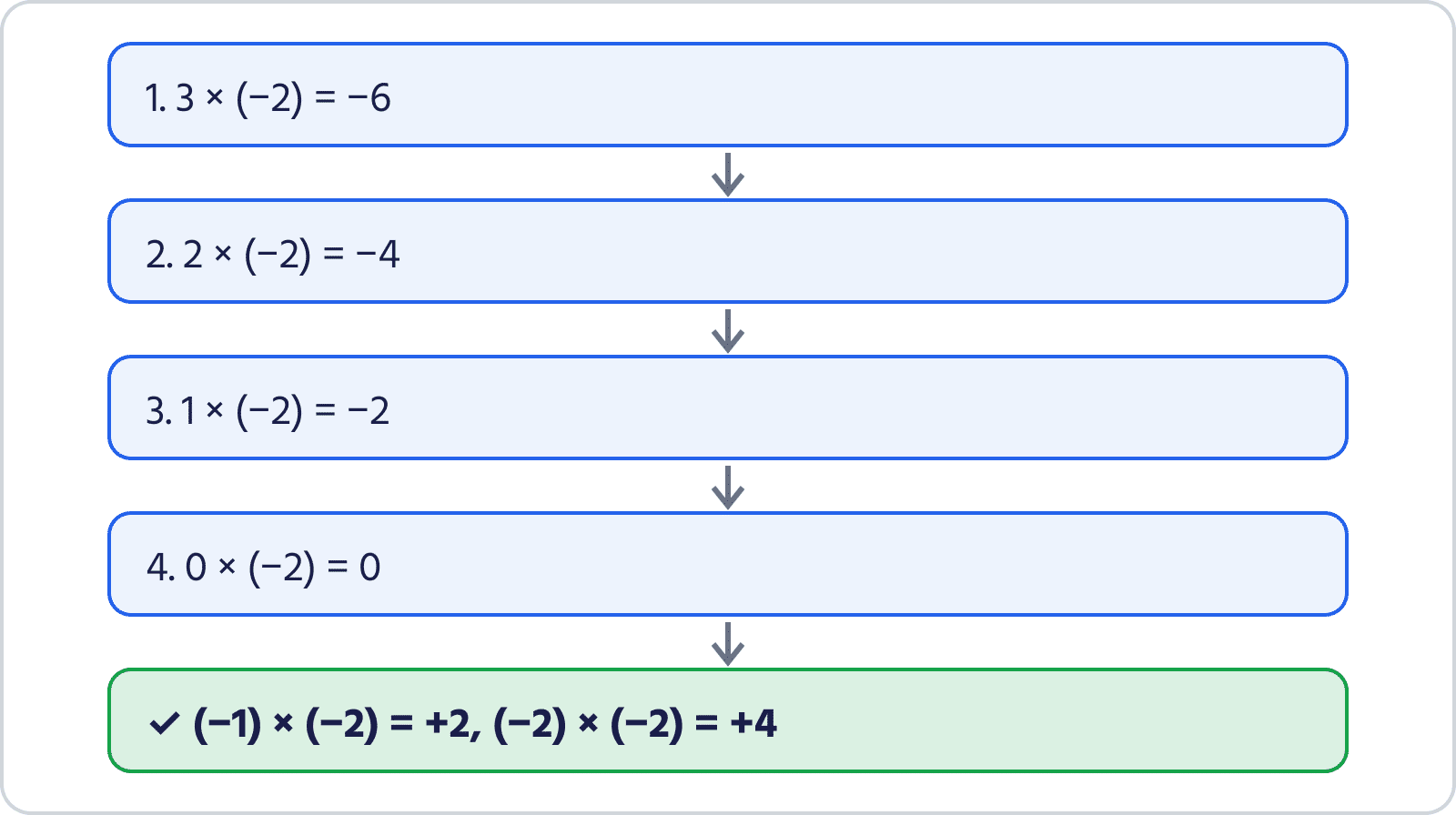
The products −6, −4, −2, 0 go up by 2 at each step, so the next is $(-1) \times (-2) = 2$. Reaching a rule from examples is the inductive method, and the child understands why the rule holds. Memorising, a calculator or drill alone does not answer "why".
Key Points
- Inductive: examples → rule; deductive: rule → examples
- Seeing patterns is a core skill in learning mathematics
Additional Information
0/10


Leave a Comment
Commenting as ·