
Corrected entries, the overlapping number, consecutive numbers, ages, a new member and batting averages: 12 questions, each worked out step by step.
Average Practice Quiz Part 2: WBPSC Clerkship 2024
Practice session
A little practice. A step forward.
12 questions
Learn with explanations
At your own pace
0 / 12 completed
00:00
The average of 50 numbers is 38. If 45 and 55 are removed, what is the average of the remaining numbers?
Explanation
Total $= 50 \times 38 = 1900$. Removing two numbers leaves $1900 - 100 = 1800$ for 48 numbers. Average $= 1800 \div 48 = 37.5$. 38.5 is impossible: the removed pair averages 50, above 38, so the rest must average less.
Key Points
- When numbers are removed, the divisor falls too: 50 to 48
- The removed pair averages 50, above 38, so the rest average less
Confusion Points
- Keeping 50 as the divisor: $1800 \div 50 = 36$ is the commonest slip
Memory Tips
- Total first, then the change, then divide by the new count
The average mark of 30 students was found to be 60. Later it was found that one student's 72 had been written as 27. What is the correct average?
Explanation
The correct mark is $72 - 27 = 45$ more than the wrong one. The average rises by $45 \div 30 = 1.5$, so the correct average is $60 + 1.5 = 61.5$. 58.5 comes from subtracting: the true value is larger, so the average goes up.
Key Points
- Correction to the average = (correct − wrong) ÷ n
- A larger correct value raises the average
Confusion Points
- Subtracting the correction instead of adding it
Memory Tips
- Reversed digits (72 ↔ 27) always differ by a multiple of 9
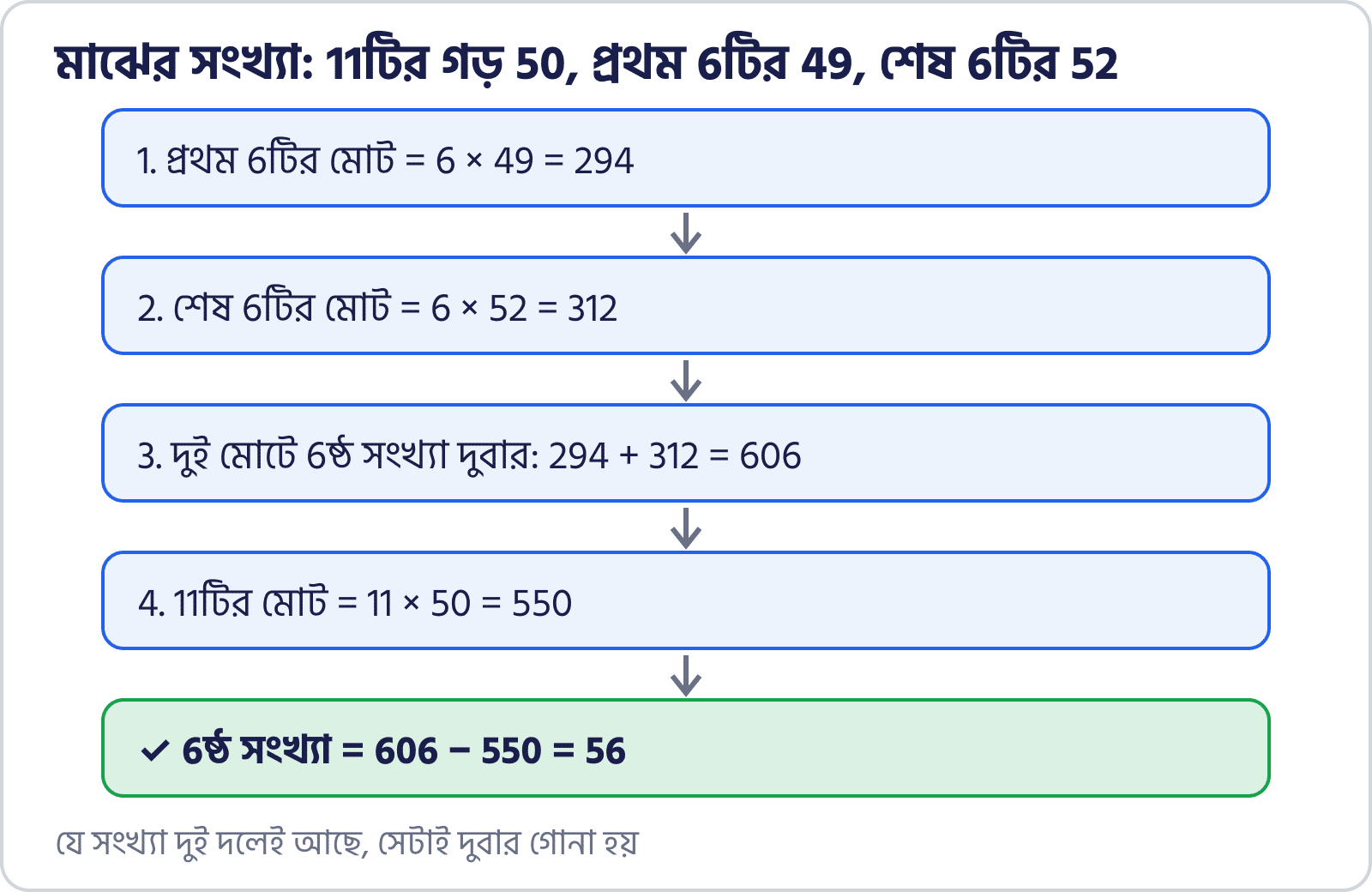
The average of 7 numbers is 40. The average of the first 4 is 38 and of the last 4 is 44. What is the fourth number?
Explanation
Sum of the first 4 $= 4 \times 38 = 152$, of the last 4 $= 4 \times 44 = 176$. The fourth number is in both. Fourth number $= 152 + 176 - 7 \times 40 = 328 - 280 = 48$.
Key Points
- 4 + 4 = 8 but there are only 7 numbers: one is counted twice
- Sum of both groups − overall total = the number counted twice
Memory Tips
- Add the group sizes and subtract the count to see how many overlap
Additional Information
The average of 6 consecutive odd numbers is 24. What is the largest of them?
Explanation
With an even count, the average lies between the middle two: 23 and 25. So the numbers are 19, 21, 23, 25, 27, 29; the largest is 29. Check: sum 144, $144 \div 6 = 24$. 27 would come from taking only 5 numbers.
Key Points
- Consecutive odd numbers are 2 apart
- With an even count the average itself is not in the list
Confusion Points
- 24 is even, so it is not one of the numbers; the middle pair is 23 and 25
Memory Tips
- Largest = average + (n − 1) for steps of 2: 24 + 5 = 29
Additional Information

What is the average of the first 20 even natural numbers?
Explanation
The first 20 even numbers are 2, 4, …, 40. Average $= (2 + 40) \div 2 = 21$, that is $n + 1$. 10.5 is the average of the first 20 natural numbers, $\frac{21}{2}$, and 20 would be the average of the first 20 odd numbers.
Key Points
- Average of the first n even numbers = n + 1
- Average of the first n odd numbers = n
- Average of the first n natural numbers = $\frac{n+1}{2}$
Confusion Points
- Mixing up the three formulas for natural, even and odd numbers
Memory Tips
- Even: n + 1, odd: n (even is always one ahead)
Additional Information
| First n | Sum | Average | Average for n = 20 |
|---|---|---|---|
| Natural numbers | n(n + 1) ÷ 2 | (n + 1) ÷ 2 | 10.5 |
| Even numbers | n(n + 1) | n + 1 | 21 |
| Odd numbers | n² | n | 20 |
What is the average of all the multiples of 7 between 1 and 100?
Explanation
The multiples of 7 between 1 and 100 are 7, 14, …, 98: $98 \div 7 = 14$ of them. They are equally spaced, so the average $= (7 + 98) \div 2 = 52.5$. 49 is a multiple near the middle, but with 14 terms the average is that of the middle pair, 49 and 56.
Key Points
- For equally spaced numbers, average = (first + last) ÷ 2
- The last multiple of 7 below 100 is 98
Memory Tips
- Find the first and last terms and average them: no need to count
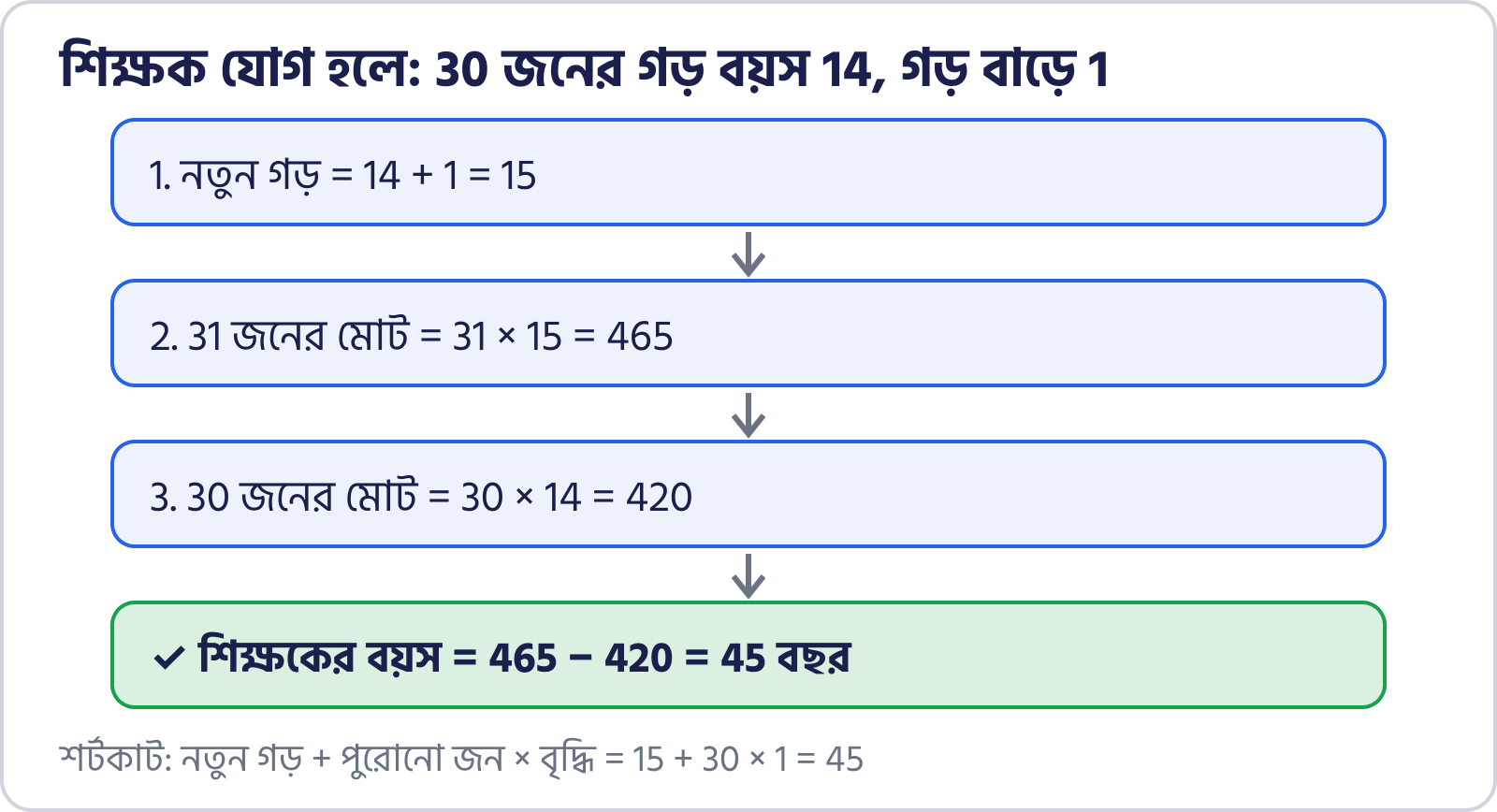
The average weight of 24 students is 40 kg. When the teacher's weight is included, the average rises by 1 kg. What is the teacher's weight?
Explanation
New average 41 kg, so 25 people total $25 \times 41 = 1025$ kg. The students total $24 \times 40 = 960$ kg. Teacher $= 1025 - 960 = 65$ kg. Shortcut: $41 + 24 \times 1 = 65$. 41 is only the new average; 66 comes from multiplying by 25.
Key Points
- New member = new average + old count × increase
- The newcomer must supply the increase for everyone already there
Confusion Points
- Multiplying the rise by 25 instead of 24: 41 + 25 = 66 is wrong
Memory Tips
- Start from the new average and add everyone's share of the rise
Additional Information
A batter scores 91 runs in the 17th innings and so raises the average by 3 runs. What is the average after 17 innings?
Explanation
With the earlier average $x$: $16x + 91 = 17(x + 3)$, so $x = 91 - 51 = 40$. New average $= 40 + 3 = 43$. Check: $16 \times 40 + 91 = 731$, $731 \div 17 = 43$. 40 is the earlier average; the question asks for the new one.
Key Points
- Runs in the new innings = new average + earlier innings × increase
- Here 91 = new average + 16 × 3, so the new average is 43
Confusion Points
- Confusing the earlier average (40) with the new one (43)
Memory Tips
- New average = new score − earlier innings × increase
Additional Information
Shortcut: new average $= 91 - 16 \times 3 = 91 - 48 = 43$. It is the teacher formula worked backwards.
Five years ago the average age of A, B and C was 28 years. Now the average age of B and C is 30 years. What is A's present age?
Explanation
In 5 years the average of the three also rises by 5: now 33, total $3 \times 33 = 99$. B and C now total $2 \times 30 = 60$. A $= 99 - 60 = 39$ years. Subtracting today's 60 from the old total 84 mixes two different times.
Key Points
- In t years everyone is t years older, so the average rises by t
- All ages must be taken at the same time
Confusion Points
- Taking today's total (60) from the old total (84): ages from two times cannot be mixed
Memory Tips
- Bring every age to 'now' first, then subtract
The average age of 8 men rises by 2 years when two of them, aged 21 and 23, are replaced by two women. What is the average age of the women?
Explanation
The count stays 8, so a rise of 2 in the average adds $8 \times 2 = 16$ to the total. The two who left total $21 + 23 = 44$, so the women total $44 + 16 = 60$ and average $60 \div 2 = 30$ years. 22 is the average of the men who left.
Key Points
- In a replacement the count stays the same: change in total = change in average × count
- When two are replaced, the extra total is shared by the two newcomers
Confusion Points
- Doubling the 16 or calling the newcomers' total their average
Memory Tips
- Newcomers' total = leavers' total + count × increase
The average of 10 numbers is 12. If each number is multiplied by 3 and then 5 is added, what is the new average?
Explanation
When every number gets the same multiplication and addition, so does the average: $12 \times 3 + 5 = 41$. Check: the total 120 becomes $120 \times 3 + 10 \times 5 = 410$, and $410 \div 10 = 41$. 36 is the multiplication alone, 17 the addition alone.
Key Points
- Adding k to each number adds k to the average
- Multiplying each by k multiplies the average by k
- Keep the order: multiply first, then add
Confusion Points
- Adding first and multiplying after: $(12 + 5) \times 3 = 51$; the order changes the answer
Memory Tips
- Treat the average as one number and do the same to it
Three numbers are in the ratio 2 : 3 : 5 and their average is 40. What is the largest number?
Explanation
Their total is $3 \times 40 = 120$. The parts add to $2 + 3 + 5 = 10$, so one part is $120 \div 10 = 12$. The largest is $5 \times 12 = 60$. 50 comes from sharing the average instead of the total.
Key Points
- Turn the average into a total first: 3 × 40 = 120
- Then share the total in the ratio
Memory Tips
- Average × count = total, then it is a ratio sum
0/12
📊 Topic Analysis
About this quiz
More for Clerkship 2024

Independence and Partition Quiz: Clerkship 2024 GS

India Geography Mixed Quiz 7: Ranges, Passes, Rivers and Dams, Islands, Soils, Industry and Ports (Clerkship 2024)

National Symbols and Important Days Quiz: WBPSC Clerkship 2024

Leave a Comment
Commenting as ·