
Ten WB TET-style questions on Bengali vowels, consonants, places of articulation and teaching pronunciation in class.
Bengali Sounds and Letters Quiz: WB TET Language I, Places of Articulation
Quiz challenge
A little practice. A step forward.
10 questions
Learn with explanations
Time per question: 45 sec
0 / 10 completed
--:--
How many vowel letters (swarabarna) does the Bengali alphabet have?
Explanation
The Bengali alphabet has 11 vowel letters: অ, আ, ই, ঈ, উ, ঊ, ঋ, এ, ঐ, ও, ঔ. Seven is the number of basic vowel sounds, not letters, which is why 7 is the commonest wrong choice.
Key Points
- 11 vowel letters and 39 consonant letters, 50 in all
- Seven basic vowel sounds: অ, আ, ই, উ, এ, অ্যা, ও
Confusion Points
- Vowel letters (written) are 11, but basic vowel sounds (spoken) are 7
Memory Tips
- 11 vowels + 39 consonants = 50 letters
Which vowel letter has no vowel sign (kar)?
Explanation
অ has no vowel sign: every consonant letter already carries it (ক = ক্ + অ). আ (া), ই (ি) and ঋ (ৃ) all have signs.
Key Points
- ক্ + অ = ক: অ is hidden inside the consonant
- The hasanta (্) removes that inherent অ
Memory Tips
- অ is hidden, so its sign is hidden too
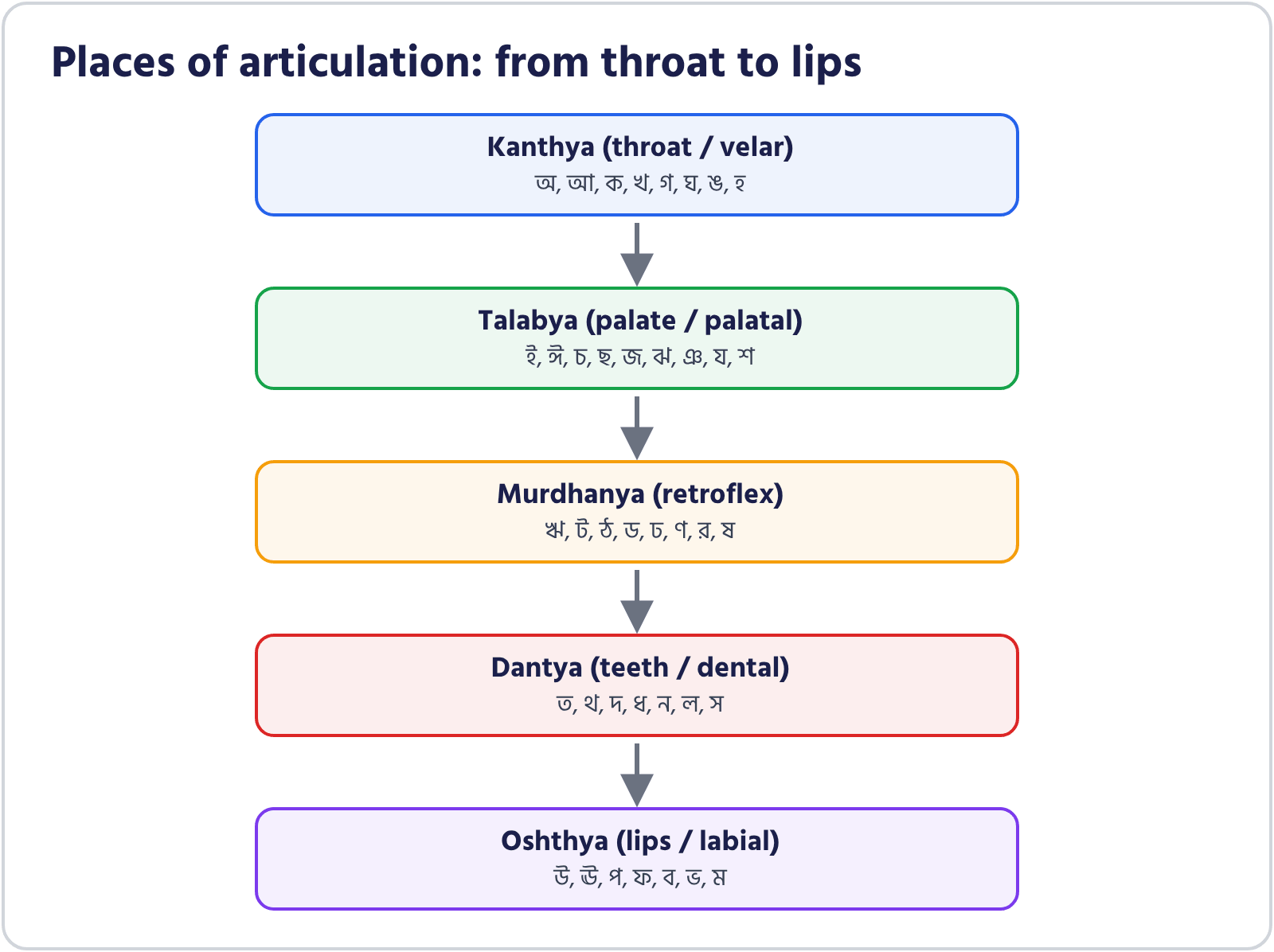
What is the place of articulation of the letters ট, ঠ, ড, ঢ, ণ?
Explanation
These are the ট group, articulated at the murdha, so they are murdhanya (retroflex) letters. The throat is the place of the ক group, the palate of the চ group and the teeth of the ত group.
Key Points
- ক group throat, চ group palate, ট group murdha, ত group teeth, প group lips
- ণ is murdhanya, ন is dental
Confusion Points
- ণ (ট group) is murdhanya, but ন (ত group) is dental
Memory Tips
- ক → চ → ট → ত → প = throat → palate → murdha → teeth → lips
Additional Information
| Group | 1st | 2nd | 3rd | 4th | 5th | Place |
|---|---|---|---|---|---|---|
| ক group | ক | খ | গ | ঘ | ঙ | Throat |
| চ group | চ | ছ | জ | ঝ | ঞ | Palate |
| ট group | ট | ঠ | ড | ঢ | ণ | Retroflex (murdha) |
| ত group | ত | থ | দ | ধ | ন | Teeth |
| প group | প | ফ | ব | ভ | ম | Lips |
1st and 2nd: voiceless; 3rd, 4th, 5th: voiced. 1st and 3rd: unaspirated; 2nd and 4th: aspirated; 5th: nasal
Which of these is NOT a basic (simple) vowel sound of Bengali?
Explanation
ঐ is a diphthong (ও + ই), made of two vowels, so it is not basic. অ্যা, এ and ও are among the seven basic vowel sounds; অ্যা has no letter of its own but is still a basic sound.
Key Points
- Basic vowel sounds: অ, আ, ই, উ, এ, অ্যা, ও
- Diphthongs: ঐ (ও + ই), ঔ (ও + উ)
Confusion Points
- অ্যা is not in the alphabet but is a basic vowel sound
Memory Tips
- ঐ and ঔ: two vowels joined, so compound
A Class 1 child says 'কাতা' for 'খাতা'. What is the teacher's most suitable step?
Explanation
The child says the aspirated খ as the unaspirated ক; the problem is pronunciation, not writing, so writing drills will not help. Feeling the puff of air on the palm is a hands-on, child-centred method. Correcting the child before the class shames them, and ignoring it leaves the error.
Key Points
- ক is unaspirated, খ aspirated: both are articulated at the throat
- Pronunciation errors are corrected by listening and speaking, not writing
Memory Tips
- A puff on the palm means aspirated (mahaprana)
Additional Information
| Group | 1st | 2nd | 3rd | 4th | 5th | Place |
|---|---|---|---|---|---|---|
| ক group | ক | খ | গ | ঘ | ঙ | Throat |
| চ group | চ | ছ | জ | ঝ | ঞ | Palate |
| ট group | ট | ঠ | ড | ঢ | ণ | Retroflex (murdha) |
| ত group | ত | থ | দ | ধ | ন | Teeth |
| প group | প | ফ | ব | ভ | ম | Lips |
1st and 2nd: voiceless; 3rd, 4th, 5th: voiced. 1st and 3rd: unaspirated; 2nd and 4th: aspirated; 5th: nasal
A teacher asks pupils to say ক and then গ with a hand on the throat; they feel a vibration on গ. Which feature of the letters is being taught?
Explanation
A vibration in the throat means the vocal cords vibrate: গ is voiced, ক voiceless. Both are unaspirated and both are articulated at the throat, so the only difference is voicing. The nasal of this group is ঙ, not ক or গ.
Key Points
- 1st and 2nd letters of a group are voiceless; 3rd, 4th, 5th voiced
- ক and গ: same place (throat), both unaspirated
Confusion Points
- Hand on the throat (vibration) teaches voicing; hand before the mouth (breath) teaches aspiration
Memory Tips
- Throat vibration = voiced; puff of air = aspirated
Additional Information
| Group | 1st | 2nd | 3rd | 4th | 5th | Place |
|---|---|---|---|---|---|---|
| ক group | ক | খ | গ | ঘ | ঙ | Throat |
| চ group | চ | ছ | জ | ঝ | ঞ | Palate |
| ট group | ট | ঠ | ড | ঢ | ণ | Retroflex (murdha) |
| ত group | ত | থ | দ | ধ | ন | Teeth |
| প group | প | ফ | ব | ভ | ম | Lips |
1st and 2nd: voiceless; 3rd, 4th, 5th: voiced. 1st and 3rd: unaspirated; 2nd and 4th: aspirated; 5th: nasal
Which is the most suitable order for introducing letters in Class 1?
Explanation
The natural order of language learning is LSRW: listening, speaking, reading, writing. The child already knows the sound and the letter is its written sign, so going from the sound of a familiar word to the letter follows the maxim 'known to unknown'. Rote learning, writing first or starting with definitions break that order.
Key Points
- Sound first, letter later
- Maxims: known to unknown, concrete to abstract
Memory Tips
- LSRW: Listen, Speak, Read, Write
Influenced by the dialect spoken at home, a child says 'নাল' for 'লাল'. What is the teacher's right approach?
Explanation
In a multilingual classroom the child's home language is a resource; shaming or punishing kills the wish to learn. But the school also teaches standard pronunciation, so silence is not right either. ল and ন are both dental; ন is nasal and ল lateral, and the teacher's model plus word-pair practice lets the child hear the difference.
Key Points
- ন: dental, nasal; ল: dental, lateral
- The teacher is a model of standard speech, not a judge
Which of these is NOT a sibilant/fricative (ushma) letter?
Explanation
The four ushma letters are শ, ষ, স and হ; breath rubs out as they are spoken. ম is the fifth letter of the প group, a nasal.
Key Points
- Ushma letters: শ, ষ, স, হ
- Nasals: ঙ, ঞ, ণ, ন, ম
Memory Tips
- 'শ ষ স হ': the four ushma
The teacher says: 'Find the letters for which both lips are used.' Which set will the pupils choose?
Explanation
প, ফ, ব (the প group) are spoken with both lips meeting, so they are labial (oshthya). The ক group is articulated at the throat, the চ group at the palate, the ত group at the teeth. Saying them before a mirror lets children see the lips move.
Key Points
- Labial letters: উ, ঊ, প, ফ, ব, ভ, ম
- A mirror is a simple TLM: the place of articulation becomes visible
Memory Tips
- প group = fifth and last place: the lips
Additional Information
0/10


Leave a Comment
Commenting as ·