
10 questions on multiplication and division for the Primary TET mathematics part, sums and classroom situations, each answer explained.
Multiplication and Division Quiz: From Tables to Long Division, WB TET Maths
Practice session
A little practice. A step forward.
10 questions
Learn with explanations
At your own pace
0 / 10 completed
00:00
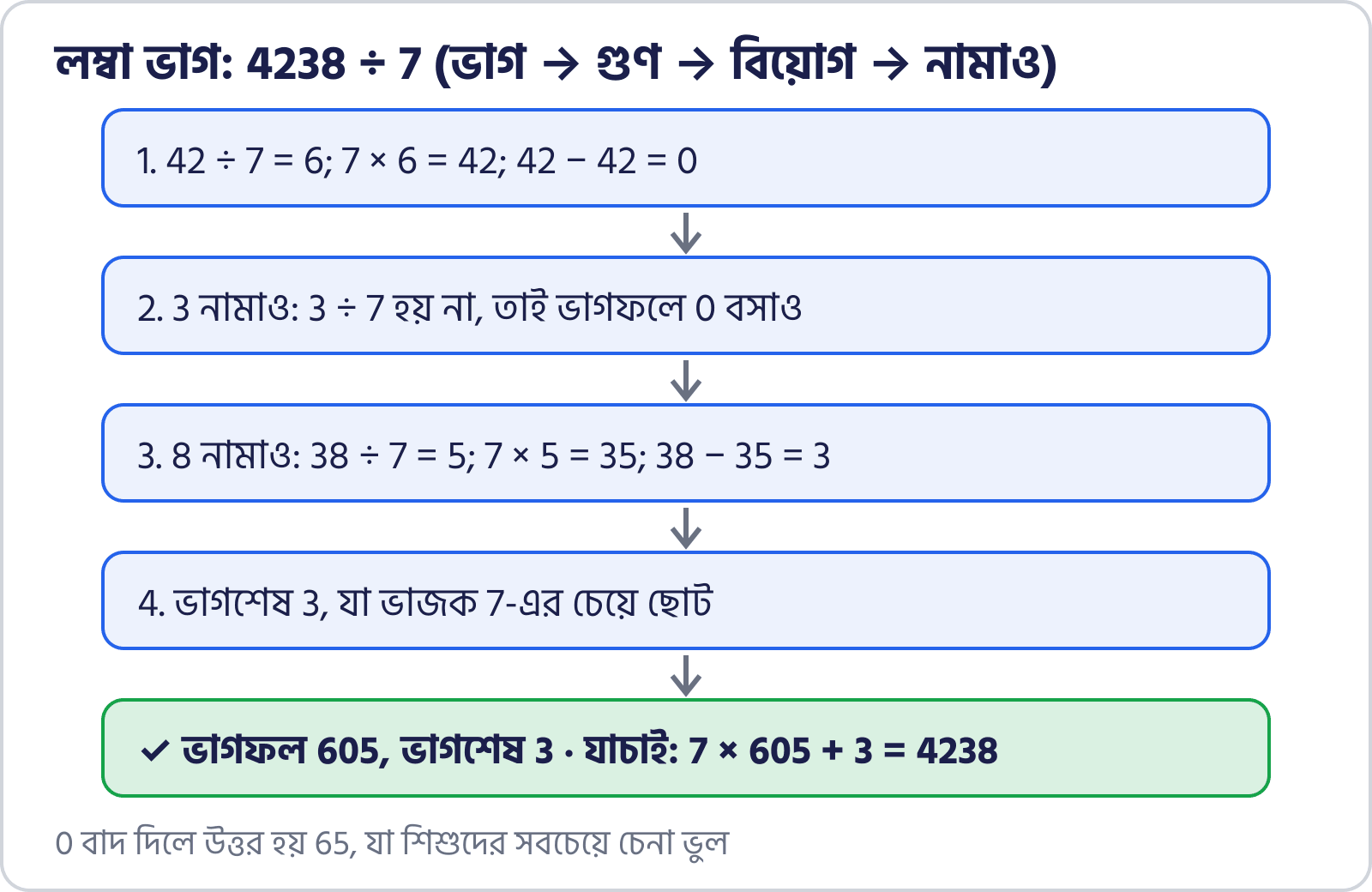
What are the quotient and the remainder when 5432 is divided by 9?
Explanation
54 ÷ 9 = 6 with nothing left. Bringing down 3 gives 3, which 9 does not divide, so a 0 goes into the quotient. Bringing down 2 gives 32 ÷ 9 = 3, remainder 5. Quotient 603, remainder 5; check: 9 × 603 + 5 = 5427 + 5 = 5432. Writing 63 drops the middle 0.
Key Points
- When the number brought down is smaller than the divisor, write 0 in the quotient
- Check with dividend = divisor × quotient + remainder
Confusion Points
- 9 × 63 + 5 = 572, not 5432: dropping the middle 0 makes the answer ten times too small
Memory Tips
- Every digit you bring down puts one digit in the quotient; if it does not divide, that digit is 0
Additional Information
- 54 ÷ 9 = 6, 9 × 6 = 54, remainder 0
- Bring down 3: 3 ÷ 9 does not go, quotient digit 0
- Bring down 2: 32 ÷ 9 = 3, 9 × 3 = 27, 32 − 27 = 5
- Quotient 603, remainder 5
456 × 25 = ?
Explanation
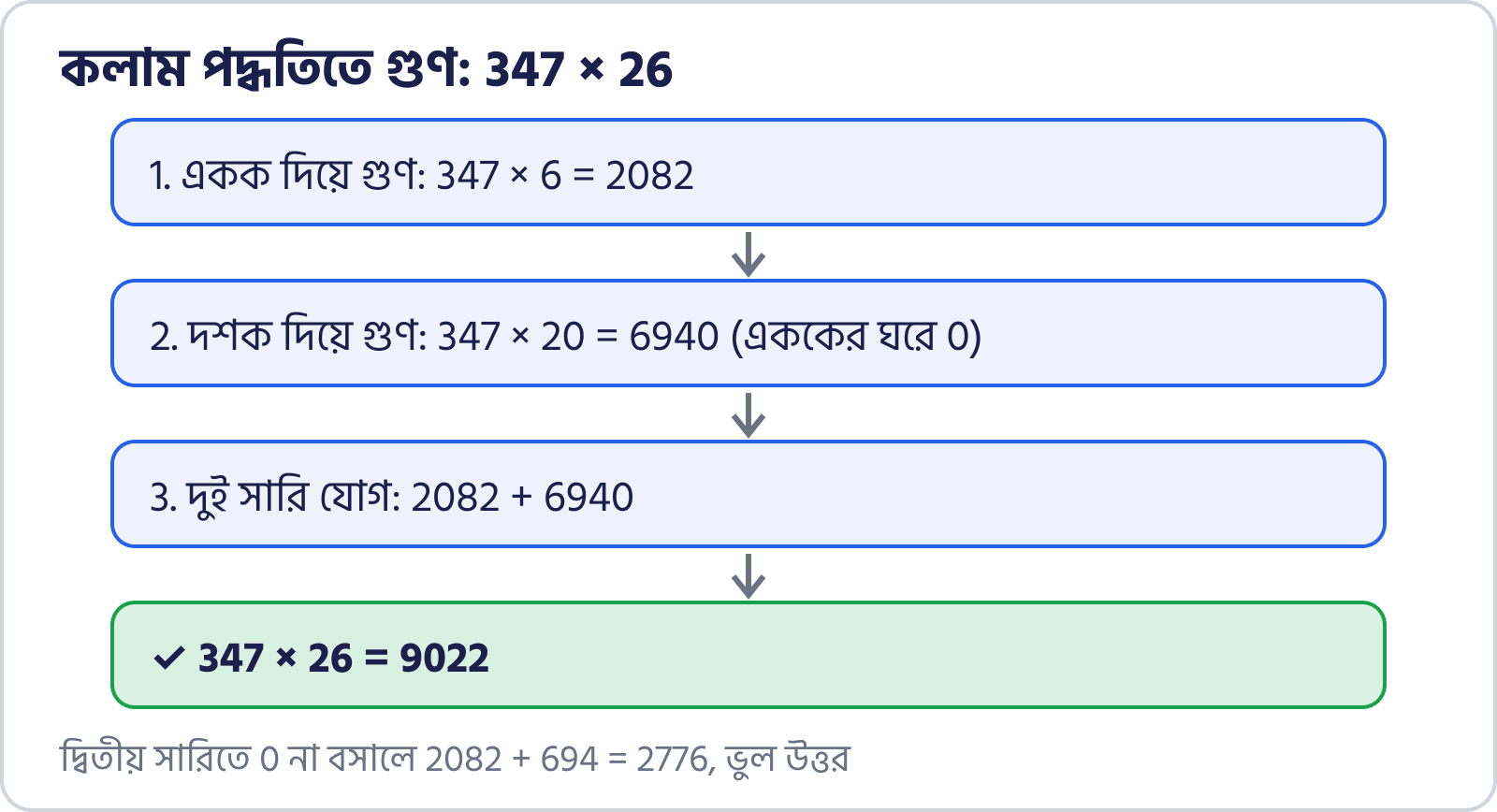
456 × 5 = 2280 and 456 × 20 = 9120; together 11400. Shortcut: multiplying by 25 is multiplying by 100 and dividing by 4, 45600 ÷ 4 = 11400. Leaving out the 0 in the second row gives 2280 + 912 = 3192, which is wrong.
Key Points
- 456 × 25 = 456 × 20 + 456 × 5 (distributive property)
- Multiplying by 25 = multiplying by 100, then dividing by 4
Confusion Points
- 3192 comes from forgetting the 0 in the tens row: it is 456 × 20, not 456 × 2
Memory Tips
- × 25 = × 100 ÷ 4, × 5 = × 10 ÷ 2
Additional Information
| Step | Working | Result |
|---|---|---|
| Multiply by the ones | 456 × 5 | 2280 |
| Multiply by the tens | 456 × 20 | 9120 |
| Add | 2280 + 9120 | 11400 |
A Class III child writes 253 × 34 = 1771. What is the most likely cause of the mistake?
Explanation
253 × 4 = 1012 and 253 × 3 = 759; 1012 + 759 = 1771, exactly the child's answer. So the tables and the carrying are right; only the place value of the second row (30) is missing. The right answer is 1012 + 7590 = 8602. It is a gap in place value, so showing 253 × 30 separately on a grid helps most.
Key Points
- Finding the cause from the pattern of the mistake is error analysis
- The right product is 8602; the child's answer is about a fifth of it
Memory Tips
- Estimate: 250 × 34 is about 8500, so 1771 is clearly wrong
Additional Information
| Child's working | Correct working | |
|---|---|---|
| First row | 253 × 4 = 1012 | 253 × 4 = 1012 |
| Second row | 253 × 3 = 759 | 253 × 30 = 7590 |
| Total | 1771 | 8602 |
What should a Class II teacher do first to introduce the idea of multiplication?
Explanation
Children of this age learn best by handling concrete objects, so building 3 × 4 = 12 from equal groups (4 + 4 + 4 = 12) is meaningful learning. Learning tables or rules without the idea is mechanical; a calculator does not build the concept.
Key Points
- Multiplication = repeated addition of equal groups
- Teach in the order concrete → pictorial → symbolic
- Tables come after the concept, through practice
Additional Information
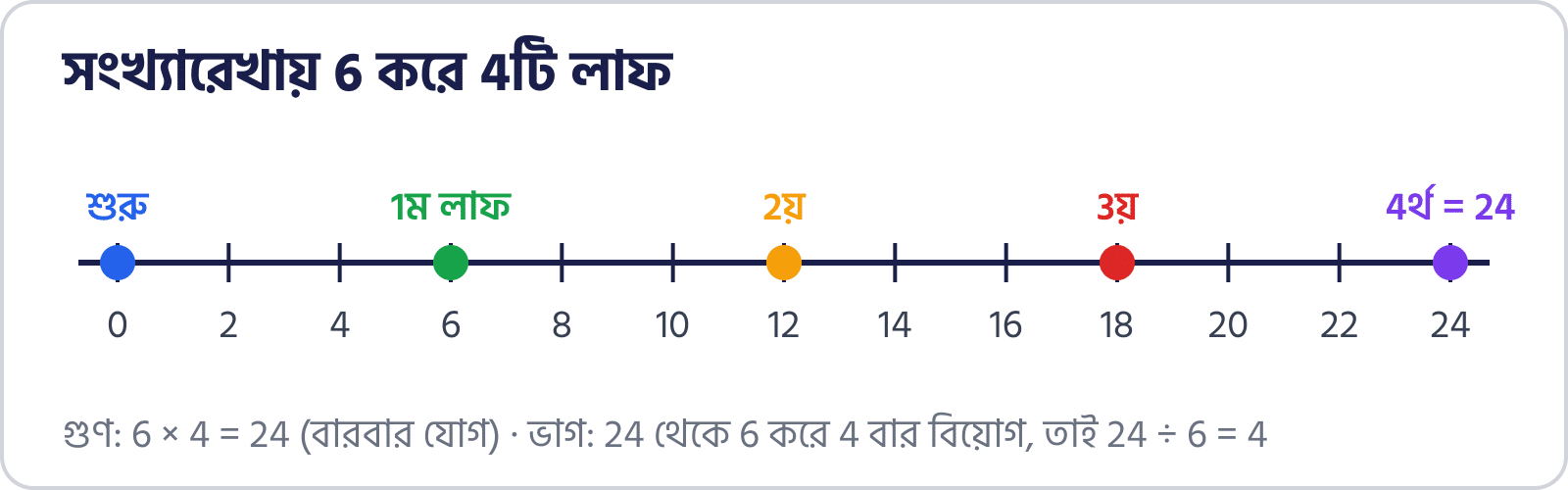
'How many packets can be made from 24 toffees if each packet holds 6?' Which idea of division does this question teach?
Explanation
The size of each group (6) is known and the number of groups is asked: 6 can be taken away from 24 four times, so 4 packets. Equal sharing is the reverse: the number of groups is known (say 6 children) and the share of each is asked. Both are 24 ÷ 6, but to a child they are different experiences, so both must be taught.
Key Points
- Grouping: group size known, number of groups unknown
- Sharing: number of groups known, size of each unknown
- Repeated subtraction can be shown as backward jumps on a number line
Confusion Points
- 'Share equally among 6' is sharing; 'packets of 6 each' is grouping: the same numbers, a different question
Additional Information
A child writes 6324 ÷ 6 = 154. What is the most suitable step for the teacher?
Explanation
The right answer is 1054 (6 × 1054 = 6324); the child left out the 0 in the hundreds place. Seeing 6 × 154 = 924, the child finds the mistake on their own, and place value shown with concrete material explains the 0. More sums only repeat the mistake, writing the answer teaches nothing, and division starts from the left (the largest place value).
Key Points
- Checking their own answer makes children independent
- Remedial teaching aimed at the cause (place value)
- Long division starts from the largest place value, on the left
Confusion Points
- Addition, subtraction and multiplication start from the right, but division from the left
Additional Information
- 6 ÷ 6 = 1 (thousand)
- 3 ÷ 6 does not go: 0 in the hundreds
- 32 ÷ 6 = 5, remainder 2 (tens)
- 24 ÷ 6 = 4 (ones): quotient 1054
Which of these has no answer (is undefined)?
Explanation
No number can be divided by 0: taking 0 away from 5 any number of times leaves 5, and no number multiplied by 0 gives 5. On the other hand 0 ÷ 5 = 0, 0 × 5 = 0 and 5 ÷ 5 = 1.
Key Points
- 0 ÷ (a non-zero number) = 0
- Any number ÷ 0 = undefined
- A non-zero number divided by itself is 1
Confusion Points
- 0 ÷ 5 and 5 ÷ 0 are not the same: the first is 0, the second is undefined
Additional Information
| Expression | Value | Why |
|---|---|---|
| 0 ÷ 5 | 0 | 5 × 0 = 0 |
| 5 ÷ 0 | Undefined | 0 × any number is never 5 |
| 0 × 5 | 0 | adding 0 five times = 0 |
| 5 ÷ 5 | 1 | 5 × 1 = 5 |
A number divided by 13 gives the quotient 24 and the remainder 9. What is the number?
Explanation
Dividend = divisor × quotient + remainder = 13 × 24 + 9 = 312 + 9 = 321. Writing 312 leaves out the remainder. Check: 321 ÷ 13 = 24, remainder 321 − 312 = 9, which is less than 13.
Key Points
- Dividend = divisor × quotient + remainder
- The remainder is always less than the divisor
Memory Tips
- 'Dividend = divisor × quotient + remainder' is the key to checking any division
Additional Information
13 × 24 = 13 × 20 + 13 × 4 = 260 + 52 = 312; adding the remainder 9 gives 321.
After making equal groups with sticks, the teacher draws an array of dots on the board to explain multiplication. According to Bruner, which mode of representation is this?
Explanation
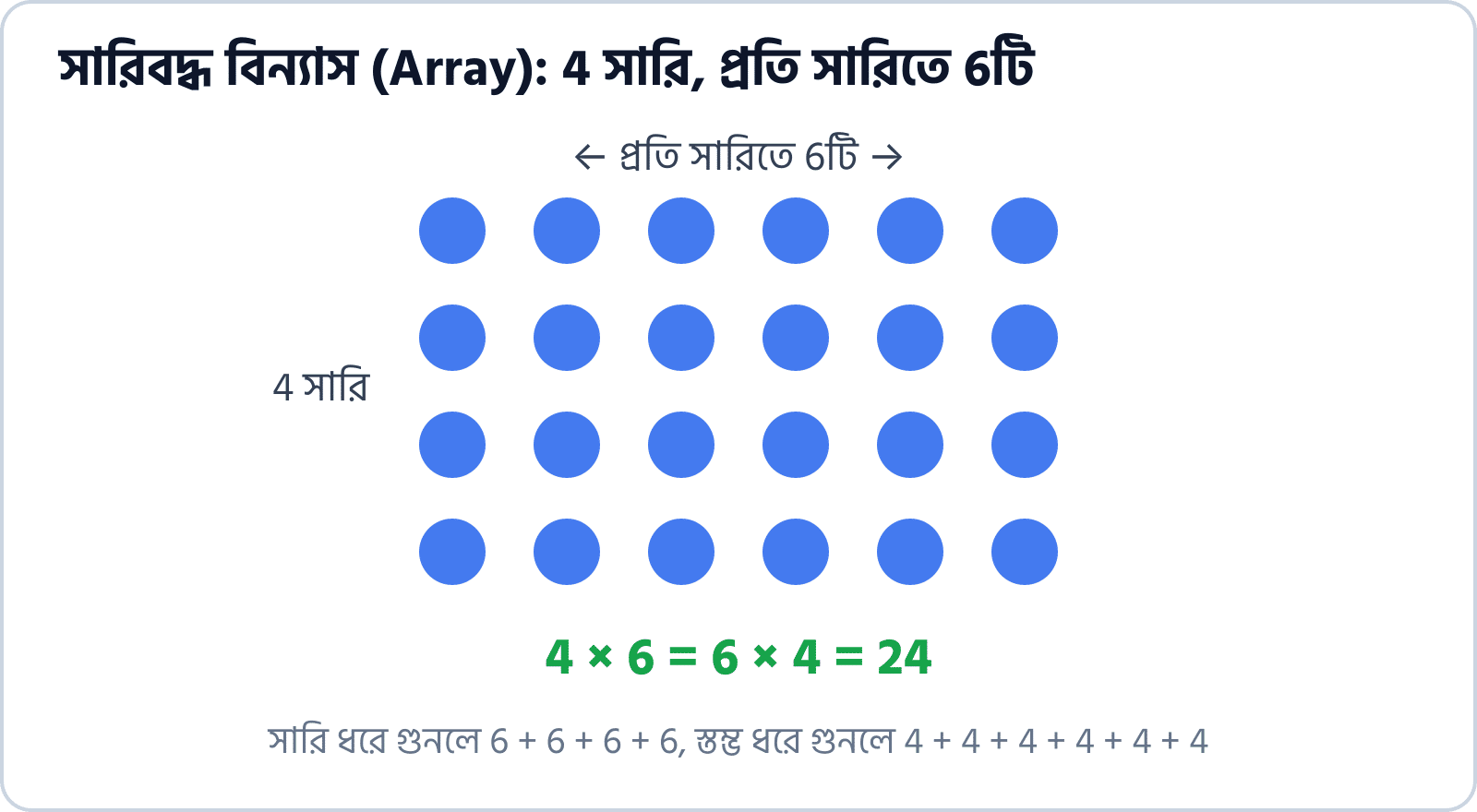
Bruner described three modes of representation: working with objects (enactive), seeing pictures or images (iconic) and writing in numbers and signs (symbolic). Arranging sticks was enactive, the dot picture is iconic, and writing 4 × 6 = 24 is symbolic. Concrete operational is a stage of Piaget's development, not one of Bruner's modes.
Key Points
- Bruner: enactive → iconic → symbolic
- The concrete → pictorial → abstract (CPA) approach in mathematics applies it
Confusion Points
- Concrete operational is Piaget's stage (about 7–11 years), not one of Bruner's modes
Memory Tips
- E-I-S: in the hands (Enactive), in the eyes (Iconic), in signs (Symbolic)
Additional Information
| Mode | Example in teaching multiplication |
|---|---|
| Enactive | Putting 4 sticks on each of 3 plates |
| Iconic | An array of dots, jumps on a number line |
| Symbolic | Writing 3 × 4 = 12 |
Working out 46 × 35 by the grid (area) method, which number will NOT appear in any cell of the grid?
Explanation
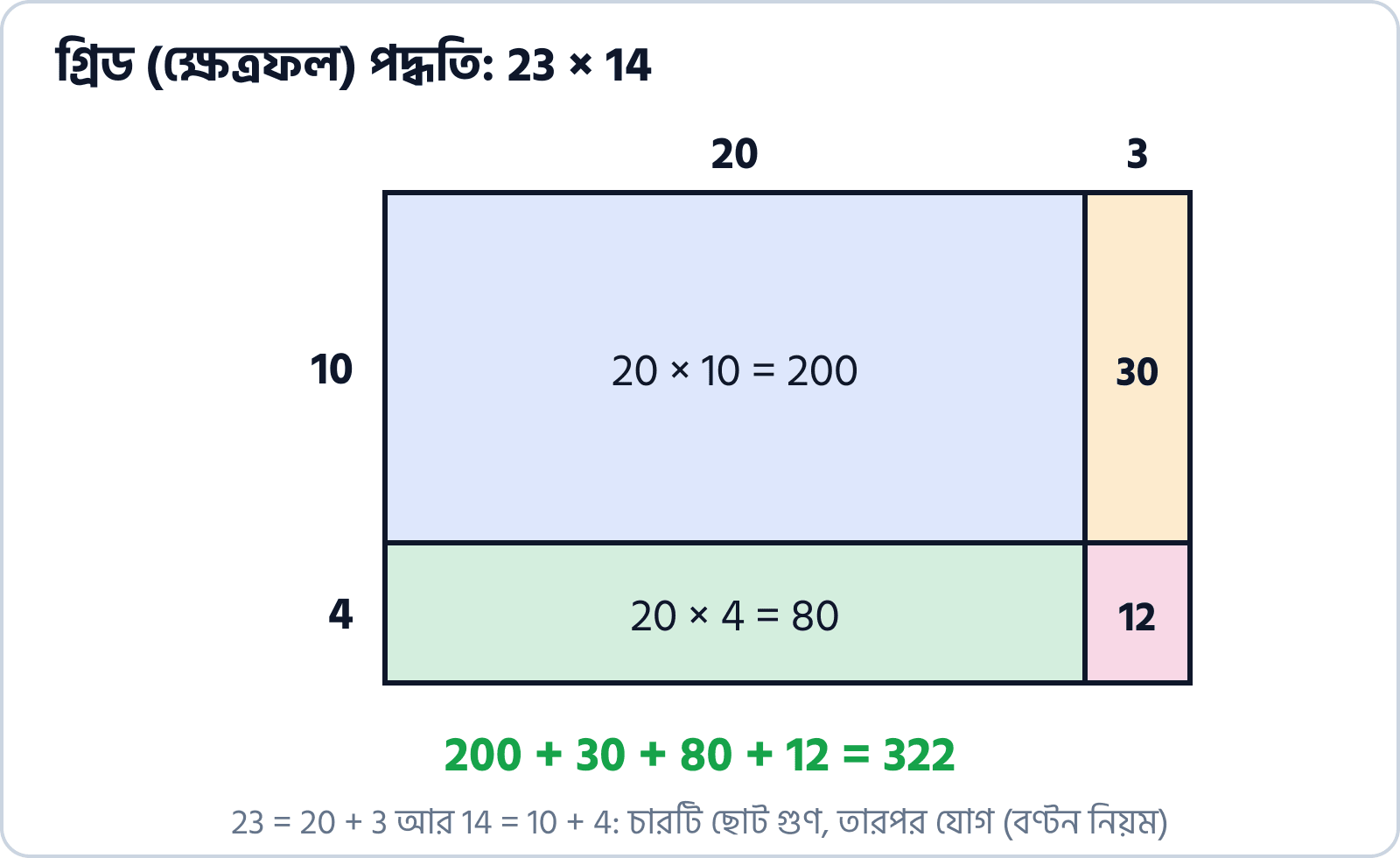
46 = 40 + 6 and 35 = 30 + 5. The four cells: 40 × 30 = 1200, 40 × 5 = 200, 6 × 30 = 180, 6 × 5 = 30; total 1610. 240 is 6 × 40, but 40 is a part of 46, not of 35, so there is no such cell.
Key Points
- Split each number by place value
- Multiply each part of one number by each part of the other
- 46 × 35 = 1200 + 200 + 180 + 30 = 1610
Additional Information
| × | 30 | 5 |
|---|---|---|
| 40 | 1200 | 200 |
| 6 | 180 | 30 |
Total 1200 + 200 + 180 + 30 = 1610
0/10


Leave a Comment
Commenting as ·