
10 questions on exponents and powers: 5 sums and 5 on pedagogy and children’s errors, each answer worked out step by step.
Exponents and Powers Quiz: WB TET Upper Primary Mathematics
Practice session
A little practice. A step forward.
10 questions
Learn with explanations
At your own pace
0 / 10 completed
00:00
What is the value of $\frac{2^{7}\times2^{3}}{2^{8}}$?
Explanation
The numerator has the same base, so add the exponents: $2^{7}\times2^{3}=2^{10}$. Dividing subtracts them: $2^{10-8}=2^{2}=4$. The other options ($2^{3}=8$, $2^{4}=16$, $2^{1}=2$) come from a slip in adding or subtracting the exponents.
Key Points
- $a^{m}\times a^{n}=a^{m+n}$
- $a^{m}\div a^{n}=a^{m-n}$
- Simplify the numerator first, then divide
Memory Tips
- Multiply the powers, add the exponents; divide the powers, subtract them
Additional Information
What is the value of $(-1)^{51}+(-1)^{50}$?
Explanation
An odd power of −1 is −1 and an even power is 1. 51 is odd, so $(-1)^{51}=-1$; 50 is even, so $(-1)^{50}=1$. The sum is $-1+1=0$. −2 or 2 comes from giving both terms the same sign.
Key Points
- $(-1)^{\text{even}}=1$
- $(-1)^{\text{odd}}=-1$
- With a large exponent only odd or even matters
Memory Tips
- Pairs of −1 multiply to +1: an even exponent wipes out the sign
What is the value of $(\frac{3}{4})^{-2}$?
Explanation
A negative exponent turns the fraction over and makes the exponent positive: $(\frac{3}{4})^{-2}=(\frac{4}{3})^{2}=\frac{16}{9}$. $\frac{9}{16}$ would be the answer for exponent +2; the two negative options come from reading a negative exponent as a negative value.
Key Points
- $(\frac{a}{b})^{-m}=(\frac{b}{a})^{m}$
- A negative exponent does not change the sign of the value
Confusion Points
- Negative exponent = reciprocal, not a negative number
Additional Information
If $5^{x-2}=125$, what is $x$?
Explanation
Write 125 as a power of 5: $125=5\times5\times5=5^{3}$. The bases are equal, so the exponents are equal: $x-2=3$, so $x=5$. Check: $5^{5-2}=5^{3}=125$. 3 is the value of $x-2$, not of $x$.
Key Points
- Bring both sides to the same base
- If $a^{m}=a^{n}$ then $m=n$
- Substitute the answer to check
Confusion Points
- Marking 3 as soon as $x-2=3$ appears: the last step is skipped
What is the standard form of 0.00072?
Explanation
Standard form is $k\times10^{n}$ with $1\le k\lt10$. Moving the decimal point 4 places right gives 7.2, so $7.2\times10^{-4}$. $72\times10^{-5}$ is also 0.00072, but 72 is more than 10, so it is not standard form; $10^{-3}$ counts one place too few, and $10^{4}$ is the form of a very large number.
Key Points
- $1\le k\lt10$
- A number below 1 has a negative exponent
- The exponent equals the places the decimal point moves
Confusion Points
- The same value is not the same form: $72\times10^{-5}$ has the right value, the wrong form
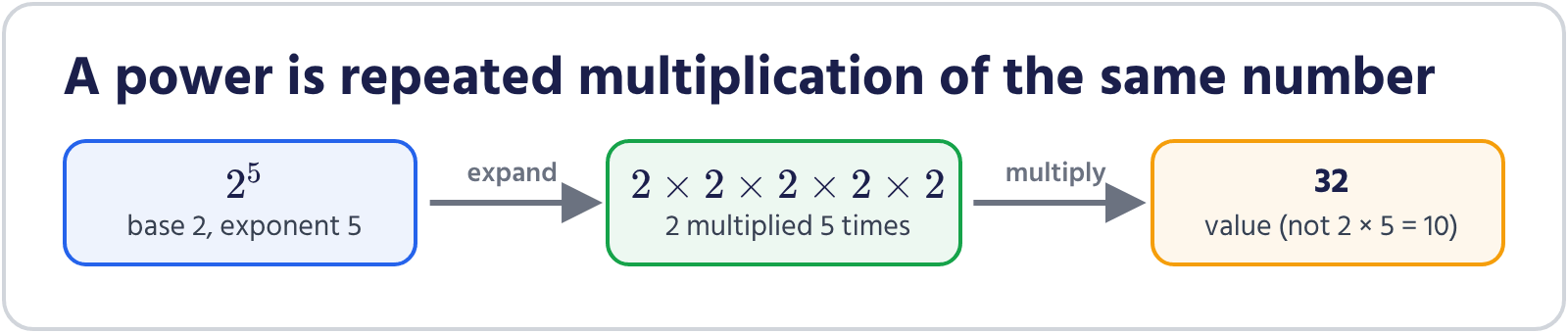
A class VII student writes $3^{4}=12$. What is the most likely cause of the error and the teacher's best step?
Explanation
$3\times4=12$, so the child used the exponent 4 as a multiplier: a misconception, not carelessness or a weak table. The cure is to expand it and show that the exponent says how many times to multiply: $3\times3\times3\times3=81$. More drill or memorising leaves the wrong idea in place.
Key Points
- The kind of error shows how the child thinks (error analysis)
- A misconception is cured with the concept, not with more drill
Additional Information
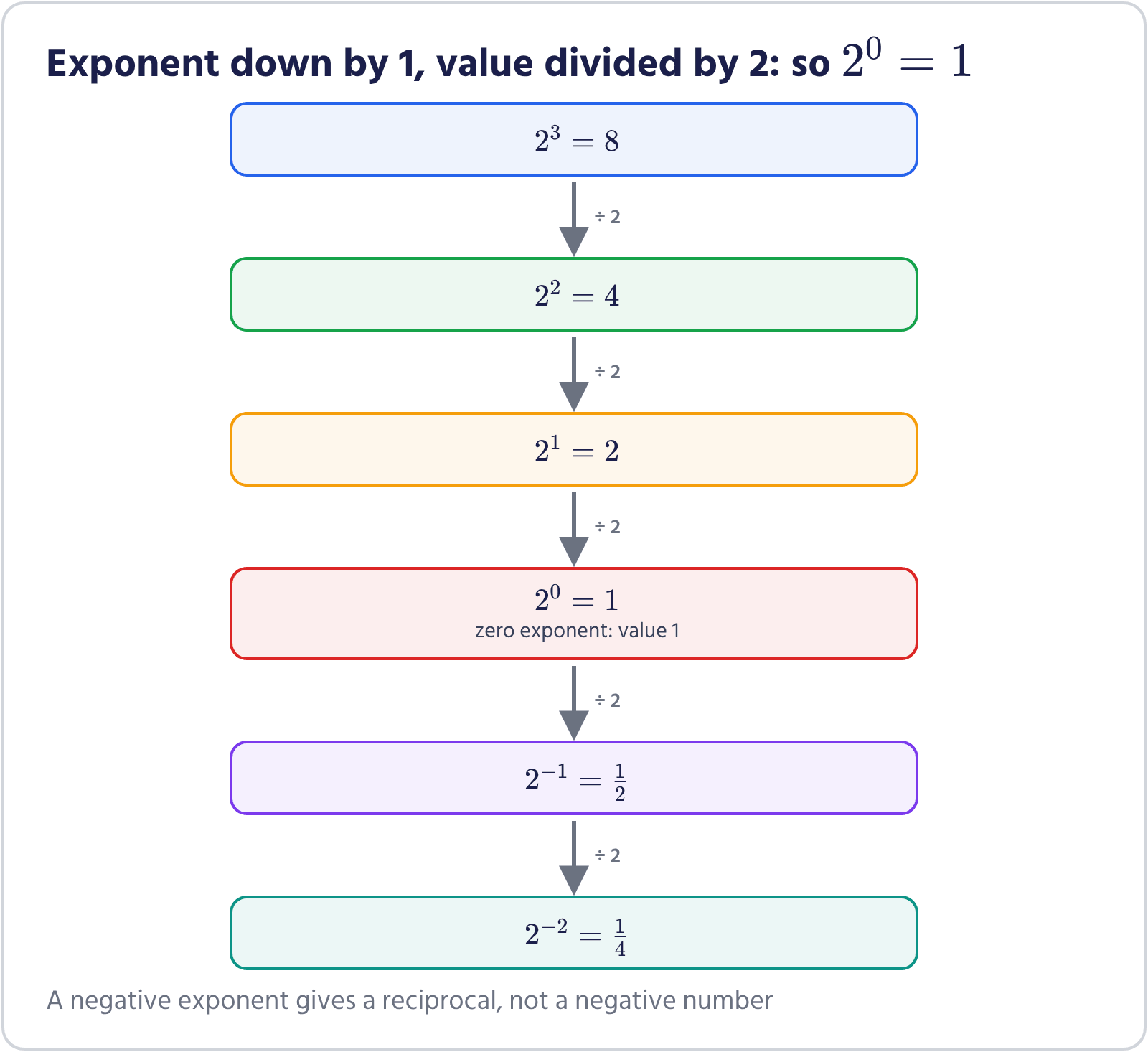
A teacher wants students to understand why $a^{0}=1$. Which approach works best?
Explanation
From the pattern the child sees that lowering the exponent by 1 divides the value by 2, so $2^{0}=2\div2=1$: discovery and meaningful learning. Rote learning or 'there is no reason' builds no understanding, and the zero exponent is part of the class VII–VIII syllabus.
Key Points
- Building a rule from a pattern = inductive and discovery method
- Meaningful learning lasts longer than rote learning
Memory Tips
- Walk the table down, ÷ 2 each step: 1 at zero, fractions below
Additional Information
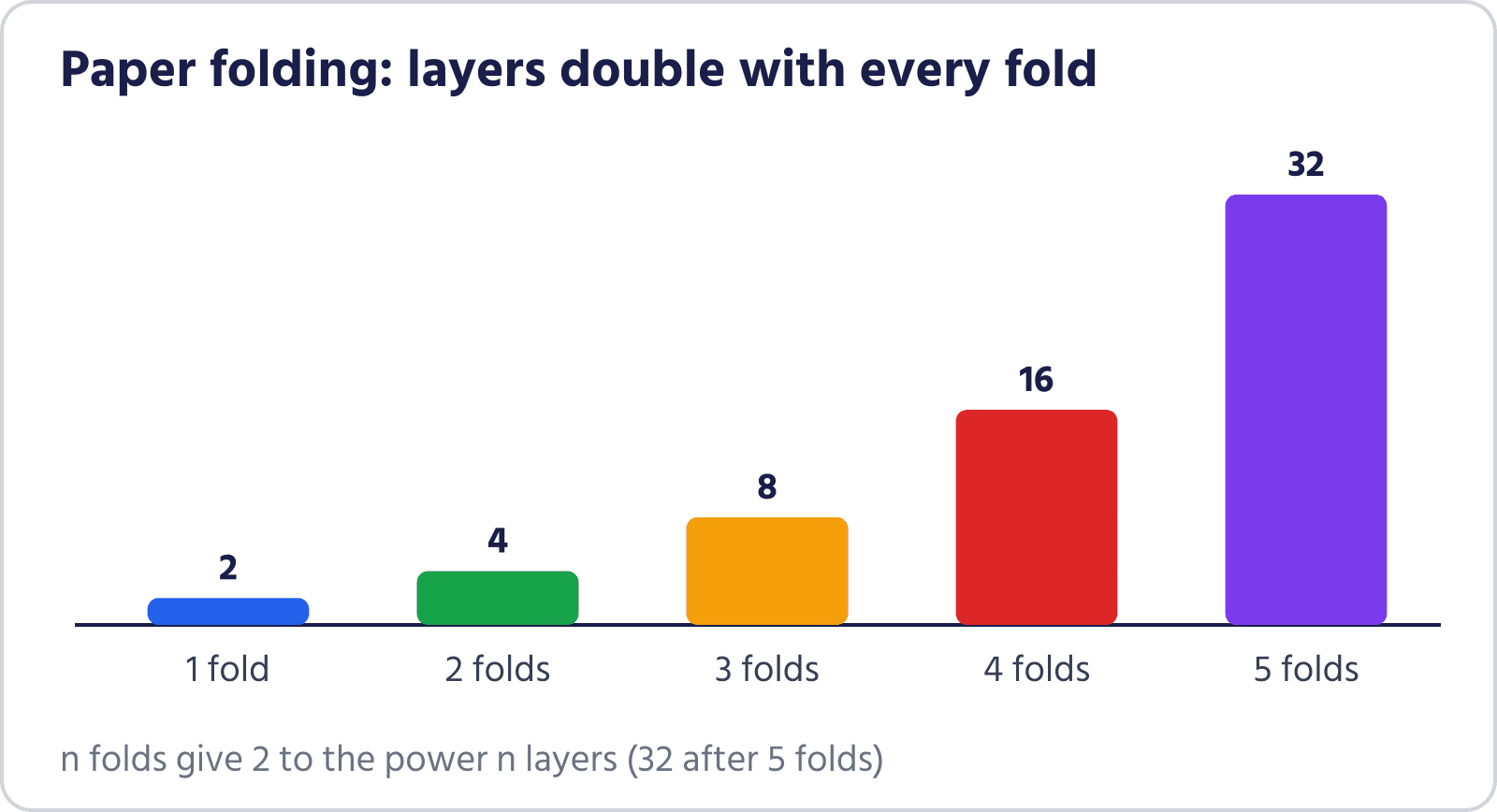
To introduce powers, a teacher has students fold a sheet of paper in half again and again and count the layers each time. Which principle of teaching does this follow?
Explanation
Folding paper and counting 2, 4, 8, 16 layers is a concrete experience; writing $2^{n}$ from it is the abstract step: concrete to abstract, learning by doing. The teacher gave no lecture, the child memorised nothing, and the order is not abstract to concrete but the reverse.
Key Points
- Maxims of teaching: known to unknown, simple to complex, concrete to abstract
- n folds give $2^{n}$ layers
Additional Information
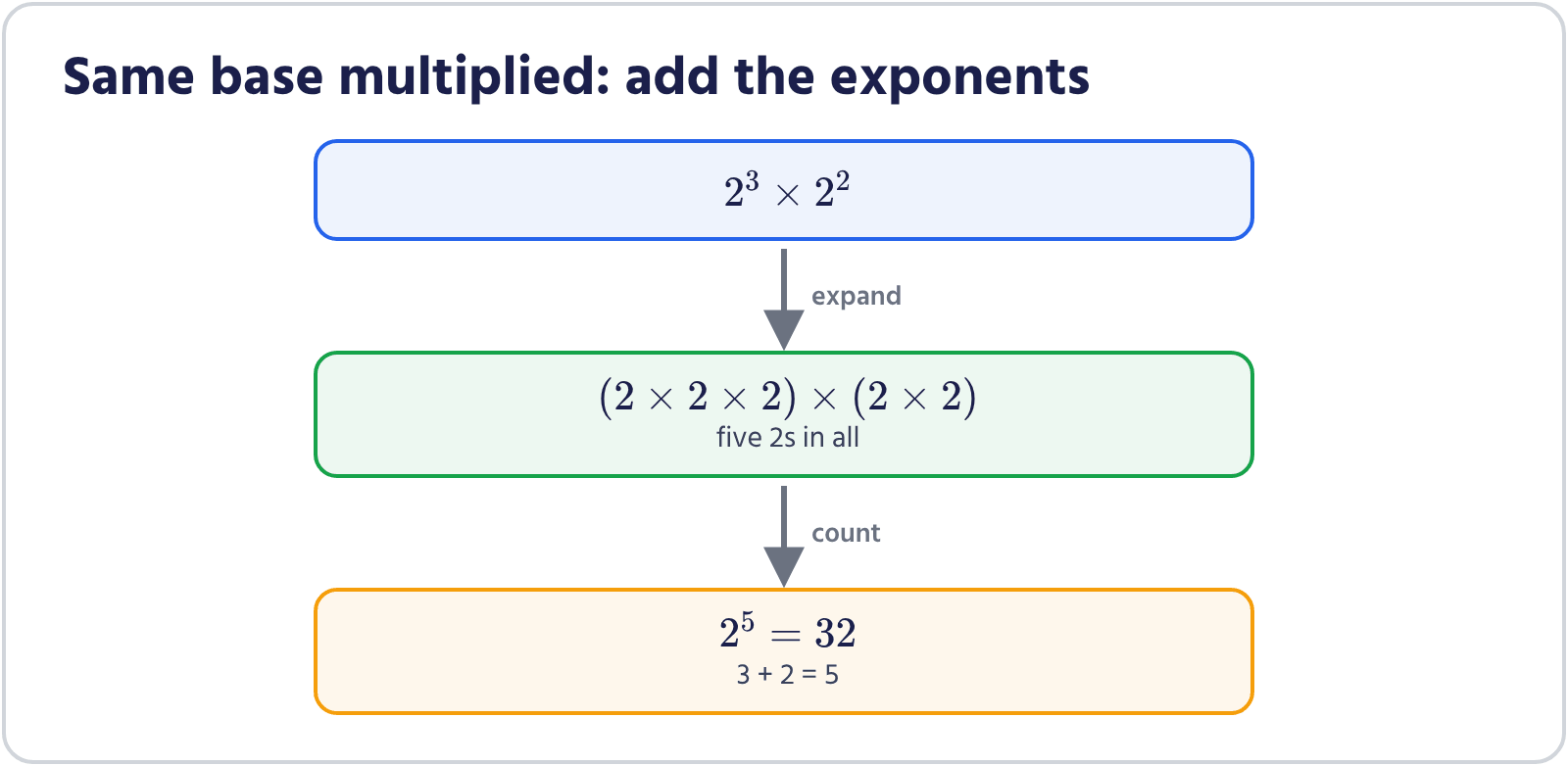
A teacher expands several examples such as $2^{3}\times2^{2}=2^{5}$ and $3^{2}\times3^{4}=3^{6}$ on the board and then asks students to find the general rule themselves. Which method is this?
Explanation
Going from particular examples to a general rule is the inductive method. The deductive method goes the other way: the rule first ($a^{m}\times a^{n}=a^{m+n}$), then applied to examples. In a project children do real work over a long time, and in a lecture the teacher talks while the children listen.
Key Points
- Inductive: examples to rule
- Deductive: rule to examples
- Inductive to build the rule, deductive to practise it: best used together
Confusion Points
- Mixing up inductive and deductive: check which comes first, the examples or the rule
Memory Tips
- Inductive climbs up (examples → rule); deductive steps down (rule → examples)
Additional Information
A student writes $2^{-3}=-8$. What is the correct value and the cause of the error?
Explanation
$2^{-3}=\frac{1}{2^{3}}=\frac{1}{8}$: a negative exponent means the reciprocal, and the value stays positive. The child put the exponent's minus sign on the value, and $-\frac{1}{8}$ keeps half of that error. If the teacher walks the table of powers of 2 down past $2^{0}=1$, the child finds $\frac{1}{2}$, $\frac{1}{4}$, $\frac{1}{8}$ unaided.
Key Points
- $a^{-m}=\frac{1}{a^{m}}$
- A negative exponent makes the value smaller, not negative
- Break the misconception with the pattern
Confusion Points
- Negative exponent versus negative base: $2^{-3}=\frac{1}{8}$, but $(-2)^{3}=-8$
Additional Information
0/10


Leave a Comment
Commenting as ·