
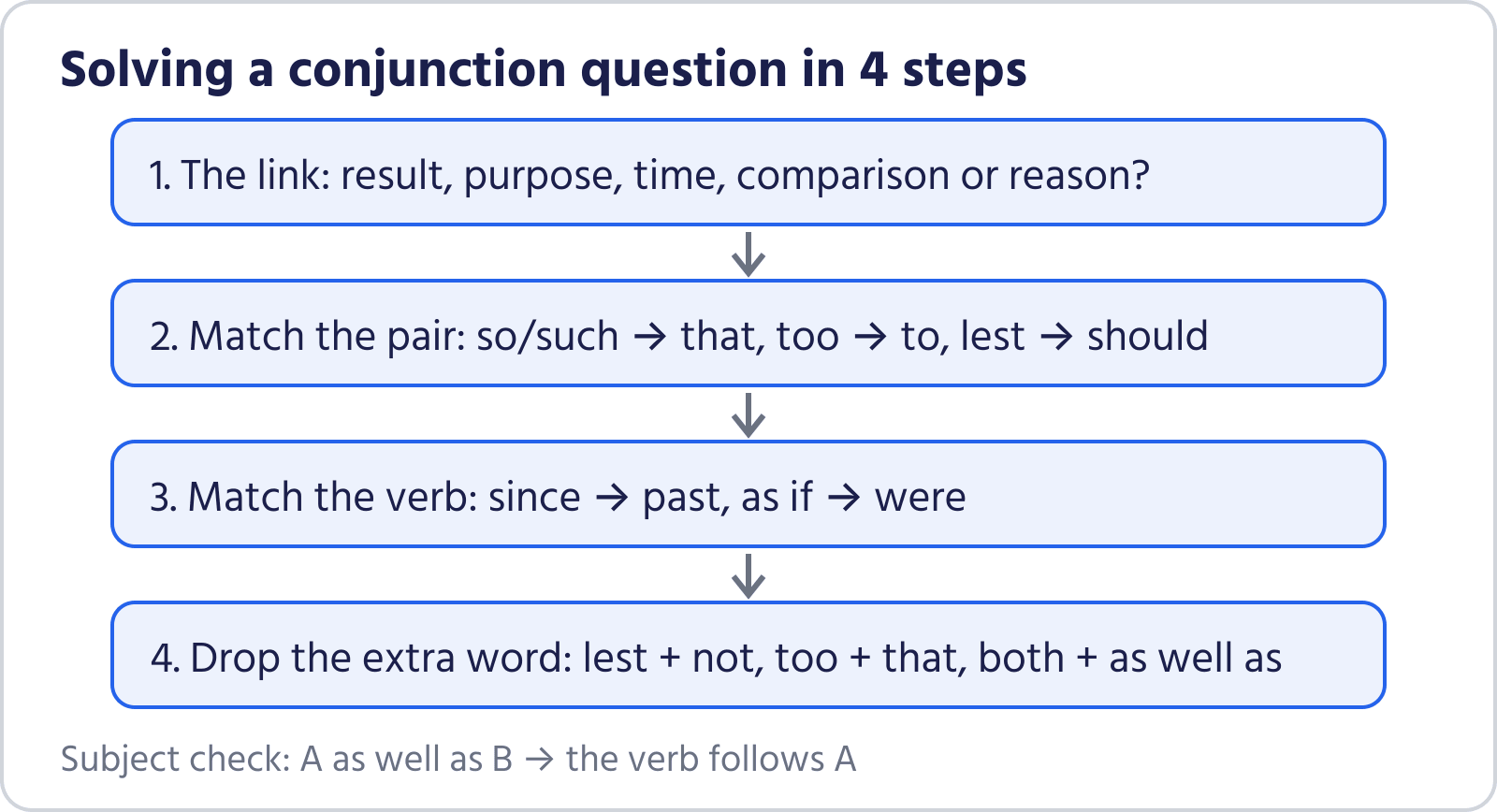
12 questions on so/such…that, too…to, lest…should, since, as well as, as if, doubt and reason…that, each answer with its rule and a memory tip.
Conjunctions Part 2 Practice Quiz: WBPSC Clerkship 2024 English
Practice session
A little practice. A step forward.
12 questions
Learn with explanations
At your own pace
0 / 12 completed
00:00
Fill in the blank: He is ___ weak to walk.
Explanation
The sentence ends with 'to walk', and too goes with to + verb: He is too weak to walk. So and such pair with that, so 'so weak to walk' is wrong; with very, 'to walk' makes no sense.
Key Points
- too + adjective + to + verb
- so + adjective + that + clause
- too already carries the negative: no not needed
Confusion Points
- 'He is too weak that he cannot walk' is wrong; 'so weak that he cannot walk' is right
Memory Tips
- See to, choose too: both contain 'to'
Additional Information
Fill in the blank: It was ___ a hot day that we stayed indoors.
Explanation
After the blank comes 'a hot day', an article and a noun, so such fits: such + a + adjective + noun + that. With an adjective alone, so would fit (The day was so hot that…). Too pairs with to, so it cannot take that here.
Key Points
- such + (a/an) + adjective + noun + that
- so + adjective/adverb + that
Memory Tips
- a/an right after the blank: choose such
Additional Information
| Pattern | Example |
|---|---|
| such + a + adj + noun + that | It was such a hot day that we stayed indoors. |
| so + adj + that | The day was so hot that we stayed indoors. |
| too + adj + to | The day was too hot to go out. |
Fill in the blank: Walk carefully lest you ___ fall.
Explanation
Lest means 'for fear that' and is followed by should: Walk carefully lest you should fall. Lest already carries the negative, so should not or will not reverses the meaning.
Key Points
- lest = for fear that
- lest + subject + should + verb
- never put not after lest
Confusion Points
- Like unless, lest takes no not: 'lest you should not fall' is wrong
Memory Tips
- lest pairs with should: 'lest … should'
Additional Information
Fill in the blank: It is five years ___ he left the village.
Explanation
It is + period + since + simple past: It is five years since he left the village. For goes before a period (for five years), from needs to or till, and ago follows a period (five years ago) and joins no clause.
Key Points
- It is + period + since + past tense
- since: a point of time; for: a period
- 'since he has left' is wrong
Memory Tips
- since + when it began (he left); for + how long (five years)
Additional Information
| Word | Comes before | Example |
|---|---|---|
| since | a point of time or an event | since Monday / since he left |
| for | a period | for five years |
| ago | after a period | five years ago |
Which part of the sentence has an error? The captain as well as the players (A) / were present (B) / at the meeting (C) / No error (D)
Explanation
When subjects are joined by as well as, the verb follows the first subject. The main subject is The captain (singular), so it should be was, not were: The captain as well as the players was present at the meeting. Part A is fine; the error is in the verb.
Key Points
- A as well as B + verb agrees with A
- the same with along with, together with, with
- Both A and B + plural verb
Confusion Points
- Joined by and, the verb is plural; joined by as well as, it is not
Memory Tips
- Read the as well as part in brackets: The captain (…) was
Additional Information
Fill in the blank: He talks as if he ___ a king.
Explanation
He is not really a king; this is an unreal comparison. After as if or as though in such a case, were is used with every subject: He talks as if he were a king. Is or has been would mean he really is one, and in the exam was is marked wrong here.
Key Points
- as if / as though + unreal idea + were
- were with I, he and she alike
- the same rule as in 'If I were you'
Confusion Points
- Although he usually takes was, an imagined idea takes were
Memory Tips
- Imagined, so were: as if he were, if I were
Fill in the blank: I doubt ___ he will come.
Explanation
After doubt in an affirmative sentence, whether or if follows: I doubt whether he will come. Because gives a reason, unless a condition and lest means 'for fear that': none of them introduces what is in doubt.
Key Points
- I doubt + whether / if
- I do not doubt + that
- whether = if or not
Memory Tips
- Doubt present → whether; doubt denied → that
Additional Information
| Sentence | Conjunction | Example |
|---|---|---|
| Affirmative | whether / if | I doubt whether he will come. |
| Negative | that | I do not doubt that he is honest. |
Fill in the blank: I do not doubt ___ he is honest.
Explanation
After a negative doubt (do not doubt, there is no doubt), that follows: I do not doubt that he is honest. Whether and if follow an affirmative doubt, and lest ('for fear that') makes no sense here.
Key Points
- negative doubt + that
- 'There is no doubt that…' follows the same rule
- affirmative doubt + whether / if
Confusion Points
- The same verb doubt, but with not it takes that, not whether
Memory Tips
- No doubt means certainty: that
Which sentence is correct?
Explanation
The two parts of a correlative pair go before words of the same kind. In the second sentence not only stands before his money and but also before his reputation: both nouns, so it is correct. In the first, not only stands before the verb lost but but also before a noun; in the third and fourth the pair is out of place.
Key Points
- not only…but also, either…or, neither…nor, both…and: the same kind of word on both sides
- noun with noun, verb with verb
Confusion Points
- Putting not only before the verb sounds natural, but it is wrong when no verb follows but also
Memory Tips
- Compare the words after each part: money / reputation
Fill in the blank: The reason why he failed is ___ he did not study.
Explanation
Reason already means cause, so because or since after it says the same thing twice. The correct form is: The reason why he failed is that he did not study. Why has already been used and cannot come again.
Key Points
- The reason (why) … is that …
- 'The reason is because' is wrong
- with because: He failed because he did not study
Confusion Points
- 'The reason is because' is heard in speech but is marked wrong in the exam
Memory Tips
- With reason, use that, not because
Fill in the blank: Both Ram ___ Shyam passed the test.
Explanation
Both always pairs with and: Both Ram and Shyam passed the test. 'Both … as well as' is a common error, and or or with does not pair with both.
Key Points
- both … and
- either … or, neither … nor
- a subject with both … and is plural
Confusion Points
- as well as also means 'and', but it never pairs with both
Memory Tips
- both = the two of them, so and
Additional Information
Fill in the blank: He could not come to office ___ he was ill.
Explanation
A full clause follows the blank (he was ill: a subject and a verb), so the conjunction because fits. Because of, due to and owing to work like prepositions and take a noun: because of illness.
Key Points
- because + subject + verb
- because of / owing to + noun
- He could not come because of illness
Memory Tips
- A verb follows? because. Only a noun? because of
0/12


Leave a Comment
Commenting as ·