
12 ratio and proportion questions for the arithmetic section of WBPSC Clerkship 2024 Part-I: duplicate, compound and inverse ratios, coins, income-expenditure and ages, each with a step-by-step solution.
Ratio and Proportion Part 2 Practice Quiz: WBPSC Clerkship 2024
Practice session
A little practice. A step forward.
12 questions
Learn with explanations
At your own pace
0 / 12 completed
00:00
What is the duplicate ratio of $5 : 6$?
Explanation
The duplicate ratio squares both terms: $5^{2} : 6^{2} = 25 : 36$. $10 : 12$ is just $5 : 6$ again, $125 : 216$ is the triplicate ratio and $\sqrt{5} : \sqrt{6}$ the sub-duplicate ratio.
Key Points
- Duplicate = squares, triplicate = cubes
- Sub-duplicate = square roots
Confusion Points
- The duplicate ratio squares the terms; it does not multiply them by 2
Memory Tips
- 'Duplicate' means power 2, 'sub' means root
What is the sub-duplicate ratio of $49 : 81$?
Explanation
The sub-duplicate ratio takes the square roots of the terms: $\sqrt{49} : \sqrt{81} = 7 : 9$. $9 : 7$ has the order reversed and $2401 : 6561$ is the duplicate ratio.
Key Points
- Sub-duplicate = square roots
- Reversing the order changes the ratio
What is the compound ratio of $3 : 4$, $8 : 9$ and $6 : 5$?
Explanation
Compound ratio = product of antecedents : product of consequents $= (3 \times 8 \times 6) : (4 \times 9 \times 5) = 144 : 180$. Dividing both by 36 gives $4 : 5$. $17 : 18$ comes from adding the terms, which is the wrong rule.
Key Points
- The terms of a compound ratio are multiplied
- Reduce with the HCF at the end
Confusion Points
- Adding the terms gives $17 : 18$, which is not the compound ratio
Memory Tips
- Compound = multiply, never add
₹1,170 is divided among A, B and C in the inverse ratio of $3 : 4 : 6$. What is the largest share?
Explanation
The inverse ratio is $\frac{1}{3} : \frac{1}{4} : \frac{1}{6}$; multiplying by the LCM 12 gives $4 : 3 : 2$. 9 parts in all, 1 part $= 1170 \div 9 =$ ₹130, so A gets $4 \times 130 =$ ₹520. Dividing straight in $3 : 4 : 6$ gives a largest share of ₹540: that is the trap.
Key Points
- In an inverse ratio the smallest term gets the largest share
- The shares are ₹520, ₹390, ₹260; total ₹1,170
Confusion Points
- An inverse ratio is not just the terms in reverse order
Memory Tips
- With three terms: write the product of the other two in each place
Additional Information
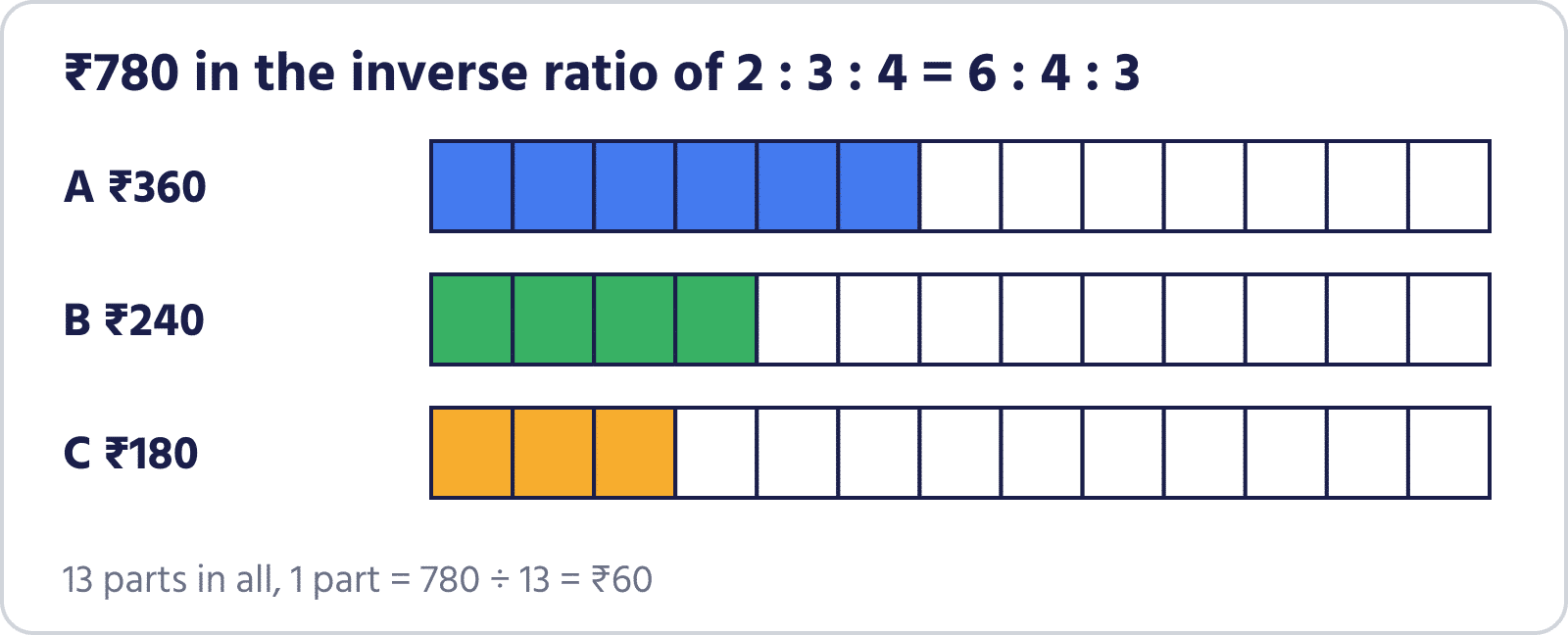
₹1,840 is divided in the ratio $\frac{1}{2} : \frac{2}{3} : \frac{3}{4}$. What is the second share?
Explanation
Multiplying by 12, the LCM of 2, 3 and 4, gives $6 : 8 : 9$, 23 parts in all. 1 part $= 1840 \div 23 =$ ₹80, so the second share is $8 \times 80 =$ ₹640. ₹480 is the first share and ₹720 the third.
Key Points
- Turn a ratio of fractions into whole numbers with the LCM of the denominators
- The shares are ₹480, ₹640, ₹720; total ₹1,840
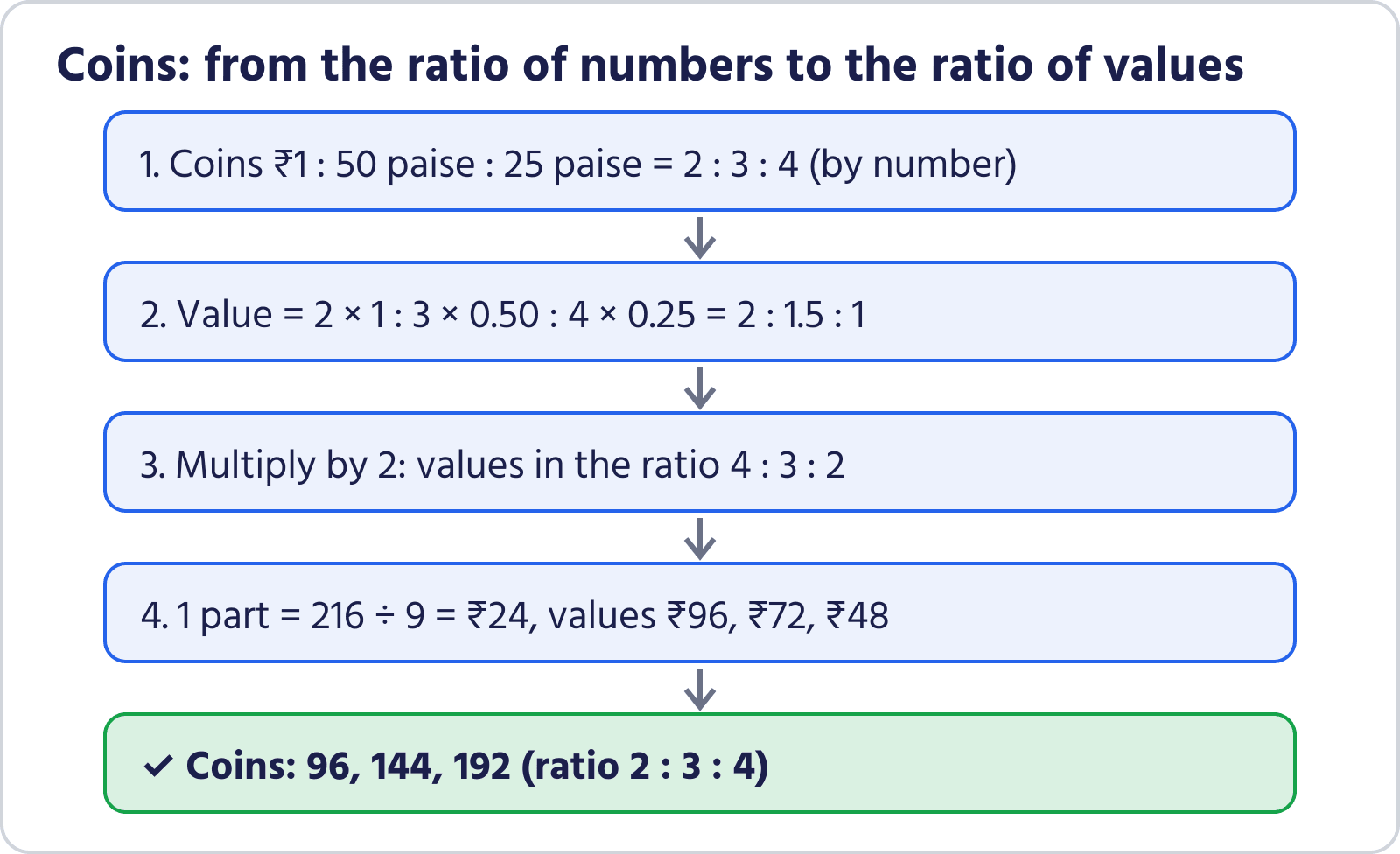
A bag has ₹1, 50-paise and 25-paise coins in the ratio $5 : 6 : 8$ by number, worth ₹210 in all. How many 25-paise coins are there?
Explanation
The values are in the ratio $5 \times 1 : 6 \times 0.50 : 8 \times 0.25 = 5 : 3 : 2$, 10 parts, 1 part $= 210 \div 10 =$ ₹21. The 25-paise coins are worth $2 \times 21 =$ ₹42, so there are $42 \times 4 = 168$ of them. 42 is the value in rupees, not the number of coins; 126 is the number of 50-paise coins.
Key Points
- Coins: 105 of ₹1, 126 of 50 paise, 168 of 25 paise
- Check: $105 : 126 : 168 = 5 : 6 : 8$
Confusion Points
- Taking the value ₹42 for the number of coins is a common slip
Memory Tips
- Ratio of values first, numbers after
Additional Information
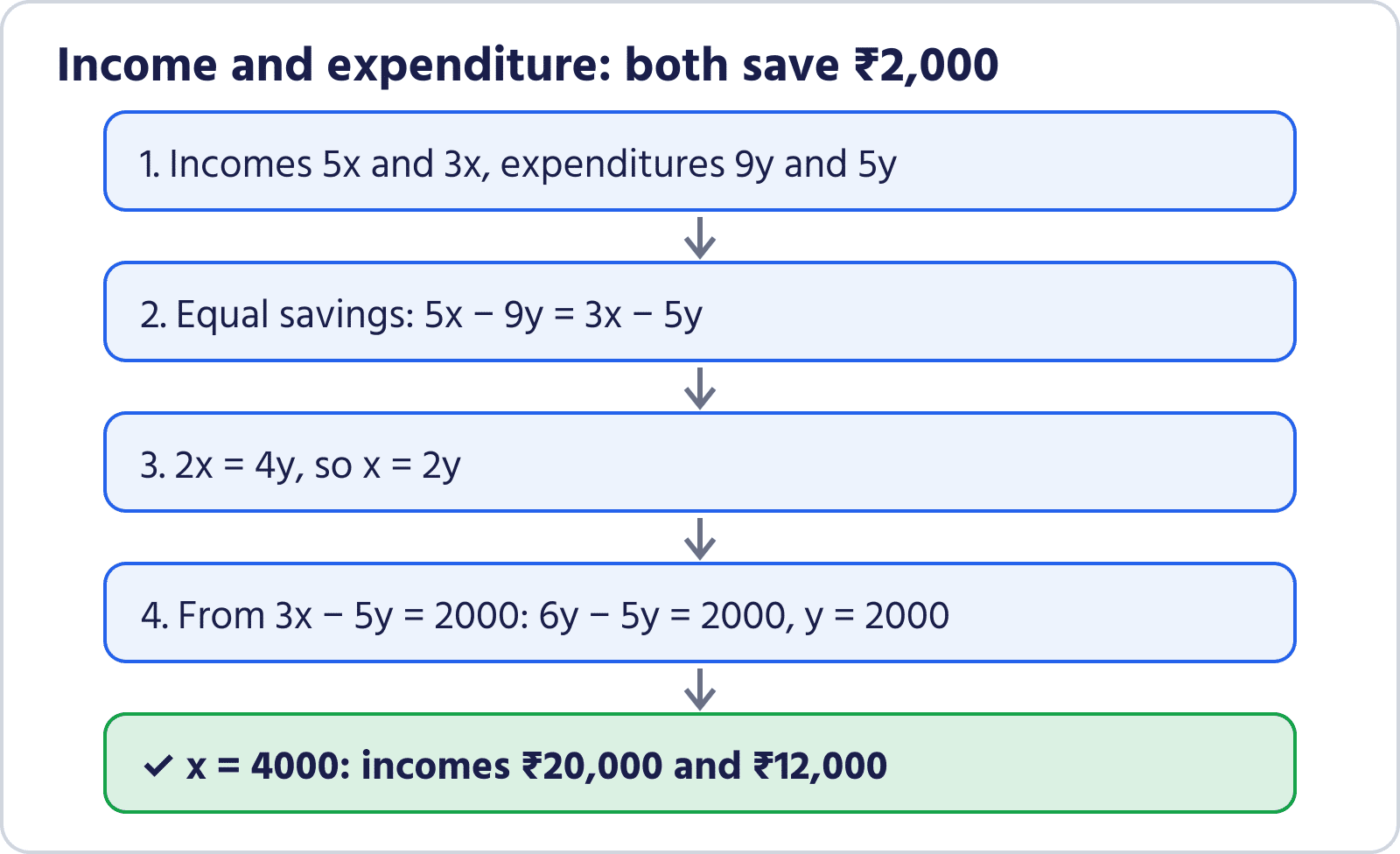
The incomes of A and B are in the ratio $4 : 3$ and their expenditures in the ratio $3 : 2$. Each saves ₹6,000 a month. What is A's monthly income?
Explanation
Let the incomes be $4x$ and $3x$, the expenditures $3y$ and $2y$. Equal savings: $4x - 3y = 3x - 2y$, so $x = y$. Then $3x - 2x = 6000$ gives $x = 6000$, and A's income is $4 \times 6000 =$ ₹24,000. ₹18,000 is B's income (and A's expenditure), ₹12,000 is B's expenditure.
Key Points
- Savings = income − expenditure
- Check: A $24000 - 18000 = 6000$, B $18000 - 12000 = 6000$
Additional Information
What number must be subtracted from each of 15, 28, 20 and 38 to make them proportional?
Explanation
If the number is $x$, then $(15 - x)(38 - x) = (28 - x)(20 - x)$, so $570 - 53x = 560 - 48x$, giving $5x = 10$ and $x = 2$. Check: $13 : 26 = 1 : 2$ and $18 : 36 = 1 : 2$.
Key Points
- If $a : b = c : d$ then $ad = bc$
- The $x^{2}$ terms cancel, leaving a simple equation
Memory Tips
- Short of time? Try the options
If $a : b = 2 : 5$, what is $(3a + b) : (2a + 3b)$?
Explanation
Put $a = 2k$, $b = 5k$: $3a + b = 6k + 5k = 11k$ and $2a + 3b = 4k + 15k = 19k$. The answer is $11 : 19$; $19 : 11$ has the order reversed.
Key Points
- Take $a = 2k$, $b = 5k$; $k$ cancels
- Putting $a = 2$, $b = 5$ directly gives the same answer
The present ages of two brothers are in the ratio $5 : 7$. Four years ago the ratio was $3 : 5$. What is the elder brother's present age?
Explanation
With ages $5k$ and $7k$, $(5k - 4) : (7k - 4) = 3 : 5$, so $25k - 20 = 21k - 12$, $4k = 8$, $k = 2$. The ages are 10 and 14; the elder is 14. Check: four years ago $6 : 10 = 3 : 5$. 10 is the younger brother's age.
Key Points
- A ratio of ages changes with time; the difference of ages does not
- Here the difference is $2k = 4$ years
Memory Tips
- The answer must be a multiple of 7: 14 or 21; 21 gives k = 3 and 11 : 17 four years ago, which fails
If $A : B = 2 : 3$, $B : C = 4 : 5$ and $C : D = 6 : 7$, what is $A : D$?
Explanation
Along the chain, $A : D = (2 \times 4 \times 6) : (3 \times 5 \times 7) = 48 : 105$; dividing both by 3 gives $16 : 35$. $2 : 7$ comes from taking only the first and the last terms, which is wrong.
Key Points
- $\frac{A}{D} = \frac{A}{B} \times \frac{B}{C} \times \frac{C}{D}$
- Product of antecedents : product of consequents
Confusion Points
- You cannot simply take the first antecedent and the last consequent
Memory Tips
- The middle quantities (B, C) cancel
Two numbers are in the ratio $3 : 5$. If 9 is subtracted from each, the ratio becomes $12 : 23$. What is the smaller number?
Explanation
With the numbers $3k$ and $5k$, $(3k - 9) : (5k - 9) = 12 : 23$, so $69k - 207 = 60k - 108$, $9k = 99$, $k = 11$. The smaller number is $3 \times 11 = 33$, the larger 55. Check: $24 : 46 = 12 : 23$.
Key Points
- Cross-multiply: $23(3k - 9) = 12(5k - 9)$
- Every option is a multiple of 3, so each still needs checking
0/12


Leave a Comment
Commenting as ·