
10 questions on force, motion and pressure for the General Studies of WBPSC Clerkship 2024 Part-I, each with an explanation.
Force, Motion and Pressure Quiz: Clerkship 2024 Everyday Science
Quiz challenge
A little practice. A step forward.
10 questions
Learn with explanations
Time per question: 30 sec
0 / 10 completed
--:--
What is the SI unit of force?
Explanation
The SI unit of force is the newton (N): the force that gives a mass of 1 kg an acceleration of $1\ \text{m/s}^{2}$. The joule is the unit of work or energy, the pascal of pressure and the watt of power.
Key Points
- The CGS unit of force is the dyne
- $1\ \text{N} = 10^{5}$ dyne
- $F = ma$
Confusion Points
- Pascal = newton per square metre: the unit of pressure, not force
Additional Information
| Quantity | SI unit |
|---|---|
| Force | newton (N) |
| Work and energy | joule (J) |
| Pressure | pascal (Pa) |
| Power | watt (W) |
When a moving bus stops suddenly, the passengers lean forward. Why?
Explanation
When the bus stops, the passenger's feet stop with it, but the upper body tends to keep moving: this is inertia of motion. When a bus starts suddenly the passenger falls backward, which is inertia of rest.
Key Points
- Inertia comes from Newton's first law
- The greater the mass, the greater the inertia
Confusion Points
- Falling back when the bus starts is inertia of rest; leaning forward when it stops is inertia of motion
Memory Tips
- Stops: forward = inertia of motion; starts: backward = inertia of rest
A rocket rises according to which law?
Explanation
A rocket pushes gas out downward at great speed (action), and the gas pushes the rocket upward with an equal and opposite force (reaction): Newton's third law. Pascal's law is about pressure in an enclosed liquid, not rockets.
Key Points
- Action and reaction are equal and opposite
- They act on two different bodies
- A gun's recoil and swimming are examples too
1 newton is equal to how many dynes?
Explanation
$1\ \text{N} = 1\ \text{kg} \times 1\ \text{m/s}^{2} = 1000\ \text{g} \times 100\ \text{cm/s}^{2} = 10^{5}$ dyne. $10^{7}$ is the joule-to-erg relation (1 joule = $10^{7}$ erg), a common mix-up.
Key Points
- 1 kg = 1000 g, 1 m = 100 cm
- The dyne is the CGS unit of force
Confusion Points
- 1 N = $10^{5}$ dyne, but 1 J = $10^{7}$ erg
A person's mass on Earth is 60 kg. What will the mass be on the Moon?
Explanation
Mass is the amount of matter in a body, so it does not change from place to place: 60 kg on the Moon too. Weight changes: the Moon's gravity is about $\frac{1}{6}$ of Earth's, so the weight becomes about $\frac{1}{6}$. 10 kg comes from mixing up mass and weight.
Key Points
- Mass in kg, weight in N
- $W = mg$
- On Earth a body weighs more at the poles than at the equator
Confusion Points
- On the Moon the weight falls, not the mass
What is the SI unit of pressure?
Explanation
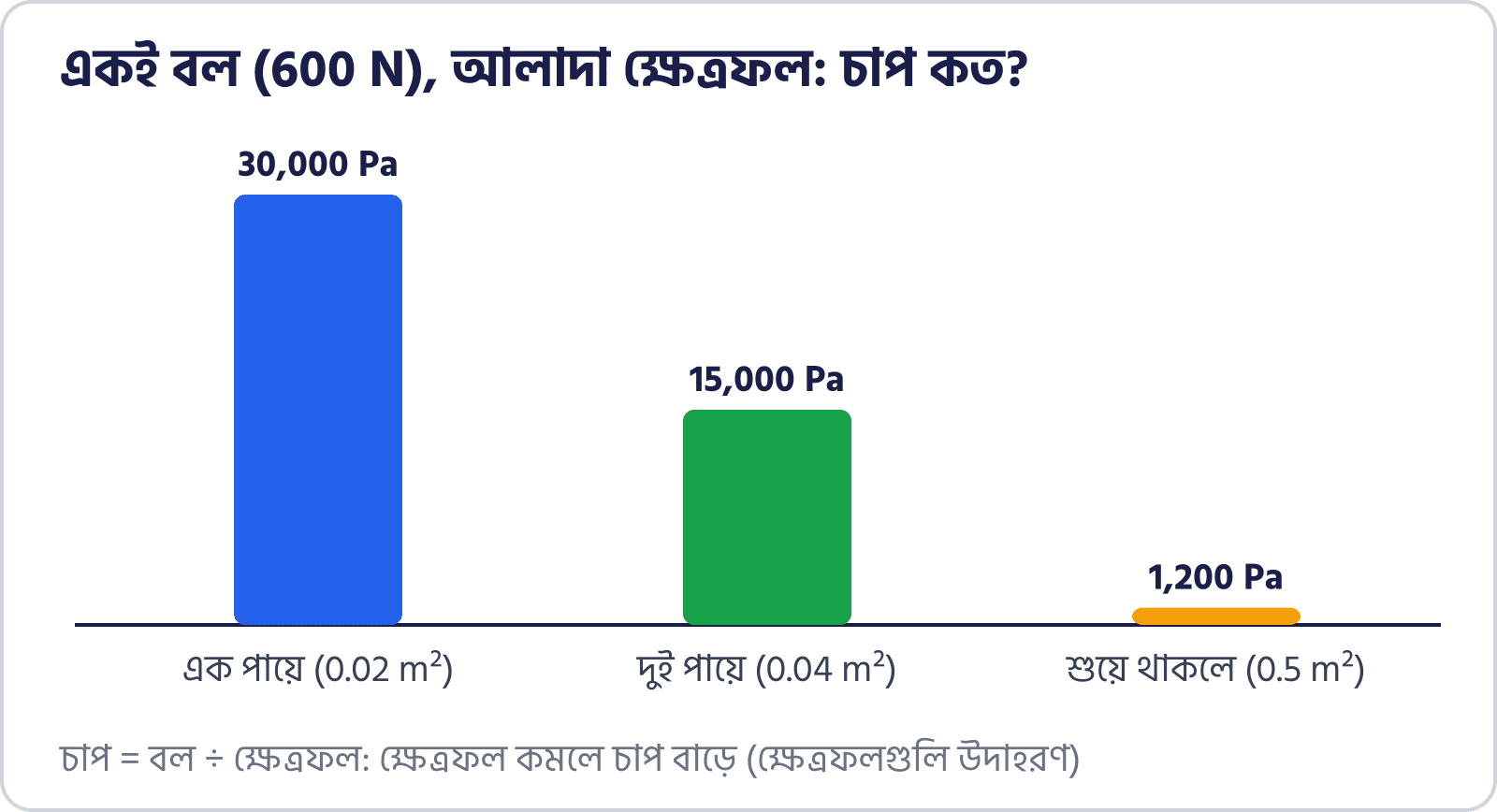
Pressure = force ÷ area, so its unit is $\text{N/m}^{2}$, named the pascal (Pa). The newton and the dyne are units of force, the joule of work.
Key Points
- $P = \frac{F}{A}$
- A smaller area means more pressure: that is why a knife's edge is thin
- Pressure is a scalar quantity
Additional Information
A speed of 72 km/h is equal to how many m/s?
Explanation
To change km/h to m/s, multiply by $\frac{5}{18}$: $72 \times \frac{5}{18} = 4 \times 5 = 20$ m/s. This is because 1 km = 1000 m and 1 hour = 3600 s, and $\frac{1000}{3600} = \frac{5}{18}$.
Key Points
- m/s to km/h: multiply by $\frac{18}{5}$
- 36 km/h = 10 m/s, 54 km/h = 15 m/s
Memory Tips
- km/h to m/s gets smaller: $\frac{5}{18}$; m/s to km/h gets bigger: $\frac{18}{5}$
Why is the wall of a dam made wider at the bottom?
Explanation
In a liquid at rest the pressure increases with depth ($P = h\rho g$), so the water pressure is greatest at the base of the dam. The lower part of the wall is made wider and stronger to bear it. Divers need special suits for the same reason.
Key Points
- Liquid pressure depends on depth and density
- At a given depth the pressure is equal in all directions
- The shape of the vessel does not change liquid pressure
Which instrument measures atmospheric pressure?
Explanation
A barometer measures atmospheric pressure; the mercury barometer was invented by Torricelli. Normal pressure at sea level is about 76 cm of mercury. A hygrometer measures humidity, an anemometer wind speed and a thermometer temperature.
Key Points
- Air pressure falls as height increases
- In the hills water boils at a lower temperature
- A sudden steep fall in the barometer reading warns of a storm
Additional Information
| Instrument | Measures |
|---|---|
| Barometer | Atmospheric pressure |
| Hygrometer | Humidity of air |
| Anemometer | Wind speed |
| Thermometer | Temperature |
Hydraulic brakes and the hydraulic press work on which principle?
Explanation
Pascal's law: pressure applied to any part of an enclosed liquid is transmitted equally in all directions. So a small force on a narrow piston gives a much larger force on a wide piston. Archimedes' principle is about buoyancy (floating and sinking).
Key Points
- The hydraulic press, brake and lift work on Pascal's law
- Archimedes: buoyant force = weight of the liquid displaced
Memory Tips
- Hydraulic means Pascal; floating or sinking means Archimedes
0/10
📊 Topic Analysis
About this quiz
More for Clerkship 2024

WBPSC Clerkship 2024: Weekly Mock Test (22 November 2026): English, General Studies, Arithmetic

HCF and LCM Part 2 Practice Quiz: WBPSC Clerkship 2024

West Bengal Districts, Agriculture and Industry Quiz: Clerkship 2024

Leave a Comment
Commenting as ·