
10 questions on West Bengal’s districts and headquarters, rice, jute and tea, and its industrial centres from Durgapur to Haldia. 30 seconds a question.
West Bengal Districts, Agriculture and Industry Quiz: Clerkship 2024
Quiz challenge
A little practice. A step forward.
10 questions
Learn with explanations
Time per question: 30 sec
0 / 10 completed
--:--
Which is the largest district of West Bengal by area?
Explanation
South 24 Parganas is the state's largest district by area; most of the Indian Sundarbans lies in it. North 24 Parganas is the largest by population, not by area. Paschim Medinipur was larger once, but it shrank when Jhargram was carved out in 2017.
Key Points
- Largest by area: South 24 Parganas
- Smallest by area: Kolkata
- Largest by population: North 24 Parganas (2011)
Confusion Points
- Largest by area is South 24 Parganas, largest by population is North 24 Parganas: read what the question asks
Alipurduar district was carved out of which district?
Explanation
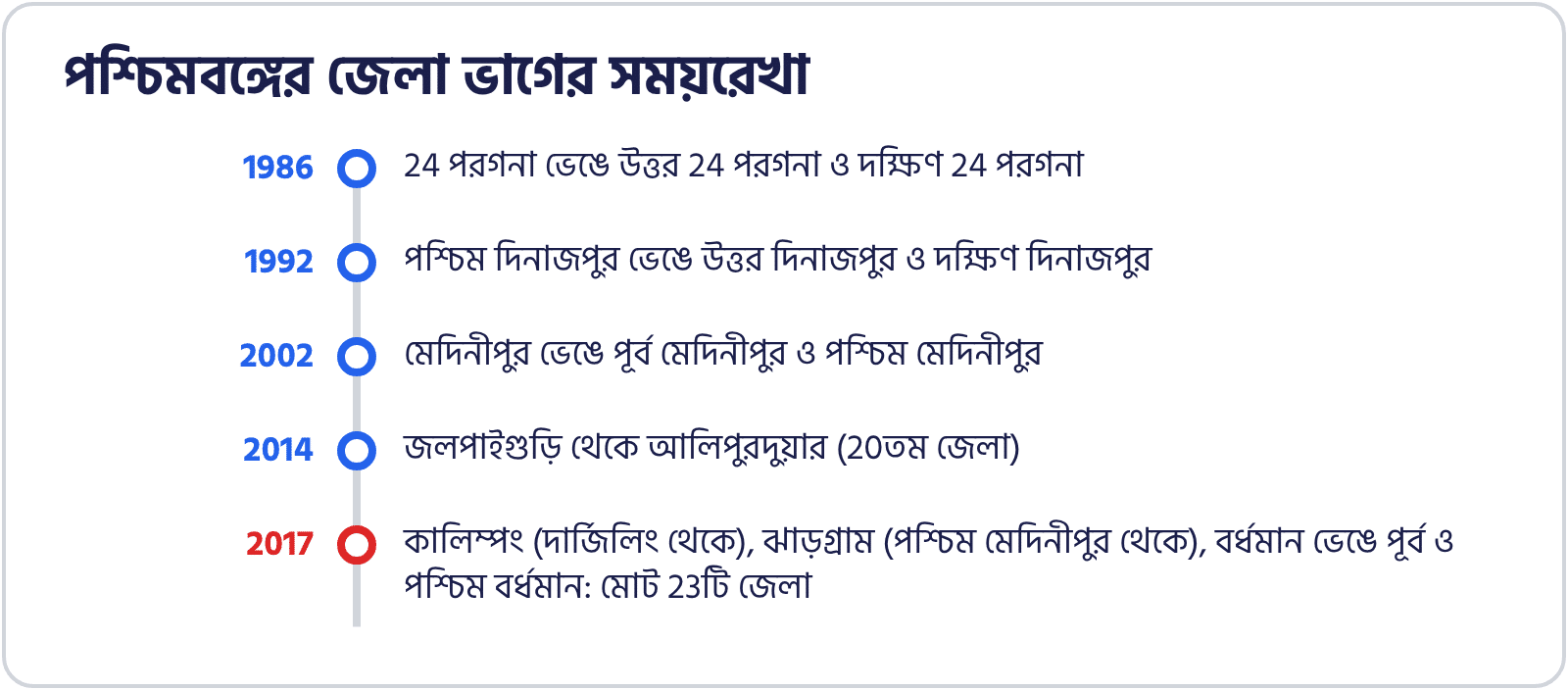
In 2014 Alipurduar was carved out of Jalpaiguri district and became West Bengal's 20th district. Kalimpong came out of Darjeeling (2017), while Cooch Behar and Uttar Dinajpur were not divided. Much of the Dooars tea belt now lies in Alipurduar.
Key Points
- Alipurduar: 2014, from Jalpaiguri
- Kalimpong: 2017, from Darjeeling
- Jhargram: 2017, from Paschim Medinipur
Memory Tips
- The two new northern districts came from their big neighbours: Alipurduar from Jalpaiguri, Kalimpong from Darjeeling
Additional Information
What is the headquarters of Dakshin Dinajpur district?
Explanation
Balurghat is the headquarters of Dakshin Dinajpur. Raiganj is the headquarters of Uttar Dinajpur and English Bazar that of Malda. The two Dinajpur districts were formed in 1992 by dividing West Dinajpur.
Key Points
- Dakshin Dinajpur → Balurghat
- Uttar Dinajpur → Raiganj
- Malda → English Bazar
Confusion Points
- Swapping Raiganj and Balurghat is the most common mistake
Memory Tips
- South has the B (Balurghat), north has the R (Raiganj)
Additional Information
| District | Headquarters |
|---|---|
| Uttar Dinajpur | Raiganj |
| Dakshin Dinajpur | Balurghat |
| Malda | English Bazar |
| Murshidabad | Baharampur |
| Hooghly | Chinsurah |
| Purba Medinipur | Tamluk |
Which district is called the 'rice bowl' of West Bengal?
Explanation
Bardhaman (now Purba Bardhaman) grows the most rice in the state, so it is called its rice bowl. Fertile alluvium and irrigation from the Damodar explain it. Hooghly is known more for potato, Nadia for jute and Malda for mango.
Key Points
- Bardhaman: the rice bowl
- Irrigation: the Damodar valley canals
- The main rice season is Aman (monsoon)
Additional Information

West Bengal ranks first in India in the production of which crop?
Explanation
West Bengal is India's largest producer of jute, thanks to the alluvium of the lower Ganga basin, a hot and humid climate and plenty of water for retting. In tea it is second after Assam, and in potato second after Uttar Pradesh. Wheat is not a major crop here.
Key Points
- Jute: first in India, the 'golden fibre'
- Tea: second after Assam
- Potato: second after Uttar Pradesh
Confusion Points
- In tea and potato West Bengal is second, not first
Additional Information
| Crop | West Bengal's rank | First |
|---|---|---|
| Jute | First | West Bengal |
| Tea | Second | Assam |
| Potato | Second | Uttar Pradesh |
Where was India's first jute mill set up?
Explanation
India's first jute mill was set up at Rishra in Hooghly district in 1855. Many more mills followed on both banks of the Hooghly, including Titagarh and Budge Budge, which is why those names also sound right. River transport for raw jute and export through Kolkata port favoured this belt.
Key Points
- First jute mill: Rishra, 1855
- The jute industry is concentrated on both banks of the Hooghly
- Raw jute comes from the fields of Nadia and Murshidabad
Memory Tips
- Two R's: first jute mill at Rishra, first coal mine at Raniganj
Additional Information

With which country's help was the Durgapur Steel Plant built?
Explanation
Of the three public sector steel plants of the Second Five-Year Plan, Durgapur was built with British help. Bhilai (Chhattisgarh) was built with the Soviet Union and Rourkela (Odisha) with West Germany. The plant is now part of SAIL.
Key Points
- Durgapur: Britain
- Bhilai: Soviet Union
- Rourkela: West Germany
Confusion Points
- Bokaro and Bhilai were both Soviet-aided; taking Durgapur for a Soviet plant is a common mistake
Memory Tips
- Durgapur–Britain, Rourkela–Germany, Bhilai–Soviet: pair them once and write them twice
Additional Information
| Steel plant | State | Partner country |
|---|---|---|
| Durgapur | West Bengal | Britain |
| Bhilai | Chhattisgarh | Soviet Union |
| Rourkela | Odisha | West Germany |
| Bokaro | Jharkhand | Soviet Union |
In which district is the Chittaranjan Locomotive Works?
Explanation
The Chittaranjan Locomotive Works is at Chittaranjan in Paschim Bardhaman district, near the Jharkhand border. It has built railway locomotives since 1950 and now builds electric ones. The district is part of the Asansol–Durgapur industrial belt; Bankura, Purulia and Birbhum are its neighbours.
Key Points
- Chittaranjan: Paschim Bardhaman
- Builds locomotives, since 1950
- Paschim Bardhaman's headquarters is Asansol
Additional Information
Where did coal mining begin in India?
Explanation
Coal mining in India began in 1774 in the Raniganj coalfield of West Bengal. Jharia and Bokaro are in Jharkhand and Talcher in Odisha; they are large coalfields developed later. Raniganj coal is the base of the steel industry of the Damodar valley.
Key Points
- First coal mining: Raniganj, 1774
- Raniganj lies in the Damodar valley
- Jharia and Bokaro are in Jharkhand
Memory Tips
- Raniganj, the queen (rani) of coal, came first (1774)
Which was the first product in India to get a GI (Geographical Indication) tag?
Explanation
Darjeeling tea was registered in 2004 as India's first GI product. A GI tag means only produce from that area may be sold under the name. The Baluchari sari and Banglar Rasogolla also have GI tags, but they came much later.
Key Points
- Darjeeling tea: India's first GI, 2004
- Tea grows in the Darjeeling hills, the Terai and the Dooars
- West Bengal is second in tea after Assam
0/10
📊 Topic Analysis
About this quiz
More for Clerkship 2024

Everyday Science Mixed Quiz 6: Pressure, Buoyancy, Gravity and Plants, WBPSC Clerkship GS

Subject-Verb Agreement Practice Quiz (Round 2): WBPSC Clerkship 2024 English

Indian National Congress, Partition of Bengal and Swadeshi Movement Quiz: Clerkship 2024

Leave a Comment
Commenting as ·