
12 questions on many a, more than one, not only…but also, the + adjective, a pair of and more. No timer; every answer explained.
Subject-Verb Agreement Practice Quiz (Round 2): WBPSC Clerkship 2024 English
Practice session
A little practice. A step forward.
12 questions
Learn with explanations
At your own pace
0 / 12 completed
00:00
Choose the correct word: Many a soldier ___ his life in the war.
Explanation
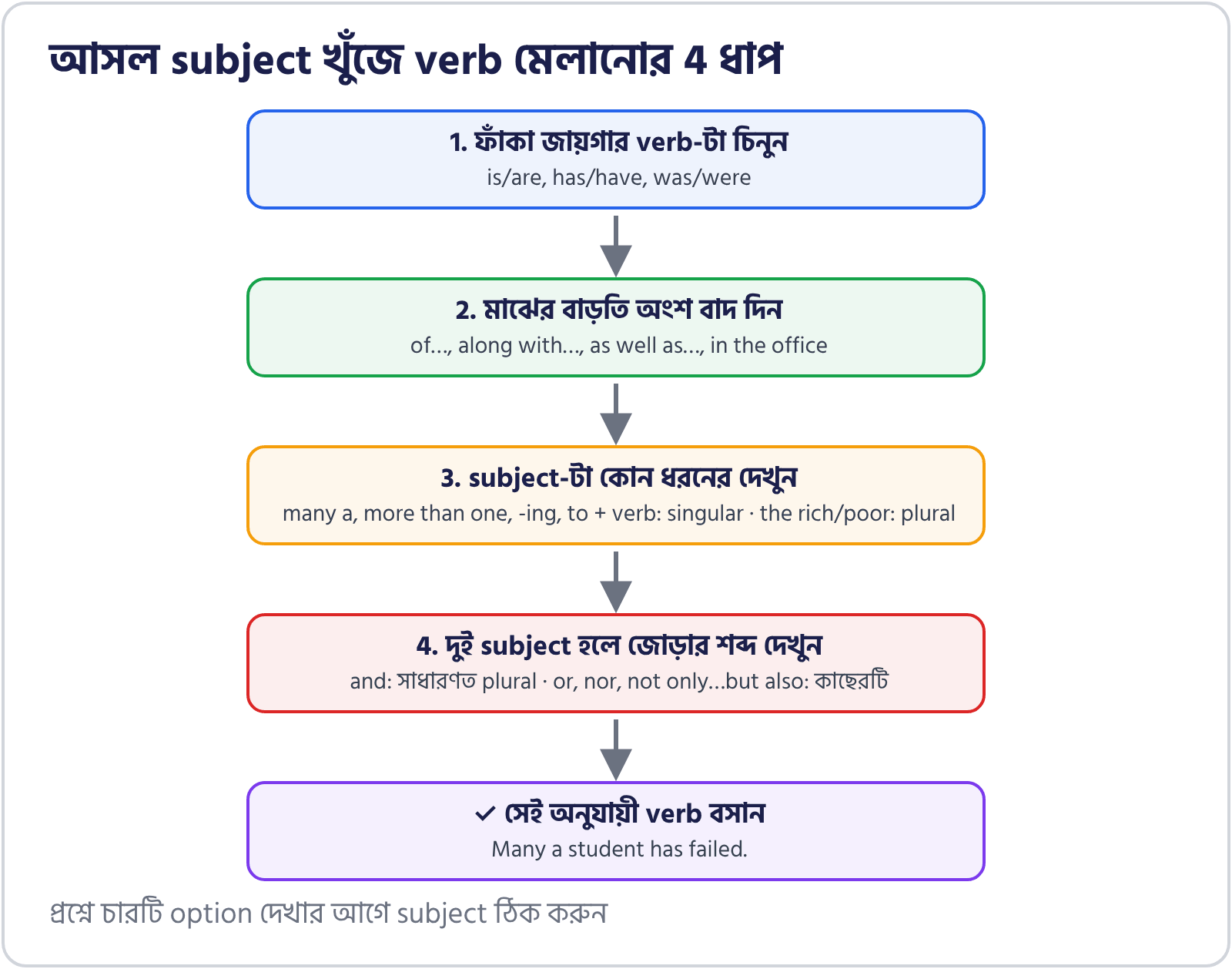
Many a is followed by a singular noun and a singular verb: has lost. Although it means many soldiers, Many a soldier is grammatically singular. have lost, were losing and are losing are plural forms, so they are wrong.
Key Points
- Many a + singular noun + singular verb
- Many soldiers have lost: many with a plural noun takes a plural verb
Confusion Points
- Using a plural verb because the meaning is many
Memory Tips
- Look at the a in Many a: a means one, so singular
Additional Information
| Pattern | Verb | Example |
|---|---|---|
| Many a + singular noun | singular | Many a student has failed. |
| Many + plural noun | plural | Many students have failed. |
Choose the correct word: Not only the clerks but also the officer ___ present at the meeting.
Explanation
When two subjects are joined by not only…but also, the verb agrees with the nearer subject, the one after but also. Here that is the officer (singular), so was. were, are and have been are plural; choosing by clerks is the trap.
Key Points
- Not only X but also Y: the verb follows Y
- Same rule as or, nor, either…or, neither…nor
Confusion Points
- Choosing a plural verb because of the first subject, clerks
- Treating it like and
Memory Tips
- Look at the word after but also
Additional Information
| Joining word | Verb agrees with | Example |
|---|---|---|
| and | usually plural | The clerks and the officer were present. |
| not only…but also | the nearer subject | Not only the clerks but also the officer was present. |
| as well as | the first subject | The officer as well as the clerks was present. |
Choose the correct word: More than one employee ___ the rule.
Explanation
More than one takes a singular noun and a singular verb: has broken. The meaning is more than one person, but the grammar follows the noun's form (employee, singular). have broken, are breaking and were breaking are plural.
Key Points
- More than one + singular noun + singular verb
- More than two employees have broken: with two, noun and verb are plural
Confusion Points
- Using a plural verb because the meaning is plural
Memory Tips
- After one the noun is singular, and so is the verb
Additional Information
Choose the correct word: It is you who ___ to blame.
Explanation
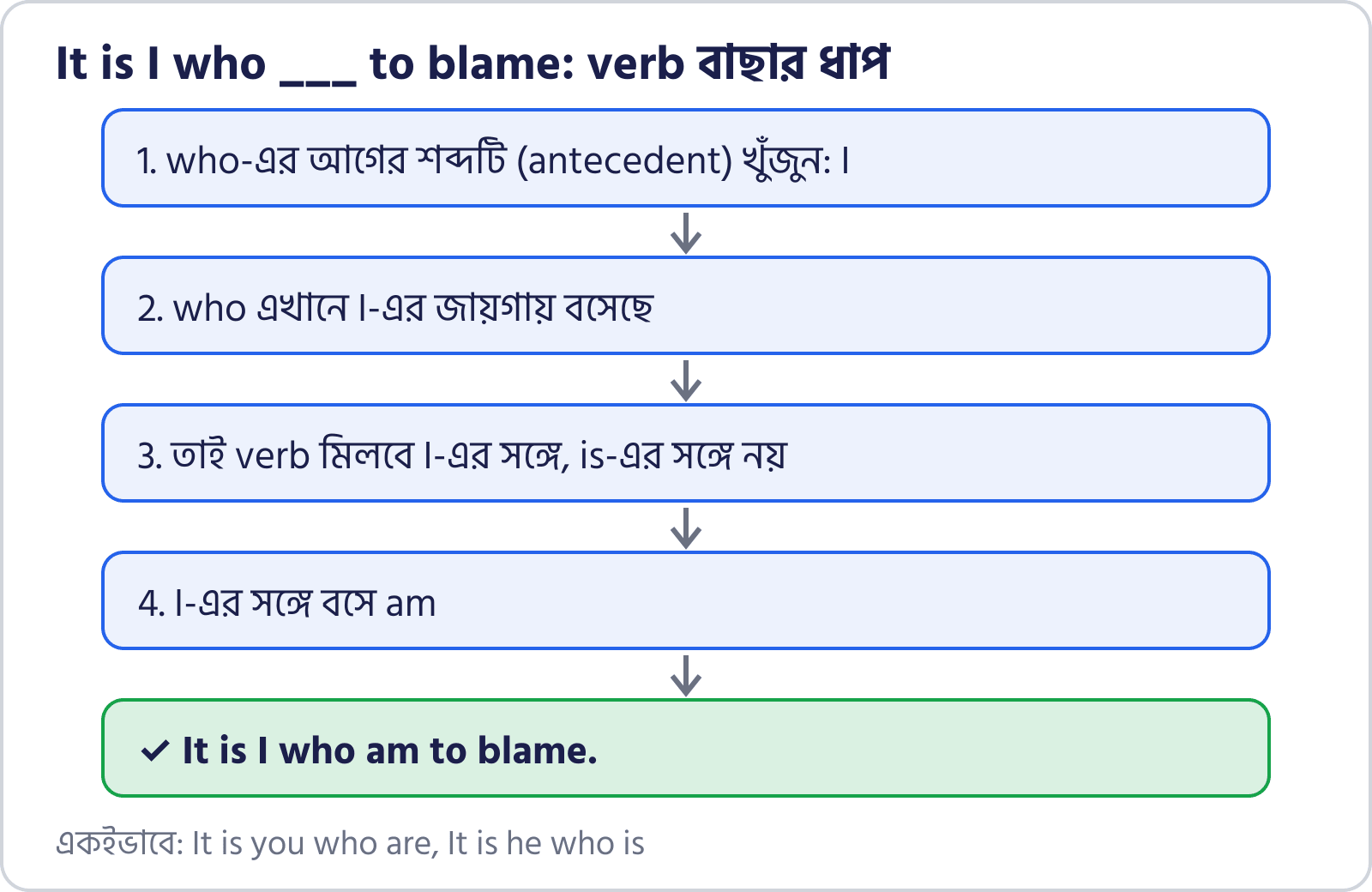
The verb after who agrees with the word before who (its antecedent). Here that is you, so the verb is the one used with you: are. is is the trap: the is of It is belongs to a different clause. am goes only with I, and has to blame changes the meaning.
Key Points
- The verb after who/which/that follows the antecedent
- It is I who am, It is you who are, It is he who is
Confusion Points
- Choosing is because the sentence starts with It is
Memory Tips
- Look at the word just before who
Additional Information
Choose the correct word: The poor ___ always in need of help.
Explanation
The + adjective (the poor, the rich, the old, the blind) means a group of people, so it takes a plural verb: are. poor has no s, but it means the poor people. is, has and was are singular, so they are wrong.
Key Points
- The + adjective = a group of people = plural
- The rich are, the young are, the wounded were
Confusion Points
- Thinking it is singular because there is no s
Memory Tips
- the poor = the poor people: add people in your head
Additional Information
| The + adjective | Meaning | Example |
|---|---|---|
| the poor | poor people | The poor need help. |
| the rich | rich people | The rich are not always happy. |
| the old | old people | The old need care. |
| the wounded | wounded people | The wounded were taken to hospital. |
Choose the correct word: Gulliver's Travels ___ written by Jonathan Swift.
Explanation
Gulliver's Travels is the title of one book, so despite the s it is one thing and takes a singular verb: was. Titles of books and films and names of countries that look plural are singular (The Arabian Nights is, The United States is). were, have been and are are plural.
Key Points
- Plural-looking titles and country names: singular
- Gulliver's Travels was written by Jonathan Swift
Confusion Points
- Taking Travels as plural because of the s
Memory Tips
- A title names one book: one thing
Additional Information
| Name | What | Verb |
|---|---|---|
| Gulliver's Travels | book | singular: is/was |
| The Arabian Nights | book | singular: is/was |
| The United States | country | singular: is/was |
Choose the correct word: All the furniture in the office ___ replaced last year.
Explanation
Furniture is an uncountable noun with no plural, so it always takes a singular verb: was. All and in the office do not make it plural: the subject is furniture. were, have been and are are plural (and last year needs the past tense).
Key Points
- furniture, information, advice, luggage, equipment, machinery: uncountable, singular
- They take no plural s: furnitures is wrong
Confusion Points
- Choosing a plural verb because of All
Memory Tips
- Things you cannot count = singular
Additional Information
| Uncountable noun | Correct sentence |
|---|---|
| furniture | The furniture is new. |
| information | This information is useful. |
| advice | His advice was good. |
| luggage | My luggage is heavy. |
| equipment | The equipment has arrived. |
Choose the correct word: Every boy and every girl ___ given a book.
Explanation
When two subjects joined by and are preceded by every or each, the verb is singular: was. every takes each person separately, so and does not make it plural. were, are and have been are plural.
Key Points
- Every/Each + noun and (every/each) + noun: singular verb
- Every man and woman has a vote
Confusion Points
- Using a plural verb because of and
Memory Tips
- every means each one separately
Additional Information
Choose the correct word: The editor and publisher ___ a friend of mine.
Explanation
The article the comes only once, before editor, so the editor and publisher is one person: singular is (a friend also points to one person). For two people it would be The editor and the publisher are. are, were and have been are plural.
Key Points
- One article + two titles = one person = singular
- Two articles = two people = plural
Confusion Points
- Choosing a plural verb just because of and
Memory Tips
- Count the: once means one person
Additional Information
| Sentence | People | Verb |
|---|---|---|
| The editor and publisher is… | one | singular |
| The editor and the publisher are… | two | plural |
| The secretary and treasurer has resigned. | one | singular |
Which part of the sentence has an error? Swimming in rivers (A) / are dangerous (B) / for small children (C) / No error (D)
Explanation
The subject is Swimming (a gerund, the -ing name of an action), not rivers. A gerund subject is singular, so are must be is: Swimming in rivers is dangerous for small children. Taking rivers as the subject leads to the wrong choice, No error.
Key Points
- A gerund (-ing) subject takes a singular verb
- So do to + verb and a what-clause: To err is human, What he said is true
Confusion Points
- Taking rivers in in rivers as the subject
Memory Tips
- Ask: what is dangerous? Swimming, one activity
Additional Information
Choose the correct word: A pair of shoes ___ lying under the bed.
Explanation
The subject here is pair (one pair); shoes only describes it after of, so the verb is singular: is. My shoes alone would take are, but with A pair of the verb follows pair. are, were and have been are plural.
Key Points
- A pair of + plural noun: singular verb
- My shoes are new, but A pair of shoes is new
Confusion Points
- Choosing a plural verb because of shoes
Memory Tips
- The word before of is the subject
Additional Information
| Sentence | Subject | Verb |
|---|---|---|
| My trousers are torn. | trousers | plural |
| A pair of trousers is torn. | pair | singular |
| Two pairs of shoes are missing. | pairs | plural |
Choose the correct word: Here ___ the bus for Howrah.
Explanation
In a sentence starting with Here or There the verb comes before the subject (inversion). The subject is the bus (singular), so comes. come, are coming and have come go with a plural subject. Here come the buses would be right for a plural.
Key Points
- Here/There + verb + subject: the verb follows the subject after it
- On the hill stands a temple, but On the hill stand two temples
Memory Tips
- Put it in normal order: The bus comes here
Additional Information
| Inverted | Normal order | Verb |
|---|---|---|
| Here comes the bus. | The bus comes here. | singular |
| Here come the buses. | The buses come here. | plural |
| On the hill stands a temple. | A temple stands on the hill. | singular |
0/12
📊 Topic Analysis
About this quiz
More for Clerkship 2024

Everyday Science Mixed Quiz 6: Pressure, Buoyancy, Gravity and Plants, WBPSC Clerkship GS

Indian National Congress, Partition of Bengal and Swadeshi Movement Quiz: Clerkship 2024

India Geography Mixed Quiz 6: States, Borders, Plateaus, Rivers, Coasts and Forests (Clerkship 2024)

Leave a Comment
Commenting as ·