
10 WBPSC Clerkship 2024 level questions on the founding of the Indian National Congress, the 1905 Partition of Bengal and the Swadeshi movement, each with an explanation.
Indian National Congress, Partition of Bengal and Swadeshi Movement Quiz: Clerkship 2024
Quiz challenge
A little practice. A step forward.
10 questions
Learn with explanations
Time per question: 30 sec
0 / 10 completed
--:--
Who presided over the first session of the Indian National Congress?
Explanation
The 1885 Bombay session was presided over by Womesh Chunder Bonnerjee. Hume founded the Congress but was not its president then. Dadabhai Naoroji presided over the second session (1886, Calcutta).
Key Points
- First session: 28.12.1885, Bombay
- 72 delegates
- Founder: A. O. Hume
Confusion Points
- Founder Hume, first president Bonnerjee: two different questions.
Memory Tips
- The first president was a Bengali, and the second session was held in Bengal (Calcutta).
Additional Information
| Year | City | President |
|---|---|---|
| 1885 | Bombay | W. C. Bonnerjee |
| 1886 | Calcutta | Dadabhai Naoroji |
| 1887 | Madras | Badruddin Tyabji |
| 1888 | Allahabad | George Yule |
Where was the first session of the Indian National Congress held?
Explanation
The first session was held at Gokuldas Tejpal Sanskrit College, Bombay, from 28 to 31 December 1885. It was planned for Poona but moved to Bombay because of an epidemic there. Calcutta hosted the second session (1886) and Madras the third (1887).
Key Points
- Gokuldas Tejpal Sanskrit College, Bombay
- Viceroy at the time: Lord Dufferin
Confusion Points
- Poona was the planned venue; the session took place in Bombay.
Additional Information
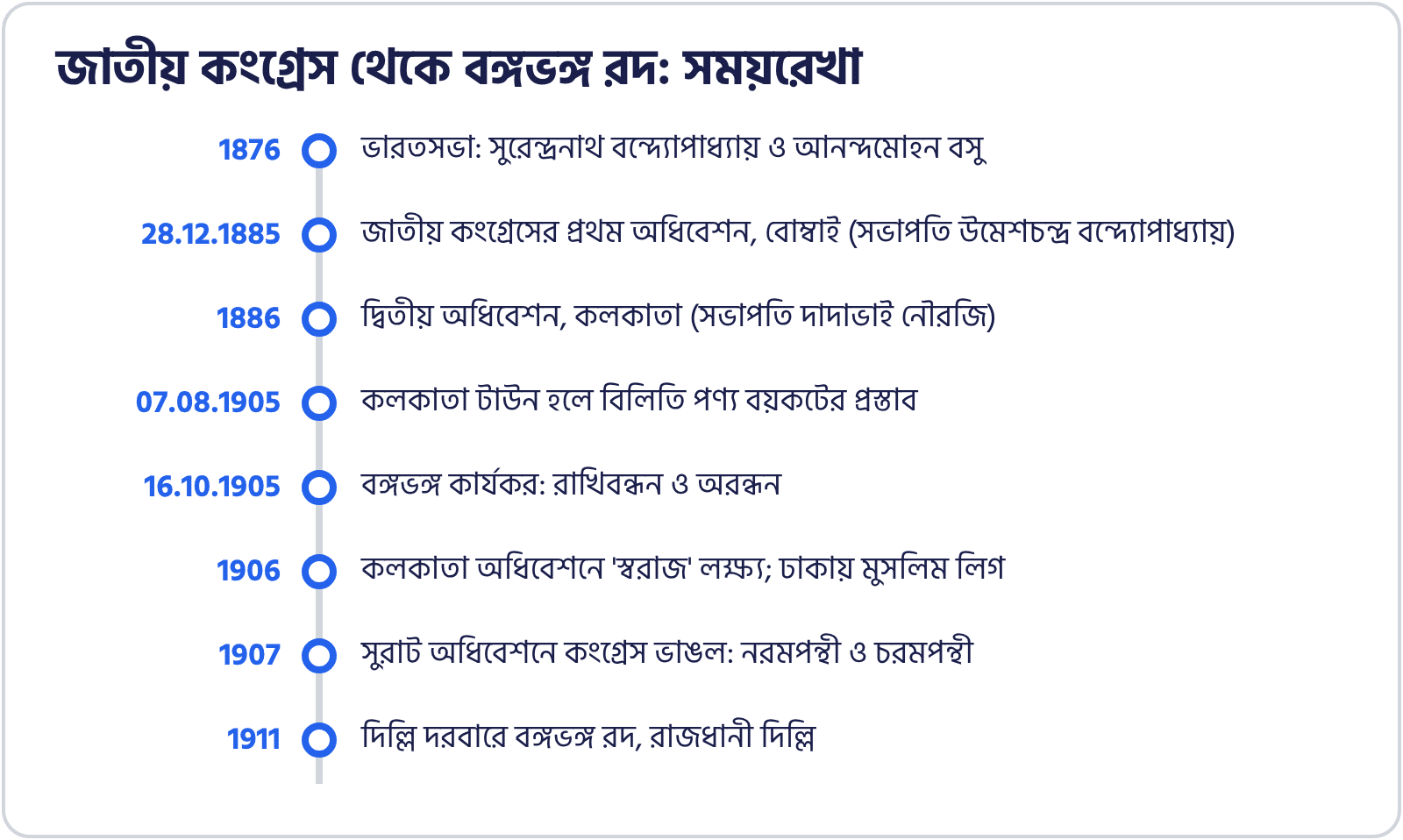
Who founded the Indian Association in 1876?
Explanation
The Indian Association was founded in Calcutta in 1876 by Surendranath Banerjea and Ananda Mohan Bose. It was Bengal's main political body before the Congress and later merged with it. The other pairs belong to a later period.
Key Points
- Indian Association: 1876, Calcutta
- Surendranath is called 'Rashtraguru'
Memory Tips
- Surendranath and Ananda Mohan: the two founders of the Indian Association.
On which date did the Partition of Bengal come into effect?
Explanation
Lord Curzon's Partition of Bengal took effect on 16 October 1905, observed in Bengal as a day of mourning with Rakhi Bandhan and Arandhan. The boycott resolution was passed at Calcutta Town Hall on 7 August 1905. The annulment was announced at the Delhi Durbar in December 1911.
Key Points
- Decision: Lord Curzon
- New province: Eastern Bengal and Assam, capital Dacca
Confusion Points
- 7 August (boycott resolution) and 16 October (partition in effect) are easily mixed up.
Memory Tips
- 16 October = Rakhi day; boycott in August, partition in October.
Additional Information
What was the capital of the province of 'Eastern Bengal and Assam' created by the partition?
Explanation
Dacca was the capital of the new province of Eastern Bengal and Assam, whose first Lieutenant Governor was Bampfylde Fuller. Calcutta stayed the capital of the rest of Bengal (West Bengal, Bihar, Orissa). Shillong was Assam's hill station and Chittagong a port town.
Key Points
- First Lieutenant Governor: Bampfylde Fuller
- The rest of Bengal kept Calcutta as capital
Who called for Rakhi Bandhan on the day of the partition, as a symbol of Hindu-Muslim unity?
Explanation
On 16 October 1905, at Rabindranath Tagore's call, Bengalis tied rakhis on one another's wrists as a symbol of Bengal's unity. In this period he wrote 'Banglar Mati Banglar Jal' and 'Amar Sonar Bangla'. Bipin Chandra Pal and Aurobindo Ghosh were Extremist leaders, Surendranath a Moderate.
Key Points
- Arandhan (no cooking) was observed the same day
- 'Amar Sonar Bangla' is now Bangladesh's national anthem
Where was the resolution to boycott British goods adopted?
Explanation
The boycott of British goods was adopted at a large meeting at Calcutta Town Hall on 7 August 1905, which is taken as the formal start of the Swadeshi movement. The Surat session (1907) is famous for the split in the Congress.
Key Points
- Date: 07.08.1905
- British cloth was burnt in public
Memory Tips
- Town Hall in August, rakhi in October.
Who was the first principal of the Bengal National College founded in the Swadeshi era?
Explanation
The Bengal National College was set up in 1906 under the National Council of Education, with Aurobindo Ghosh as its first principal. The national education movement aimed to build Indian-run education in place of government schools and colleges. Ashutosh Mukherjee was Vice-Chancellor of Calcutta University.
Key Points
- National Council of Education: 1906
- National education was one of the four resolutions of the 1906 Calcutta session
At which Congress session did the Moderates and the Extremists split?
Explanation
At the 1907 Surat session (president Rash Behari Ghosh) the Congress split into Moderates and Extremists over the methods of the movement. Gokhale presided over the 1905 Benares session, and at the 1906 Calcutta session Naoroji declared Swaraj the goal.
Key Points
- Extremists: Lal-Bal-Pal and Aurobindo
- Moderates: Gokhale, Pherozeshah Mehta, Surendranath
Memory Tips
- Split at Surat: S for split, 1907.
Additional Information
Who was the Viceroy of India when the Partition of Bengal was annulled?
Explanation
King George V announced the annulment at the Delhi Durbar of 1911, when Lord Hardinge was Viceroy; the shift of the capital from Calcutta to Delhi was announced at the same time. Lord Curzon had made the partition, Lord Minto was Viceroy during the Morley-Minto reforms of 1909, and Lord Dufferin when the Congress was founded.
Key Points
- Annulment announced: Delhi Durbar, 1911
- Capital moved from Calcutta to Delhi
Confusion Points
- Partition by Curzon, annulment under Hardinge: two different Viceroys.
Memory Tips
- Curzon cuts, Hardinge joins.
Additional Information
| Viceroy | Event |
|---|---|
| Lord Dufferin | Founding of the Indian National Congress (1885) |
| Lord Curzon | Partition of Bengal (1905) |
| Lord Minto | Morley-Minto reforms, separate electorates (1909) |
| Lord Hardinge | Annulment of the partition, capital to Delhi (1911) |
0/10
📊 Topic Analysis
About this quiz
More for Clerkship 2024

India Geography Mixed Quiz 6: States, Borders, Plateaus, Rivers, Coasts and Forests (Clerkship 2024)

Simplification Part 2 Practice Quiz: Decimals, Identities and Continued Fractions, WBPSC Clerkship 2024

Environment and Pollution Quiz: Clerkship GS Practice

Leave a Comment
Commenting as ·