
20 everyday-science questions: pressure and buoyancy, gravity, instruments and units, properties of liquids and plant life.
Everyday Science Mixed Quiz 6: Pressure, Buoyancy, Gravity and Plants, WBPSC Clerkship GS
Quiz challenge
A little practice. A step forward.
20 questions
Learn with explanations
Time per question: 30 sec
0 / 20 completed
--:--
What is the SI unit of pressure?
Explanation
Pressure is the force acting perpendicularly on a unit area, so pressure = force ÷ area. One newton acting on one square metre gives a pressure of 1 pascal (Pa). The newton is the unit of force, the joule of work and energy, the watt of power.
Key Points
- 1 Pa = 1 N/m²
- Normal atmospheric pressure is about 1.013 × 10⁵ Pa (76 cm of mercury)
- The unit is named after Blaise Pascal
Memory Tips
- Force in newtons, pressure in pascals: two scientists, two units
Which instrument measures atmospheric pressure?
Explanation
A barometer measures air pressure; a sudden steep fall in its reading warns of a storm. A hygrometer measures humidity, a lactometer the density of milk and an ammeter electric current.
Key Points
- Torricelli made the mercury barometer
- A sudden fall in the barometer reading signals a storm
- Air pressure falls with height
Memory Tips
- Baro = pressure (Greek baros: weight)
Additional Information
| Instrument | Measures |
|---|---|
| Barometer | Atmospheric pressure |
| Hygrometer | Relative humidity of air |
| Lactometer | Density (purity) of milk |
| Altimeter | Altitude (in aircraft) |
| Speedometer | Instantaneous speed of a vehicle |
| Odometer | Distance travelled by a vehicle |
| Tachometer | Engine revolutions per minute (rpm) |
Which instrument shows the total distance a vehicle has travelled?
Explanation
An odometer counts the turns of the wheels and shows the total distance travelled. A speedometer shows the speed at that moment, a tachometer the engine's revolutions per minute (rpm) and an altimeter the height of an aircraft.
Key Points
- Odometer: distance (km)
- Speedometer: speed (km/h)
- Both usually sit on the same dashboard
Confusion Points
- A speedometer measures speed, not distance: distance is the odometer's job
Memory Tips
- Odo (Greek hodos) = road, so the odometer measures the length of the road covered
Additional Information
| Instrument | Measures |
|---|---|
| Barometer | Atmospheric pressure |
| Hygrometer | Relative humidity of air |
| Lactometer | Density (purity) of milk |
| Altimeter | Altitude (in aircraft) |
| Speedometer | Instantaneous speed of a vehicle |
| Odometer | Distance travelled by a vehicle |
| Tachometer | Engine revolutions per minute (rpm) |
Why does ice float on water?
Explanation
When water freezes its volume grows by about 9%, so the density of ice falls to about 0.92 g/cm³, against 1 g/cm³ for water. Anything less dense than a liquid floats in it. A huge block of ice floats too, however heavy, so density, not mass, is the reason.
Key Points
- Water expands when it freezes
- Ice has a density of about 0.92 g/cm³
- So about 90% of an iceberg lies under water
Confusion Points
- Floating or sinking depends on density, not mass: an iron nail sinks, a huge log floats
Additional Information
Densities compared
Ice · 0.92 g/cm³
Pure water (4°C) · 1 g/cm³
Sea water · 1.03 g/cm³
At what temperature is pure water densest?
Explanation
Most liquids contract as they cool, but water expands as it cools from 4°C to 0°C: the anomalous expansion of water. So at 4°C water has its smallest volume and its greatest density (1 g/cm³). When a pond freezes on top in a cold country, the water at the bottom stays near 4°C and the fish survive.
Key Points
- Water is densest at 4°C: 1 g/cm³
- From 4°C to 0°C water expands as it cools
- A pond freezes from the top, not the bottom
Confusion Points
- Water freezes at 0°C but is densest at 4°C: two different numbers
Memory Tips
- Water's special number is 4: it is heaviest at 4°C
By which principle does a huge iron ship float on water?
Explanation
Archimedes' principle: a body in a liquid gets an upward force (buoyancy) equal to the weight of the liquid it displaces. A ship's hull is hollow and wide, so it pushes aside water equal to its own weight and floats. A solid iron ball cannot displace that much water and sinks.
Key Points
- Buoyant force = weight of the liquid displaced
- A body floats when the liquid it displaces weighs as much as itself
- Buoyancy is why things feel lighter in water
Memory Tips
- Archimedes: floating and sinking; Pascal: pressure passed on
On which law does a car's hydraulic brake work?
Explanation
Pascal's law: pressure applied to any part of an enclosed liquid is passed on equally in every direction. Pressing the brake pedal sends that pressure through the brake fluid to the brakes of all four wheels at once. The hydraulic press and the hydraulic jack work the same way.
Key Points
- Pressure in an enclosed liquid is transmitted equally in all directions
- Hydraulic brake, press, jack, lift: Pascal's law
- A small force on a small piston gives a large force on a large piston
Memory Tips
- Hear 'hydraulic', think Pascal
Why is it easier to swim in sea water than in river water?
Explanation
Sea water has salt dissolved in it, so its density (about 1.03 g/cm³) is higher than that of fresh river water. A denser liquid displaced by the same volume weighs more, so it gives more buoyancy and the body floats more easily. Depth does not add buoyancy.
Key Points
- Buoyancy grows with the density of the liquid
- Sea water has a density of about 1.03 g/cm³
- In the very salty Dead Sea a person hardly sinks
Additional Information
Densities compared
Ice · 0.92 g/cm³
Pure water (4°C) · 1 g/cm³
Sea water · 1.03 g/cm³
What is the approximate value of the acceleration due to gravity (g) at the Earth's surface?
Explanation
Near the Earth's surface a freely falling body gains about 9.8 m/s of speed every second, so g ≈ 9.8 m/s². 1.6 m/s² is the value of g on the Moon. The number 6.67 comes from the gravitational constant G (6.67 × 10⁻¹¹ N m²/kg²), which is not g.
Key Points
- g ≈ 9.8 m/s² at the Earth's surface
- On the Moon g is about 1.6 m/s², roughly one-sixth of Earth's
- Without air resistance heavy and light bodies fall together
Confusion Points
- Small g (acceleration due to gravity, 9.8 m/s²) and capital G (gravitational constant, 6.67 × 10⁻¹¹) are different
A body has a mass of 60 kg on Earth. What will its mass be on the Moon?
Explanation
Mass is the amount of matter in a body, so it does not change from place to place: it is 60 kg on the Moon too. What changes is weight, because weight = mass × g, and the Moon's g is about one-sixth of Earth's. So on the Moon the weight is about 98 N, a sixth of the 588 N on Earth. The answer 10 kg is the trap of mixing up mass and weight.
Key Points
- Mass stays the same; its unit is the kg
- Weight is a force; its unit is the newton (N)
- Weight on the Moon is about one-sixth of that on Earth
Confusion Points
- Check whether the question asks for mass or weight: mass does not change, weight does
Memory Tips
- Mass travels with you; weight changes with the place
Additional Information
| On Earth | On the Moon | |
|---|---|---|
| Mass | 60 kg | 60 kg |
| Acceleration due to gravity g | 9.8 m/s² | about 1.6 m/s² |
| Weight (mass × g) | 588 N | about 98 N (one-sixth of Earth's) |
Where on Earth is the weight of a body greatest?
Explanation
The Earth is slightly flattened at the poles, so the poles are nearest the centre and g is greatest there; the effect of the Earth's spin is also absent at the poles. At the equator the radius is largest, so weight on the surface is least. At the centre of the Earth g is zero, so weight is zero too.
Key Points
- On the surface g is greatest at the poles, least at the equator
- Weight is zero at the centre of the Earth
- g falls as you go up or deep down
Confusion Points
- The centre of the Earth does not give the greatest weight: the pulls from all sides cancel and weight is zero
A nutcracker (for cutting betel nut) is a lever of which class?
Explanation
In a nutcracker the fulcrum (the hinge) is at one end, the effort is applied at the other end, and the nut (the load) sits between them. A lever with the load in the middle is of the second class; it lets a small effort overcome a large load. Scissors have the fulcrum in the middle (first class), tongs the effort in the middle (third class).
Key Points
- First class: fulcrum in the middle
- Second class: load in the middle; it always gives a mechanical advantage
- Third class: effort in the middle
Confusion Points
- A nutcracker looks like scissors, but scissors are hinged in the middle (first class), a nutcracker at the end (second class)
Memory Tips
- What is in the middle: F-L-E (Fulcrum 1, Load 2, Effort 3)
Additional Information
| Class | In the middle | Examples |
|---|---|---|
| First | Fulcrum | Scissors, see-saw, common balance |
| Second | Load | Nutcracker, wheelbarrow, bottle opener |
| Third | Effort | Tongs, human forearm, fishing rod |
A light-year is a unit of what?
Explanation
The distance light travels in a vacuum in one year is one light-year: about 9.46 × 10¹² km. Despite the word 'year' it is a unit of distance, not time. It is used for very distant objects such as stars.
Key Points
- 1 light-year ≈ 9.46 × 10¹² km
- The speed of light in a vacuum is about 3 × 10⁵ km/s
- The parsec is an even larger unit of distance in astronomy
Confusion Points
- Despite the word 'year', a light-year measures distance, not time
One horsepower is equal to about how many watts?
Explanation
Horsepower is an old unit of power; 1 hp ≈ 746 watts. The power of cars, pumps and motors is still often given in hp. 550 is the trap: 1 hp = 550 foot-pounds per second, not watts. 1000 W is one kilowatt.
Key Points
- The SI unit of power is the watt (W) = 1 joule per second
- 1 hp ≈ 746 W
- 1 kW = 1000 W
Confusion Points
- 550 and 746 both belong to horsepower: 550 foot-pounds per second, 746 watts
Oil rises up the wick of a lamp or lantern because of which property?
Explanation
A liquid rising by itself through a narrow tube or the gaps between threads is called capillarity. The narrow gaps between the threads of a wick act like capillary tubes, so the oil climbs up. Blotting paper soaking up ink and water rising through soil are capillarity too. Surface tension lies behind it, but the effect is called capillarity.
Key Points
- The rise or fall of a liquid in a narrow tube: capillarity
- The narrower the tube, the higher the liquid rises
- Examples: a wick, blotting paper, a towel
Memory Tips
- Capillary comes from Latin capillus, hair: tubes as thin as a hair
What is the loss of water as vapour through the stomata of a plant's leaves called?
Explanation
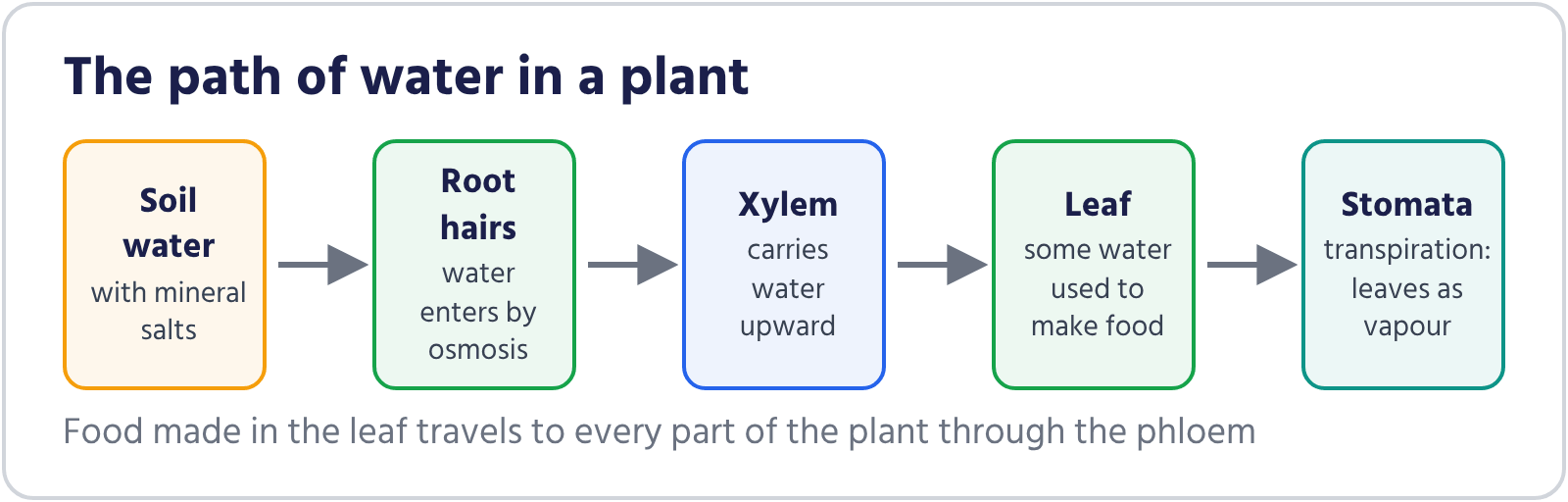
The loss of water as vapour from a plant, mostly through the stomata of the leaves, is transpiration. Its pull draws water up from the roots through the xylem and keeps the leaves cool. In osmosis the root hairs take water in from the soil; respiration breaks down food to release energy.
Key Points
- Transpiration happens mostly through the stomata
- Transpiration pulls water up the plant
- It is greatest on hot, dry, windy days
Confusion Points
- Osmosis = water coming in (at the root), transpiration = water going out (at the leaf)
Additional Information
Which plant hormone ripens unripe fruit?
Explanation
Ethylene is a gaseous plant hormone that ripens fruit. Unripe fruit kept beside a ripe banana ripens faster, because the ripe fruit gives off ethylene. Auxin promotes shoot growth, gibberellin lengthens the stem, cytokinin drives cell division.
Key Points
- Ethylene: the only gaseous plant hormone
- Ripe fruit itself gives off ethylene
- Ripening fruit with calcium carbide is illegal and harmful
Additional Information
| Hormone | Main role |
|---|---|
| Auxin | Growth at the shoot tip, bending towards light |
| Gibberellin | Stem elongation, seed germination |
| Cytokinin | Cell division |
| Ethylene | Ripening of fruit (the only gaseous hormone) |
| Abscisic acid | Closing stomata, seed dormancy |
Which plant tissue carries water and minerals from the roots to the leaves?
Explanation
Xylem carries water and dissolved minerals up from the roots to the stem and leaves, and this flow runs one way (upward). Phloem carries the food made in the leaves to every part of the plant. Cambium makes new cells and thickens the stem; the epidermis is the outer covering.
Key Points
- Xylem: water and minerals, upward
- Phloem: food, both up and down
- Wood is mostly old xylem
Confusion Points
- Xylem and phloem are often swapped: water in the xylem, food in the phloem
Memory Tips
- Phloem carries food (f for food)
Additional Information
Which of these is an insectivorous plant?
Explanation
The pitcher plant (Nepenthes) traps insects in its pitcher-shaped leaves and digests them to make up for a lack of nitrogen; so it is insectivorous. Dodder is a parasite that draws food from another plant. The money plant is a climber, the water lily an aquatic plant.
Key Points
- Insectivorous plants usually grow in soil poor in nitrogen
- Pitcher plant, sundew (Drosera), Venus flytrap are insectivorous
- Insectivorous plants are still green and photosynthesise
Confusion Points
- Dodder is a parasite, not insectivorous: both take food from others, so they get mixed up
Which gas is lighter than air yet does not burn, so it is safe for filling balloons and airships?
Explanation
Helium is much lighter than air and inert: it does not catch fire, so it is safe in balloons and airships. Hydrogen is the lightest gas but highly flammable. Nitrogen is about as heavy as air and carbon dioxide is heavier than air.
Key Points
- Helium: an inert (noble) gas that does not burn
- Hydrogen is the lightest gas but flammable
- Carbon dioxide is heavier than air, which helps it smother fires
Confusion Points
- The lightest gas is hydrogen, but the safe balloon gas is helium: watch for 'does not burn' in the question
0/20
📊 Topic Analysis
About this quiz
More for Clerkship 2024

Subject-Verb Agreement Practice Quiz (Round 2): WBPSC Clerkship 2024 English

Indian National Congress, Partition of Bengal and Swadeshi Movement Quiz: Clerkship 2024

India Geography Mixed Quiz 6: States, Borders, Plateaus, Rivers, Coasts and Forests (Clerkship 2024)

Leave a Comment
Commenting as ·