
10 TET-style questions on heredity and environment: laws, psychologists and classroom situations, each with an explanation.
Heredity and Environment Quiz: WB TET Child Development and Pedagogy
Quiz challenge
A little practice. A step forward.
10 questions
Learn with explanations
Time per question: 45 sec
0 / 10 completed
--:--
'Development is not the sum but the product of heredity and environment': which psychologist is linked with this idea?
Explanation
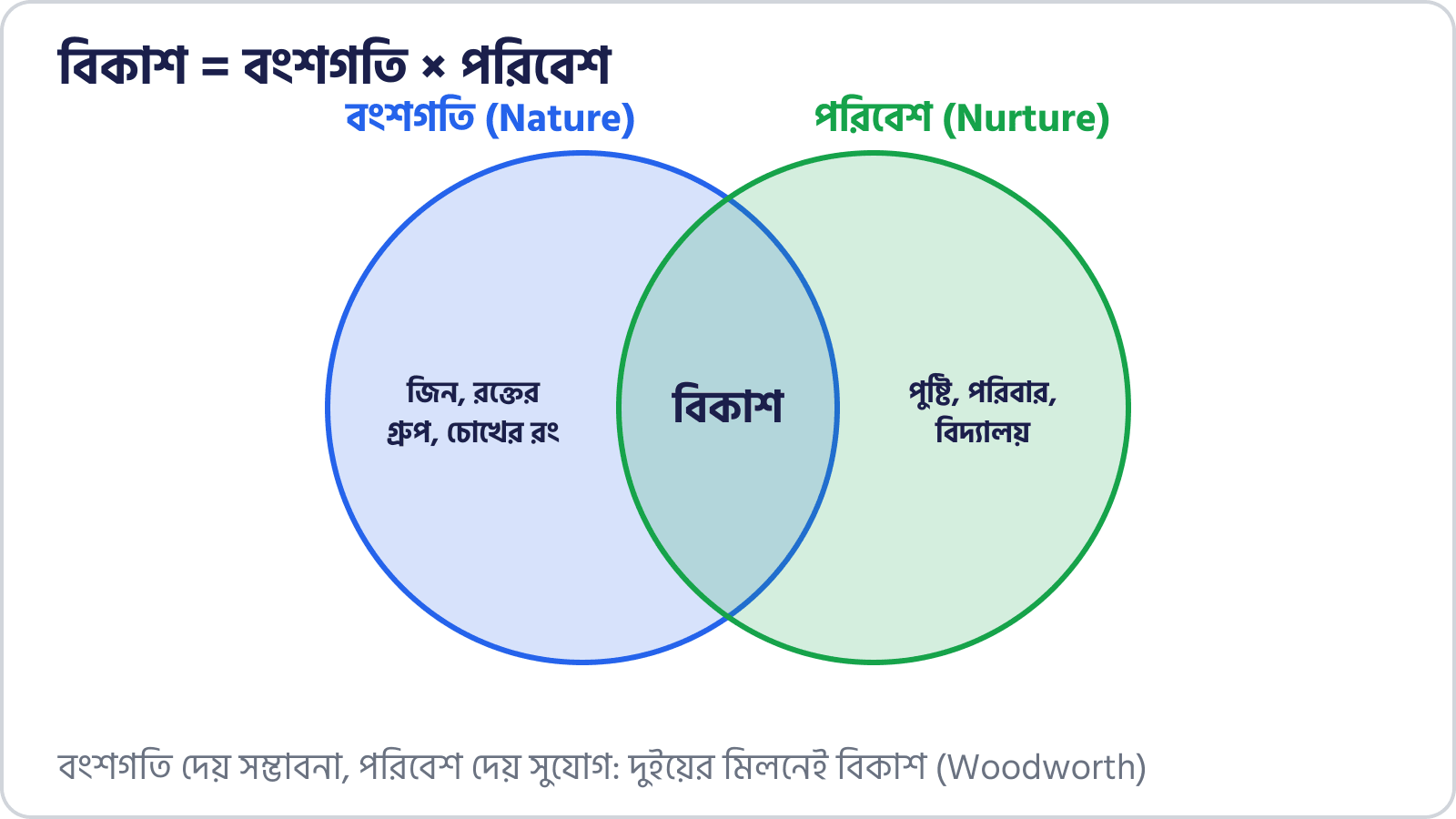
Woodworth called development the product of heredity and environment: if either is zero, development is zero. Galton favoured heredity and Watson favoured environment, each treating one as the main force. Piaget worked on the stages of cognitive development.
Key Points
- Woodworth: development = heredity × environment
- If one factor is zero, the product is zero
- The modern view: interaction
Memory Tips
- Woodworth = 'Work both': both factors work
Additional Information
How many pairs of chromosomes are there in a human body cell?
Explanation
A human body cell has 23 pairs, that is 46 chromosomes in all. 46 is the number of chromosomes, not of pairs; 22 pairs are only the autosomes, and one pair of sex chromosomes is added to them.
Key Points
- 22 pairs of autosomes + 1 pair of sex chromosomes
- Female XX, male XY
- The father's sperm decides the child's sex
Confusion Points
- 46 = total chromosomes, 23 = pairs; 22 pairs = autosomes only
Which of these traits is determined mainly by heredity?
Explanation
The blood group is fixed by genes and does not change with surroundings. A child learns the mother tongue, food habits and religious beliefs from the family and society, so they come from the environment.
Key Points
- Heredity: blood group, eye colour, hair type
- Environment: language, habits, values
Additional Information
| Trait | Mainly from |
|---|---|
| Blood group | Heredity |
| Eye colour | Heredity |
| Mother tongue | Environment |
| Food habits | Environment |
| Height | Both: the potential in genes, its fulfilment through nutrition |
A teacher says, 'His parents never studied, so he will never learn mathematics.' From the view of child development, which is correct about this remark?
Explanation
Development is not fixed by heredity alone; a rich school environment can take a child much closer to their potential. Besides, parents not having studied is a matter of the home environment, not heredity. The last option is extreme too, since heredity does have an effect.
Key Points
- Labelling a child by family background is wrong
- The classroom environment is in the teacher's hands
- 'Only heredity' or 'only environment' answers are usually wrong
Two identical twins were brought up in two different families after birth. Later their reading skills differed a good deal. What does this difference mainly show?
Explanation
Identical (monozygotic) twins have exactly the same genes, so a difference between them comes not from genes but from the environment they grew up in. Regression and resemblance are laws of heredity and do not apply here.
Key Points
- Identical twins: one zygote, the same genes
- Fraternal twins: two eggs, like ordinary siblings
- A difference in different surroundings = the effect of environment
Confusion Points
- Identical = monozygotic; fraternal = dizygotic
Children of very tall parents are often shorter than them, close to the average. Which law of heredity explains this?
Explanation
The law of regression says that children of parents with very high or very low traits move towards the average; the idea is Francis Galton's. Under the law of resemblance the child would be as tall as the parents. Variation is about siblings being different, and maturation is not a law of heredity.
Key Points
- Resemblance: the child is like the parents
- Variation: siblings differ
- Regression: from the extreme towards the average (Galton)
Memory Tips
- 'Like, unlike, back to average' = resemblance, variation, regression
Additional Information
| Law | What it says |
|---|---|
| Resemblance | The child is like the parents |
| Variation | Children of the same parents differ |
| Regression | Children of parents with extreme traits move towards the average |
Two siblings from the same family are in a class: one draws very well, the other is good at mathematics. Which is the teacher's most suitable decision?
Explanation
Children of the same parents differ (the law of variation), and each also has their own environment and experiences; this is individual difference. So the teacher gives each child opportunities that suit their interests. Expecting the same result, labelling, or giving up all go against child-centred education.
Key Points
- The law of variation: children of one family differ too
- Individual differences come from both heredity and environment
- The teacher's task: suitable opportunities for each child
Both parents of a child are tall, but long malnutrition in early childhood left the child short. Which conclusion from this is the most correct?
Explanation
The potential to be tall was in the child's genes, but lack of nutrition (environment) kept it from being fulfilled: the two factors work together. Regression is a move towards the average for genetic reasons, not a result of malnutrition. Both options beginning with 'alone' are extreme.
Key Points
- Heredity = potential and its limit
- Environment = the chance to fulfil it
- Mid-day meals and health are part of a child's development
Confusion Points
- Short because of malnutrition = environment; moving towards the average = regression (heredity)
Additional Information
'Give me a dozen healthy infants and my own chosen environment, and I will make any of them into any kind of specialist.' Which view does this statement support?
Explanation
The statement is the behaviourist J. B. Watson's; he believed environment and training shape a person, so he was the strongest supporter of environment. Galton and Mendel stand on the side of heredity, and Woodworth spoke of the product of both.
Key Points
- Watson: behaviourist, the strongest supporter of environment
- Galton: Hereditary Genius (1869), a supporter of heredity
- Mendel: the father of genetics
Memory Tips
- Galton = Gene, Watson = World
Assertion (A): A teacher cannot change a child's heredity, yet can play a big part in the child's development. Reason (R): Environment affects development, and the school environment is largely in the teacher's hands. Which is correct?
Explanation
Heredity is fixed at conception, so a teacher cannot change it: A is true. R is true as well, and it is exactly why the teacher can play a part in development: they enrich the classroom environment. So R explains A.
Key Points
- Heredity: fixed at conception
- In the teacher's hands: the classroom environment, methods, encouragement
- Assertion-reason: check A and R separately, then read them joined by 'because'
Memory Tips
- Read A 'because' R: if the sentence makes sense, R is the correct explanation
0/10


Leave a Comment
Commenting as ·