
12 questions on prepositions of movement, by and till, unwanted prepositions, verb+ing after to and new fixed pairs. No timer; every answer is explained.
Prepositions Practice Quiz (Round 2): WBPSC Clerkship 2024 English
Practice session
A little practice. A step forward.
12 questions
Learn with explanations
At your own pace
0 / 12 completed
00:00
The boy jumped ___ the pond to save the puppy.
Explanation
Jumping from outside into the water is movement, so into is right. In shows only position (The fish are in the pond), not entering. On and at do not express going into the water.
Key Points
- into, onto: movement, where something goes
- in, on: position, where something is
Confusion Points
- "Jumped in the pond" sounds familiar, but for movement into something the exam answer is into
Memory Tips
- After jump, fall, run or go, use into for entering
Additional Information
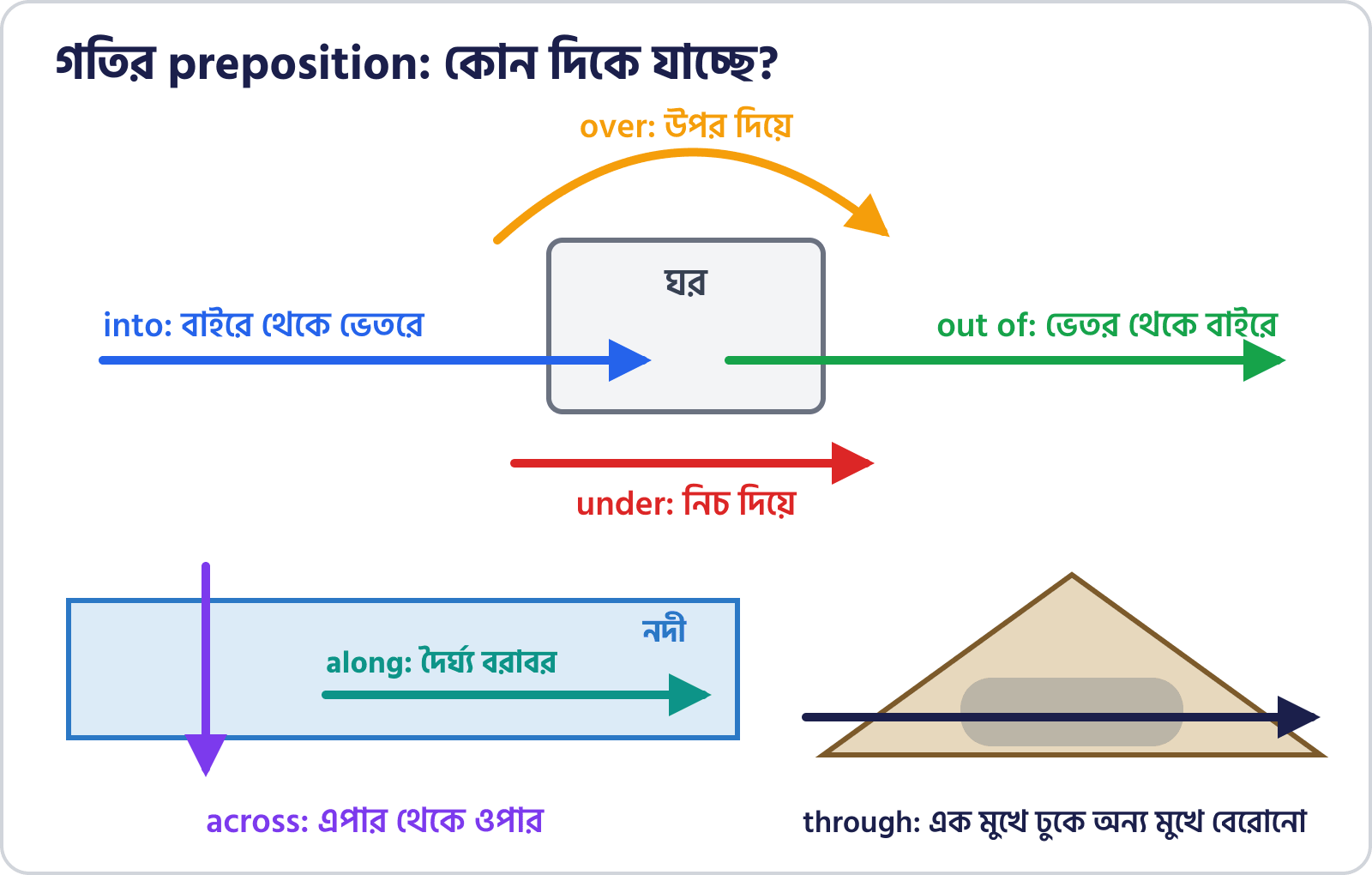
The train passed ___ a long tunnel.
Explanation
Entering a tunnel at one end and coming out at the other is through. Across means from one side of a surface to the other (across the road), along means following the length, above means higher than; none of them is going inside the tunnel.
Key Points
- through: from one end to the other, inside something
- through the tunnel, through the forest, through the crowd
Memory Tips
- Tunnel, forest, crowd, window: going inside it is through
Additional Information
The children swam ___ the river to reach the other bank.
Explanation
Going from one bank to the other is across: swam across the river. Along would mean swimming up or down the length of the river, not reaching the other side. Through is for going inside something enclosed, and between is for a position in the middle of two things.
Key Points
- across: from one side to the other
- along: following the length
Confusion Points
- across the river = to the other bank; along the river = following its length
Memory Tips
- Across contains "cross": it means crossing
Additional Information
___ English, she can also speak French and Hindi.
Explanation
The meaning is "in addition to English", so Besides. Beside means next to (Sit beside me). Except means leaving out, but the sentence says also, so she does speak English; Without makes no sense here.
Key Points
- besides = in addition to
- beside = next to
- except = leaving out
Confusion Points
- beside and besides look almost the same but mean different things
Memory Tips
- Besides has an extra s and means "extra" (in addition)
Candidates must submit the form ___ 5 p.m. on Friday.
Explanation
Submitting is done once and 5 p.m. is the deadline, so by: not later than that time. Till or until goes with an action that continues (wait till 5 p.m.). Since points from a past time to now and does not fit with must.
Key Points
- by: a deadline, at or before that time
- till / until: continuously up to that time
Confusion Points
- till and by can both feel like "up to"; a one-time action takes by, a continuing one takes till
Memory Tips
- A deadline means by
Additional Information
| Preposition | Meaning | Example |
|---|---|---|
| by | not later than (a deadline) | Submit the form by Friday. |
| till / until | continuously up to that time | I will wait till six o'clock. |
| within | inside a period of time | Finish the work within a week. |
| in | after that much time from now | The train will leave in ten minutes. |
Four prepositions of time limits
I will wait for you ___ six o'clock.
Explanation
Waiting goes on continuously up to six, so till. By goes with a one-time action and a deadline (reach by six). Since does not fit a future sentence, and within goes before a length of time (within an hour), not a clock time.
Key Points
- Use till with continuing actions such as wait, stay, work
- within + a length of time: within a week
Additional Information
| Preposition | Meaning | Example |
|---|---|---|
| by | not later than (a deadline) | Submit the form by Friday. |
| till / until | continuously up to that time | I will wait till six o'clock. |
| within | inside a period of time | Finish the work within a week. |
| in | after that much time from now | The train will leave in ten minutes. |
Four prepositions of time limits
Choose the correct sentence.
Explanation
Discuss takes its object directly; no about, on or over after it: We discussed the plan. Adding about is the most common mistake. The noun does take about: a discussion about the plan.
Key Points
- discuss, reach, enter, resemble, marry, attack: no preposition after the verb
- the noun takes one: a discussion about, an attack on
Confusion Points
- discussed about is wrong, but a discussion about is right
Memory Tips
- Discuss already means "talk about", so no second about
Additional Information
| Wrong | Right |
|---|---|
| We discussed about the plan. | We discussed the plan. |
| He reached to the station. | He reached the station. |
| She entered into the room. | She entered the room. |
| He resembles to his father. | He resembles his father. |
| She married with a teacher. | She married a teacher. |
I am looking forward to ___ you next week.
Explanation
The to in look forward to is a preposition, not the to of the infinitive; a preposition is followed by a noun or a verb+ing, so meeting. Test: "I look forward to the holidays" works, so this to is a preposition. Meet, met or have met break the grammar.
Key Points
- look forward to, be used to, object to, with a view to: then verb+ing
- Test by putting a noun after to
Confusion Points
- I used to work (a past habit) is different from I am used to working (accustomed)
Memory Tips
- If a noun fits after to, a verb goes there in its ing form
Additional Information
- I look forward to meeting you.
- She is used to working at night.
- He objected to waiting outside.
- He joined the course with a view to getting a job.
Rahul is senior ___ me by two years.
Explanation
Senior, junior, superior, inferior and prior compare, but they take to, not than: senior to me. Than goes with -er comparatives such as older or taller (older than me). From and over are not used here.
Key Points
- -ior words take to
- -er comparatives take than: older than me
Confusion Points
- The meaning is a comparison, so than is tempting, but senior than is wrong
Memory Tips
- -ior means to
Additional Information
| Word | Right | Wrong |
|---|---|---|
| senior / junior | senior to me | senior than me |
| superior / inferior | superior to others | superior than others |
| prior | prior to the exam | prior than the exam |
| prefer (first lesson) | prefer tea to coffee | prefer tea than coffee |
Every employee must comply ___ the rules of the office.
Explanation
Comply takes with: comply with the rules. Abide by also means to follow rules, which makes by tempting, but comply by is wrong. To and for do not go with comply.
Key Points
- comply with = obey
- abide by = obey
Confusion Points
- comply and abide mean the same, but take different prepositions: with and by
Memory Tips
- comply with, abide by
You should refrain ___ smoking in public places.
Explanation
Refrain means to hold yourself back, and it takes from: refrain from smoking. After from a verb takes its ing form. Of, to and off do not go with refrain.
Key Points
- refrain from + verb+ing
- prevent from and abstain from work the same way
Memory Tips
- Holding back means staying away from something: from
The selection committee consists ___ seven members.
Explanation
To say what something is made up of, use consist of: consists of seven members. Consist in also exists, but it means "to lie in" (Happiness consists in contentment), not to be made of members. With and from do not go with consist.
Key Points
- consist of = be made up of
- consist in = lie in
- comprise takes nothing: comprises seven members
Confusion Points
- consist in sounds right, but for parts and members it is consist of
0/12


Leave a Comment
Commenting as ·