
WB Primary TET Mathematics practice: carrying, subtracting across zero, missing digits, and diagnosing children’s errors. 10 questions, each explained.
Addition and Subtraction Quiz: Carrying, Regrouping and Children’s Errors, WB TET Maths
Practice session
A little practice. A step forward.
10 questions
Learn with explanations
At your own pace
0 / 10 completed
00:00
3,685 + 2,847 = ?
Explanation
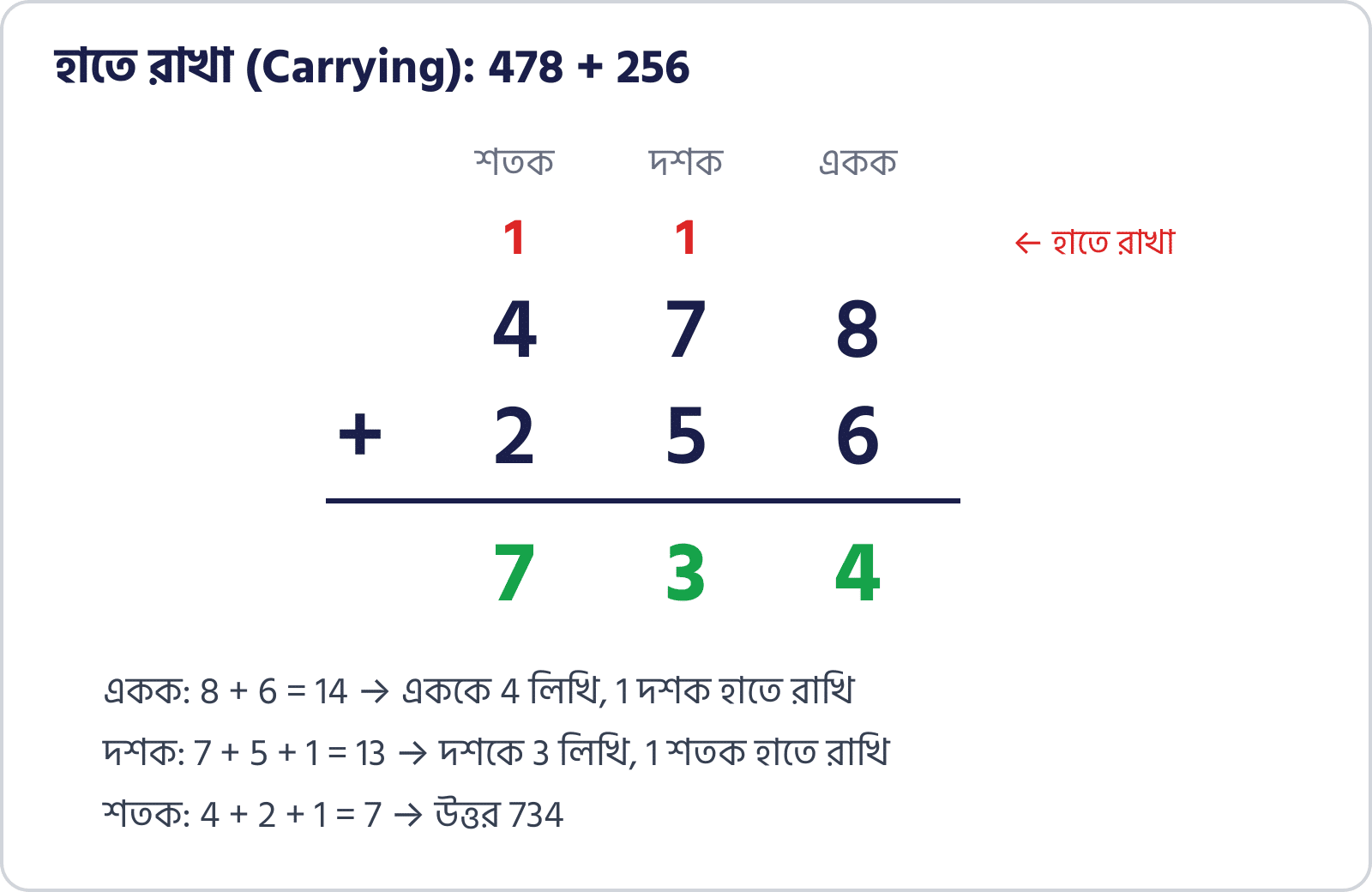
Ones: 5 + 7 = 12, write 2, carry 1. Tens: 8 + 4 + 1 = 13, write 3, carry 1. Hundreds: 6 + 8 + 1 = 15, write 5, carry 1. Thousands: 3 + 2 + 1 = 6, so 6,532. 6,522 comes from forgetting the carry into the tens, 5,532 from forgetting the carry into the thousands.
Key Points
- Three carries are needed here
- Start from the ones and add each carry to the next column
Memory Tips
- Check the last digit: 5 + 7 = 12, so the answer must end in 2
7,000 − 2,436 = ?
Explanation
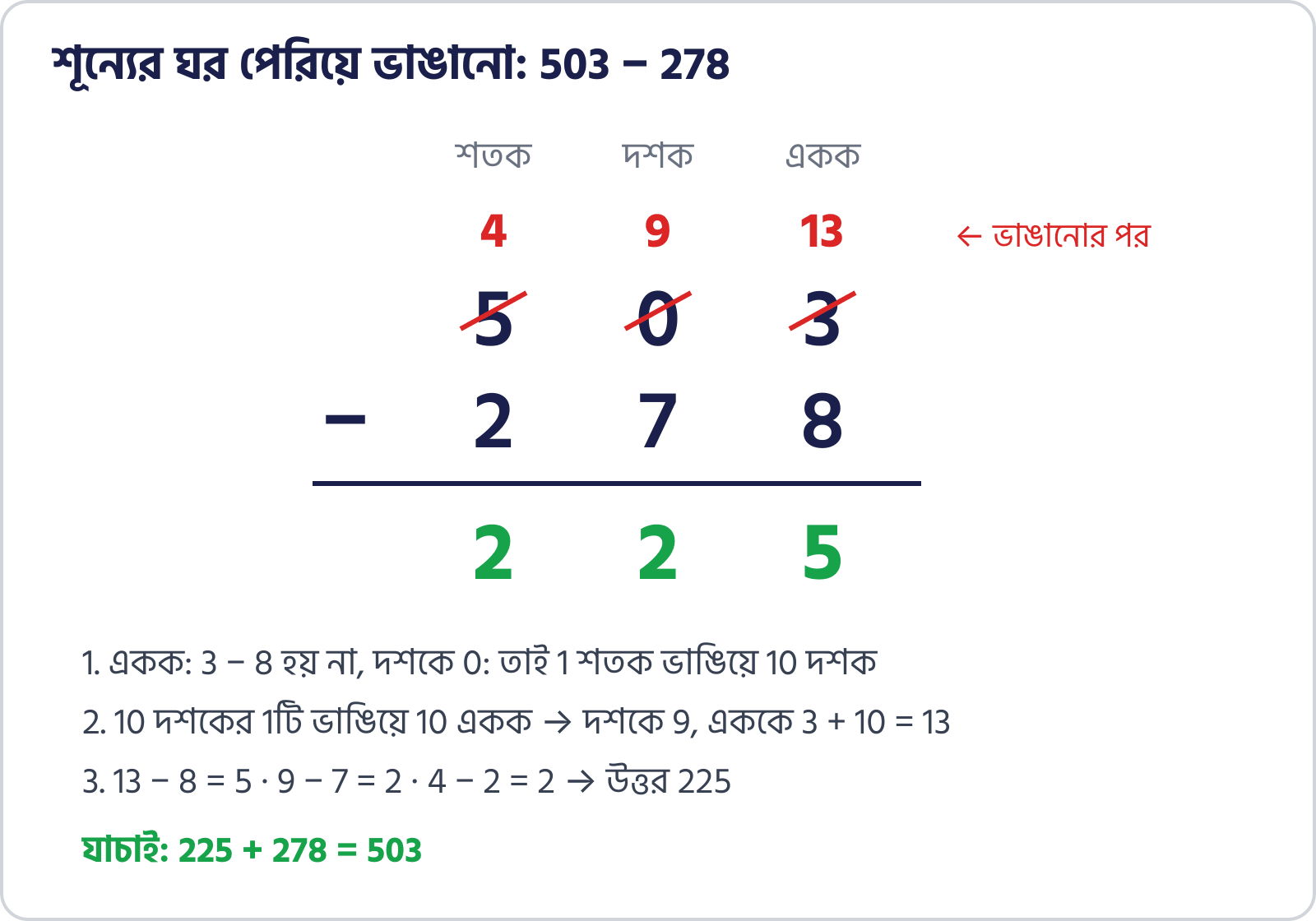
7,000 = 6 thousands + 9 hundreds + 9 tens + 10 ones. 10 − 6 = 4, 9 − 3 = 6, 9 − 4 = 5, 6 − 2 = 4, so 4,564. Check: 4,564 + 2,436 = 7,000. 5,436 is the answer of a child who cannot subtract from 0 and simply writes the lower digit.
Key Points
- Regrouping across zeros turns each 0 into 9
- Difference + subtrahend = minuend: the check
Confusion Points
- Writing 6 − 0 = 6 because 0 − 6 is not possible is wrong: the order in subtraction cannot be swapped
Memory Tips
- 7,000 − 2,436 = 6,999 − 2,436 + 1: subtracting from 9 never needs regrouping
Additional Information
A Class 3 child writes 52 − 27 = 35. What is the most likely cause of the error?
Explanation
Unable to do 2 − 7 in the ones, the child did 7 − 2 = 5, and in the tens 5 − 2 = 3, giving 35. The right answer is 25: break a ten, 12 − 7 = 5, 4 − 2 = 2. Confusing the signs would give 79, and carrying belongs to addition. An error that repeats is not carelessness but a misconception.
Key Points
- This is the best-known subtraction misconception ('smaller from larger')
- The right answer is 25
Confusion Points
- Not carelessness: the child follows a wrong rule of its own and will repeat it
Additional Information
| Column | What the child did | What should be done |
|---|---|---|
| Ones | 7 − 2 = 5 | Break a ten: 12 − 7 = 5 |
| Tens | 5 − 2 = 3 | 4 − 2 = 2 |
| Answer | 35 | 25 |
To correct the error of a child who wrote 52 − 27 = 35, which first step by the teacher is most suitable?
Explanation
A misconception is corrected by starting with concrete material: opening a bundle, the child sees with their own hands that 5 tens 2 ones = 4 tens 12 ones. Repeating the same sums only fixes the wrong rule, and a memorised rule gives no reason. Deducting marks is a punishment, not a remedy.
Key Points
- Concrete → pictorial → symbolic: Bruner's sequence
- In remedial teaching, understanding first, practice after
If 5□3 − 27□ = 268, which digits go in the two boxes (from the left)?
Explanation
In the ones, 3 − □ cannot give 8, so a ten was broken: 13 − □ = 8, the second box is 5. The tens lost 1; (□ − 1) − 7 = 6 would need □ = 14, impossible, so a hundred was broken here too: (□ − 1) + 10 − 7 = 6, the first box is 4. Hundreds: 5 − 1 − 2 = 2. Check: 543 − 275 = 268.
Key Points
- When a digit of the answer is larger than the top digit, that column was regrouped
- Regrouping lowers the column on the left by 1
Memory Tips
- Check by adding back: 268 + 275 = 543
A child writes 47 + 38 = 715. Which idea has the child not formed?
Explanation
In the ones 7 + 8 = 15; the child wrote the whole 15 and put 4 + 3 = 7 in the tens, giving 715. The child has not understood that 15 ones = 1 ten 5 ones; the right answer is 85. It has nothing to do with the commutative rule or multiplication (47 × 38 = 1,786). Two two-digit numbers add to less than 200, so a quick estimate shows 715 is impossible.
Key Points
- The right answer is 85
- A place-value error: carrying is not understood
Memory Tips
- Estimate first: about 50 + 40 = 90
Additional Information
While teaching carrying, a teacher used bundles of sticks first, then pictures of bundles, and finally numerals only. This sequence follows the stages proposed by which psychologist?
Explanation
Jerome Bruner held that children represent knowledge in three ways: by action (enactive), by images (iconic) and by language and symbols (symbolic). Sticks → pictures → numerals is exactly this order. Kohlberg's stages are of moral development, Freud's ideas are about personality, and Pavlov's theory is classical conditioning.
Key Points
- In mathematics teaching this is the concrete-pictorial-abstract (CPA) approach
- Do not hurry from materials to symbols
Memory Tips
- E-I-S: hands, eyes, symbols
Using the easiest mental method, what is 297 + 156?
Explanation
Taking 297 as 300 adds 3 too many: 300 + 156 = 456, then remove 3, 456 − 3 = 453. This is compensation. In columns too: ones 7 + 6 = 13, tens 9 + 5 + 1 = 15, hundreds 2 + 1 + 1 = 4: 453. 443 and 463 come from slipping by 10 in the adjustment.
Key Points
- Round to the nearest ten or hundred, then take away the extra
- Mental arithmetic builds number sense
While teaching subtraction, many teachers say 'break a ten into 10 ones' instead of 'borrow'. What is the main reason?
Explanation
Hearing 'borrow', a child expects to return it later, and some even add 1 to the next column. 'Breaking' or 'exchanging' shows that 1 ten and 10 ones are the same value in another form. The word is not incorrect and it does not speed anything up; the reason is conceptual.
Key Points
- 'Regrouping' conveys the right idea
- A teacher's words can themselves cause a misconception
After a subtraction test, a teacher sorted each child's errors by type to see exactly where each one gets stuck, then gave remedial lessons in separate groups. What kind of assessment was the teacher's first step?
Explanation
Finding a learner's specific weaknesses and their causes is diagnostic assessment; remedial teaching is the step after it. Summative assessment measures overall achievement at the end of a unit or year, placement assessment decides at the start which level a learner is at, and an aptitude test measures future potential.
Key Points
- Diagnostic → remedial: a pair the TET asks about again and again
- Error analysis is the main tool of diagnostic assessment
Confusion Points
- Do not confuse diagnostic (why the errors happen) with formative (ongoing assessment during learning): here the main task is finding the cause of errors
0/10


Leave a Comment
Commenting as ·