
10 TET-style questions on the Harappan and Vedic civilisation notes: half facts, half classroom situations, each with an explanation.
Harappan and Vedic Civilisation Quiz: WB TET Social Studies and Pedagogy
Quiz challenge
A little practice. A step forward.
10 questions
Learn with explanations
Time per question: 45 sec
0 / 10 completed
--:--
Who discovered the Harappa site in 1921?
Explanation
Daya Ram Sahni excavated Harappa in 1921. Rakhal Das Banerjee found Mohenjo-daro the next year (1922). John Marshall was then Director General of the ASI and oversaw the work, but he was not the discoverer.
Key Points
- Harappa: Daya Ram Sahni, 1921, on the Ravi
- Mohenjo-daro: R. D. Banerjee, 1922, on the Indus
- John Marshall: Director General of the ASI
Confusion Points
- The usual trap is swapping the discoverers of Harappa and Mohenjo-daro
Memory Tips
- Alphabetical and chronological: D (Daya Ram, 1921) before R (Rakhal Das, 1922)
At which Harappan site was a dockyard found?
Explanation
A large burnt-brick dockyard was found at Lothal in Gujarat, evidence of sea trade. Kalibangan is known for a ploughed field, Mohenjo-daro for the Great Bath and Harappa for its granary.
Key Points
- Lothal: Gujarat, dockyard
- Kalibangan: Rajasthan, ploughed field
- Mohenjo-daro: Great Bath
Memory Tips
- Lothal sits near the sea coast of Gujarat: a port needs a dock
Additional Information

| Site | Where | What was found |
|---|---|---|
| Harappa | On the Ravi, Punjab (Pakistan) | Granary; the first site found (1921) |
| Mohenjo-daro | On the Indus, Sindh (Pakistan) | Great Bath; bronze dancing girl |
| Lothal | Gujarat | Dockyard |
| Kalibangan | Rajasthan | Traces of a ploughed field |
| Dholavira | Kutch, Gujarat | Water reservoirs |
A teacher teaching the Harappan Civilisation relies mainly on archaeological evidence (seals, pottery, buildings). What is the main reason?
Explanation
The Harappans did write: their pictographic script is on the seals, but no one has deciphered it. So written sources cannot be used and objects are the main evidence. The Vedas are from a later age and do not describe Harappa.
Key Points
- Harappan script: pictographic, undeciphered
- Main source for Harappa: archaeological
- Main source for the Vedic age: literary (the Vedas)
Confusion Points
- 'Had no script' and 'script not deciphered' are different: the second is right
In which Veda is the Gayatri Mantra found?
Explanation
The Gayatri Mantra is part of the Rigveda, the oldest of the four Vedas, made of hymns to the gods. The Samaveda has chants set to music, the Yajurveda the rules of sacrifice and the Atharvaveda spells for healing and daily life.
Key Points
- Rigveda: the oldest, 10 mandalas
- Samaveda: chants; Yajurveda: sacrifice; Atharvaveda: healing and magic
Memory Tips
- Order R-S-Y-A: Rig, Sama, Yajur, Atharva
Additional Information
| Veda | Main content |
|---|---|
| Rigveda | Hymns to the gods; the oldest |
| Samaveda | Chants set to music |
| Yajurveda | Rules of sacrifice |
| Atharvaveda | Healing, magic, daily life |
Which method is most effective for helping Class VI pupils understand Harappan town planning (straight streets, covered drains)?
Explanation
Looking at a plan and comparing it with their own surroundings moves children from the known to the unknown and makes an abstract idea concrete. Reading aloud, rote memorising and copying notes are teacher-centred and do not build the child's own understanding.
Key Points
- The maxim 'from known to unknown'
- Visual TLM makes history concrete
- NCF 2005: link learning to the child's life
A Class VII pupil asks, 'If no one can read the Harappan script, how do we know what they ate?' What is the teacher's most suitable response?
Explanation
Letting the child reach a conclusion from evidence is inquiry-based learning, which builds historical reasoning. The Vedas belong to a later age and are not a source for Harappan food. 'Just remember it' or dodging the question kills curiosity.
Key Points
- History = conclusions from evidence
- A child's question is a chance to learn, not to avoid
- Harappans grew wheat, barley and cotton
What is the main purpose of using a timeline in a history class?
Explanation
A timeline shows which event came first and which later, for example the Rig Vedic age after the decline of the Harappan cities. This builds the child's sense of chronology. A map builds a sense of place, not of time.
Key Points
- Timeline: sense of time
- Map: sense of place
- Harappa (c. 2500 BCE) → Rig Vedic (c. 1500 BCE)
Confusion Points
- Timelines and maps are both visual aids, but one is about time, the other about place
Additional Information
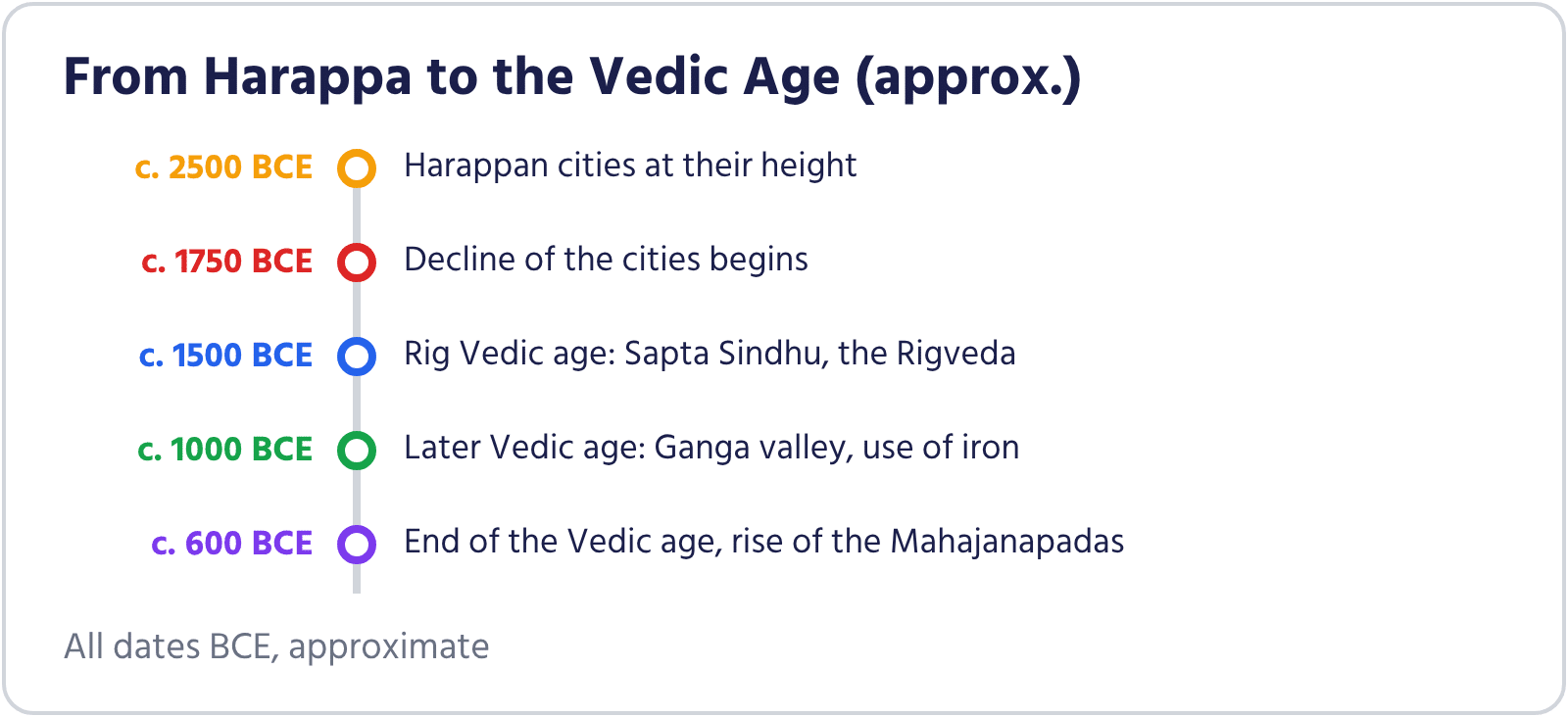
Which of these is NOT a feature of the Rig Vedic age?
Explanation
Iron came into use in the later Vedic age (after about 1000 BCE), which let people clear the forests of the Ganga valley and spread farming. The Sabha and Samiti, cattle as wealth and Indra's importance all belong to the Rig Vedic age.
Key Points
- Rig Vedic: cattle-rearing, copper, Sapta Sindhu
- Later Vedic: farming, iron, Ganga valley
Confusion Points
- In a 'NOT' question, a feature of another age hides among three true ones
Memory Tips
- Rig first, iron later
Additional Information
| Topic | Rig Vedic age | Later Vedic age |
|---|---|---|
| Region | Sapta Sindhu (Punjab) | Ganga-Yamuna valley |
| Metal | Copper, bronze | Iron (krishna ayas) |
| Economy | Mainly cattle-rearing; cows were wealth | Mainly farming |
| Varna | Flexible | Rigid, by birth |
Assertion (A): Pupils understand the chapter better when they make Harappan seals out of clay in class. Reason (R): Learning by doing makes the distant past concrete for children.
Explanation
In hands-on work the child makes something, so the seal's shape, picture and use become her own experience. R gives exactly the reason A is true, so R explains A. This matches Dewey's 'learning by doing' and the project method.
Key Points
- Learning by doing: John Dewey
- Project method and activity-based learning
- Experience makes the abstract concrete
A teacher shows three things: a hymn of the Rigveda, a picture of a seal from Mohenjo-daro, and a paragraph on this chapter from a modern textbook. Which of them is a secondary source?
Explanation
A primary source comes from the time itself: the Rigveda hymn (literary) and the seal (archaeological). A modern textbook is an interpretation written later from those sources, so it is secondary. Teaching this difference is the first step of source-based teaching.
Key Points
- Primary source: objects or writings of that time
- Secondary source: later interpretation, e.g. a textbook
- Harappa: archaeological; Vedic: literary
Confusion Points
- The photo is modern, but the seal is from that time: as a source it is primary
0/10


Leave a Comment
Commenting as ·