
WBPSC Clerkship 2024 Part-I: 20 mixed questions on Indian history, with explanations.
Indian History Mixed Quiz 7: Kalibangan to the Chittagong Armoury, WBPSC Clerkship GK
Quiz challenge
A little practice. A step forward.
20 questions
Learn with explanations
Time per question: 30 sec
0 / 20 completed
--:--
At which Harappan site was evidence of a ploughed field found?
Explanation
At Kalibangan, on the Ghaggar in Rajasthan, the pre-Harappan level shows a field ploughed in two directions across each other. Fire altars were also found there. Lothal (Gujarat) is known for its dockyard, Mohenjo-daro for the Great Bath and Dholavira for its reservoirs and water system.
Key Points
- Kalibangan: Rajasthan, on the Ghaggar
- Kalibangan means 'black bangles'
- Fire altars were also found at Kalibangan
Memory Tips
- Kalibangan = black bangles + plough + fire altars; Lothal = dockyard
Additional Information
| Site | Where now | Known for |
|---|---|---|
| Kalibangan | Rajasthan | Ploughed field, fire altars |
| Lothal | Gujarat | Dockyard (port) |
| Mohenjo-daro | Sindh, Pakistan | Great Bath |
| Dholavira | Gujarat (Kutch) | Reservoirs and water system |

From which text is 'Satyameva Jayate', written below India's national emblem, taken?
Explanation
'Satyameva Jayate' (truth alone triumphs) is part of a mantra of the Mundaka Upanishad. The national emblem is taken from the lion capital of Ashoka's pillar at Sarnath, adopted on 26.01.1950, and the words are written under it in Devanagari. The Katha Upanishad has the story of Nachiketa and Yama; the Gayatri Mantra is from the Rigveda.
Key Points
- 'Satyameva Jayate': Mundaka Upanishad
- National emblem: lion capital of Ashoka's pillar at Sarnath
- National emblem adopted on 26.01.1950
Confusion Points
- 'Asato ma sadgamaya' is from the Brihadaranyaka Upanishad, not the Mundaka
Memory Tips
- Mundaka gives the motto: Satyameva Jayate
Where did Gautama Buddha attain mahaparinirvana (pass away)?
Explanation
At the age of 80, Gautama Buddha attained mahaparinirvana at Kushinagar (in today's Uttar Pradesh). The other three places are also tied to his life: born at Lumbini, enlightened at Bodh Gaya, first sermon at Sarnath. So all four options look familiar; match the event.
Key Points
- Kushinagar: Uttar Pradesh, the place of the Buddha's mahaparinirvana
- The Buddha passed away at the age of 80
- The four places are the chief Buddhist pilgrimages
Confusion Points
- Sarnath is the place of the first sermon, not of the mahaparinirvana
Memory Tips
- Order 'Lu-Bo-Sa-Ku': Lumbini (birth), Bodh Gaya (enlightenment), Sarnath (sermon), Kushinagar (death)
Additional Information
| Event | Place | Where now |
|---|---|---|
| Birth | Lumbini | Nepal |
| Enlightenment | Bodh Gaya | Bihar |
| First sermon | Sarnath | Uttar Pradesh |
| Mahaparinirvana | Kushinagar | Uttar Pradesh |

Where was the First Buddhist Council held?
Explanation
Soon after the Buddha's mahaparinirvana, the First Buddhist Council met at Rajagriha (today's Rajgir, Bihar) under the patronage of Ajatashatru, king of Magadha, presided over by Mahakassapa. The second council was at Vaishali (Kalashoka), the third at Pataliputra (Ashoka) and the fourth in Kashmir (Kanishka). The Buddha's teachings were compiled here into the Sutta and Vinaya Pitakas.
Key Points
- First council: Rajagriha, king Ajatashatru, president Mahakassapa
- Compiling of the Sutta and Vinaya Pitakas began at the first council
- Order of the four councils: Rajagriha, Vaishali, Pataliputra, Kashmir
Memory Tips
- 'Ra-Vai-Pa-Ka': Rajagriha, Vaishali, Pataliputra, Kashmir
Additional Information
| Council | Place | King | President |
|---|---|---|---|
| First | Rajagriha | Ajatashatru | Mahakassapa |
| Second | Vaishali | Kalashoka | Sabakami |
| Third | Pataliputra | Ashoka | Moggaliputta Tissa |
| Fourth | Kashmir | Kanishka | Vasumitra |
On the banks of which river did Alexander fight King Porus in 326 BCE?
Explanation
Alexander fought Porus on the Jhelum in 326 BCE; the Greeks called the river the Hydaspes, so it is known as the Battle of the Hydaspes. Porus lost, but Alexander gave his kingdom back to him. Later, on reaching the Beas, Alexander's soldiers refused to go further.
Key Points
- Battle of the Hydaspes: 326 BCE, on the Jhelum
- Greek names: Jhelum = Hydaspes, Beas = Hyphasis
- On the Beas, Alexander's soldiers refused to march on
Confusion Points
- The Beas (Hyphasis) is not where the battle was; it is where Alexander turned back
Additional Information
| River | Greek name |
|---|---|
| Jhelum | Hydaspes |
| Chenab | Acesines |
| Ravi | Hydraotes |
| Beas | Hyphasis |
What was the capital of Shashanka, king of Gauda?
Explanation
Shashanka, king of Gauda in the early seventh century, is called the first independent sovereign king of Bengal; his capital was Karnasuvarna, in today's Murshidabad district. He was a contemporary and rival of Harshavardhana of Thanesar. Tamralipta (Tamluk) was an ancient port and Pataliputra the capital of Magadha.
Key Points
- Shashanka: king of Gauda, early seventh century
- Capital Karnasuvarna: in today's Murshidabad district
- A contemporary and rival of Harshavardhana
Memory Tips
- Karnasuvarna = 'golden ear': Shashanka's golden capital
Who founded the Pala dynasty of Bengal?
Explanation
After Shashanka, Bengal went through a long anarchy called 'matsyanyaya' (the big fish eating the small). To end it, the leading men chose Gopala as king in the middle of the eighth century, as Dharmapala's Khalimpur copper plate records. Dharmapala was his son, who founded the Vikramashila Mahavihara.
Key Points
- Founder of the Pala dynasty: Gopala, mid-eighth century
- Matsyanyaya: the anarchy after Shashanka
- Gopala's election is recorded in the Khalimpur copper plate
Memory Tips
- Pala order: Go-Dha-De (Gopala, Dharmapala, Devapala)
Which Chola king built the Brihadeeswarar temple at Thanjavur?
Explanation
The Brihadeeswarar (Rajarajeshwaram) temple at Thanjavur was built by Rajaraja I Chola and completed in 1010 CE. It is one of the finest works of Dravidian architecture and part of UNESCO's 'Great Living Chola Temples'. His son Rajendra I built a new capital and temple at Gangaikonda Cholapuram.
Key Points
- Brihadeeswarar temple: Thanjavur, Tamil Nadu
- Built by Rajaraja I Chola, completed in 1010 CE
- UNESCO World Heritage: Great Living Chola Temples
Confusion Points
- Rajendra I built Gangaikonda Cholapuram, not the Thanjavur temple
Memory Tips
- Rajaraja → Rajarajeshwaram (Brihadeeswarar)
Who introduced the silver 'tanka' and the copper 'jital' in the Delhi Sultanate?
Explanation
Iltutmish introduced the Arabic-style silver tanka and copper jital in the Delhi Sultanate. He also organised the iqta system. Muhammad bin Tughlaq later tried a token currency of copper and brass that failed, and Sher Shah introduced the silver 'rupiya'.
Key Points
- Silver tanka and copper jital: Iltutmish
- Iltutmish also organised the iqta system
- Token currency: Muhammad bin Tughlaq
Confusion Points
- The tanka is Iltutmish's, the token currency Muhammad bin Tughlaq's, the rupiya Sher Shah's
Additional Information
| Coin | Introduced by |
|---|---|
| Silver tanka, copper jital | Iltutmish |
| Copper and brass token currency | Muhammad bin Tughlaq |
| Silver rupiya | Sher Shah |
Which Sultan founded the city of Agra in 1504 and moved his capital there?
Explanation
Sikandar Lodi founded the city of Agra in 1504 and moved his capital there. He introduced the 'Gaz-i-Sikandari' for measuring land. Bahlul Lodi founded the Lodi dynasty (1451), and Ibrahim Lodi was the last Sultan, defeated by Babur at Panipat in 1526.
Key Points
- Founding of Agra: Sikandar Lodi, 1504
- Gaz-i-Sikandari: Sikandar Lodi's unit of measurement
- Lodi dynasty: Bahlul (founder), Sikandar, Ibrahim (last)
Memory Tips
- Lodi order 'B-S-I': Bahlul, Sikandar, Ibrahim; the middle one built Agra
Where was Sri Chaitanya Mahaprabhu born?
Explanation
Sri Chaitanya was born in 1486 at Nabadwip in Nadia; his childhood name was Vishvambhar Mishra, called Nimai. He spread the Gaudiya Vaishnava bhakti movement through nama-sankirtan. He spent the last part of his life at Puri, which is why Puri looks familiar though it is wrong.
Key Points
- Chaitanya's birth: 1486, Nabadwip (Nadia)
- Real name Vishvambhar Mishra, called Nimai
- His last years were spent at Puri
Confusion Points
- Puri is where Chaitanya spent his last years, not his birthplace
Who built and repaired the 'Sadak-e-Azam' (later the Grand Trunk Road) from Sonargaon to Peshawar?
Explanation
Sher Shah (reigned 1540–1545) built and repaired the long road 'Sadak-e-Azam' from Sonargaon in Bengal to Peshawar; under the British it came to be called the Grand Trunk Road. He built sarais along it, and horsemen carried the post. The silver 'rupiya' is also his.
Key Points
- Sadak-e-Azam: Sonargaon to Peshawar, Sher Shah
- Called the Grand Trunk Road under the British
- Sher Shah built sarais along the road
Memory Tips
- Sher Shah's three S's: sadak (road), sarai, sikka (the rupiya)
Who wrote the 'Ain-i-Akbari'?
Explanation
The 'Ain-i-Akbari' was written by Akbar's courtier Abul Fazl as the third volume of his 'Akbarnama'; it describes Akbar's administration, revenue and empire. Faizi, a poet, was Abul Fazl's elder brother; Badauni wrote the 'Muntakhab-ut-Tawarikh' and Gulbadan Begum the 'Humayun-nama'.
Key Points
- Ain-i-Akbari: Abul Fazl, third volume of the Akbarnama
- Humayun-nama: Gulbadan Begum
- Muntakhab-ut-Tawarikh: Badauni
Confusion Points
- Faizi and Abul Fazl were brothers; the book is the younger brother Abul Fazl's
Additional Information
| Book | Author |
|---|---|
| Akbarnama and Ain-i-Akbari | Abul Fazl |
| Humayun-nama | Gulbadan Begum |
| Muntakhab-ut-Tawarikh | Badauni |
| Tuzuk-i-Baburi (Baburnama) | Babur |
Between whom was the Battle of Wandiwash (1760) fought?
Explanation
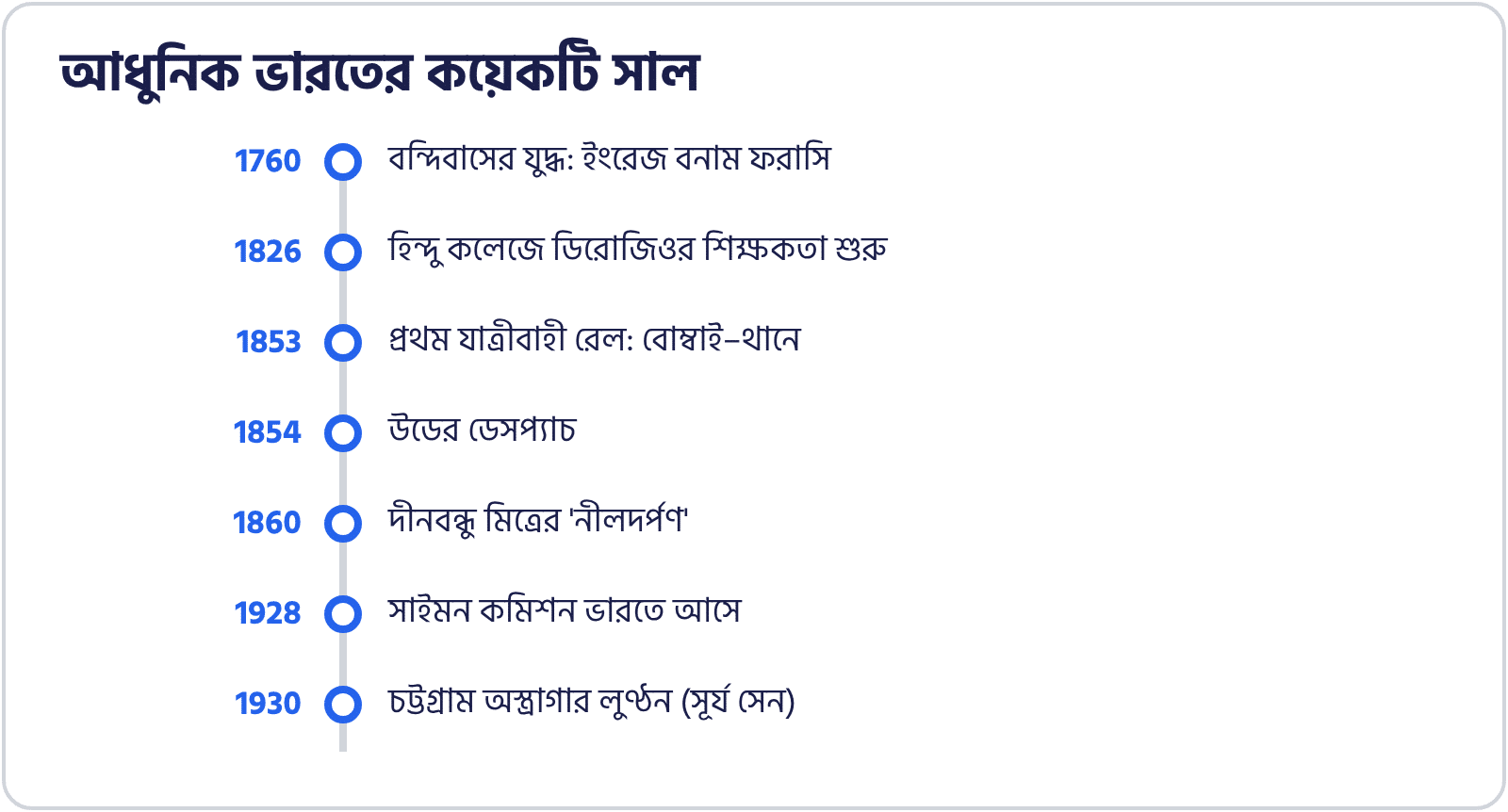
In the Third Carnatic War, the English under Eyre Coote defeated Count de Lally's French army at Wandiwash in 1760. After it, French hopes of power in India came to an end. The English fought the Dutch at Bedara in 1759.
Key Points
- Battle of Wandiwash: 1760, English vs French
- English commander Eyre Coote, French commander Lally
- The decisive battle of the Third Carnatic War
Confusion Points
- Bedara (1759) was English vs Dutch; Wandiwash (1760) English vs French
Additional Information
Between which two places did India's first passenger train run (16.04.1853)?
Explanation
Under Lord Dalhousie, India's first passenger train ran on 16.04.1853 over about 34 km from Bori Bunder in Bombay to Thane. The first train in eastern India ran from Howrah to Hooghly on 15.08.1854. So the Howrah–Hooghly option is a trap for Bengal's candidates.
Key Points
- First passenger train: 16.04.1853, Bori Bunder (Bombay) to Thane
- The Governor-General then was Lord Dalhousie
- First train in eastern India: Howrah–Hooghly, 15.08.1854
Confusion Points
- Howrah–Hooghly was eastern India's first train (1854), not India's first
Additional Information
Which is called the 'Magna Carta' of English education in India?
Explanation
The 1854 education despatch of Charles Wood, President of the Board of Control, laid down the whole structure of education from primary school to university, so it is called the 'Magna Carta' of English education. On its recommendation the universities of Calcutta, Bombay and Madras were set up in 1857. Macaulay's Minute (1835) argued for English-medium education, but the 'Magna Carta' title belongs to Wood's Despatch.
Key Points
- Wood's Despatch: 1854, Charles Wood
- On its advice, the universities of Calcutta, Bombay and Madras in 1857
- Macaulay's Minute: 1835, for English-medium education
Confusion Points
- Macaulay's Minute (1835) is known as the start of English education, but the 'Magna Carta' is Wood's Despatch
Additional Information
| Year | Education policy |
|---|---|
| 1835 | Macaulay's Minute |
| 1854 | Wood's Despatch |
| 1882 | Hunter Commission |
| 1917 | Sadler Commission (Calcutta University) |
Which teacher of Hindu College inspired the 'Young Bengal' group?
Explanation
Henry Louis Vivian Derozio (1809–1831), a young teacher of Hindu College, encouraged his students to reason and think freely; his followers became known as 'Young Bengal'. He was removed from the college in 1831 and died that same year at only 22. David Hare helped found Hindu College, while Duff and Carey were missionary educators.
Key Points
- Young Bengal movement: Derozio, Hindu College
- Derozio (1809–1831) died at the age of 22
- David Hare helped found Hindu College
Additional Information
Who wrote the play 'Nil Darpan' on the suffering of the indigo farmers?
Explanation
Dinabandhu Mitra's 'Nil Darpan' (1860) showed the oppression by indigo planters and the plight of the indigo farmers, at the time of the Indigo Revolt in Bengal (1859–60). Rev. James Long was tried and punished for publishing its English translation. Harish Chandra Mukherjee's paper 'Hindoo Patriot' wrote in support of the farmers.
Key Points
- Nil Darpan: Dinabandhu Mitra, 1860
- Indigo Revolt: 1859–60, Bengal
- Rev. James Long was punished for publishing the English translation
Memory Tips
- Dinabandhu, the 'friend of the poor', held up the mirror (darpan) to indigo
Additional Information
What was the main reason for the 'Simon Go Back' protests against the Simon Commission?
Explanation
A seven-member commission under John Simon was set up in 1927 to review India's government; all its members were British. When it arrived in 1928, the Congress and other parties boycotted it with black flags and the slogan 'Simon Go Back'. Lala Lajpat Rai, hurt by lathi blows at a protest in Lahore, died later.
Key Points
- Simon Commission: set up in 1927, came to India in 1928
- All seven members British, chaired by John Simon
- Lala Lajpat Rai, hurt at a protest in Lahore, died later
Memory Tips
- Simon Commission = the 'all-white' commission: all seven British
Additional Information
Who led the Chittagong armoury raid of 18 April 1930?
Explanation
Revolutionaries led by 'Masterda' Surya Sen seized the Chittagong armoury on 18.04.1930, followed by a fight with British troops on Jalalabad hill. Surya Sen was hanged in 1934. Pritilata Waddedar of his group attacked the Pahartali European Club in 1932; Benoy Basu took part in the Writers' Building raid of 1930.
Key Points
- Chittagong armoury raid: 18.04.1930, Masterda Surya Sen
- After the raid came the battle of Jalalabad hill
- Surya Sen was hanged in 1934
Confusion Points
- The Writers' Building raid of Benoy, Badal and Dinesh was also in 1930, but in Calcutta, not Chittagong
Additional Information
0/20


Leave a Comment
Commenting as ·