
10 TET-style questions on food chains, food webs, the 10% law, ecological pyramids, biomagnification and EVS pedagogy.
Food Chain and Food Web Quiz: WB TET Environmental Studies
Quiz challenge
A little practice. A step forward.
10 questions
Learn with explanations
Time per question: 45 sec
0 / 10 completed
--:--
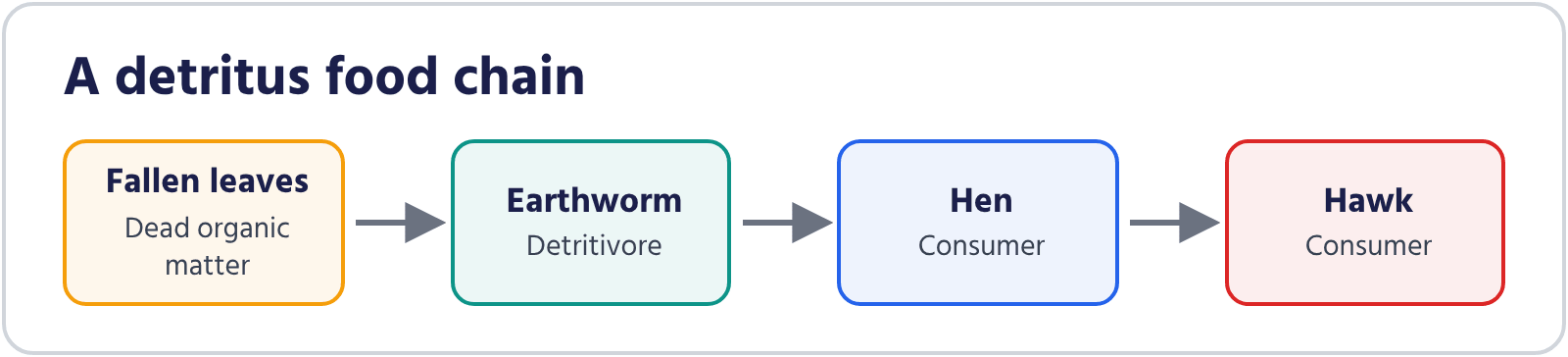
Which food chain begins with dead organic matter?
Explanation
A detritus food chain begins with dead organic matter such as fallen leaves and dead bodies, and its first consumers are detritivores like earthworms. A grazing food chain begins with green producers. 'Aquatic food chain' is not a separate type; a pond chain is usually a grazing chain.
Key Points
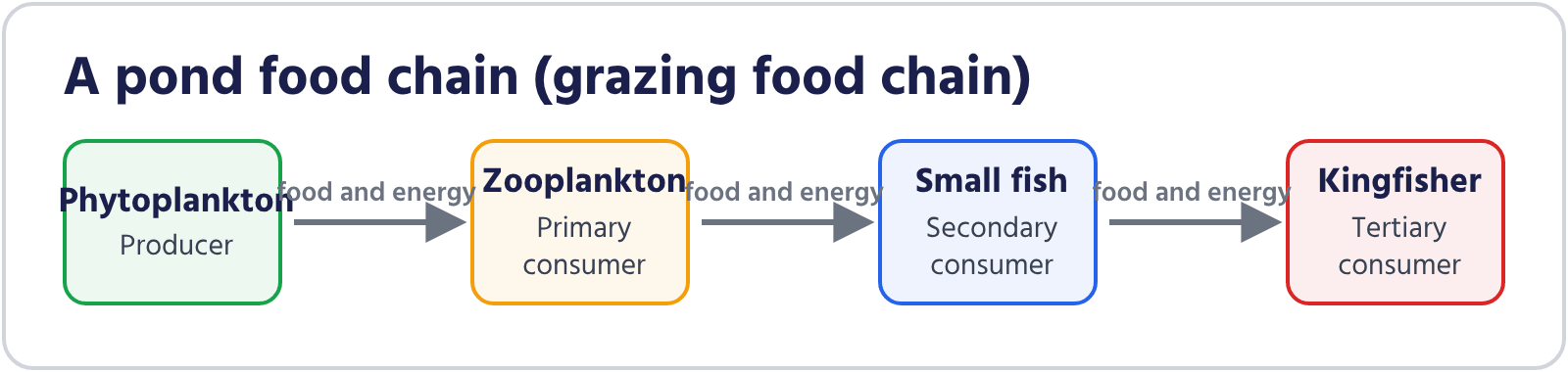
- Grazing: starts with green plants or algae
- Detritus: starts with dead organic matter
- Decomposers and detritivores drive the detritus chain
Memory Tips
- Grazing = grazing on green grass; detritus = fallen leaves
Additional Information
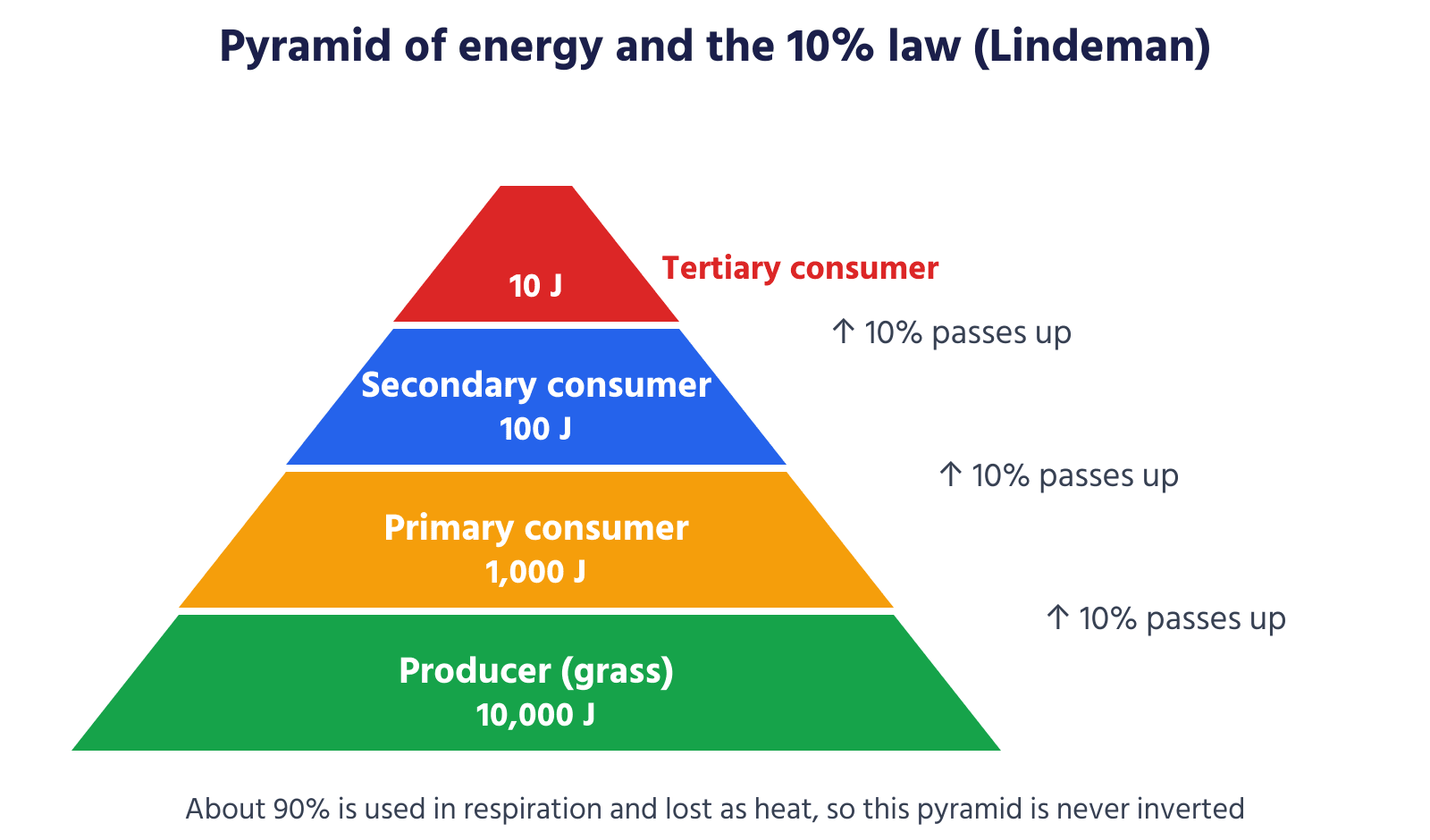
Producers in an ecosystem hold 10,000 J of energy. By the 10% law, how much energy reaches the secondary consumers?
Explanation
Primary consumers get 10% of 10,000, that is 1,000 J. Secondary consumers get 10% of 1,000, that is 100 J. 1,000 J is the primary consumers' share, and 10 J the tertiary consumers'.
Key Points
- The 10% law: Raymond Lindeman, 1942
- About 90% is used in respiration and lost as heat
- Energy flow is one-way
Confusion Points
- A secondary consumer is not the second trophic level: it is the third, two steps above the producers
Memory Tips
- Drop one zero at each step: 10,000 → 1,000 → 100 → 10
Additional Information
Which ecological pyramid is upright in every ecosystem and is never inverted?
Explanation
Energy falls at every trophic level, so the pyramid of energy is always upright. The pyramid of numbers is inverted on a single big tree with many insects, and the pyramid of biomass can be inverted in a pond, where the phytoplankton weigh less in total than the animals.
Key Points
- Pyramids are Charles Elton's idea (Eltonian pyramids)
- Numbers: inverted on a tree
- Biomass: inverted in a pond or the sea
Memory Tips
- The energy pyramid never stands on its head
Additional Information
| Pyramid | Upright or inverted | Example |
|---|---|---|
| Pyramid of numbers | Usually upright, sometimes inverted | Upright in a grassland; inverted on a single big tree |
| Pyramid of biomass | Upright on land, can be inverted in water | Inverted in a pond or the sea |
| Pyramid of energy | Always upright | No exception |
A Class IV child writes 'tiger → deer → grass' in the notebook. What is the teacher's most suitable step?
Explanation
In a child-centred, constructivist approach the teacher treats the error as a chance to learn: questions and concrete material let the child find the mistake, so the idea sticks. Crossing it out and giving the answer does not show why it is wrong; writing ten times is rote; silence leaves the misconception in place.
Key Points
- Arrows go from food to eater: grass → deer → tiger
- A child's error shows the teacher how the child thinks
- Concrete to abstract is the rule at the primary stage
Memory Tips
- The arrow points to the one who eats
Additional Information
In Class IV, which activity best shows how the organisms in a food web depend on one another?
Explanation
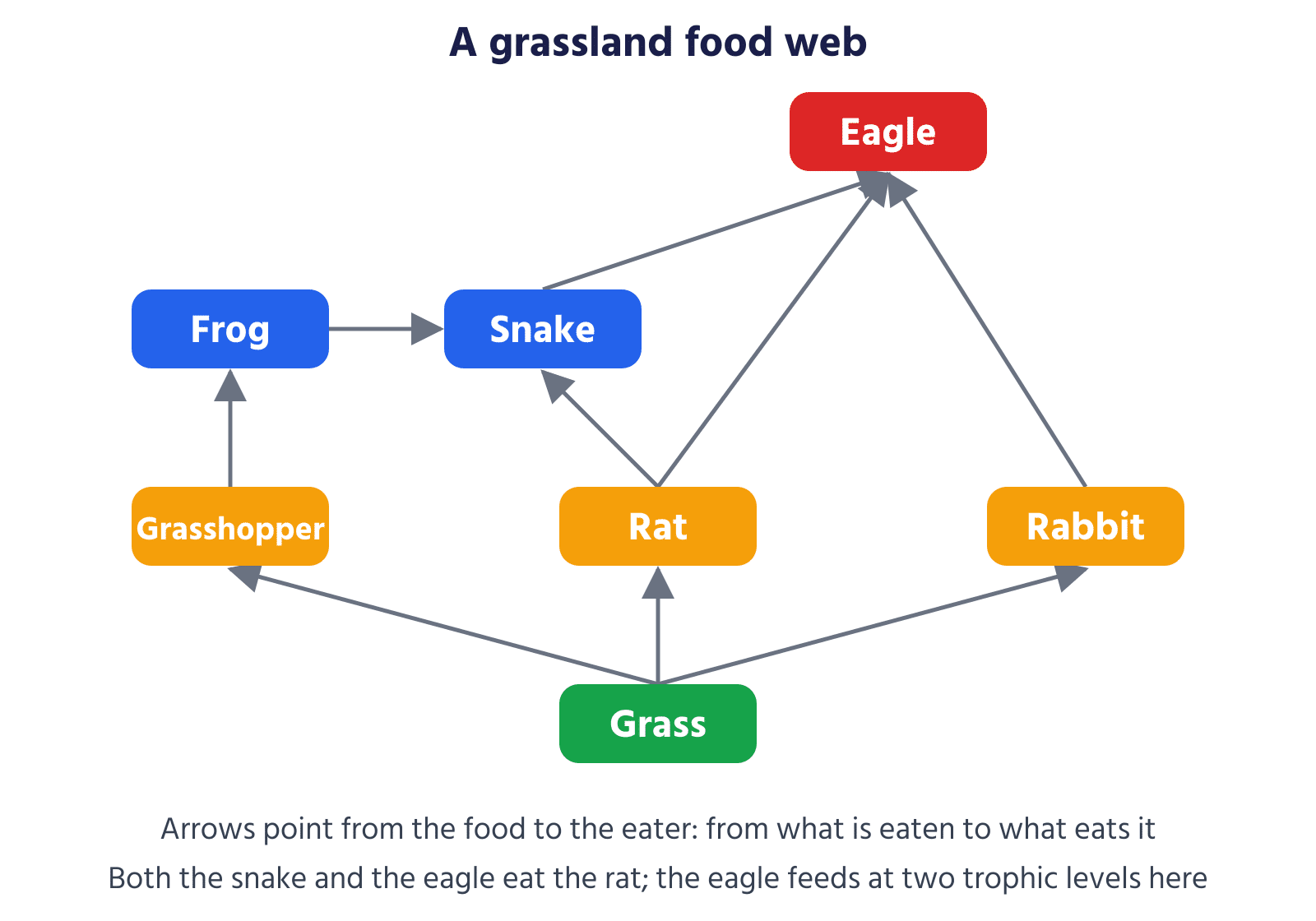
In the string game children take part and see that when one organism drops out, many others lose their pull: interdependence becomes something they experience. This is active, experiential learning. Copying, lectures or naming a picture keep the child a passive listener.
Key Points
- Learning by doing is central to EVS
- Losing one species affects the whole web
- Play makes an abstract idea concrete
Additional Information
To show the role of decomposers (bacteria, fungi), which is the most suitable step for a Class III teacher?
Explanation
In a compost pit children see fallen leaves slowly turn into soil, that is, decomposers returning minerals to the soil. Observing and recording is project-based learning. Memorising names, reading aloud or writing definitions do not show the process.
Key Points
- Decomposers break dead matter down and return minerals to the soil
- This keeps nutrients cycling
- Observation and projects suit EVS
Assertion (A): A food web is more stable than a food chain. Reason (R): In a food web an organism has more than one source of food. Which is correct?
Explanation
Both are true and R is the reason for A: because there are other food paths, a consumer survives on other food when one species declines, so the web does not break easily. In a simple food chain, losing one level leaves everything above it without food.
Key Points
- Food chain: one simple line, no alternatives
- Food web: many chains joined, with alternatives
- A complex web means more balance
Additional Information
DDT has entered a pond. Because of biomagnification, which organism will have the highest concentration of DDT?
Explanation
DDT does not break down in the body, so it builds up at every trophic level; it is highest in the top consumer, the fish-eating bird. Phytoplankton are producers and have the least; zooplankton and small fish are in between.
Key Points
- Biomagnification: substances that do not break down build up at higher levels
- Examples: DDT, mercury
- DDT thins the eggshells of birds
Confusion Points
- Energy falls up the chain, but the concentration of DDT rises
Memory Tips
- Poison collects at the top
Additional Information
Following NCF 2005, where should the teaching of food chains begin at the primary stage?
Explanation
NCF 2005 asks that learning be linked to the child's life outside school, so EVS moves from the known to the unknown, from near to far. Amazon or polar examples are outside the child's experience, and starting with a definition starts with the abstract.
Key Points
- Known to unknown, near to far, concrete to abstract
- EVS is an integrated subject in Classes III–V
- Field trips and observation suit it
Which is NOT a suitable way of formative assessment in the food chain unit?
Explanation
Formative assessment runs during learning so the teacher can help in time (assessment for learning). A single written test at the end of the year is summative (assessment of learning), so it is the answer. Drawing, checklists and peer discussion are all formative tools.
Key Points
- Formative: during learning, for learning
- Summative: at the end, of learning
- CCE uses both, continuously and comprehensively
Confusion Points
- Assessment for learning = formative; assessment of learning = summative
0/10


Leave a Comment
Commenting as ·