
The second practice quiz on percentage for WBPSC Clerkship 2024 arithmetic: 12 questions on population growth, depreciation, votes, pass-fail, income and spending, and mixtures, each with the full working.
Percentage Part 2 Quiz: Population, Votes, Pass-Fail and Mixtures (Clerkship 2024)
Practice session
A little practice. A step forward.
12 questions
Learn with explanations
At your own pace
0 / 12 completed
00:00
The population of a village is 16,000 and grows 5% every year. What will it be after 2 years?
Explanation
In year 1 it grows by 5% of 16,000 = 800, to 16,800. In year 2 it grows by 5% of 16,800 = 840, to 17,640. 17,600 comes from adding 10% for two years, which is wrong.
Key Points
- After $n$ years = $P \times (1 + \frac{r}{100})^{n}$
- $16000 \times 1.05 \times 1.05 = 17640$
Memory Tips
- 5% a year for 2 years adds 10.25%: 5 + 5 + 0.25
Additional Information
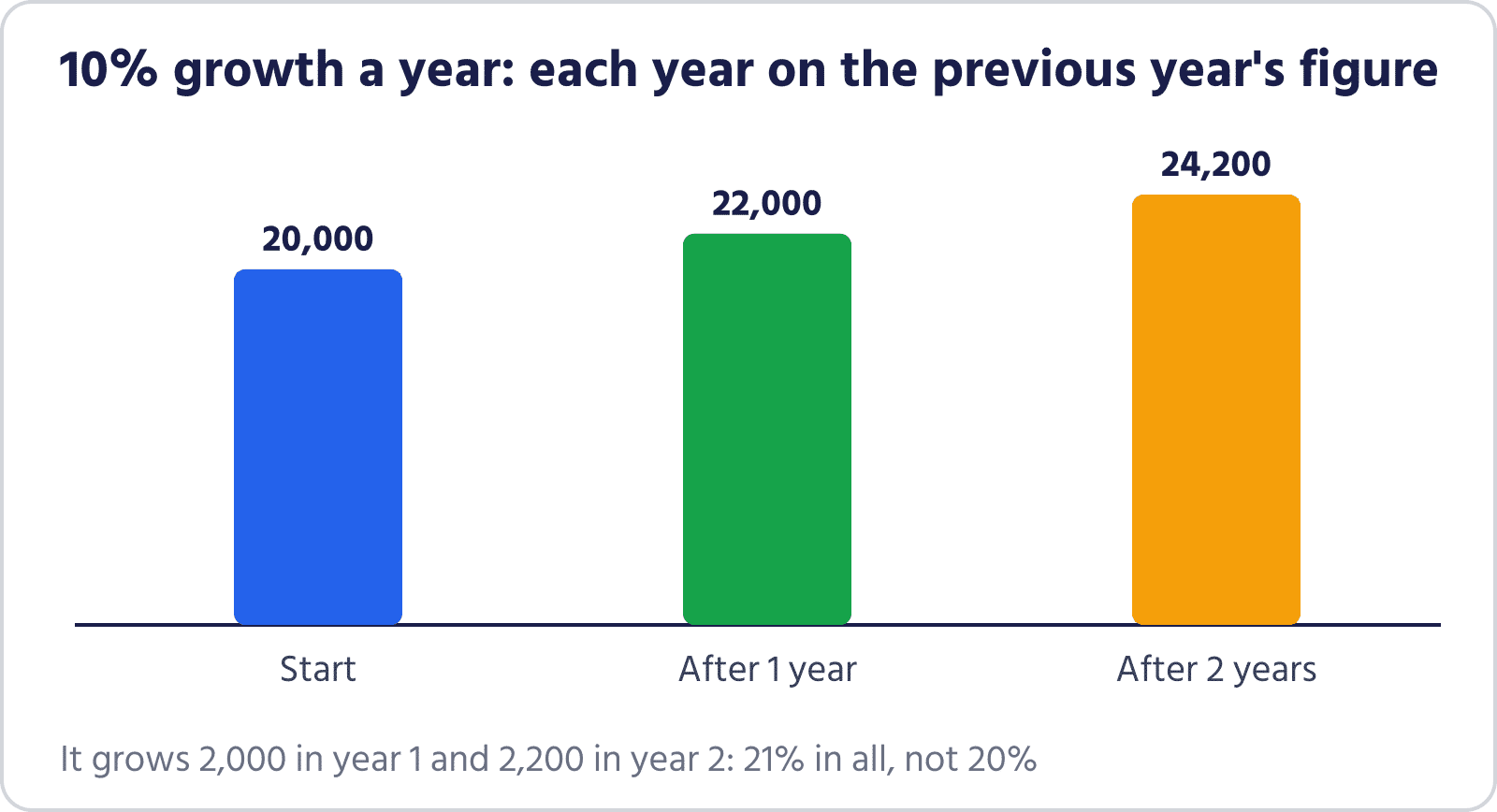
A town's population is now 13,310. It has grown 10% every year for the last 3 years. What was it 3 years ago?
Explanation
The 3-year factor is $1.1 \times 1.1 \times 1.1 = 1.331$, so 3 years ago it was $13310 \div 1.331 = 10000$. 12,100 and 11,000 are the figures 1 and 2 years ago. 9,317 comes from taking 30% off 13,310, which is the wrong method.
Key Points
- Going back, divide by the product of the factors
- Check: 10,000 → 11,000 → 12,100 → 13,310
Confusion Points
- Taking 30% off the present figure does not give the old one: the growth was on smaller figures
A scooter costs ₹80,000. Each year its value falls by 10% of the previous year's value. What will it be worth after 2 years?
Explanation
After year 1 it is worth 90% of 80,000 = ₹72,000. After year 2, 90% of 72,000 = ₹64,800. ₹64,000 comes from taking 20% off at once, but the second year's fall is on the reduced value.
Key Points
- The depreciation factor is $1 - \frac{r}{100}$
- $80000 \times 0.9 \times 0.9 = 64800$
Memory Tips
- 10% depreciation for 2 years takes off 19%, not 20%
In an election between two candidates, all votes were valid. The winner got 62% of the votes and won by 7,200 votes. How many votes were cast?
Explanation
The loser got 38%, so the margin is 62 − 38 = 24%. 24% of the total = 7,200, so the total = $7200 \div 24 \times 100 = 30000$. The other options come from treating 62% or another wrong share as the margin.
Key Points
- Margin between two candidates = (2x − 100)%
- Check: 18,600 − 11,400 = 7,200
Memory Tips
- Margin % = twice the winner's share minus 50
In an election, 15,000 votes were cast and 20% were invalid. Of the two candidates, A got 60% of the valid votes. How many votes did B get?
Explanation
Valid votes = 80% of 15,000 = 12,000. B got 40% of the valid votes = 4,800. 6,000 is 40% of all the votes, and 7,200 is A's count.
Key Points
- Find the valid votes first, then the share
- A got 7,200 and B 4,800: 12,000 in all
Confusion Points
- The candidates' shares are of the valid votes, not of all votes
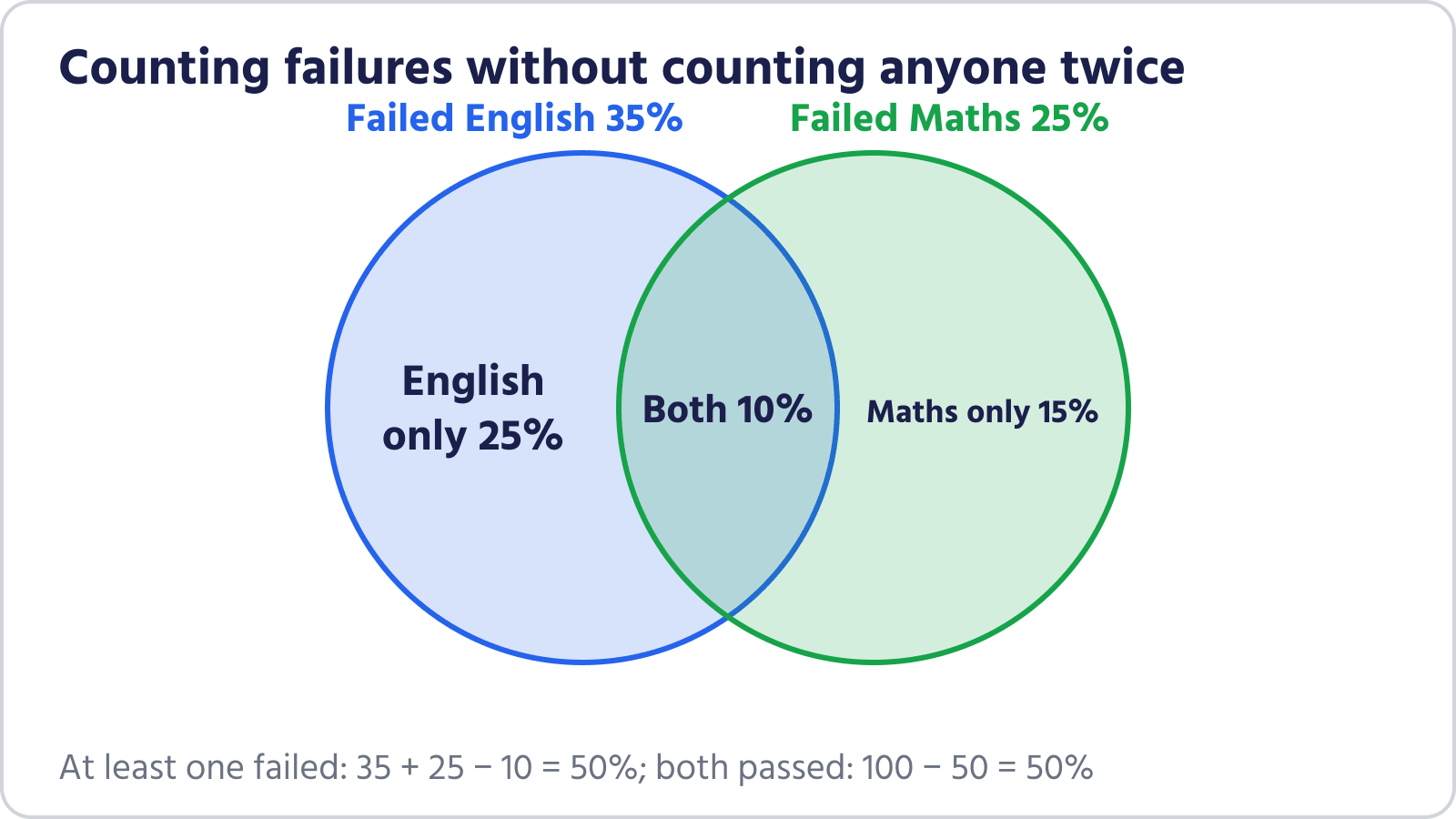
In an exam, 40% of the candidates failed in Bengali, 30% in English and 15% in both. What percentage passed in both?
Explanation
Failed at least one = 40 + 30 − 15 = 55%, so passed both = 100 − 55 = 45%. 55% is the share that failed at least one, and 30% comes from not taking away the 15% who failed both.
Key Points
- Failed at least one = A + B − both
- Failed only Bengali 25%, only English 15%
Confusion Points
- Those who failed both are counted in both subjects' figures: take them away once
Additional Information
In an exam, 32% of the candidates failed in Maths, 26% in Science and 12% in both. 324 passed in both. How many candidates were there?
Explanation
Failed at least one = 32 + 26 − 12 = 46%, so 54% passed both. 54% of the total = 324, so the total = $324 \div 54 \times 100 = 600$. Check: 54% of 600 = 324.
Key Points
- Find the share that passed both, then work back
- Total = number ÷ percentage × 100
Additional Information
A man spends 75% of his income and saves the rest. His income rises 20% and his spending 10%. By what percentage do his savings rise?
Explanation
Take income as 100: spending 75, savings 25. Afterwards income is 120, spending 110% of 75 = 82.5, savings 37.5. The rise is 12.5, which is 50% of 25. 10% is the gap between the two rises, not the answer.
Key Points
- Take income as 100 and find spending and savings
- Divide the rise in savings by the old savings
Additional Information
| Income | Spending | Savings | |
|---|---|---|---|
| Before | 100 | 75 | 25 |
| After | 120 | 82.5 | 37.5 |
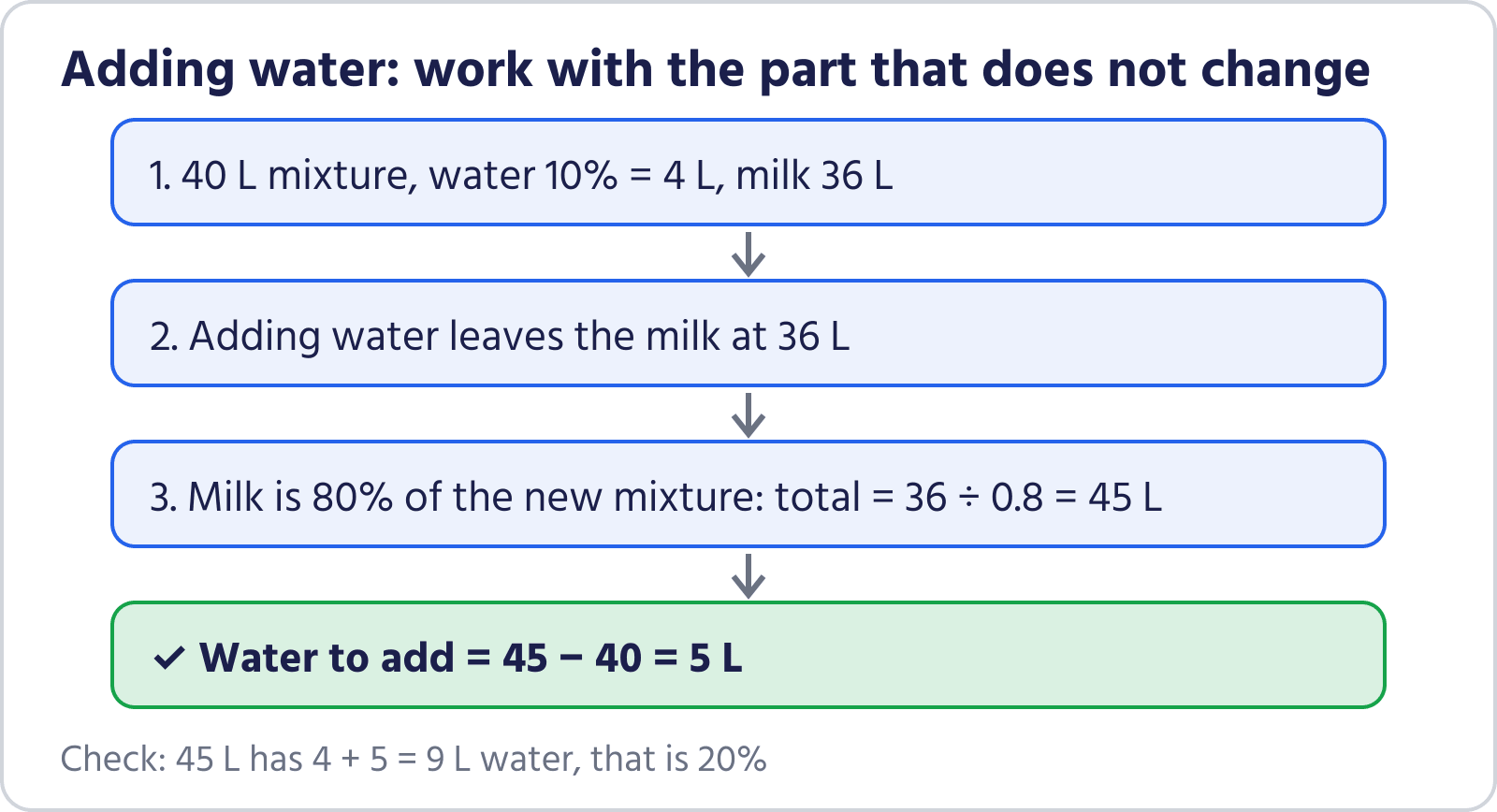
A 60-litre mixture of milk and water is 20% water. How many litres of water must be added to make it 25% water?
Explanation
Now there are 12 L of water and 48 L of milk. Adding water leaves the milk unchanged, and milk is 75% of the new mixture. New total = $48 \div 0.75 = 64$ L, so add 64 − 60 = 4 litres. Check: 64 L holds 16 L of water, which is 25%.
Key Points
- Fix the part that does not change and find the new total
- New total = milk ÷ milk's new percentage
Confusion Points
- Taking 5% of 60 = 3 litres is wrong: the added water is part of the new total too
Additional Information
Subtracting 25% of a number from 35% of it leaves 18. What is the number?
Explanation
35% − 25% = 10%, and 10% of the number = 18. So the number is $18 \times 10 = 180$. Check: 35% of 180 = 63, 25% = 45, the difference is 18.
Key Points
- Two percentages of the same number can be subtracted directly
- If 10% is known, the whole is 10 times it
A man spends 30% of his income on food and 20% of the remainder on rent. He is left with ₹8,400. What is his income?
Explanation
After food, 70% of the income is left. Rent is 20% of that 70% = 14% of the income, so 70 − 14 = 56% is left. 56% of the income = ₹8,400, so the income = $8400 \div 56 \times 100 = 15000$, that is ₹15,000. Adding the two percentages (50%) gives ₹16,800, which is wrong.
Key Points
- A percentage of the remainder is taken on the reduced amount
- He keeps $0.7 \times 0.8 = 0.56$ of the income
Confusion Points
- "20% of the remainder" is not "20% of the income"
An alloy of 50 kg is 30% copper. How many kg of copper must be added to make it 44% copper?
Explanation
The other metal is 70% of 50 = 35 kg, and adding copper does not change it. In the new alloy it is 56%, so the new total = $35 \div 0.56 = 62.5$ kg. Add 62.5 − 50 = 12.5 kg. Check: copper is 15 + 12.5 = 27.5 kg, which is 44% of 62.5.
Key Points
- Here the part that does not change is the other metal
- Taking 14% of 50 = 7 kg is wrong: the added copper joins the new total
Additional Information
0/12


Leave a Comment
Commenting as ·